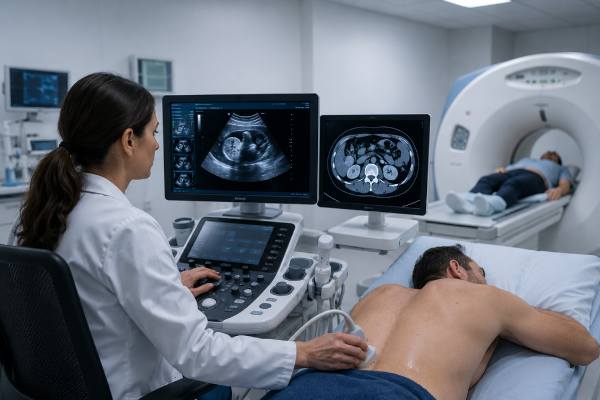
A kidney ultrasound and a CT scan both create pictures of the urinary system, but they answer different questions. Ultrasound is often the simpler first look: it shows kidney size, swelling, cysts, some stones, bladder fullness, and whether urine seems backed up. CT gives a sharper, more detailed map. It shows small stones, ureter stones, bleeding causes, tumors, injury, infection complications, and problems outside the urinary tract that feel like kidney pain.
The “better” test is not the same for every situation. A pregnant patient with flank pain usually starts with ultrasound. An adult with sudden severe stone-like pain often gets a low-dose non-contrast CT. A kidney mass found by chance usually needs a dedicated contrast CT or MRI, not a basic ultrasound alone. This guide explains what each test shows, where each one falls short, and how doctors usually choose between them.
Table of Contents
- Quick Comparison: Ultrasound vs CT for Kidneys
- What a Kidney Ultrasound Shows Best
- What a CT Scan Shows Best
- Kidney Stones, Blockage, and Severe Flank Pain
- Cysts, Masses, and Possible Kidney Cancer
- Blood in Urine, Infection, and Other Symptoms
- Radiation, Contrast, Pregnancy, and Kidney Safety
- How to Choose the Right Test and Understand the Result
Quick Comparison: Ultrasound vs CT for Kidneys
The simplest difference is this: ultrasound is a safe, radiation-free screening tool, while CT is a more detailed cross-sectional scan. Ultrasound uses sound waves. CT uses X-rays and computer processing to create thin image slices through the body.
| Question | Kidney ultrasound | CT scan |
|---|---|---|
| Uses radiation? | No | Yes |
| Uses IV contrast? | Usually no | Sometimes; depends on the reason for the scan |
| Best for | Kidney swelling, simple cysts, kidney size, bladder volume, follow-up checks | Stones, ureter blockage, tumors, trauma, complex infection, abdominal causes of pain |
| Stone detection | Good for some kidney stones, weaker for small stones and ureter stones | Excellent, especially without contrast for suspected stones |
| Cyst evaluation | Good for simple fluid-filled cysts | Better for complex cysts and masses when done with the right contrast protocol |
| Pregnancy and children | Usually preferred first | Used selectively when the benefit outweighs radiation concerns |
| Speed | Often quick, but depends on scheduling and operator skill | Very fast once performed; images are highly detailed |
A kidney ultrasound is often enough when the main question is “Are the kidneys swollen?” or “Is this a simple cyst?” It is also useful for checking kidney size in chronic kidney disease, looking for urine left in the bladder after peeing, and following known findings that do not need fine detail.
A CT scan becomes more useful when the question needs precision. For example, a CT scan shows whether a stone is in the kidney or ureter, how large it is, whether it is causing blockage, and whether another condition is causing the pain. A CT scan also gives doctors a better look at the surrounding organs, blood vessels, lymph nodes, bones, and abdominal tissues.
The important point is that these tests are not direct substitutes. A normal ultrasound does not always rule out a small ureter stone. A CT scan without contrast is excellent for most stones but not the best test to fully characterize every kidney mass. A contrast CT is helpful for tumors and bleeding evaluation, but it is not always needed for straightforward stone pain.
What a Kidney Ultrasound Shows Best
A kidney ultrasound gives a real-time look at the kidneys and bladder without radiation. During the exam, a sonographer places gel on the skin and moves a handheld probe over the back, side, and lower abdomen. The pictures depend on sound waves bouncing off organs and fluid.
Ultrasound works especially well for structures that contain fluid. That is why it is strong for cysts, kidney swelling, and bladder volume. It is less strong for tiny stones, deep ureter stones, and details hidden by bowel gas or body habitus.
Kidney size, shape, and tissue appearance
Ultrasound measures each kidney’s length and looks at the outline. Adult kidneys are often around 9–12 centimeters long, though normal size varies with body size. A kidney that is much smaller than expected, scarred, or thinned out suggests long-standing damage rather than a sudden problem.
The report often mentions “echogenicity,” which means how bright the kidney tissue looks compared with nearby organs. Increased echogenicity is a nonspecific clue. It does not diagnose one condition by itself, but it supports the bigger picture when combined with blood tests such as creatinine, eGFR, and urine protein. If kidney function labs are abnormal, a broader guide to low eGFR evaluation helps explain why imaging is only one part of the workup.
Hydronephrosis: swelling from backed-up urine
One of the most useful ultrasound findings is hydronephrosis. This means the urine-collecting area inside the kidney is stretched because urine is not draining normally. The cause might be a stone, a narrowed ureter, an enlarged prostate, pregnancy-related pressure, a tumor, or a bladder that is not emptying.
Ultrasound shows the swelling well, but it often does not show the exact cause. A report might say “mild right hydronephrosis” without seeing a stone. That finding tells the clinician to connect the image with symptoms, urine tests, kidney function, and sometimes a CT or another study. A focused explanation of kidney swelling and hydronephrosis is useful when a report uses that term without much explanation.
Cysts and bladder checks
Simple kidney cysts are common, especially with age. On ultrasound, a simple cyst looks like a round or oval fluid pocket with thin walls and no solid parts. When the appearance is classic, it is usually benign and often needs no treatment.
Ultrasound also checks the bladder. The sonographer might measure the bladder before and after urination. A high “post-void residual” means urine remains after peeing, which happens with an enlarged prostate, nerve-related bladder problems, medication effects, or obstruction. Ultrasound does not show bladder lining detail as well as cystoscopy, but it gives a useful first look at bladder fullness, stones, and large masses.
Ultrasound’s main limitation is detail. The ureters are thin tubes, and much of their course is hard to see. Small stones and early tumors are easy to miss. When symptoms are serious or the ultrasound result does not explain the problem, CT often becomes the next step.
What a CT Scan Shows Best
A CT scan creates detailed slices through the body. For kidney and urinary problems, doctors order different CT types depending on the question. The protocol matters as much as the word “CT.”
A non-contrast CT means no IV dye. This is the usual CT choice for suspected kidney stones. Stones stand out well against the soft tissues, and the scan shows their size and location.
A contrast CT uses iodine-based dye through a vein. Contrast helps show blood flow, infection complications, tumors, injuries, and the way a mass enhances. Enhancement means the area takes up contrast, which helps separate a solid tumor from a fluid-filled cyst.
A CT urogram is a special contrast CT designed to evaluate the kidneys, ureters, and bladder in phases. It is often used when doctors need to look for causes of blood in the urine, especially in higher-risk patients.
| CT type | Main use | Why that protocol matters |
|---|---|---|
| Non-contrast CT abdomen/pelvis | Suspected kidney or ureter stone | Stones are visible without dye, and contrast is usually unnecessary |
| Contrast CT abdomen/pelvis | Infection complications, trauma, tumors, unexplained abdominal pain | Contrast highlights blood flow, inflammation, abscesses, and organ injury |
| CT urogram | Blood in urine, suspected upper urinary tract tumor, detailed ureter evaluation | Delayed images show contrast passing through the collecting system and ureters |
| Multiphase renal mass CT | Indeterminate kidney mass or complex cyst | Multiple phases show whether a lesion enhances like solid tissue |
CT also sees beyond the kidneys. This matters because pain that feels like “kidney pain” sometimes comes from appendicitis, diverticulitis, gallbladder disease, ovarian problems, aortic aneurysm, spine disease, or muscle injury. Ultrasound targeted to the kidneys will not reliably evaluate all of those alternatives.
The tradeoff is radiation. A single CT scan is often justified when the result changes treatment, but repeated CT scans deserve more thought, especially in younger patients and people with recurrent stones. Low-dose CT protocols reduce exposure for stone evaluation while preserving the information doctors need.
Kidney Stones, Blockage, and Severe Flank Pain
For sudden severe flank pain in a nonpregnant adult, a non-contrast CT is usually the most complete test. It shows the stone, measures it, locates it, and checks for swelling above the blockage. That information shapes the next decision: pain control and waiting, urgent drainage, or a procedure.
Ultrasound still has an important role. It is often used first in pregnancy, children, younger patients, and people who already have a known stone history where doctors want to limit radiation. It also shows hydronephrosis, which tells the clinician that urine flow is likely blocked even when the stone itself is not seen.
What CT tells you during a stone attack
A stone’s size and location matter because they affect the chance of passing it. A tiny stone near the bladder has a better chance of passing than a larger stone high in the ureter. CT also detects more than one stone, stones in both kidneys, and complications such as severe obstruction.
If the scan report mentions stone size, a practical kidney stone size chart helps translate millimeters into likely next steps. Size is not the only factor, but it is one of the clearest details patients see on the report.
CT also helps when the pain story is unclear. A patient might arrive with nausea, flank pain, and blood in the urine, which sounds like a stone. If CT shows no stone, doctors look harder for another cause. That is useful because several abdominal emergencies mimic stone pain.
What ultrasound tells you during a stone attack
Ultrasound answers a slightly different question: “Is the kidney swollen from blocked urine?” It often detects larger kidney stones, but it misses many ureter stones because the ureter is hard to follow through the abdomen and pelvis.
This means a normal ultrasound does not fully rule out a stone. A person with classic symptoms, blood in the urine, and ongoing severe pain still needs further evaluation if the ultrasound is negative or unclear.
Ultrasound is especially useful for follow-up after a known stone, when the main question is whether swelling has improved. It is also helpful for patients with recurrent stones who need repeated imaging over years. Avoiding unnecessary radiation becomes more important when scans pile up.
When imaging suggests urgent care
Stone pain becomes more dangerous when blockage and infection happen together. Fever, chills, confusion, low blood pressure, vomiting that prevents fluids, one functioning kidney, pregnancy, or rising creatinine changes the situation. A blocked infected kidney needs urgent treatment because antibiotics alone might not drain the infection.
A patient with severe pain, fever, and urinary symptoms should not wait for an outpatient scan days later. A guide to kidney stone pain and ER warning signs gives a clearer picture of when stone symptoms need immediate care.
Cysts, Masses, and Possible Kidney Cancer
Ultrasound is often the first test that finds a kidney cyst or mass. Sometimes the finding is obvious and harmless. Other times the report uses words such as “complex,” “solid,” “septated,” “calcified,” or “indeterminate.” Those words usually mean more imaging is needed.
A simple cyst has thin walls, clear fluid, and no solid component. Ultrasound is good at recognizing that pattern. A complex cyst or solid mass needs more detail because doctors need to know whether it enhances with contrast. Enhancement is one of the key clues that tissue has blood flow and might represent a tumor rather than simple fluid.
CT with a dedicated renal mass protocol, or MRI with a renal mass protocol, is usually the next step for an indeterminate finding. A routine CT done for another reason might not include the right phases. That is why a report sometimes recommends “renal protocol CT or MRI” even after a CT has already been done.
A report that says “complex cyst” deserves careful follow-up, but it is not the same as saying cancer. Complex cysts range from low-risk findings to lesions that need surgery or close surveillance. The details matter: wall thickness, septations, nodules, calcifications, and enhancement. A dedicated discussion of a complex kidney cyst and Bosniak categories helps explain the language radiologists use.
CT also gives a wider cancer evaluation than ultrasound. It shows the kidney, nearby fat, lymph nodes, adrenal glands, veins, and surrounding organs. If doctors are concerned about kidney cancer, CT or MRI helps stage the finding and plan treatment.
Ultrasound still remains useful after that. It is often used for surveillance when a lesion has already been characterized and the clinician simply needs to watch size over time. It is also useful when contrast is not suitable, though contrast-enhanced ultrasound is a separate specialized option available in some centers.
Blood in Urine, Infection, and Other Symptoms
Blood in the urine needs a different imaging strategy than stone pain. The right test depends on whether the blood is visible, whether it appears only under a microscope, the patient’s age, smoking history, infection results, kidney function, and other risk factors.
For low-risk microscopic blood in urine, clinicians often start with repeat urine testing and selective imaging. For higher-risk blood in urine, CT urography is commonly used because it evaluates the kidneys and ureters in detail. Ultrasound gives useful information about kidney size, cysts, masses, and hydronephrosis, but it is less sensitive for small upper-tract tumors and ureter problems.
Visible blood in urine should be taken seriously, especially when it happens without pain. Stones and infection are common causes, but tumors, kidney disease, prostate problems, and urinary tract injury also belong on the list. A practical guide to blood in urine and red flags helps separate common explanations from signs that need prompt evaluation.
Kidney infection is another case where imaging depends on severity. Many uncomplicated kidney infections are diagnosed from symptoms and urine testing, then treated without immediate imaging. Imaging becomes more important when symptoms are severe, the patient is diabetic or immunocompromised, fever does not improve after treatment, there is concern for obstruction, or doctors suspect an abscess.
Ultrasound can show hydronephrosis and sometimes large abscesses, but CT with contrast is better for complicated infection. It shows areas of poor blood flow, pus collections, gas-forming infection, stones blocking drainage, and inflammation around the kidney. That detail helps doctors decide whether antibiotics are enough or whether drainage or a urology procedure is needed.
Symptoms also guide the test choice. Burning with urination, urgency, and cloudy urine point more toward bladder infection or irritation. Severe one-sided flank pain with nausea points more toward a stone. Fever plus flank pain points toward kidney infection or an infected obstruction. Imaging is most valuable when it answers a specific question raised by the symptoms, not when it is ordered as a generic “kidney check.”
Radiation, Contrast, Pregnancy, and Kidney Safety
Ultrasound has two major safety advantages: no ionizing radiation and usually no IV contrast. That is why it is commonly preferred first during pregnancy and in children. It is also useful for people who need repeated follow-up scans.
CT uses ionizing radiation. The dose depends on the protocol, body size, and scanner settings. A low-dose CT for suspected stones has less radiation than many standard abdominal CT scans, but it still uses radiation. This does not make CT “bad.” It means the scan should have a clear purpose.
Pregnancy and children
Pregnancy changes the imaging pathway. Ultrasound is usually the first test for suspected stones, hydronephrosis, and many kidney symptoms during pregnancy. MRI without contrast is sometimes used when ultrasound does not answer the question. CT is reserved for situations where the needed information outweighs radiation concerns.
Children also start with ultrasound more often. Their lifetime sensitivity to radiation is higher, and many childhood urinary problems can be evaluated well with ultrasound. CT still has a role when the diagnosis remains unclear, the child is very ill, or the detail will change urgent treatment.
Contrast and kidney function
Some CT scans use iodine-based IV contrast. Contrast helps doctors see tumors, bleeding, blood vessels, abscesses, and inflamed tissue. For many stone scans, contrast is not needed.
Before a contrast CT, clinicians often check kidney function, especially in people with known chronic kidney disease, diabetes, dehydration, older age, or recent acute illness. The blood test commonly used is creatinine, which is used to estimate eGFR. If creatinine is high, the team weighs the need for contrast against the risk and considers hydration, alternative imaging, or a different protocol. A patient trying to understand an abnormal lab result can start with what high creatinine means, but the imaging decision should be made with the ordering clinician and radiology team.
Contrast allergy is a separate issue from kidney function. A previous mild reaction, such as hives, is handled differently from a severe reaction with breathing trouble or low blood pressure. Tell the imaging center about prior contrast reactions, asthma history, severe allergies, kidney disease, metformin use, pregnancy, and breastfeeding before the scan.
When avoiding CT creates its own risk
Radiation concerns are real, but avoiding CT is not always safer. A missed obstructing stone, abscess, bleeding injury, or tumor has its own risks. The better question is not “Which test has less risk?” but “Which test gives the needed answer with the least reasonable risk?”
For example, ultrasound is a good first step for a stable pregnant patient with flank pain. A severely ill adult with fever, low blood pressure, and suspected infected obstruction likely needs fast, detailed imaging. In that situation, the risk of delay outweighs the usual concerns about CT.
How to Choose the Right Test and Understand the Result
The right test starts with the clinical question. A vague order such as “check kidneys” often leads to frustration because no single test answers everything. The more specific question might be “Is there hydronephrosis?” “Is there a ureter stone?” “Is this cyst simple or complex?” “Is blood in the urine coming from the upper tract?” or “Is infection complicated by an abscess?”
| Situation | Common first or next test | Reason |
|---|---|---|
| Sudden severe flank pain in a nonpregnant adult | Low-dose non-contrast CT | Best detail for stone size, location, obstruction, and alternate causes |
| Flank pain during pregnancy | Ultrasound first | No radiation; checks for hydronephrosis and visible stones |
| Known simple kidney cyst follow-up | Ultrasound | Good for size checks without radiation |
| Complex cyst or solid kidney mass | Renal protocol contrast CT or MRI | Shows enhancement and internal structure |
| High-risk blood in urine | CT urogram, often with cystoscopy | Evaluates upper urinary tract and bladder pathway more completely |
| Complicated kidney infection | Contrast CT when suitable | Shows abscess, obstruction, gas, and spread of infection |
| Chronic kidney disease with size check | Ultrasound | Measures kidney size, scarring clues, cysts, and obstruction |
When reading the report, look for the answer to the original question first. A good report usually includes a “Findings” section and an “Impression” section. The impression is the plainest summary of what matters most.
Useful details to notice include:
- Laterality: right, left, or both kidneys.
- Stone size and location: kidney, upper ureter, mid ureter, lower ureter, or near the bladder.
- Hydronephrosis grade: mild, moderate, or severe.
- Cyst description: simple, complex, septated, calcified, or enhancing.
- Mass description: solid, fat-containing, enhancing, indeterminate, or suspicious.
- Bladder findings: wall thickening, stone, mass, or high post-void residual.
- Comparison: whether a finding is new, stable, larger, or resolved compared with prior imaging.
- Recommendation: follow-up ultrasound, renal protocol CT, MRI, urology referral, or no follow-up.
A normal scan does not always mean nothing is wrong. Ultrasound can miss ureter stones. CT can miss very early bladder lining problems that require cystoscopy. A scan also does not replace urine tests, kidney function labs, urine culture, or a physical exam.
The most useful question to ask after imaging is: “Does this result explain my symptoms, and what is the next step if it does not?” If the scan shows a clear stone and symptoms match, the plan is usually straightforward. If the scan is normal but symptoms continue, the clinician should reconsider other causes, repeat urine testing, review medications, or choose a different test.
Seek urgent care rather than waiting for routine follow-up if symptoms include fever with flank pain, inability to keep fluids down, no urination, severe worsening pain, confusion, fainting, visible blood with clots, or known single kidney with possible blockage. Imaging is valuable, but timing matters. A scan done too late is less helpful than a prompt evaluation when warning signs are present.
References
- ACR Appropriateness Criteria® Acute Onset Flank Pain-Suspicion of Stone Disease (Urolithiasis) 2023 (Practice Guideline)
- EAU Guidelines on Urolithiasis 2025 (Guideline)
- Updates to Microhematuria: AUA/SUFU Guideline (2025) 2025 (Guideline)
- Hydronephrosis on Prior Imaging-Unknown Cause 2024 (Appropriateness Criteria)
- ACR Appropriateness Criteria® Indeterminate Renal Mass 2020 (Practice Guideline)
- Manual on Contrast Media 2025 (Clinical Reference)
Disclaimer
This article is for education about kidney imaging and does not diagnose the cause of pain, blood in urine, abnormal kidney labs, cysts, or masses. The right imaging test depends on symptoms, pregnancy status, kidney function, prior scans, contrast safety, and the specific question your clinician needs answered. Seek urgent medical care for fever with flank pain, severe uncontrolled pain, vomiting, very low urine output, confusion, or blood clots in the urine.