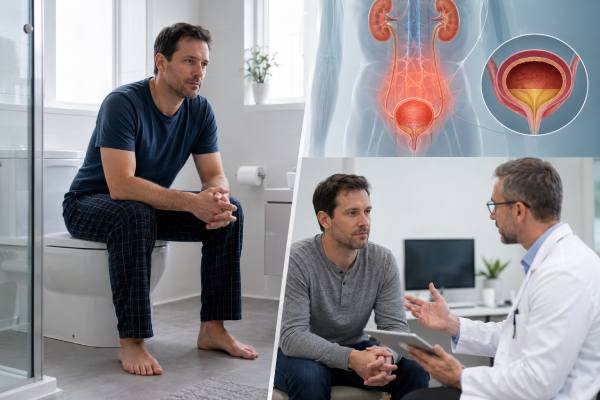
Double voiding is a simple bathroom habit used when the bladder does not feel fully empty after urinating. Instead of standing up right away, you stay relaxed for a short time, then try to urinate again. That second attempt sometimes releases urine that remained in the bladder after the first stream stopped.
This technique is most useful for people who finish peeing, leave the bathroom, and quickly feel the urge to go again. It also helps some people with a weak stream, stop-start flow, mild dribbling after urination, or a bladder that feels heavy even after a trip to the toilet. Double voiding does not fix every cause of incomplete emptying, but it gives the bladder a better chance to drain without straining.
The key is doing it gently. Double voiding is not pushing, bearing down, or sitting on the toilet for a long time. It is a short, calm reset that uses posture, breathing, and a second try to improve emptying.
Table of Contents
- What Double Voiding Means
- Who Double Voiding Helps Most
- How to Do Double Voiding Correctly
- What Not to Do When Trying to Empty Better
- Common Reasons the Bladder Does Not Empty Fully
- How to Tell Whether It Is Working
- When Incomplete Emptying Needs Medical Care
- Other Options That Work Alongside Double Voiding
What Double Voiding Means
Double voiding means urinating, waiting briefly, then trying to urinate again before leaving the bathroom. The goal is to reduce the amount of urine left in the bladder after the first void. That leftover amount is called post-void residual, often shortened to PVR.
A small amount of urine left behind is common. The concern is persistent leftover urine that causes symptoms, raises infection risk, or points to an underlying problem such as bladder outlet obstruction, weak bladder muscle contraction, pelvic floor tension, nerve disease, or medication side effects.
Double voiding works best when the first urination stops because the body has not fully relaxed, the bladder needs a few extra moments to contract again, or posture is interfering with flow. It is not a cure for a blockage, a severely overfilled bladder, or nerve-related retention. It is a low-risk technique that helps some people empty more completely while they also watch for signs that they need evaluation.
A typical double void looks like this: you urinate normally, stay seated or calmly reposition yourself, wait about 20 to 60 seconds, then try again without forcing. The second stream is often smaller. Sometimes it is only a short trickle. That still counts if it reduces the heavy or unfinished feeling.
Double voiding is different from frequent “just in case” urination. Going too often when the bladder is barely full trains the bladder to send urgency signals at smaller volumes. Double voiding is used after a real urination, especially when emptying feels incomplete. It should not turn into repeated trips to the toilet every few minutes.
Who Double Voiding Helps Most
Double voiding helps most when incomplete emptying is mild, intermittent, or related to bathroom habits. It is less useful when the bladder is seriously retaining urine because urine flow is blocked or the bladder muscle is not contracting well.
People often try it when they notice one or more of these patterns:
- Feeling unfinished after peeing
- Returning to the bathroom within minutes
- A weak or interrupted stream
- Mild leaking soon after urinating
- A sense of bladder heaviness after the stream stops
- Nighttime urination that seems related to poor emptying before bed
- Recurrent urinary symptoms where leftover urine is suspected
Men with prostate enlargement sometimes use double voiding as part of a broader plan for lower urinary tract symptoms. An enlarged prostate can narrow the channel urine passes through, leading to hesitancy, weak stream, dribbling, and incomplete emptying. Double voiding gives extra time, but persistent symptoms still deserve proper assessment. A fuller guide to BPH urinary symptoms explains how prostate-related flow problems are usually evaluated and treated.
Women can also have incomplete emptying. Causes include pelvic floor tightness, pelvic organ prolapse, constipation, medication effects, recent surgery, childbirth-related changes, urinary tract infection, and nerve conditions. The feeling of incomplete emptying does not always mean a large amount of urine remains. Some people feel unfinished because the bladder or urethra is irritated, even when the bladder has emptied well.
Double voiding also helps some people with post-void dribbling. This is the leakage of a small amount of urine after the main stream has stopped, often when standing, walking away, or adjusting clothing. In men, dribbling can also come from urine trapped in the urethra rather than urine left inside the bladder. The best fixes are slightly different, so persistent leakage after peeing is worth comparing with post-void dribbling causes and fixes.
Double voiding is not the right main strategy for someone who cannot urinate, has severe lower belly pain, has rapidly worsening symptoms, or keeps getting infections. Those situations need medical attention because retained urine can overstretch the bladder and, in serious cases, affect the kidneys.
How to Do Double Voiding Correctly
Good double voiding is calm, short, and repeatable. The technique should make bathroom trips more effective, not turn them into long sessions.
Step-by-step technique
- Go when you have a real urge. Do not force yourself to urinate when the bladder is nearly empty. Wait until the urge feels normal, unless your clinician has given you a timed voiding schedule.
- Sit fully on the toilet. Sitting helps the pelvic floor relax. This matters for women and also helps many men with slow flow or incomplete emptying. Do not hover over the toilet seat, because hovering keeps the thighs, abdomen, and pelvic floor tense.
- Place both feet flat. Use a small footstool if the toilet is high. Your knees should be supported and your body should feel stable.
- Lean slightly forward. Rest your forearms or hands on your thighs. Keep your shoulders loose. This position reduces bracing through the belly and pelvic floor.
- Let the first stream happen naturally. Avoid pushing. Breathe slowly into your lower belly. Give the stream time to taper off on its own.
- Wait 20 to 60 seconds. Stay seated. Some people gently rock forward and back once or twice, then settle again. Others stand briefly, sit back down, and try again. Use the version that feels easiest and safest.
- Try to urinate again. Relax the jaw, belly, buttocks, and thighs. Think of “letting go” rather than “pushing out.” A short second stream or trickle is enough.
- Stop after the second try. Do not keep repeating the cycle. If nothing happens, leave the bathroom and try again later when you have a normal urge.
Best times to use it
Use double voiding at the times when incomplete emptying causes the most trouble. Many people start with the morning, before leaving home, and before bed. Bedtime is a common choice because leftover urine contributes to waking up soon after falling asleep.
It also makes sense before a long car ride, a meeting, or another situation where a quick return to the bathroom is inconvenient. Still, it should not become an anxious ritual before every activity. If you use it constantly because you fear leakage or urgency, tracking symptoms and getting guidance is more useful than spending extra time in the bathroom all day.
How long to try it
Try double voiding consistently for one to two weeks. That is long enough to see whether bathroom trips feel more complete, whether quick return trips decrease, and whether nighttime urination improves.
Stop if it causes pain, frustration, pelvic pressure, or more urgency. A technique that makes you tense usually worsens emptying because the pelvic floor tightens around the urethra.
What Not to Do When Trying to Empty Better
The biggest mistake is turning double voiding into straining. Pushing hard with the belly does not train the bladder to empty better. It increases pressure through the pelvic floor and can aggravate hemorrhoids, pelvic organ prolapse, hernias, and pelvic pain. It also teaches the body to rely on abdominal force instead of coordinated bladder contraction and pelvic floor relaxation.
Avoid these habits:
- Do not bear down hard. Gentle relaxation is the goal. Straining is a warning sign that something else needs attention.
- Do not sit for 10 or 15 minutes trying to force more urine out. Long toilet sessions increase tension and make the bathroom feel like work.
- Do not keep trying over and over. One second attempt is enough. Repeated attempts can irritate the bladder and feed urgency.
- Do not cut fluids drastically. Drinking too little concentrates urine, which can worsen burning, urgency, odor, and bladder irritation.
- Do not ignore a weak stream that is getting worse. A slowing stream points to obstruction, medication effects, or bladder muscle trouble.
- Do not assume every unfinished feeling means retained urine. Bladder irritation, overactive bladder, urinary tract infection, and pelvic floor pain can create the same sensation.
Another common mistake is rushing the first void. People who are busy often tense their abdomen, hover, or start wiping and standing before the stream has fully ended. In that case, double voiding is only part of the fix. The better habit is to slow the first void, sit properly, breathe, and let the bladder finish.
Caffeine, alcohol, citrus drinks, spicy foods, and carbonated drinks do not usually cause true urinary retention, but they trigger urgency and bladder discomfort in some people. If urgency is the main issue, a guide to common bladder irritants is more relevant than focusing only on emptying techniques.
Common Reasons the Bladder Does Not Empty Fully
Incomplete emptying is a symptom pattern, not a diagnosis. Double voiding helps the symptom for some people, but the cause determines whether home strategies are enough.
Bladder outlet obstruction
Obstruction means urine has trouble leaving the bladder. In men, prostate enlargement is a common reason. Other causes include urethral stricture, bladder neck narrowing, stones, tumors, swelling from infection, or scar tissue after procedures.
Obstruction often causes hesitancy, weak stream, stop-start flow, straining, dribbling, and a feeling that urination takes too long. The bladder may work harder for a while, then become stretched or weaker over time. Double voiding gives extra time, but it does not remove the obstruction.
Pelvic floor tension
The pelvic floor muscles wrap around the urethra and help control urine release. During urination, these muscles need to relax. If they stay tight, the stream becomes slow, interrupted, or difficult to start.
Pelvic floor tension is easy to miss because people often associate pelvic floor exercises with strengthening. A tight pelvic floor usually needs relaxation training, breathing work, and sometimes pelvic floor physical therapy rather than more Kegels. Symptoms can include urinary hesitancy, pelvic pain, constipation, pain after peeing, pain with sex, and a feeling that urine is trapped. When pelvic pain and urinary symptoms overlap, pelvic floor dysfunction is one of the patterns to consider.
Constipation
A full rectum sits close to the bladder and urethra. When stool builds up, it can press on the bladder, irritate bladder nerves, and make it harder to empty. Constipation can also keep the pelvic floor in a guarded, tense state.
Clues include hard stools, straining to have a bowel movement, a sense of incomplete bowel emptying, bloating, and urinary symptoms that flare when bowel movements slow down. Treating constipation often improves urgency, frequency, and incomplete emptying. This connection is explained more in constipation-related bladder symptoms.
Medication effects
Some medicines tighten the outlet, relax the bladder too much, or interfere with bladder signals. Common culprits include sedating antihistamines, some cold medicines, decongestants, certain antidepressants, antispasmodics, opioids, and medications with anticholinergic effects.
This does not mean you should stop a prescribed medicine on your own. It means new or worsening trouble peeing after starting a medication deserves a medication review. Allergy medicines are a frequent example, especially older sedating products. If symptoms started after taking allergy tablets, compare them with antihistamine-related urinary retention. Cold and sinus medicines can also be a problem, especially products containing pseudoephedrine or phenylephrine, which are covered in decongestant-related urinary symptoms.
Nerve and bladder muscle problems
The bladder depends on coordinated nerve signals. Diabetes, spinal problems, multiple sclerosis, Parkinson’s disease, stroke, pelvic surgery, and some injuries can disrupt those signals. The bladder muscle may contract weakly, contract at the wrong time, or fail to sense fullness normally.
In these cases, double voiding is sometimes used, but monitoring matters more. A person can retain large amounts of urine without strong discomfort if bladder sensation is reduced. That is why clinicians use bladder scans, post-void residual measurements, urinalysis, kidney tests, imaging, cystoscopy, or urodynamic testing when symptoms suggest a more complex problem.
How to Tell Whether It Is Working
The most useful sign is not the amount that comes out on the second try. The better question is whether symptoms improve in daily life.
Track these changes for one to two weeks:
- Fewer return trips to the bathroom within 10 to 20 minutes
- Less heaviness or pressure after urinating
- Less dribbling after leaving the toilet
- Fewer nighttime bathroom trips
- Easier first stream after sitting and relaxing
- Less urgency soon after peeing
- Fewer episodes of feeling “stuck” or unable to finish
A simple bladder diary makes patterns easier to see. Write down the time you urinate, whether you double voided, whether a second stream happened, urgency level, leaks, fluid intake, bowel movements, and any triggers such as coffee, alcohol, stress, or constipation. A structured bladder diary is especially useful when symptoms vary from day to day.
| What you notice | What it suggests | Best next step |
|---|---|---|
| Second try releases urine and you feel better | The technique is likely helping with mild incomplete emptying | Use it at key times, not obsessively |
| No second urine comes out, but urgency remains | The problem may be irritation, overactive bladder, or pelvic floor tension | Track triggers and consider evaluation |
| You need to strain to get urine out | There may be obstruction, tension, or weak bladder contraction | Stop straining and get checked |
| Stream is getting weaker over time | Progressive outlet obstruction or bladder muscle changes are possible | Book a medical visit |
| You cannot urinate despite strong urge | Acute urinary retention is possible | Seek urgent care now |
If you have access to a clinician, a post-void residual test gives a clearer answer. This test measures how much urine remains after you urinate. It is usually done with a bladder scanner or ultrasound. The result helps separate a true emptying problem from a sensation problem.
Numbers are interpreted with symptoms, age, medical history, and timing. A single mildly elevated result does not always mean a dangerous condition. Repeated high residuals, infections, kidney swelling, bladder stones, or worsening symptoms are more concerning.
When Incomplete Emptying Needs Medical Care
Do not use double voiding as a substitute for care when symptoms are severe, new, or worsening. The bladder can be damaged if it stays overfilled, and retained urine can contribute to infection, bladder stones, overflow leakage, and pressure on the upper urinary tract.
Seek urgent medical care now if you have:
- A strong urge to urinate but cannot pass urine
- Painful swelling or pressure in the lower belly
- Fever, chills, flank pain, or feeling very unwell
- New weakness, numbness, loss of saddle-area sensation, or loss of bowel control
- New inability to urinate after surgery, childbirth, injury, or starting a new medication
- Blood in the urine with clots or trouble passing urine
- Very low urine output despite drinking fluids
Make a non-urgent appointment if incomplete emptying lasts more than a week or two, keeps returning, or comes with recurrent UTIs, slow stream, nighttime urination, leakage, bladder pain, or the need to strain. Men with new urinary symptoms, people with known prostate enlargement, and anyone with diabetes or neurologic disease should not wait too long because retention can be quieter than expected.
A urologist is often the right specialist when symptoms suggest obstruction, recurrent retention, high post-void residual, bladder stones, urethral stricture, prostate trouble, or unexplained urinary symptoms. A practical guide to when to see a urologist gives a broader list of referral reasons.
Testing depends on the pattern. A clinician may check urine for infection or blood, measure post-void residual, review medications, examine the abdomen and pelvis or prostate, order kidney function blood tests, use ultrasound, or recommend cystoscopy. If the issue seems related to bladder muscle function or coordination, urodynamic testing can show how the bladder stores and releases urine.
Other Options That Work Alongside Double Voiding
Double voiding works best as one small part of a sensible bladder plan. The right add-ons depend on the cause.
Timed voiding helps people who wait too long and overfill the bladder. Instead of waiting until the urge is intense, you urinate on a planned schedule, often every three to four hours during the day. This reduces overdistension and gives the bladder a more predictable rhythm. Timed voiding is different from urinating every time you feel a tiny urge.
Bladder training helps people with urgency and frequency, especially when the bladder sends strong signals before it is truly full. The goal is to gradually increase the time between bathroom trips while using urge-control strategies. This is more useful for overactive bladder than for true retention. If urgency and leakage are the main symptoms, bladder training is usually more targeted than double voiding alone.
Pelvic floor physical therapy helps when the pelvic floor is too tight, poorly coordinated, painful, or weak. For incomplete emptying, the focus is often relaxation and coordination rather than strengthening. A therapist may teach breathing, pelvic floor drop techniques, toileting posture, hip mobility, constipation strategies, and ways to stop guarding.
Medication changes help when urinary symptoms started after a new drug or dose change. A clinician may adjust timing, lower the dose, switch products, or treat the urinary issue directly. This is especially relevant for decongestants, sedating antihistamines, opioids, and drugs with anticholinergic effects.
Prostate treatment helps when BPH is causing obstruction. Options include watchful waiting, lifestyle changes, alpha-blockers, 5-alpha-reductase inhibitors, combination treatment, minimally invasive procedures, and surgery. The choice depends on symptom severity, prostate size, urinary retention history, side effects, and personal priorities.
Catheter-based emptying is needed when the bladder cannot empty safely on its own. Intermittent self-catheterization sounds intimidating at first, but many people learn it as a clean, scheduled way to prevent overfilling and protect the bladder. It is very different from leaving a catheter in place all the time. Clinicians usually reserve it for significant retention, nerve-related bladder problems, or persistent high residuals.
Daily bowel care matters more than many people expect. Regular bowel movements reduce pressure near the bladder and help the pelvic floor relax. Useful steps include enough fluid, fiber from food, walking, responding promptly to bowel urges, and asking a clinician about stool softeners or laxatives when constipation is persistent.
The most practical approach is simple: use double voiding gently, fix obvious bathroom habits, track symptoms, and get checked when signs point beyond a mild habit problem. A bladder that empties well should not require force, long toilet sessions, or constant planning around bathrooms.
References
- Bladder Post Void Residual Volume 2024 (Review)
- Urinary Retention Evaluation and Catheterization Algorithm for Adult Inpatients 2024 (Clinical Algorithm Study)
- Management of Lower Urinary Tract Symptoms Attributed to Benign Prostatic Hyperplasia (BPH): AUA Guideline Amendment 2023 2024 (Guideline)
- Clinical Relevance and Symptom Burden Associated with Elevated Post-void Residual Urine in Women: A Cohort Study 2026 (Cohort Study)
- Self-Management for Men With Lower Urinary Tract Symptoms: A Systematic Review and Meta-Analysis 2021 (Systematic Review)
- Treatment of Urinary Retention 2019 (Government Patient Guidance)
Disclaimer
This article is for education about double voiding and incomplete bladder emptying. It cannot diagnose urinary retention, prostate obstruction, pelvic floor dysfunction, infection, or nerve-related bladder problems. Seek medical care promptly if you cannot urinate, have severe lower belly pain, fever, flank pain, blood clots in urine, new neurologic symptoms, or worsening urinary retention.