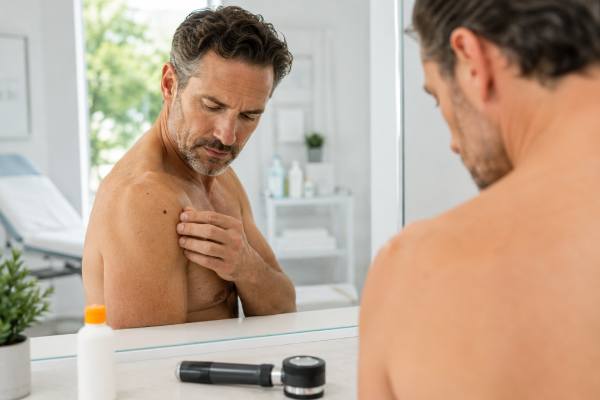
Skin cancer can start as a small spot that is easy to ignore: a scab from shaving that keeps coming back, a rough patch on the ear, a dark line under a toenail, or a mole on the back that a man never sees in the mirror. Men are more likely than women to die from melanoma, the most dangerous type of skin cancer, and delayed attention is one reason. Work outdoors, weekend sports, bald or thinning scalp, less sunscreen use, and skipped skin checks can all add up over time.
Most suspicious spots are not melanoma, but a changing or non-healing mark deserves a proper look. Early skin cancers are often easier to treat and may need only a minor procedure. The goal is simple: know what looks wrong, check the areas men often miss, and protect skin before damage builds.
Table of Contents
- Why Men Often Miss Skin Cancer
- The Main Types of Skin Cancer Men Should Know
- Warning Signs That Need a Skin Check
- How to Do a Monthly Skin Self-Check
- Risk Factors That Raise a Man’s Chances
- Prevention Habits That Work in Real Life
- What Happens at a Skin Cancer Appointment
- Follow-Up After a Diagnosis or Removal
Why Men Often Miss Skin Cancer
A common pattern is waiting until a spot bleeds, hurts, or becomes hard to hide. Skin cancer does not always announce itself with pain. Many early cancers are flat, rough, shiny, scaly, or only slightly different from the surrounding skin.
Men also tend to develop suspicious spots in hard-to-see places. Melanoma in men often appears on the trunk, including the upper back, shoulders, and chest. Basal cell and squamous cell cancers often show up on sun-exposed areas such as the scalp, ears, face, neck, forearms, and hands. A man with thinning hair may protect his face but forget the crown of his head. A golfer may cover his arms but leave the ears exposed. A runner may apply sunscreen before a race but not reapply after sweating.
Another reason men miss skin cancer is that they explain away warning signs. A bleeding spot on the neck becomes “razor burn.” A crusty patch on the ear becomes “dry skin.” A dark mark under a toenail becomes “old trauma.” Those explanations may be correct, but they become less convincing when the area changes, grows, bleeds without clear injury, or does not heal.
Skin checks also compete with other health concerns. Men may remember blood pressure, cholesterol, prostate discussions, or colon screening, but leave skin off the list. A yearly visit is a good time to ask whether your personal history, job, hobbies, skin type, or family history makes a professional skin exam worth scheduling. Broader prevention planning can fit naturally into an annual physical for men or an age-based screening conversation.
The Main Types of Skin Cancer Men Should Know
Skin cancer is not one disease. The three names most men hear are basal cell carcinoma, squamous cell carcinoma, and melanoma. They can look different, grow at different speeds, and carry different levels of risk.
Basal cell carcinoma
Basal cell carcinoma is the most common type. It often grows slowly and is usually very treatable, but it can damage nearby tissue if ignored. It commonly appears on the face, nose, ears, scalp, neck, shoulders, and arms.
It may look like:
- A shiny or pearly bump
- A pink or reddish patch
- A sore that heals and then opens again
- A scar-like area that feels firm or waxy
- A bump that bleeds after shaving or minor rubbing
Basal cell cancers can be easy to underestimate because they may not hurt. A man may keep nicking the same spot with a razor for months before realizing it is not a normal cut.
Squamous cell carcinoma
Squamous cell carcinoma can also be very treatable when found early, but it is more likely than basal cell carcinoma to grow deeper or spread, especially when it appears on the lip, ear, genital skin, scar tissue, or in someone with a weakened immune system.
It may look like:
- A rough, scaly red patch
- A thickened or crusted bump
- A wart-like growth
- A sore that bleeds, crusts, or does not heal
- A tender or painful area on sun-damaged skin
Men who work outside, have a history of many sunburns, or have bald scalp exposure should pay close attention to rough patches that keep returning.
Melanoma
Melanoma is less common than basal and squamous cell cancers, but it causes most skin cancer deaths. It can develop in an existing mole or appear as a new spot. It may be brown or black, but it can also include red, blue, white, pink, or skin-colored areas.
Melanoma can appear anywhere, including the back, chest, legs, scalp, palms, soles, and under nails. In men with darker skin tones, melanoma is less common overall, but it may be found later and can appear on areas not usually exposed to the sun, such as the soles, palms, or nail beds.
Warning Signs That Need a Skin Check
A spot does not need to look dramatic to deserve medical attention. The most important warning sign is change. A mole, bump, sore, or patch that changes in size, shape, color, texture, bleeding, or symptoms should be checked.
The ABCDE rule is useful for moles and pigmented spots:
- A — Asymmetry: One half does not match the other.
- B — Border: The edges are uneven, blurred, notched, or scalloped.
- C — Color: The spot has several colors or uneven shading.
- D — Diameter: It is larger than about 6 millimeters, roughly the size of a pencil eraser, though melanoma can be smaller.
- E — Evolving: It changes over time or starts itching, bleeding, crusting, or hurting.
The “ugly duckling” sign is just as important. This means one spot looks different from the rest of your moles. A man with many small, even brown moles should pay attention to one larger, darker, redder, or oddly shaped spot.
| What you notice | Why it matters | What to do |
|---|---|---|
| A sore that bleeds, crusts, heals, then returns | Basal cell and squamous cell cancers can behave this way | Book a skin exam, especially if it lasts more than a few weeks |
| A rough patch on the ear, scalp, lip, face, or hand | Sun-damaged areas can develop precancers or squamous cell cancer | Have it checked if it persists, thickens, hurts, or bleeds |
| A changing mole on the back, chest, or shoulder | Men often miss melanoma in these areas | Take a photo and arrange a prompt dermatology visit |
| A dark line or spot under a nail that does not grow out | Rare melanomas can occur under nails | Get checked, especially if there was no clear injury |
| A new dark spot on the sole, palm, or between toes | Skin cancer can occur where sun exposure is not obvious | Do not assume it is a bruise or stain if it changes or persists |
Shaving irritation, acne, eczema, warts, fungal infections, and ingrown hairs can mimic skin cancer. The difference is persistence and change. A normal razor nick should improve. A pimple should shrink. A bruise under the nail should move outward as the nail grows. A spot that refuses to follow the expected timeline deserves a closer look.
Seek faster care if a spot is rapidly growing, bleeding often, painful, black and changing, or paired with a new lump nearby. Men who are unsure whether a symptom can wait can use broader guidance on symptoms men should not ignore, but suspicious skin changes should not be watched for months.
How to Do a Monthly Skin Self-Check
A good skin self-check takes about 10 minutes once you know the routine. The best time is after a shower, before getting dressed, in a bright room. Use a full-length mirror, a hand mirror, and your phone camera for hard-to-see areas.
Start with your face and scalp. Check the nose, lips, eyelids, ears, behind the ears, and neck. If you have thinning hair or a shaved head, look closely at the scalp and hairline. Use a comb or ask someone to look through thicker hair.
Move down the body in a set order:
- Front: Chest, stomach, groin, thighs, shins, ankles, tops of feet, and toenails.
- Sides: Lift each arm and check the ribs, armpits, outer arms, hips, and outer legs.
- Back: Use mirrors or a partner to check the back of the neck, shoulders, upper back, lower back, buttocks, backs of thighs, calves, and heels.
- Hands and arms: Check palms, backs of hands, between fingers, fingernails, wrists, forearms, elbows, and upper arms.
- Feet: Check soles, between toes, toenails, and the skin around the heels.
- Genital and anal area: Skin cancers are less common here, but new, changing, bleeding, or non-healing spots still need care.
Photos make self-checks much more useful. Take clear pictures of moles or spots you want to follow, ideally with the same lighting and distance each time. A ruler or coin beside the spot can help show size. Do not rely on memory for a mole on your back.
A monthly self-check does not mean diagnosing yourself. It means noticing what is new, changing, or unusual. Mark a calendar reminder if needed. Men who already track workouts, blood pressure, sleep, or medications can add skin checks to the same routine. Age-based prevention planning, including cancer screenings, can also be organized with a men’s preventive screenings by age checklist.
Ask a partner, barber, or close family member to mention spots on the scalp, neck, ears, or back. Barbers sometimes notice changing scalp or ear lesions before the person does. A simple comment such as “Tell me if you see a spot that looks new or bleeds” can help catch areas you cannot inspect well.
Risk Factors That Raise a Man’s Chances
Anyone can get skin cancer, but risk is not equal. Some men need closer attention because their lifetime exposure, skin type, medical history, or immune system puts them at higher risk.
Important risk factors include:
- Fair skin, light eyes, red or blond hair, freckles, or skin that burns easily
- A history of blistering sunburns, especially earlier in life
- Frequent outdoor work or outdoor sports
- Tanning bed use
- Many moles or unusual-looking moles
- A personal history of skin cancer or precancerous actinic keratoses
- A family history of melanoma
- Weakened immune system, including after organ transplant or from certain medications
- Prior radiation therapy
- Long-term arsenic exposure
- Older age, especially with years of sun damage
- Bald or thinning scalp without regular sun protection
Skin tone changes the pattern but does not remove the risk. Men with darker skin have more natural protection from UV damage than men with very fair skin, but they can still get skin cancer. Spots on the soles, palms, nail beds, mouth, and genital skin deserve attention in every skin tone. A cancer that is noticed late can be harder to treat.
Occupation matters. Construction workers, landscapers, farmers, roofers, delivery workers, lifeguards, military personnel, and men who drive for work may get repeated UV exposure. Glass blocks much UVB, the main sunburn ray, but UVA can still pass through some windows and contribute to skin aging and damage. The left side of the face and left arm can receive more exposure in drivers in the United States.
Some health habits also overlap with skin cancer risk and recovery. Smoking does not cause most skin cancers in the same direct way UV light does, but it can affect wound healing and overall cancer risk. Men who smoke may benefit from connecting skin prevention with broader changes in smoking and men’s health.
Risk should guide how careful you are, not whether you care at all. A fair-skinned roofer with past blistering sunburns needs strict daily protection and a lower threshold for dermatology checks. A man with medium or dark skin who rarely burns should still check nails, soles, palms, scars, and any changing spot.
Prevention Habits That Work in Real Life
The best prevention plan is one you can follow on normal days, not only at the beach. Skin damage comes from repeated exposure: walking the dog, coaching kids’ sports, driving, mowing, fishing, golfing, working outside, or eating lunch in the sun.
Use layers of protection instead of relying on sunscreen alone.
Seek shade when UV is strongest. In many places, UV rays are strongest from late morning through afternoon. Shade is especially important when the UV Index is 3 or higher. Clouds do not make skin fully safe; UV can still reach you on cool or overcast days.
Wear protective clothing. Long sleeves, lightweight pants, a wide-brim hat, and UV-blocking sunglasses reduce the amount of skin that needs sunscreen. Tightly woven fabrics protect better than thin, loose fabrics. UPF-rated clothing can help men who work, fish, hike, or exercise outdoors for long periods.
Protect the scalp and ears. Baseball caps shade the forehead but leave the ears, neck, and sides of the face exposed. A wide-brim hat is better. Men with shaved heads, thinning hair, or bald spots should treat the scalp as high-risk skin.
Use broad-spectrum sunscreen. Choose a broad-spectrum sunscreen with SPF 30 or higher for exposed skin. Apply it before going outside, and use more than you think you need. Reapply at least every two hours when outdoors, and sooner after swimming, heavy sweating, or towel drying.
Do not use tanning beds. A tan is a sign of skin injury, not health. Tanning beds expose skin to UV radiation and raise skin cancer risk. A “base tan” does not provide safe protection.
Store sunscreen where you use it. Keep it by the door, in a gym bag, in a golf bag, at work, or in the car for use before getting out. Avoid leaving sunscreen in extreme heat for long periods because it can break down.
Make sun protection part of gear, not grooming. Men who dislike the feel of sunscreen may do better with lighter lotions, gels, sprays used carefully, sticks for the face, or mineral formulas. The best product is one you will use correctly.
Outdoor exercise is still healthy. The goal is not to avoid the outdoors; it is to avoid repeated burns and heavy UV exposure. Men focused on long-term health after midlife can pair sun protection with fitness, sleep, blood pressure, and cancer screening habits covered in men’s health after 50.
What Happens at a Skin Cancer Appointment
A skin cancer visit is usually straightforward. The clinician looks at the spot, asks how long it has been there, whether it has changed, whether it bleeds or hurts, and whether you have a personal or family history of skin cancer. A dermatologist may use a dermoscope, a handheld tool that helps show structures in the skin that are not easy to see with the naked eye.
Bring useful information:
- When you first noticed the spot
- Whether it has grown, changed color, bled, crusted, or hurt
- Photos showing earlier appearance
- A list of past skin cancers or biopsies
- Medicines that affect the immune system or bleeding
- Family history of melanoma
- History of tanning bed use, outdoor work, or severe sunburns
If the spot looks suspicious, the next step is often a biopsy. A biopsy means removing part or all of the spot so a lab can examine it under a microscope. Numbing medicine is used first. The procedure may feel like pressure, but it should not be sharply painful after numbing. The area is then covered with a bandage, and you receive wound-care instructions.
Biopsy results may show a benign growth, a precancer, basal cell carcinoma, squamous cell carcinoma, melanoma, or another diagnosis. Treatment depends on the type, size, depth, location, and risk features. Some basal and squamous cell cancers are removed with a simple excision. Others, especially on the face, ears, hands, genitals, or high-risk areas, may be treated with Mohs surgery, a technique that checks thin layers of tissue during the procedure to remove cancer while sparing healthy skin.
Melanoma usually needs surgical removal with a margin of normal-looking skin. If melanoma is deeper or has higher-risk features, doctors may discuss lymph node testing, imaging, oncology care, or additional treatments.
Routine whole-body screening is more nuanced than many people think. For adults without symptoms and without a history of concerning skin lesions, national preventive guidance has found the evidence insufficient to recommend for or against routine clinician screening for everyone. That does not mean suspicious spots should wait. It also does not apply the same way to men with prior skin cancer, many atypical moles, strong family history, organ transplant, or another high-risk situation. Those men should ask a clinician how often professional skin exams make sense.
Follow-Up After a Diagnosis or Removal
A skin cancer diagnosis changes future risk. After one skin cancer, a man is more likely to develop another, so follow-up is not just about the treated spot. It is about watching the rest of the skin.
Follow-up timing depends on the diagnosis. A low-risk basal cell carcinoma may need less frequent follow-up than melanoma or high-risk squamous cell carcinoma. Your dermatologist may recommend visits every few months at first, then less often if no new problems appear. Keep the schedule you are given, even if the treated area looks healed.
At home, watch for two things: recurrence and new lesions. A treated area should gradually heal. Call the office if it develops a growing bump, repeated bleeding, new ulcer, increasing pain, or a change that resembles the original cancer. Also keep checking the rest of the skin monthly.
Scars need sun protection too. Fresh scars can darken, burn, or heal poorly with UV exposure. Cover the area or use sunscreen after the wound has closed and your clinician says it is safe. Follow wound-care instructions carefully, especially if you smoke, have diabetes, take blood thinners, or have circulation problems.
Men treated for melanoma may receive more detailed instructions. These can include lymph node checks, scheduled skin exams, and watching for symptoms such as unexplained lumps, persistent pain, unusual weight loss, or ongoing fatigue. Many symptoms are not cancer, but follow-up care is designed to catch serious changes early.
A diagnosis can also be a useful reset point for family members. First-degree relatives may have higher melanoma risk if there is a family history. Adult children, brothers, and parents may need to know that melanoma occurred in the family so they can mention it during medical visits.
Prevention still matters after treatment. Sunscreen, hats, shade, and protective clothing reduce further UV damage. They also help prevent more rough precancerous patches from developing on the scalp, ears, face, arms, and hands. Skin care does not need to be complicated; it needs to be consistent.
References
- Screening for Skin Cancer: US Preventive Services Task Force Recommendation Statement 2023 (Guideline)
- Skin Cancer Prevention (PDQ®)–Health Professional Version 2025 (Review)
- Sun Safety Facts 2026 (Official)
- What to look for: ABCDEs of melanoma 2022 (Official)
- Basal and Squamous Cell Skin Cancer Symptoms 2024 (Official)
- A review of sunscreen in the prevention of skin cancer 2025 (Review)
Disclaimer
This article is for education only and does not replace care from a qualified health professional. A changing, bleeding, painful, fast-growing, or non-healing skin spot should be examined by a clinician, especially if you have a history of skin cancer, many unusual moles, a weakened immune system, or strong family history of melanoma. Do not try to diagnose or remove suspicious skin growths at home.