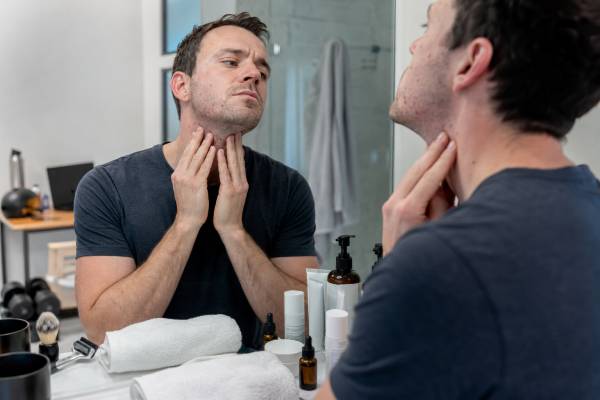
Adult acne in men often feels more frustrating than teenage acne because it shows up when life is already full of work, workouts, shaving, stress, and routines that are hard to change. Breakouts may appear along the jaw, beard line, neck, chest, shoulders, or back. Some men get deep sore bumps that linger for weeks. Others deal with small clogged pores, razor bumps, or sweat-related flare-ups that never fully clear.
The useful question is not simply “Why do I still have acne?” It is “What is actually triggering it, and what treatment matches the pattern?” Hormones, oily skin, shaving irritation, gym sweat, helmets, hair products, supplements, and medication side effects can all play a role. Once you separate true acne from razor bumps, folliculitis, or irritation, treatment becomes much more targeted.
Table of Contents
- What Adult Acne Looks Like in Men
- Why Hormones and Oil Keep Breakouts Going
- Shaving Acne, Razor Bumps, and Beard-Line Breakouts
- Sweat, Workouts, and Back Acne
- A Simple Skin Routine That Actually Helps
- Treatment Options From Drugstore to Dermatologist
- When Acne Needs a Medical Check
- How to Prevent Relapse, Scarring, and Common Mistakes
What Adult Acne Looks Like in Men
Adult acne in men is not always the same as teenage acne. Teen breakouts often center on the forehead, nose, and cheeks. Adult breakouts more often involve the lower face, jawline, beard area, neck, chest, shoulders, and back. The bumps may be fewer, but they are often deeper, slower to heal, and more likely to leave dark marks or scars.
Acne forms when pores become clogged with oil and dead skin cells. Bacteria and inflammation then turn that clogged pore into a red bump, pustule, or painful nodule. In men, this process is often made worse by higher oil production, facial hair, shaving, sweat, and friction from clothing or sports gear.
Not every bump is acne, though. That distinction matters because the wrong treatment can make the problem worse.
| Pattern | What it often looks like | Common trigger | What helps most |
|---|---|---|---|
| Classic acne | Blackheads, whiteheads, red bumps, pustules, or deep cysts | Oil, clogged pores, hormones, inflammation | Benzoyl peroxide, retinoids, prescription acne treatment |
| Razor bumps | Small bumps along the beard line, often with trapped or curved hairs | Close shaving, curly hair, shaving against the grain | Shaving changes, gentle exfoliation, less-close shave |
| Folliculitis | Uniform itchy or tender bumps around hair follicles | Bacteria, yeast, sweat, tight clothing | Medical evaluation if persistent, antibacterial or antifungal treatment |
| Acne mechanica | Breakouts where gear, straps, collars, helmets, or pads rub | Heat, sweat, pressure, friction | Reducing friction, showering after sweat, breathable clothing |
A useful clue is whether the bumps contain comedones. Comedones are clogged pores: blackheads and whiteheads. If those are present, acne is likely part of the problem. If the bumps are all similar, itchy, and centered on hair follicles, folliculitis becomes more likely. If they follow the shave line and you can see curled hairs entering the skin, shaving bumps may be the main issue.
Location also helps. Acne on the forehead may be linked to hair products, hats, or oily skin. Jaw and neck bumps often involve shaving, hormones, or ingrown hairs. Chest and back acne often worsen with sweat, tight shirts, backpacks, workout benches, or occlusive products. For deeper coverage of body breakouts, back acne triggers often overlap with the same sweat and friction patterns discussed here.
Why Hormones and Oil Keep Breakouts Going
Hormones do not need to be “abnormal” for acne to persist. Male skin is sensitive to androgens, a group of hormones that includes testosterone and dihydrotestosterone. These hormones stimulate sebaceous glands, which make sebum, the oily material that helps protect the skin. When sebum mixes with dead skin cells inside a pore, the pore can clog.
This is why adult male acne often continues even when blood testosterone levels are normal. The issue is not always too much testosterone in the bloodstream. It may be how strongly oil glands respond to androgens in the skin.
That said, a sudden change matters. New or rapidly worsening acne after starting testosterone therapy, anabolic steroids, some bodybuilding drugs, or certain supplements deserves attention. Acne linked to hormone exposure often appears on the chest, shoulders, upper back, jawline, and neck. It may feel deeper and more inflamed than ordinary clogged pores.
Men using testosterone replacement therapy should pay attention to acne that appears after dose changes, injection frequency changes, or higher hormone levels. Acne is one possible side effect, along with changes in red blood cell count, sleep apnea risk, mood, fertility, and hair loss. A more complete review of TRT side effects can help put skin changes into the wider monitoring picture.
Anabolic steroids and non-prescribed hormone-like drugs are a different concern. They can cause severe acne, especially on the trunk, and may also affect fertility, mood, cholesterol, blood pressure, liver health, and natural testosterone production. Men who develop sudden cystic acne while using performance-enhancing drugs should not treat it as a purely cosmetic problem. The skin may be showing a larger hormone disruption. The health risks are broader than breakouts, which is why anabolic steroid side effects deserve separate attention.
Hormones also interact with sleep, stress, and weight. Poor sleep and chronic stress can raise inflammation and make skin healing worse. Excess body fat can affect hormone balance and insulin signaling. High-glycemic diets and frequent sugary drinks may worsen acne in some people, although diet is rarely the only cause. The practical takeaway is not to chase one magic food rule. It is to notice patterns: breakouts after heavy sugar intake, repeated late nights, supplement changes, or a new hormone prescription.
Shaving Acne, Razor Bumps, and Beard-Line Breakouts
Many men call every beard-line bump “acne,” but shaving creates its own problems. Razor bumps, also called pseudofolliculitis barbae, happen when shaved hairs curl back into the skin or grow sideways under the surface. The body reacts to that trapped hair as irritation, creating red or dark bumps that can look like pimples.
This is more common in men with tightly curled or coarse facial hair, but anyone who shaves close can develop it. The neck, under the jaw, cheeks, and lower beard line are common trouble spots. Razor bumps may sting, itch, darken after healing, or leave firm spots if they keep recurring.
The easiest way to tell shaving bumps from acne is to look closely at the pattern. Shaving bumps usually follow shaved areas. They often appear a day or two after shaving. You may see a hair trapped inside the bump or re-entering the skin. Acne, by contrast, often includes whiteheads, blackheads, and inflamed bumps beyond the exact shave line.
Shaving changes that reduce bumps
Start with a less aggressive shave. A perfectly smooth shave may look clean for a few hours, but it increases the chance that hair tips retract below the skin surface and become trapped.
Helpful changes include:
- Shave after a warm shower or after softening the beard with warm water.
- Use a slick, fragrance-free shave gel or cream instead of dry shaving.
- Shave with the direction of hair growth, not against it.
- Avoid stretching the skin tight while shaving.
- Use fewer blade passes over the same area.
- Consider an electric trimmer that leaves slight stubble instead of a very close blade shave.
- Replace dull blades and rinse the razor during shaving.
Men who need a clean shave for work may need a compromise: closer than a beard trimmer, but not so close that the blade cuts hair below the skin surface. Some do better with a single-blade safety razor. Others do better with an electric foil or guard. The best tool is the one that reduces bumps without causing repeated irritation.
After shaving, skip alcohol-heavy aftershaves if they burn or dry the skin. Use a light, non-comedogenic moisturizer instead. “Non-comedogenic” means the product is less likely to clog pores. If the beard area is acne-prone, a thin layer of benzoyl peroxide wash a few times per week or a low-strength retinoid at night may help, but both can irritate freshly shaved skin. Introduce them slowly and avoid applying harsh products immediately after shaving if your skin stings.
Do not dig out ingrown hairs with dirty tweezers or needles. That raises the risk of infection, dark marks, and scarring. If one hair is visible at the surface, a clean warm compress and gentle release may be enough. Deep, painful, recurring bumps need medical care rather than repeated picking.
Sweat, Workouts, and Back Acne
Sweat itself does not poison the skin or directly cause acne. The problem is what often comes with sweat: heat, friction, pressure, bacteria, tight clothing, occlusive gear, and delayed showering. A sweaty cotton shirt under a backpack strap, a tight compression top, a football pad, a cycling jersey, or a helmet chin strap can trap heat and rub the skin until pores become irritated.
This is why men who train regularly often get breakouts on the shoulders, upper back, chest, neck, or along waistbands. The bumps may be true acne, acne mechanica, folliculitis, or a mix of all three.
The goal is not to stop exercising. Exercise helps overall health, mood, blood sugar, cardiovascular fitness, and weight control. The goal is to reduce the skin conditions that turn workouts into flare-ups.
A practical post-workout routine is simple:
- Change out of sweaty clothes as soon as possible.
- Shower after training, especially after heavy sweating or contact sports.
- Use a benzoyl peroxide wash on acne-prone body areas if tolerated.
- Rinse thoroughly because benzoyl peroxide can bleach towels and clothing.
- Wear breathable, moisture-wicking fabrics that are not overly tight.
- Wash workout shirts, towels, hats, and gear liners regularly.
- Avoid heavy oils or greasy balms on the chest, shoulders, and back.
For back and chest acne, wash-off treatments are often easier than leave-on creams. Benzoyl peroxide wash can reduce acne-causing bacteria, while salicylic acid wash can help loosen clogged pores. Leave the wash on the skin briefly before rinsing, unless your skin becomes dry or irritated. Start a few times per week rather than twice daily.
If bumps are itchy, very uniform, and worsen with heat, yeast folliculitis is possible. This is often mistaken for acne. Acne treatments may not fully work because the problem is not just clogged pores. A clinician may recommend an antifungal wash or medication. This is especially worth considering when the bumps are mostly on the chest, back, shoulders, or upper arms and look nearly identical.
Sweating can also overlap with odor, rashes, and irritation in skin folds. Men with heavy sweating may need a broader plan, especially if sweat is interfering with work, sleep, clothing, or exercise. In that case, excessive sweating causes and treatments are worth reviewing separately.
A Simple Skin Routine That Actually Helps
A good acne routine for men should be boring, consistent, and easy to repeat. Complicated routines often fail because they irritate the skin or take too much effort. Most men do better with a cleanser, one main treatment, moisturizer, and sunscreen when exposed to the sun.
Morning routine
Wash with a gentle cleanser or, if oily and acne-prone, a benzoyl peroxide cleanser. Do not scrub with a rough cloth or brush. Scrubbing makes skin feel cleaner for a few minutes, but it increases irritation and can worsen inflamed acne.
After washing, apply a light non-comedogenic moisturizer if the skin feels tight or dry. This step matters even for oily skin. Dry, irritated skin often leads men to stop treatment early. Moisturizer helps you stay consistent with acne medicines.
Use sunscreen on exposed skin, especially if you use retinoids, acids, doxycycline, or treatments that increase sun sensitivity. Choose a lightweight, non-greasy product labeled non-comedogenic.
Evening routine
At night, wash again if your face is oily, sweaty, or covered in sunscreen. Apply a retinoid if it is part of your plan. Adapalene is available over the counter in some places and is often a practical starting option. Retinoids help prevent clogged pores, reduce inflammation, and support maintenance after acne improves.
The mistake is using too much. A pea-sized amount for the whole face is enough. Apply it to dry skin, not wet skin, because wet skin absorbs more and may become irritated. Start two or three nights per week, then increase slowly.
Avoid stacking too many actives at once. A routine with benzoyl peroxide, salicylic acid, glycolic acid, retinoid, exfoliating scrub, and aftershave is not “stronger.” It is often a fast route to burning, peeling, and quitting.
Product clues that matter
Look for labels such as “non-comedogenic,” “oil-free,” “fragrance-free,” or “for acne-prone skin.” These labels are not perfect guarantees, but they help narrow the field.
Be cautious with:
- Heavy beard oils applied close to acne-prone skin
- Greasy hair pomades that touch the forehead or temples
- Thick occlusive sunscreens on oily skin
- Fragranced aftershaves that sting or burn
- Harsh scrubs marketed as deep-cleaning products
Beard oils are not automatically bad. The problem is heavy, pore-clogging products applied to skin that already breaks out. If you use beard oil, apply the smallest amount needed to the hair rather than soaking the skin underneath.
Treatment Options From Drugstore to Dermatologist
Acne treatment works best when it targets several parts of acne at once: clogged pores, oil, bacteria, and inflammation. Most treatments take 8 to 12 weeks to show their real effect. Early dryness does not mean the treatment is working better. Severe irritation usually means the plan needs adjusting.
| Treatment | Best for | Main advantage | Common issue |
|---|---|---|---|
| Benzoyl peroxide | Inflamed bumps, pustules, body acne | Reduces acne bacteria and helps prevent antibiotic resistance | Dryness, irritation, bleaching fabric |
| Topical retinoids | Clogged pores, recurring acne, maintenance | Prevents new comedones and helps long-term control | Dryness and peeling at the start |
| Salicylic acid | Mild clogged pores and oily skin | Easy over-the-counter option | Can irritate if overused |
| Topical antibiotics | Inflamed acne when combined with benzoyl peroxide | Reduces inflammatory lesions | Should not be used alone due to resistance risk |
| Oral antibiotics | Moderate inflammatory acne | Useful for widespread face, chest, or back acne | Temporary tool, not ideal as long-term monotherapy |
| Clascoterone | Hormone-influenced acne in males and females | Topical anti-androgen option for acne-prone skin | Cost and access may vary |
| Isotretinoin | Severe, scarring, cystic, or treatment-resistant acne | Most powerful long-term acne option | Requires medical monitoring and side effect discussion |
For mild acne, a drugstore plan may be enough: benzoyl peroxide in the morning and a retinoid at night, introduced slowly. For sensitive skin, start with one active treatment first. If the skin tolerates it after two weeks, add the second.
For moderate acne, especially if it affects the back or chest, a clinician may prescribe a topical retinoid plus benzoyl peroxide, sometimes with an oral antibiotic for a limited period. Antibiotics should not be the only treatment because acne often returns when they stop. Combining them with benzoyl peroxide and a retinoid improves control and reduces resistance concerns.
For deep cystic acne, repeated nodules, or scarring, isotretinoin may be the most effective option. Some men avoid it because they have heard only the worst stories. It does require careful discussion and monitoring, but for the right patient it can prevent years of scarring and repeated antibiotic use. Men do not have the same pregnancy-prevention requirements as women taking isotretinoin, but they still need counseling about dryness, sun sensitivity, lab monitoring, mood symptoms, medication interactions, and follow-up.
Acne connected to testosterone therapy needs a coordinated plan. Sometimes the acne can be treated directly. Sometimes the hormone dose, injection schedule, or overall monitoring needs review. Do not stop prescribed testosterone on your own, but do tell the prescribing clinician if acne appears suddenly or becomes severe.
When Acne Needs a Medical Check
A few pimples do not require a specialist. Persistent adult acne, painful cysts, scarring, or sudden severe breakouts do deserve proper evaluation. The earlier deep acne is controlled, the lower the chance of permanent scars.
See a dermatologist or qualified clinician if:
- Acne is painful, deep, cystic, or leaving scars.
- Drugstore treatment has not helped after 8 to 12 weeks of consistent use.
- Breakouts started suddenly after a new medication, supplement, or hormone therapy.
- Chest and back acne is widespread or severe.
- Bumps are itchy, uniform, or look more like folliculitis than acne.
- Shaving bumps are causing dark marks, infection, or scarring.
- Acne is affecting confidence, dating, work, sleep, or mood.
Adult acne can also overlap with other skin conditions. Redness around the nose and cheeks may be rosacea. Flaking around the eyebrows, beard, scalp, or sides of the nose may be seborrheic dermatitis rather than acne. If flakes and oily redness are part of the picture, seborrheic dermatitis in men can look like a separate but related skin issue.
Men with genital bumps, penile bumps, or groin-area “acne” should be more cautious. Not every bump in those areas is a clogged pore. Ingrown hairs and folliculitis are common, but cysts, warts, herpes, molluscum, and other causes also occur. When bumps appear after sexual exposure, are painful, blistered, ulcerated, spreading, or associated with discharge, testing and medical evaluation are safer than self-treating. For that situation, genital bumps in men need a different decision pathway.
When you do see a clinician, bring useful details. Note when the acne started, where it appears, what you have tried, whether shaving affects it, what supplements or medications you use, and whether you are taking testosterone or performance-enhancing substances. Photos from flare days can help if your skin looks calmer during the appointment.
How to Prevent Relapse, Scarring, and Common Mistakes
Acne prevention is mostly maintenance. Many men stop treatment as soon as the skin clears, then feel surprised when acne returns. That is understandable, but acne-prone skin usually needs ongoing support. Once active breakouts improve, the plan often shifts from “clear the flare” to “keep pores from clogging again.”
A retinoid is often useful for maintenance because it helps prevent new clogged pores. Benzoyl peroxide can be used less often if irritation is an issue. Men with body acne may keep using a medicated wash after workouts or several times per week.
The biggest mistake is picking. Squeezing deep bumps forces inflammation deeper into the skin and raises the risk of scars. If a painful cyst appears before an event, a dermatologist may be able to inject it with a small amount of corticosteroid to calm it quickly. That is safer than trying to drain it at home.
Another common mistake is changing products every few days. Acne treatments need time. Switching too often makes it impossible to know what is helping and often creates irritation that looks like worsening acne. Pick a simple plan and give it a fair trial unless you develop severe burning, swelling, rash, or allergic symptoms.
Men also tend to undertreat body acne because it is harder to reach. A long-handled applicator, spray formulation, or wash-off product can make treatment more realistic. For back acne, consistency beats perfection.
Pay attention to these relapse triggers:
- New protein powders, muscle-building supplements, or hormone-related products
- Greasy hair products touching the forehead, temples, neck, or back
- Workout clothes worn long after training
- Helmets, hats, collars, straps, or pads that are not cleaned
- Close shaving against the grain
- Heavy beard oils or balms applied directly to acne-prone skin
- Stopping retinoids immediately after the skin clears
- Using harsh scrubs to “dry out” oily skin
Scarring prevention deserves priority. Dark marks often fade, but true depressed or raised scars are harder to treat. If acne is leaving pits, thickened scars, or repeated dark marks, do not wait years before seeking care. Active acne should be controlled first; then scar treatments such as microneedling, laser, chemical peels, subcision, or prescription topicals may be considered depending on skin type and scar pattern.
The most useful mindset is to treat acne like a recurring skin condition, not a personal hygiene failure. Most adult men with acne are not dirty, lazy, or doing one obvious thing wrong. The problem usually comes from biology plus repeated triggers: oil glands, hormones, shaving, sweat, friction, and inflammation. A steady plan that matches your actual pattern works better than scrubbing harder or buying the strongest product on the shelf.
References
- Guidelines of care for the management of acne vulgaris 2024 (Guideline)
- Acne vulgaris: management 2021, last updated 2026 (Guideline)
- Adult acne versus adolescent acne: a narrative review with a focus on epidemiology to treatment 2023 (Review)
- Managing acne vulgaris: an update 2024 (Review)
- Review of treatments for pseudofolliculitis barbae 2023 (Review)
- Hormonal Therapies for Acne: A Comprehensive Update for Dermatologists 2025 (Review)
Disclaimer
This article is for educational purposes and does not replace medical diagnosis or personal treatment advice. Adult acne, razor bumps, folliculitis, medication-related breakouts, and hormone-related acne can look similar but require different approaches. See a qualified healthcare professional if acne is painful, scarring, sudden, widespread, linked to hormone use, or not improving with consistent over-the-counter care.