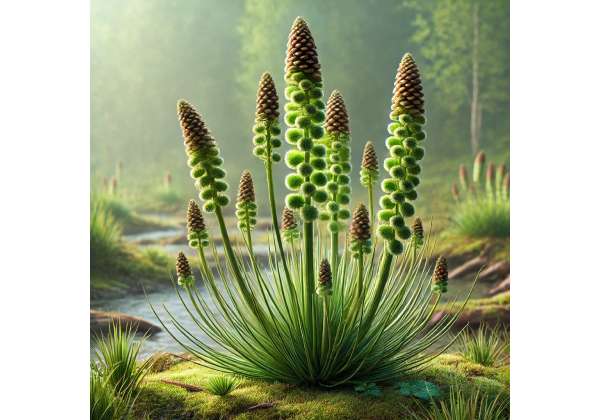
Field horsetail, or Equisetum arvense, is one of the oldest surviving plant lineages on earth, yet its modern appeal is surprisingly practical. This fern-like herb has long been used in European and traditional herbal medicine for mild urinary complaints, fluid balance support, and superficial wound care. Today, it is best known for two things: its diuretic reputation and its unusually high silica content, which has made it popular in products aimed at hair, nails, skin, and bone health. The plant also contains flavonoids, phenolic acids, and mineral salts that help explain its antioxidant and tissue-supportive profile.
Still, horsetail is not a casual “beauty herb” or a harmless daily detox tea. Its benefits depend heavily on the form used, the dose, and the reason for taking it. It also carries real cautions, including thiaminase-related concerns, product quality issues, and important limits for pregnancy, kidney disease, and long-term unsupervised use. The most helpful way to approach field horsetail is as a targeted traditional herb with a few credible uses, a number of overstated claims, and a safety profile that deserves respect.
Quick Facts
- Field horsetail is most credible for short-term urinary flushing support and possibly mild topical wound support.
- Its silica, flavonoids, and phenolic acids help explain interest in skin, nail, and connective-tissue health, but those claims are less proven in humans.
- Traditional tea use often falls around 3 to 12 g/day of dried aerial parts, divided across 3 to 4 servings.
- Avoid long-term unsupervised use because raw or poorly processed horsetail may contain thiaminase and can interact with diuretics or glucose-lowering therapy.
- People who are pregnant, breastfeeding, under 12, or advised to restrict fluids because of heart or kidney disease should not self-use horsetail.
Table of Contents
- What is field horsetail?
- Field horsetail active compounds
- Does field horsetail help urinary health?
- Can horsetail help skin, hair, nails, and bone?
- How to use field horsetail
- How much field horsetail per day?
- Side effects, interactions, and who should avoid it
- What the research actually says
What is field horsetail?
Field horsetail is a perennial, spore-forming plant in the Equisetaceae family. Although it is often grouped with herbs in everyday language, it is not a flowering herb in the usual sense. It is more accurately described as a fern ally with a rigid, segmented, brush-like appearance. That unusual structure is one reason horsetail has stood out in traditional medicine for centuries: it looks distinctive, feels rough from its mineral content, and has been easy to identify in the wild by experienced gatherers.
The medicinal part is usually the sterile aerial stem, harvested after the fertile spring shoots have passed. In trade, reputable products should clearly identify Equisetum arvense and the aerial parts used. This matters because horsetail is one of those herbs where species confusion can create real safety issues. Adulteration with other Equisetum species, especially marsh horsetail, is a known quality concern and one reason professionally sourced material is preferable to casual wildcrafting.
Traditional use has centered on two main roles. The first is urinary support: horsetail has long been used to increase urine flow and help “flush” the urinary tract in minor complaints. The second is topical support for superficial wounds. Some traditions also used it for swelling, joint discomfort, weak connective tissues, and heavy bleeding, though these broader uses are less clearly supported.
Modern interest in field horsetail has expanded for a different reason: silica. Because horsetail is rich in silica and mineral salts, it is frequently marketed for hair, nails, skin, collagen, and bone. That marketing has given the plant a beauty-supplement reputation that is only partly deserved. The plant’s chemistry is interesting, but strong human evidence for most cosmetic claims is still limited.
A more grounded way to understand field horsetail is this:
- It is a traditional urinary herb with some clinical support for short-term diuretic use.
- It has a plausible topical role for minor, superficial skin support.
- It is chemically rich enough to justify scientific interest.
- It is not a proven cure for hair thinning, brittle nails, osteoporosis, or chronic kidney problems.
That distinction helps with expectations. Many people encounter horsetail in “detox” teas or hair-growth formulas and assume it is a broad tonic. In reality, it works better as a narrow-purpose herb. When used thoughtfully, it may support a few real goals. When used vaguely, it tends to collect exaggerated promises that the evidence does not fully support.
Field horsetail active compounds
Field horsetail’s medicinal reputation comes from a layered chemical profile, not from a single standout ingredient. That profile helps explain why the plant has been linked to fluid balance, tissue support, antioxidant activity, and topical healing.
The best-known component is silica, usually discussed as silicic acid or mineral-rich silica complexes within the plant. Horsetail is one of the classic plant sources associated with silica support for connective tissues. Silica is interesting because it is linked with collagen-rich structures such as skin, nails, bone, cartilage, and blood vessels. This is the main reason horsetail appears in “hair, skin, and nails” products. Still, silica content alone does not prove that crude horsetail will improve those tissues in a meaningful clinical way. It explains the theory better than it proves the outcome.
Beyond silica, horsetail contains flavonoids, including quercetin and kaempferol-related glycosides. These compounds are widely studied in plant medicine for antioxidant and inflammation-modulating actions. They may help explain why horsetail has shown anti-inflammatory and immune-modulating effects in laboratory studies. Phenolic acids and caffeic acid derivatives add to that antioxidant profile, giving the herb a plausible role in calming irritated tissues.
Other reported constituents include:
- Saponins, which may contribute to membrane and fluid-related effects
- Sterols, which are often part of the plant’s broader anti-inflammatory profile
- Potassium and other mineral salts, traditionally linked to mild diuretic action
- Small amounts of alkaloids and trace compounds that complicate safety
- Tannins, which may support the plant’s astringent feel in topical use
One of the most important safety-related constituents is not something users seek out: thiaminase. This is an enzyme that can degrade thiamine, also known as vitamin B1. It appears to be more relevant in raw or poorly processed material than in some standardized commercial extracts, because heat and certain extraction methods can reduce or eliminate its activity. That does not make the issue trivial. It means product type matters. A clean, well-made tea or extract is not equivalent to raw plant material from an uncertain source.
A practical way to think about horsetail’s chemistry is to divide it into three groups:
- Structural compounds, mainly silica and minerals, which drive its connective-tissue reputation.
- Protective compounds, mainly flavonoids and phenolic acids, which support its antioxidant and anti-inflammatory profile.
- Limiting compounds, including thiaminase and unwanted contaminants or species mix-ups, which define its safety boundaries.
This is why horsetail cannot be reduced to one simple marketing line. It is not just a silica herb, not just a urinary herb, and not just a folk remedy. Its chemistry is broad enough to make it useful, but also complex enough to reward careful sourcing and realistic expectations.
Does field horsetail help urinary health?
Urinary support is the clearest traditional and clinical use for field horsetail. If the question is where this plant has its best evidence, the answer is mild diuretic use. That does not mean it treats urinary tract infections, dissolves stones, or replaces prescription diuretics. It means horsetail has a defensible place as a short-term herb used to increase urine output and support flushing of the urinary tract in minor complaints.
This use has both historical and modern backing. European herbal authorities have recognized horsetail for increasing urine flow in minor urinary complaints, and a human trial found that a standardized extract produced a short-term diuretic effect comparable to a conventional diuretic benchmark in healthy volunteers. That is more evidence than many traditional herbs ever receive. Even so, the trial was short, involved healthy adults, and does not justify broad claims for kidney disease or chronic edema.
What horsetail may realistically help with includes:
- Mild urinary sluggishness when a gentle increase in urine flow is desired
- Short-term urinary flushing in minor lower urinary discomfort
- Mild fluid retention in otherwise healthy adults
- Situations where a traditional tea-based diuretic is preferred over a harsher stimulant approach
What it is not well suited for includes:
- Fever, flank pain, or suspected infection
- Blood in urine
- Recurrent urinary symptoms without diagnosis
- Swelling caused by heart, liver, or kidney disease
- Urinary retention or obstructive symptoms
That distinction matters because the phrase “diuretic herb” often sounds more universal than it is. Horsetail is best seen as supportive, not corrective. It may help the body move more urine, but it does not solve the reason symptoms are happening.
Compared with other traditional urinary herbs, horsetail tends to be more mineral-rich and tissue-oriented than strongly antiseptic. For readers looking at gentler alternatives, corn silk for milder urinary support is often easier to tolerate and more beverage-like. Horsetail sits a bit closer to the “medicinal flushing” category.
A subtle but important point is hydration. A diuretic herb only makes sense when fluid intake is appropriate. If someone is already dehydrated, overusing caffeine, or restricting water, horsetail can make them feel worse rather than better. Good practice includes drinking enough fluid, limiting unnecessary bladder irritants, and stopping the herb if dizziness, excessive thirst, or cramping develops.
The bottom line is straightforward: field horsetail can support minor urinary complaints through a mild diuretic effect, and this is the part of the herb’s reputation that is most clinically credible. It is useful, but only inside the right boundaries.
Can horsetail help skin, hair, nails, and bone?
This is the most searched part of horsetail, and also the part that needs the most careful framing. Horsetail is heavily promoted for hair growth, stronger nails, better skin elasticity, collagen support, and bone health. Those ideas are not baseless, but they are more plausible than proven.
The reason these claims exist is simple: horsetail is rich in silica and also contains flavonoids and phenolic compounds that may support connective tissue biology. Silica is often linked with collagen formation, mineralization, and structural resilience. That makes horsetail an attractive ingredient in beauty and bone formulas. The problem is that a good biochemical story is not the same as strong clinical proof.
For hair and nails, the evidence is especially thin when field horsetail is used alone. Many products combine horsetail with biotin, zinc, amino acids, collagen, or other botanical extracts. If users notice improvement, it is hard to know how much credit belongs to horsetail itself. There is not strong human evidence showing that simple horsetail tea or capsules reliably improve hair density or nail strength on their own.
For bone, the logic is somewhat stronger but still limited. Silica has real structural relevance to bone, and horsetail has shown intriguing activity in cell and animal studies related to osteoblast and osteoclast balance. That makes it scientifically interesting, especially for connective tissue and mineral metabolism. But it still falls short of being a proven osteoporosis therapy or a replacement for calcium, protein, vitamin D, resistance exercise, and standard treatment when needed.
Topical use may be the most promising non-urinary area. Traditional wound support and more recent studies suggest horsetail preparations may aid superficial wound healing and local tissue recovery. In that role, it overlaps slightly with witch hazel for superficial skin care, though horsetail is less established in everyday over-the-counter skin practice.
The most realistic benefit summary looks like this:
- Skin and wound support: plausible, especially in topical products
- Hair and nails: popular, but under-proven as a stand-alone use
- Bone and connective tissue: biologically interesting, but not clinically established enough for strong claims
- Collagen support: possible in theory, but still indirect
A practical insight many articles miss is that horsetail’s beauty reputation may come as much from symbolism as from science. A silica-rich, structurally tough plant naturally invites a “strengthens tissues” narrative. That narrative is not wrong, but it becomes misleading when turned into guaranteed cosmetic or skeletal benefits.
So, can horsetail help? Possibly, especially in topical tissue support and perhaps as part of broader connective-tissue nutrition. But readers should be careful with products that promise dramatic hair regrowth, rapid nail repair, or major bone protection from horsetail alone. That is where marketing is usually ahead of evidence.
How to use field horsetail
Field horsetail can be used as tea, capsules, tinctures, dry extracts, and topical preparations. The best form depends on the reason for using it, and that matters more with horsetail than with many simpler herbs.
Tea is the most traditional form. It is usually made from the dried sterile aerial parts and works well when the goal is urinary flushing or mild fluid-balance support. Because the plant is fibrous and mineral-rich, a longer steep or short decoction often works better than a quick infusion. Tea also helps reinforce hydration, which suits horsetail’s traditional urinary role.
Capsules and dry extracts are more convenient and are often chosen when people want measured dosing. This is also where product quality matters most. Standardized extracts are usually preferable to vague powders from uncertain sources, because processing can influence thiaminase activity and general consistency. A good label should identify the plant part, extraction type, and serving amount.
Topical forms include washes, dressings, creams, gels, and ointments. These are usually aimed at superficial wounds, minor skin stress, or localized tissue support. Topical use makes more sense than oral use when the goal is skin comfort rather than fluid balance. In that context, some people compare horsetail with other traditional urinary herbs and find that horsetail’s identity is actually broader: it is both a urinary herb and a superficial wound-support herb, depending on the preparation.
A practical guide by form:
- Tea or decoction: best for traditional urinary use
- Capsules or extracts: best for measured dosing and convenience
- Topical washes or creams: best for superficial wound-supportive use
- Multi-ingredient beauty formulas: most common in the marketplace, but hardest to interpret
There are also a few common mistakes worth avoiding:
- Using wild-collected horsetail without species certainty.
- Treating raw plant material as equivalent to processed medicinal herb.
- Taking it indefinitely because it is “natural.”
- Using it for kidney symptoms that actually need diagnosis.
- Assuming a hair-and-nails product proves the herb’s best use.
Timing depends on the goal. For diuretic use, morning and early afternoon tend to be better than late evening, since frequent nighttime urination can disrupt sleep. For topical use, application usually follows product directions and the condition of the skin.
In real life, horsetail works best when matched to a narrow task. A measured tea for a few days of mild urinary support makes sense. A short course of topical use on superficial skin stress may also make sense. A vague plan to take random horsetail products for “detox, hair, and bones” usually does not.
How much field horsetail per day?
Horsetail dosage depends strongly on the form. There is no single universal daily number that covers tea, solid herb, tincture, and dry extract equally well, so the safest approach is form-specific dosing rather than guessing.
For traditional tea use, one of the clearest official ranges is 1 to 4 grams of the dried comminuted herb in about 150 mL of boiling water, taken 3 to 4 times daily. That puts the practical daily range at roughly 3 to 12 grams of dried aerial parts. This is the range most relevant to people using horsetail as a urinary tea.
For solid oral forms made from the herb itself, one established traditional pattern is about 570 mg taken 3 times daily, or around 1.7 g per day total. Dry extracts vary more. Depending on the extract ratio and solvent, official monograph ranges fall around 600 to 1,110 mg per day for some standardized dry extract forms. Liquid extracts vary even more, which is why label details matter.
For topical use, a common traditional preparation is a decoction made with 10 grams of the herb in 1 liter of water, used for dressings or irrigation one to several times daily. This is a topical preparation, not an oral dose.
The practical dose questions most people ask are really three questions:
- How much for tea?
- How long can I use it?
- When should I stop?
The simplest answers are:
- Tea: usually 3 to 12 g/day divided
- Duration: often 2 to 4 weeks at most for traditional oral use
- Reassessment: sooner if symptoms persist beyond about a week or worsen
It is wise to keep duration short because horsetail is not designed for casual long-term self-medication. If the reason for using it is unclear after a few days, or if the problem becomes recurrent, the issue may no longer be a “dose” problem but a diagnosis problem.
A few useful dosing rules:
- Start at the lower end of the range if you are new to the herb.
- Drink enough water unless a clinician has told you to limit fluids.
- Do not stack horsetail with multiple diuretic herbs just to “make it stronger.”
- Avoid long-term use in place of proper care for swelling, recurrent urinary symptoms, or beauty goals.
- Use the product label, not internet folklore, when dealing with concentrated extracts.
For people who want a gentler, food-like herb for occasional fluid support, dandelion tea use and safety is often compared with horsetail. Horsetail tends to require more respect for preparation quality and duration.
Side effects, interactions, and who should avoid it
Field horsetail is often described as “generally well tolerated,” which is true only when the herb is used appropriately, in the right form, and for a limited time. The safety story is not frightening, but it is more complicated than many supplement labels suggest.
The most common side effects are mild digestive complaints. These may include nausea, abdominal discomfort, or diarrhea. Allergic reactions can also occur, including rash or facial swelling in sensitive users. For topical products, irritation is possible if the skin is already highly reactive.
The more important safety issue is thiaminase. This enzyme can break down thiamine, or vitamin B1, and is one reason raw or poorly processed horsetail is not ideal for long-term use. This concern is especially relevant in people who already have poor nutrition, alcohol overuse, or borderline thiamine status. It is also a reason that quality-controlled commercial products are preferable to improvised raw plant preparations.
Interactions are another concern. Because horsetail has diuretic activity, it can complicate fluid and electrolyte balance when combined with:
- Prescription diuretics
- Lithium
- Some blood pressure medicines
- Glucose-lowering therapy if food intake is poor
- Other strong diuretic herbs used at the same time
There are also a few population groups who should avoid self-treatment with horsetail:
- Pregnant people
- Breastfeeding people
- Children under 12
- People with kidney disease
- People with heart failure or other conditions where fluid restriction is advised
- Anyone with recurrent blood in urine, fever, painful urination, or unexplained swelling
Another underappreciated risk is product authenticity. Horsetail is a plant where species confusion matters. Marsh horsetail and some other related species are not interchangeable with field horsetail and may carry greater toxicity concerns. Good sourcing is not a luxury here; it is part of safe use.
A good safety mindset is to treat horsetail the way you would treat a light medicinal diuretic, not a casual daily tonic. That means short courses, clear reasons for use, and a willingness to stop if side effects or uncertain symptoms appear.
Stop using horsetail and seek medical advice if you develop:
- Persistent nausea or diarrhea
- Rash or swelling
- Dizziness or dehydration
- Worsening urinary pain
- Fever
- Blood in urine
- Persistent swelling
- Any symptom suggesting that a simple herbal approach is no longer appropriate
Horsetail is safest when used briefly, carefully, and with respect for its boundaries.
What the research actually says
The research on field horsetail is real, but it is uneven. That is the fairest conclusion. Some uses are supported by traditional regulatory recognition and a small number of human studies. Others rest mainly on preclinical findings, plausible chemistry, or marketing enthusiasm.
The strongest human evidence is for diuretic action. A randomized clinical trial found that a standardized field horsetail extract increased urine output in healthy volunteers and performed comparably to a conventional diuretic comparator over the short term, without major electrolyte problems in that setting. For a traditional herb, that is meaningful evidence.
Topical wound support also has some encouraging evidence, including human work in episiotomy healing and a broader traditional use record. Still, this area remains smaller and more specialized than the marketing around urinary use. It is fair to say that topical horsetail is promising, not fully established.
Where the evidence becomes much thinner is in the beauty and bone category. The silica narrative is biologically plausible, and lab data on inflammation, connective tissue, and bone-related cell activity are interesting. But strong human evidence for hair growth, nail strengthening, or osteoporosis prevention from field horsetail alone is still lacking. This is why the herb often sounds more proven on supplement packaging than it does in a careful review of the literature.
The evidence profile breaks down like this:
- Best supported: mild short-term diuretic use
- Traditionally supported and somewhat plausible: superficial wound care
- Mechanistically promising but under-proven: anti-inflammatory and antioxidant effects
- Popular but weakly validated: hair, nails, skin beauty, and bone claims
A second important finding from the literature is that form matters. Processed extracts, official herbal teas, and topical preparations are not interchangeable with raw plant powders or loosely sourced products. This matters because safety concerns such as thiaminase and species substitution can change the risk profile.
The overall evidence message is balanced rather than dramatic. Field horsetail is not a fake herb. It has a legitimate traditional role and some respectable modern support. But it is also not a miracle detox plant, not a proven hair-growth treatment, and not a stand-alone therapy for chronic urinary or skeletal problems.
That middle position is often the most useful one. Horsetail is worth taking seriously, but not worth overselling. If readers approach it as a short-term urinary herb with interesting secondary uses, they are close to what the evidence actually supports. If they approach it as a cure-all for beauty, bone, kidneys, and inflammation, they are moving past the science and into wishful thinking.
References
- European Union herbal monograph on Equisetum arvense L., herba 2015 (Monograph)
- Phytochemistry and Pharmacology of the Genus Equisetum (Equisetaceae): A Narrative Review of the Species with Therapeutic Potential for Kidney Diseases – PMC 2021 (Review)
- Horsetail – LiverTox – NCBI Bookshelf 2022 (Safety Reference)
- Phytochemical Investigation of Equisetum arvense and Evaluation of Their Anti-Inflammatory Potential in TNFα/INFγ-Stimulated Keratinocytes – PMC 2023
- Randomized, Double-Blind Clinical Trial to Assess the Acute Diuretic Effect of Equisetum arvense (Field Horsetail) in Healthy Volunteers – PMC 2014 (RCT)
Disclaimer
This article is for educational purposes only and does not replace medical advice, diagnosis, or treatment. Field horsetail can affect fluid balance, interact with medications, and may be unsafe in certain groups, especially during pregnancy, breastfeeding, childhood, and in people with heart or kidney conditions that require careful fluid management. It should not be used to self-treat fever, blood in urine, kidney pain, significant swelling, or persistent urinary symptoms. Speak with a qualified healthcare professional before using horsetail if you take prescription medicines, have chronic illness, or plan to use it for more than a short period.
If you found this article helpful, please share it on Facebook, X, or your preferred platform so others can find accurate, safety-minded information about field horsetail.