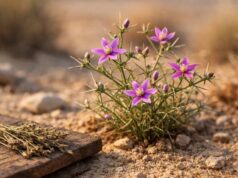
Fuzzy Weed, here referring to Salvia leucophylla, is a soft-leaved, strongly aromatic California sage more commonly known as purple sage or San Luis purple sage. It belongs to the mint family and is recognized by its gray-white, felted foliage and lavender-purple flower spikes. While it is often celebrated as a drought-tolerant native shrub, it also has a quieter medicinal story. Traditional California plant use and contemporary Western herbal practice have treated purple sage as an aromatic herb for mouth and throat rinses, gentle steam inhalations, sore-muscle foot soaks, and occasional teas aimed at colds, heavy mucus, or external cleansing.
What makes the plant especially interesting is its chemistry. Salvia leucophylla is rich in volatile monoterpenes, especially camphor and 1,8-cineole, along with other aromatic compounds that help explain its penetrating scent and its traditional use for clearing, drying, and freshening. At the same time, this is not a well-studied clinical herb. Most hard data center on essential-oil composition and plant-to-plant effects, not human trials. That means the best guide is a careful one: useful for understanding realistic benefits, but clear about dosage uncertainty, essential-oil cautions, and the limits of the evidence.
Key Takeaways
- Fuzzy Weed is best understood as an aromatic sage for gentle topical, throat-rinse, and steam-support uses rather than a proven internal medicine.
- Its main volatile compounds include camphor and 1,8-cineole, which help explain its clearing scent and traditional “drying” reputation.
- A cautious infusion often starts around 1–2 g dried leaf in 150–250 mL hot water, once or twice daily.
- Concentrated essential oil should not be swallowed and may irritate sensitive skin or airways.
- Pregnant or breastfeeding people, young children, and people with seizure disorders should generally avoid unsupervised medicinal use.
Table of Contents
- What is Fuzzy Weed
- Key compounds and medicinal properties
- What can it help with
- How is Fuzzy Weed used
- How much Fuzzy Weed per day
- Side effects, interactions, and who should avoid it
- What does the research actually show
What is Fuzzy Weed
Fuzzy Weed is not the name most botanists or California native-plant growers use for Salvia leucophylla, which is better known as purple sage, gray sage, or San Luis purple sage. Still, the nickname makes sense. The leaves are pale, wrinkled, and densely hairy, giving the plant a soft, felted texture that looks almost dusted in silver. That fuzzy surface is more than cosmetic. It helps the shrub handle heat, wind, and drought in the coastal sage scrub and chaparral landscapes where it naturally grows.
Botanically, Salvia leucophylla is an evergreen shrub in the mint family, Lamiaceae. It is native to coastal and inland Southern California and northern Baja California, where it grows on dry slopes, open scrub, and gravelly soils. In garden settings it is often chosen for pollinators and low-water landscapes. In herbal terms, though, its value comes from its aromatic leaves and flowering tops.
The plant’s scent is its first clue to its medicinal personality. When the leaves are rubbed, they release a sharp, resinous fragrance that is less sweet than culinary sage and more penetrating than many garden salvias. This aroma reflects a chemistry rich in volatile compounds that can feel clearing, drying, and stimulating to the senses. That profile makes Salvia leucophylla more comparable to the aromatic California sages than to a gentle demulcent herb.
It also helps to place this species in context. Unlike white sage, which has a much stronger ceremonial and ethnobotanical literature, Salvia leucophylla has a more modest medicinal record in the published literature. It appears in regional herbal practice, educational materials on California native plants, and some traditional-use notes, but it has not been studied in the kind of human clinical detail that would support confident therapeutic claims.
The medicinal part is usually the leaf, though aerial parts are also relevant in aromatic preparations. Contemporary use tends to focus on teas, gargles, foot soaks, steam inhalations, and occasionally topical rinses. Essential-oil discussion exists because the plant is chemically rich in monoterpenes, but this should not be mistaken for a green light to treat it as a casual ingestible oil.
The most useful way to think about Fuzzy Weed is as a regional aromatic sage with a traditional support role. It is not a modern mainstream supplement, not a standardized pharmaceutical herb, and not a plant whose benefits are fully settled. But it is a genuine medicinal shrub with a distinctive chemistry, a long-standing local reputation, and a narrower, more careful place in herbal use than the title “sage” sometimes suggests.
Key compounds and medicinal properties
Most of what is known with confidence about Salvia leucophylla comes from its volatile chemistry. Published work repeatedly points to a monoterpene-rich profile, especially camphor and 1,8-cineole, with additional contributions from beta-pinene, alpha-pinene, camphene, and other aromatic compounds. These are the plant’s best-documented “key ingredients,” and they largely explain why Fuzzy Weed smells so penetrating and feels so different from sweeter, softer sages.
The major compounds most often associated with Salvia leucophylla include:
- Camphor
- 1,8-cineole
- Beta-pinene
- Alpha-pinene
- Camphene
This list matters because each compound points toward a slightly different medicinal logic. Camphor is associated with a cooling, penetrating, and strongly aromatic character. 1,8-cineole is common in herbs used for freshness, airflow, and clearing steam preparations. The pinenes add further resinous sharpness and may contribute to the plant’s traditional reputation as an herb that “opens” or “dries” rather than softens and moistens.
One of the most original things about Salvia leucophylla is that the published literature does not focus on the same kinds of medicinal questions seen with better-known sages. Instead of large studies on cognition, digestion, or menopausal symptoms, the species is famous in plant science for the “Salvia phenomenon,” a classic example of allelopathy. In simple terms, its volatile compounds affect nearby plants. That is not a human health effect, but it is still highly relevant because it confirms how biologically active the monoterpenes are.
From an herbal perspective, that chemistry suggests several medicinal properties that are plausible, though not equally proven:
- Aromatic and clearing
- Mildly antimicrobial in the broad sage tradition
- Traditionally drying to excess secretions
- Topically freshening and cleansing
- Potentially soothing in warm rinses or steam use
- Possibly mildly antioxidant or anti-inflammatory by family pattern, though far less documented here than in common sage
The caution is important. With many medicinal plants, the chemical story and the therapeutic story develop together. With Fuzzy Weed, the chemical story is much stronger than the clinical one. We know more about the leaf volatiles than we do about consistent human outcomes.
That is why comparisons must be made carefully. Aromatic monoterpene-rich herbs such as rosemary are often discussed for cognitive, circulatory, and antioxidant uses because their broader clinical and phytochemical literature is deeper. Salvia leucophylla shares some of the aromatic logic, but not the same evidence base.
So when people ask about “medicinal properties,” the honest answer is this: Fuzzy Weed appears to be an active aromatic sage with a chemistry that supports traditional external, respiratory, and cleansing uses. But the plant’s key compounds tell us more clearly what it is likely to do than modern clinical studies do. That makes careful interpretation essential.
What can it help with
The realistic benefits of Fuzzy Weed are narrower than the name “sage” might lead people to expect. It is not a proven all-purpose medicinal sage, and it should not inherit every claim made for Salvia officinalis or other better-studied species. Its most defensible uses are aromatic, topical, and supportive.
A reasonable place to begin is with mouth, throat, and upper-respiratory comfort. Aromatic sages have long been used as warm rinses, steam herbs, and teas for colds, thick mucus, throat irritation, and that feeling of “stuck” congestion. Because Salvia leucophylla is rich in camphor and 1,8-cineole, it fits that broad pattern well. A mild infusion used as a gargle or inhaled as warm steam makes more sense than assuming the plant is a strong internal remedy.
A second practical area is external cleansing and soothing. Regional native-plant teaching materials describe purple sage among California salvias used in simple rinses or herbal washes. In real-world terms, that points toward low-risk external applications: mouth rinses, skin rinses, or foot soaks used for freshness, mild soreness, or a sense of cleansing rather than for treating serious infection.
A third area is body-comfort support through hot or warm preparations. Some contemporary California herbal traditions use purple sage in foot soaks and warming washes for generalized achiness or heaviness. This is believable not because Fuzzy Weed has been proven as a pain herb in trials, but because aromatic heat-based preparations can have a modest soothing effect even when the pharmacology is not dramatic.
The key is to keep expectations realistic:
- It may help a sore or coated-feeling throat when used as a rinse.
- It may feel clearing in a steam bowl during a mild cold.
- It may freshen and comfort the skin in diluted external use.
- It may contribute to a warming foot soak for everyday aches.
What it should not be expected to do:
- Treat pneumonia, asthma flares, or serious sinus infections
- Replace dental care for gum disease or mouth infections
- Serve as a proven anti-inflammatory supplement
- Act as a standardized cognitive or memory herb
- Solve chronic pain conditions
Readers who want a gentler, better-studied tea herb for general comfort usually do better with chamomile or another softer aromatic. Fuzzy Weed is sharper, more resinous, and more niche. Its likely value lies in small, purposeful uses rather than in daily wellness routines.
There is also an original point worth making here: the plant’s strongest public scientific reputation is ecological, not clinical. That alone is a reminder not to overmarket it. A chemically forceful plant can be interesting without being broadly appropriate as medicine.
In practical herbal terms, Fuzzy Weed helps most when the goal is mild and local: rinse, steam, wash, soak, or occasional tea. The bigger the promise, the less convincing the evidence becomes. That is not a weakness of the herb. It is simply the honest boundary of what can be said at present.
How is Fuzzy Weed used
Fuzzy Weed is best used in ways that respect both its aromatic strength and its limited clinical evidence. In practice, that means simple preparations tend to make more sense than concentrated ones. The plant’s leaves are the main medicinal part, and most uses revolve around getting their volatile compounds into water, air, or diluted topical preparations.
The most practical forms are:
- Mild infusion or tea
- Gargle or mouth rinse
- Steam inhalation
- Foot soak
- Diluted external rinse
- Dried aromatic herb in sachets or household use
A light infusion is the easiest starting point. Because the plant is pungent and resinous, it is usually better as a short-steeped tea or rinse than as a long-boiled decoction. People interested in internal use often do not need a strong cup. A moderate infusion can be sipped in small amounts, but in many cases it is more convincing as a gargle or warm rinse than as a beverage taken several times a day.
Steam inhalation is another logical form. Warm water releases the plant’s aroma quickly, and that volatile fraction is the part of the herb that has been studied most clearly. This is one of the few uses where the chemistry and traditional logic line up cleanly. A brief steam session can feel clearing without requiring large internal intake.
Foot soaks are more traditional than modern supplement culture tends to notice, but they make sense here. They are a low-risk way to use a strongly aromatic herb, and they align with the way purple sage is sometimes discussed in California native-plant medicine. Even if the effect is partly sensory, that does not make it trivial. Many aromatic herbs work best when warmth, scent, and contact reinforce each other.
External rinses are also reasonable, as long as the preparation is mild and the skin is intact. This is not a plant to apply as a harsh concentrate to broken skin, eyes, or deep wounds.
It helps to compare Fuzzy Weed with a better-known aromatic herb such as English lavender. Both can be used in steam, bath, and external preparations, but lavender is usually gentler and more relaxation-oriented. Fuzzy Weed is more bracing and “sage-like,” with a profile that feels drier, sharper, and less forgiving if overdone.
A few use rules are worth following:
- Favor weak to moderate infusions over concentrated extracts.
- Use external and aromatic forms before experimenting with regular oral intake.
- Avoid swallowing essential oil or homemade concentrates.
- Keep the plant single-herb at first so its effect is easier to judge.
- Treat ceremonial or smoke use with cultural awareness and practical caution, especially indoors.
The broader lesson is that this herb is most useful when used simply. Fuzzy Weed does not need elaborate formulas to be interesting. It works best as a carefully prepared aromatic sage, not as an aggressive “more is better” remedy.
How much Fuzzy Weed per day
There is no well-established modern clinical dosage for Salvia leucophylla. That is the single most important dosing fact. If someone is looking for a species with validated human dosing, this is not it. Most practical guidance comes from traditional sage-style use, aromatic logic, and cautious extrapolation rather than controlled trials.
For a mild infusion, a conservative starting range is about 1 to 2 g of dried leaf or flowering aerial parts in 150 to 250 mL of hot water. One cup once or twice daily is a reasonable upper frame for a short trial. Some people may use less, especially if the herb is being taken mainly for throat rinsing or aromatic sipping rather than as a full medicinal tea.
For a gargle or rinse, the same infusion can be used warm rather than swallowed. This is often the better choice because it targets the area of interest while limiting total exposure. If the goal is throat comfort or mouth freshness, there is little reason to force large oral intake.
For steam inhalation, exact dose matters less than concentration and tolerance. A small handful of fresh leaves or a light pinch of dried herb in hot water is enough to release the scent. Stronger is not always better. The volatile compounds are potent enough that heavy inhalation may feel irritating rather than helpful.
For foot soaks, a somewhat larger quantity of herb can be used because the exposure is external. Even here, a moderate preparation is usually sufficient.
What dosing should be avoided?
- Repeated large cups across the entire day
- Strong homemade extracts without clear ratios
- Oral use of essential oil
- Combining Fuzzy Weed tea, steam, and concentrated topical forms all at once
A sensible dosing pattern looks like this:
- Start with one mild preparation.
- Use it for a clear purpose, such as a rinse, short tea trial, or steam.
- Stop if irritation, nausea, headache, or dizziness appears.
- Keep the trial brief unless guided by a knowledgeable practitioner.
This plant is not a good candidate for “maintenance dosing.” In other words, it makes more sense as a situational herb than as a daily tonic. That is one reason people who want a softer long-term aromatic tea often prefer lemon balm or similarly gentle herbs.
Another useful insight is that dose is inseparable from form. A weak leaf infusion, a vapor-rich steam bowl, and an essential oil are not interchangeable versions of the same thing. The oil, if used at all, belongs in a very cautious category and should not be treated as a tea equivalent.
The safest conclusion is simple: because no modern standardized dose exists, Fuzzy Weed should be used lightly, for short periods, and in the mildest form that meets the goal. That approach respects both the plant’s aromatic power and the present limits of the evidence.
Side effects, interactions, and who should avoid it
Fuzzy Weed deserves more caution than its pleasant California-sage identity might suggest. The main reason is not a long list of documented poisonings. It is the combination of strong volatile chemistry, limited human safety data, and the tendency people have to assume that native aromatic plants are automatically gentle.
The most likely problems are irritation-related:
- Stomach upset from overly strong tea
- Throat or mouth irritation from concentrated rinses
- Headache or dizziness from intense inhalation
- Skin irritation from strong topical preparations
- Fragrance-triggered discomfort in scent-sensitive people
The biggest safety concern involves concentrated essential oil. Camphor- and cineole-rich oils can be much harsher than a leaf infusion. They should not be swallowed casually, used undiluted on sensitive skin, or treated like a kitchen ingredient. Even when a plant is traditionally medicinal, its concentrated oil can behave like a much stronger substance.
Certain groups should be especially cautious or avoid unsupervised use:
- Pregnant or breastfeeding people
- Infants and young children
- People with seizure disorders
- People with significant asthma or scent-triggered bronchospasm
- People with very reactive skin
- Anyone already using multiple strong essential oils
Drug-interaction data for Salvia leucophylla are limited, but a few practical cautions follow from its chemistry. If a preparation feels stimulating, drying, or strongly aromatic, it may not combine well with other concentrated aromatic oils. It also makes sense to be careful with sedatives, seizure medicines, and products used around the airways, even though species-specific interaction trials are lacking.
Topical use should stay simple. Patch-testing is wise. Eyes, inner ears, mucous membranes, and deep wounds are not the place for improvised purple-sage experiments. This matters especially because folk herb practices sometimes drift into home procedures that sound natural but are poorly controlled in strength and cleanliness.
There is also a difference between using a leaf infusion and using a commercial essential oil. A mild tea or rinse occupies the lower-risk end of the spectrum. An oil occupies the higher-risk end. That distinction is essential for safe decision-making.
For readers mainly seeking topical freshness or surface cleansing, tea tree is a more standardized example of an aromatic topical herb, though it also requires careful dilution and is not risk-free. The comparison is useful because it shows how easily essential-oil use can outrun common sense.
The final safety point is one of evidence, not drama. Because human data are thin, the safest use is cautious use. Fuzzy Weed may be suitable for short, mild, purpose-specific applications in healthy adults. It is not a good choice for heavy, repeated, concentrated, or experimental use. When the science is limited, restraint is part of good herbal practice.
What does the research actually show
The research on Salvia leucophylla is much stronger in plant chemistry and ecology than in clinical medicine. That is the most important truth to carry through this entire article. If someone searches the herb expecting human trials on sore throats, coughs, foot soaks, memory, or inflammation, they will find very little. If they search for work on monoterpenes, essential-oil behavior, and allelopathy, they will find much more.
This imbalance shapes everything else. The species is one of the classic examples used to explain plant-produced volatile inhibitors, especially camphor and 1,8-cineole. Several important studies showed that these monoterpenes affect neighboring plants by inhibiting germination and root-cell activity. That does not tell us how well the herb works in a human throat rinse, but it does confirm that the plant is chemically active in a serious, measurable way.
The strongest research-supported points are:
- Salvia leucophylla is an aromatic shrub rich in monoterpenes.
- Camphor and 1,8-cineole are major documented volatile constituents.
- Its volatiles can exert biologically meaningful effects.
- The species is famous scientifically for allelopathy, not for clinical herbal trials.
The weaker or unresolved points are just as important:
- Human efficacy studies are essentially absent.
- Standardized medicinal dosing is not established.
- Safety data in the form most people would use are limited.
- Many claimed “health benefits” are inferred from traditional use, broader sage practice, or compound logic rather than species-specific clinical proof.
That means an evidence-based article has to be modest. It is fair to say the herb has plausible aromatic, topical, and supportive uses. It is fair to say its chemistry helps explain why people have used it in rinses, steams, and soaks. It is not fair to present it as a clinically proven remedy for respiratory disease, chronic pain, mouth infection, or cognitive decline.
This is where comparison matters. If someone wants an inflammation herb with a clearer body of human evidence, boswellia is easier to defend. Fuzzy Weed belongs in a more exploratory category: traditional, aromatic, interesting, but not conclusively tested.
There is also an originality point here that gets missed in many herb write-ups. Sometimes a plant’s strongest evidence is not directly therapeutic, but still useful. In this case, the monoterpene literature tells us that the plant’s active compounds are potent enough to alter biological systems. That supports caution in use even while it falls short of clinical endorsement.
So what does the research actually say? It says Fuzzy Weed is a real medicinal candidate, not an invented folk remedy. It says the plant’s volatile chemistry is distinctive and significant. It also says that marketing claims should stay humble. The current evidence supports careful aromatic and traditional use far more than it supports bold promises. For most readers, that is exactly the kind of clarity that makes a herbal guide genuinely useful.
References
- Monoterpenes of Salvia leucophylla 2012 (Review)
- Allelopathic effects of volatile monoterpenoids produced by Salvia leucophylla: Inhibition of cell proliferation and DNA synthesis in the root apical meristem of Brassica campestris seedlings 2005
- Chemical Composition and Antigerminative Activity of the Essential Oils from Five Salvia Species 2010
- Salvia leucophylla Greene – Joshua Tree National Park (U.S. National Park Service) 2015
Disclaimer
This article is for educational purposes only and does not replace medical advice, diagnosis, or treatment. Fuzzy Weed, or Salvia leucophylla, is a traditional aromatic herb with limited direct human clinical evidence. Do not use it to self-treat ongoing respiratory symptoms, significant mouth or throat infections, chronic pain, or neurologic conditions. Speak with a qualified healthcare professional before medicinal use, especially if you are pregnant, breastfeeding, taking prescription medicines, or considering essential-oil use.
If this article was helpful, please share it on Facebook, X, or your preferred platform.