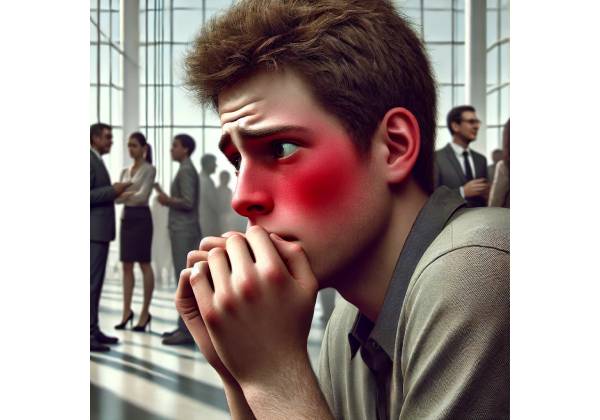
Blushing is a normal human response. It can appear in moments of embarrassment, attention, praise, conflict, or sudden self-consciousness. For someone with erythrophobia, however, blushing is not a passing inconvenience. It becomes the center of intense fear. The person may dread meetings, conversations, dating, public speaking, or even casual eye contact because of the possibility that their face will turn red and others will notice. That fear can create a painful cycle: anxiety increases blushing, and blushing increases anxiety.
Erythrophobia is usually understood as a fear of blushing that overlaps strongly with social anxiety and fear of negative evaluation. It can be deeply distressing, but it is also treatable. This article explains what erythrophobia is, how it shows up, why it develops, how clinicians assess it, and which treatment and self-management strategies are most helpful.
Table of Contents
- What Erythrophobia Is
- Signs and Symptoms
- Causes and Risk Factors
- How Diagnosis Works
- Daily Life and Complications
- Treatment Options
- Management and When to Seek Help
What Erythrophobia Is
Erythrophobia is the intense fear of blushing. In everyday terms, it means a person becomes highly anxious about their face turning red, warm, or visibly flushed in front of other people. The fear is usually not about the skin change alone. It is about what the blushing might seem to mean: embarrassment, weakness, lack of confidence, loss of control, exposure, or social failure. For many people, the most distressing part is the belief that others will notice and judge them.
Clinically, erythrophobia is not usually treated as a completely separate mental disorder with its own standalone diagnostic category. It is more often understood as part of social anxiety disorder, or as a prominent symptom cluster within social fear. That matters because the core problem is often not the blushing itself, but the anticipated social consequences of blushing.
The fear can become self-reinforcing in a very specific way:
- A social situation begins.
- The person worries that they might blush.
- Self-monitoring increases.
- Anxiety rises.
- Blushing becomes more likely or feels more noticeable.
- The person interprets this as proof that something is going wrong.
This loop can make even minor facial warmth feel dramatic. Some people do blush visibly. Others mainly experience the sensation of blushing and assume it must be obvious to everyone else. Either way, the distress can be real and intense.
Common situations that may trigger erythrophobia include:
- speaking in meetings
- being introduced to new people
- answering questions in class
- dating or flirting
- eating while being watched
- receiving praise or criticism
- disagreeing with someone
- being the center of attention
A useful distinction is the difference between normal self-consciousness and phobic fear. Many people dislike blushing. Erythrophobia goes further. The fear becomes persistent, hard to control, and disruptive enough to change behavior. People may avoid speaking, stay silent when they have ideas, decline promotions, skip social events, or organize their whole day around reducing the chance of turning red.
It is also important to separate erythrophobia from medical causes of facial redness. Rosacea, menopause, heat, alcohol, some medications, thyroid problems, and skin sensitivity can all cause flushing. A person may have one of those conditions and also develop a fear of blushing, but the psychological problem lies in the intense anxiety and avoidance built around the symptom.
Signs and Symptoms
The symptoms of erythrophobia often involve both fear of blushing and fear of being seen blushing. That combination can make the condition feel especially painful, because the body becomes both the source of anxiety and the thing the person believes others are judging.
Physical symptoms may include:
- sudden facial warmth
- visible flushing or redness
- rapid heartbeat
- sweating
- shaking
- dry mouth
- nausea
- tightness in the chest or throat
- dizziness
- a sense of mental blankness during social moments
For some people, the blushing is brief and mild but feels catastrophic. For others, it is more obvious and lasts longer, especially under stress. The important point is that the distress usually comes less from the biology of blushing and more from the meaning attached to it.
Thought patterns are often intense and repetitive. Common examples include:
- “Everyone can see it.”
- “They think I am weak or strange.”
- “I am losing control of my face.”
- “Once I start blushing, I will not recover.”
- “People will remember this.”
- “If I blush, I will humiliate myself.”
These thoughts can appear so quickly that the person feels ambushed. Even before a conversation begins, they may scan for signs of heat in the cheeks or imagine what others are about to notice.
Behavioral symptoms are often the clearest sign that erythrophobia has become clinically significant. A person may:
- avoid eye contact
- keep conversations short
- sit at the back of a room
- wear makeup or certain clothing to conceal redness
- avoid warm rooms, bright lights, or close seating
- rehearse sentences excessively before speaking
- skip presentations, dates, interviews, or group meals
- leave situations early after feeling their face heat up
Children and teenagers may show the problem in subtler ways. They may become quiet in class, refuse oral presentations, dread being called on, or seem oppositional when the real problem is fear of attention and blushing.
Symptoms can vary by severity. Mild cases cause discomfort in selected situations. Moderate cases lead to regular avoidance and distress. Severe cases can produce panic-like episodes and major disruption in school, work, relationships, and self-esteem.
One especially difficult feature is anticipatory anxiety. A person may start worrying hours or days before an event, not only about what they will say, but about whether they will blush. This can make the fear feel constant even when no social event is happening. Over time, the person may begin to fear the fear itself, which keeps the cycle active.
Causes and Risk Factors
Erythrophobia usually develops through a mix of temperament, learning, social experience, and reinforcement. There is rarely one simple cause. In some people, the fear starts after a specific humiliating moment. In others, it grows slowly out of a broader pattern of social anxiety and self-consciousness.
A common starting point is a memorable episode of blushing that felt embarrassing or exposed. This may involve:
- being teased about turning red
- blushing during a presentation
- feeling singled out in class
- becoming flushed during conflict or romantic attention
- having someone comment on facial redness in front of others
When a moment like this feels emotionally intense, the brain may store it as a warning. Later, similar situations can reactivate the same alarm response. The person then starts watching for any sign that the blushing will return.
Certain personality and developmental traits can make erythrophobia more likely:
- high self-consciousness
- behavioral inhibition in childhood
- sensitivity to criticism
- perfectionism
- strong fear of embarrassment
- a tendency toward catastrophic thinking
- family history of anxiety disorders
Social learning also matters. A child or teenager who grows up in an environment with heavy criticism, teasing, or strong pressure to appear composed may become especially alert to visible signs of emotion. In that context, blushing can feel like proof of failure rather than a normal human response.
Another important factor is self-focused attention. Instead of staying engaged with the conversation or task, the person shifts inward and monitors their face, temperature, heartbeat, and perceived appearance. That internal surveillance increases anxiety and often makes blushing more likely. It also makes the person less able to notice that others may be reacting neutrally or not paying much attention at all.
Several factors can maintain the fear once it begins:
- avoiding feared situations
- using concealment strategies all the time
- seeking constant reassurance
- replaying social interactions afterward
- overestimating how obvious or memorable the blushing was
- assuming others interpret blushing negatively
Medical or physical triggers can complicate the picture. Some people flush easily because of rosacea, hormonal changes, certain medications, alcohol, heat, spicy food, or exercise. When visible redness becomes frequent, a person who is already socially anxious may become more afraid of being seen blushing. In those cases, the physical tendency and the psychological fear may reinforce each other.
Erythrophobia does not mean a person is vain, weak, or overly dramatic. It reflects an anxious threat system that has become tightly linked to social visibility. The person is not simply disliking blush; they are bracing against what they believe blush will cost them socially. That distinction is important, because treatment needs to address not just redness, but fear, attention, meaning, and avoidance.
How Diagnosis Works
Diagnosis begins with a detailed clinical assessment. There is no blood test or scan that identifies erythrophobia. A qualified clinician listens for the pattern: fear of blushing, fear of negative judgment, avoidance of social situations, physical anxiety symptoms, and the degree to which these problems interfere with daily life.
Because erythrophobia is often tied closely to social anxiety, the diagnostic process usually asks whether the person meets criteria for social anxiety disorder rather than for a separate phobia. The key questions often include:
- What situations trigger the fear?
- Is the fear focused on blushing itself, or on being judged because of it?
- How often does the person avoid situations because of this fear?
- How much distress or impairment is it causing?
- How long has the pattern been present?
- Could another mental health or medical condition explain it better?
A clinician will often explore the full cycle of symptoms:
- anticipatory worry before events
- self-monitoring during events
- blushing or perceived blushing
- safety behaviors, such as hiding, silence, or concealment
- rumination after the event
That full map helps distinguish erythrophobia from ordinary embarrassment.
Assessment also includes differential diagnosis, because not every case of facial redness with distress is a fear disorder. A clinician may consider whether the person’s symptoms are better explained by:
- social anxiety disorder without a specific blushing focus
- panic disorder
- body dysmorphic concerns
- obsessive-compulsive symptoms involving checking or reassurance
- trauma-related symptoms
- medical causes of flushing or facial redness
Possible medical contributors to facial flushing may include rosacea, menopausal vasomotor symptoms, fever, thyroid disease, medication effects, alcohol use, and certain skin or vascular conditions. If flushing is frequent, intense, or medically suspicious, it may be appropriate to involve a primary care clinician or dermatologist.
Structured interviews and rating scales can also help. Depending on age and setting, clinicians may use standardized measures of social anxiety, avoidance, and impairment. For children and adolescents, multiple informants can matter. A parent may notice school refusal or avoidance patterns that a young person minimizes, while the child may describe internal shame the family has not fully seen.
A useful diagnostic clue is functional impact. Discomfort alone is not enough. The problem becomes clinically important when it affects education, work, relationships, performance, confidence, or normal social development. For example, a student who refuses presentations, an adult who avoids meetings, or a person who turns down dating and career opportunities because of fear of blushing is showing more than simple shyness.
A thoughtful diagnosis can be relieving. Many people have spent years believing they are uniquely flawed or unusually visible. Naming the pattern often helps them see that the problem is understandable, common in anxiety care, and responsive to treatment.
Daily Life and Complications
Erythrophobia can narrow life in quiet but powerful ways. Because blushing is tied to ordinary human interaction, the person may not be avoiding one rare object or place. They may be avoiding the most ordinary forms of contact: speaking up, being noticed, receiving attention, asking questions, meeting new people, or expressing disagreement.
This can affect daily life in several domains.
At school or work, the person may:
- avoid presentations
- stay silent in meetings
- decline leadership roles
- resist job interviews
- avoid asking for help
- dread performance reviews or introductions
In relationships, they may:
- avoid dating
- hide feelings
- pull back from conflict
- misread neutral attention as scrutiny
- worry excessively during simple conversations
- decline invitations where they might become the focus
In everyday routines, they may choose cooler rooms, sit near exits, avoid crowded places, or carefully plan clothing, makeup, and seating to lower the chance that anyone notices redness. These adjustments can look small from the outside, but together they can become exhausting.
One major complication is chronic self-monitoring. The person spends so much time checking whether their face feels hot, whether others are looking, and whether they appear composed that they stop participating naturally in the moment. This can harm concentration, memory, and social connection. Ironically, the effort to avoid embarrassment can make conversations feel more awkward and less fluent.
Another complication is post-event rumination. After an interaction, a person may replay it in detail:
- Did they see me blush?
- Was my face red the whole time?
- Did I sound nervous?
- Will they think about it later?
This replay can last for hours or days and makes future situations feel even more threatening.
Over time, erythrophobia can contribute to:
- reduced confidence
- social withdrawal
- loneliness
- missed educational opportunities
- stalled career development
- increased general anxiety
- depressed mood
- dependence on concealment or avoidance habits
Children and adolescents may be especially vulnerable because social attention is intense during those years. Fear of blushing can interfere with participation, friendships, classroom learning, and normal developmental risks such as trying new activities or speaking in front of peers.
Some people also become trapped in a cycle of attempted control. They may overuse mirror checking, cool compresses, makeup, strategic hair styling, posture changes, or rigid scripts for conversation. These strategies are understandable, but if they become constant they can reinforce the message that blushing would be intolerable if it happened openly.
The complication is not simply blushing more. It is living smaller. When a person begins organizing their education, work, friendships, and identity around avoiding facial redness, the cost becomes significant. That is why treatment aims not only to reduce symptoms, but to restore freedom in daily life.
Treatment Options
The most effective treatment for erythrophobia is usually cognitive behavioral therapy, especially when it includes work on exposure, attention, beliefs about social judgment, and safety behaviors. Because the fear of blushing is so often tied to social anxiety, treatment needs to address the entire loop rather than only the skin response.
A good treatment plan often includes several parts.
1. Psychoeducation
The person learns how blushing works, how anxiety amplifies it, and why attempts to suppress it often make it feel worse. Understanding the cycle can reduce shame and make symptoms feel less mysterious.
2. Cognitive work
Therapy helps identify beliefs such as:
- “Blushing means I am weak.”
- “People will judge me harshly if they see it.”
- “If I blush, the situation is ruined.”
- “Everyone notices and remembers it.”
These beliefs are not challenged with empty reassurance. Instead, therapy tests them against evidence, social reality, and actual experience.
3. Attention training
Many people with erythrophobia focus intensely on their face and internal sensations. Treatment often teaches a shift away from self-monitoring and back toward the conversation, the task, or the other person. This can reduce the sense of being trapped inside one’s own physiological reaction.
4. Exposure
Exposure-based work is central. The goal is not to guarantee that blushing never happens. It is to learn that the person can tolerate the possibility of blushing, remain present, and discover that the feared social consequences are often exaggerated.
Exposure tasks may include:
- making brief eye contact
- asking a question in a group
- initiating conversation
- speaking without over-rehearsing
- entering situations where attention is possible
- dropping concealment strategies gradually
Some clinicians also use behavioral experiments, video feedback, imagery work, or task concentration training. These methods can help correct distorted assumptions about how visible or socially damaging blushing really is.
Medication may help in some cases, especially when erythrophobia occurs as part of broader social anxiety. For example, an SSRI may be considered when symptoms are severe, persistent, or accompanied by wider anxiety or depression. Medication is usually not the full answer on its own, because it does not automatically change avoidance patterns or distorted beliefs.
Treatment may also need coordination with medical care when flushing has a physical contributor such as rosacea or medication side effects. Addressing both the bodily trigger and the fear can be more effective than treating either one alone.
The overall aim is realistic, not perfectionistic. Success does not mean never blushing again. It means being able to participate in work, relationships, and everyday life without the fear of blushing controlling those choices.
Management and When to Seek Help
Between formal treatment sessions, and sometimes before therapy even begins, self-management can make a meaningful difference. The most useful approach is usually steady, realistic, and non-punitive. Erythrophobia tends to worsen when a person fights their body aggressively or treats every social moment like a test they must pass flawlessly.
Helpful day-to-day strategies include:
- reducing excessive mirror checking
- noticing and naming anticipatory thoughts early
- practicing outward attention during conversations
- limiting over-rehearsal before ordinary interactions
- using slow breathing to settle the body without turning it into a hidden ritual
- keeping a record of avoided situations and small approach goals
- reducing alcohol-based coping, which may worsen anxiety over time
It can also help to separate practical coping from avoidance disguised as coping. Practical coping supports participation. Avoidance shrinks it.
Examples of practical coping:
- arriving a little early to settle into a room
- preparing one or two points for a meeting
- choosing breathable clothing for comfort
- learning a clear sentence to begin speaking
Examples of avoidance that can quietly maintain the fear:
- refusing all attention-related situations
- sitting only where escape feels easy
- covering the face constantly
- canceling plans whenever facial warmth is noticed
- depending on reassurance every time a social event approaches
A graded plan often works better than a dramatic one. Someone might begin by tolerating brief social attention, then asking one question in a meeting, then speaking a little longer, then attending an event without concealment habits they usually rely on. Progress is usually built through repetition.
Professional help is a good idea when:
- the fear has lasted for months
- the person is avoiding school, work, dating, or important conversations
- rumination and anticipatory anxiety are consuming time
- self-esteem is worsening
- panic symptoms occur
- symptoms are spreading into broader social anxiety
- depression or hopelessness is developing
Medical evaluation may also be appropriate when facial flushing is new, severe, painful, associated with other physical symptoms, or suggestive of a skin, hormonal, or medication-related cause.
Urgent help is needed if anxiety is accompanied by thoughts of self-harm, severe functional breakdown, dangerous substance use, or inability to manage basic responsibilities.
The outlook is often good. Erythrophobia can feel uniquely personal because the feared sign is visible and tied to emotion, but the mechanisms behind it are well recognized in anxiety treatment. People improve when they stop organizing life around concealment and begin testing the fear in structured ways. The turning point is often not the disappearance of blush. It is the moment blushing stops deciding what a person can do next.
References
- Treatment Options for Fear of Blushing 2020 (Review)
- Recent advances in the understanding and psychological treatment of social anxiety disorder 2023 (Review)
- The efficacy of psychotherapy for social anxiety disorder, a systematic review and meta-analysis 2024 (Systematic Review and Meta-analysis)
- Psychological interventions for social anxiety disorder in children and adolescents: A systematic review and network meta-analysis 2024 (Systematic Review and Network Meta-analysis)
- Social anxiety disorder: recognition, assessment and treatment 2013, reviewed 2024 (Guideline)
Disclaimer
This article is for educational purposes only and is not a substitute for diagnosis, medical advice, or mental health treatment. Persistent fear of blushing, facial redness, or social situations should be assessed by a qualified clinician, especially when symptoms interfere with school, work, relationships, or emotional well-being. If facial flushing is new or severe, or if there are thoughts of self-harm, seek prompt professional care.
If this article was helpful, please share it on Facebook, X, or another platform you prefer.