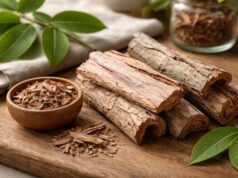
Ailanthus, also called “tree of heaven,” is a fast-growing deciduous tree best known today as an aggressive invasive plant in many regions. Yet long before it became a landscaping escapee, parts of the tree—especially the bark and root bark—were used in traditional medicine systems, most notably in East Asian herbal practice. Ailanthus is intensely bitter and astringent, qualities that hint at its traditional role in digestive complaints such as diarrhea-like urgency and dysentery-pattern bowel symptoms. Modern laboratory research has added another layer of interest by identifying distinctive bitter compounds (including quassinoids such as ailanthone) with antimicrobial, anti-inflammatory, and cell-signaling effects in preclinical studies.
That said, Ailanthus is not a casual “kitchen herb.” Its chemistry is potent, its quality can vary widely, and safe self-use is not straightforward. This guide explains what Ailanthus is, what’s inside it, what it may help with, how it is traditionally prepared, practical dosage context, and—most importantly—how to think about safety and evidence.
Essential Ailanthus Takeaways
- Traditionally used for acute diarrhea-pattern urgency and dysentery-style bowel symptoms, but human evidence is limited.
- Bitter bark constituents show antimicrobial and anti-inflammatory activity in lab studies, not a substitute for medical care.
- Typical traditional decoction range is about 6–9 g dried bark per day under qualified guidance.
- Avoid during pregnancy, breastfeeding, and in children due to safety uncertainty and potential toxicity.
Table of Contents
- What is Ailanthus?
- Key ingredients and actions
- Potential health benefits
- How Ailanthus is used
- How much and when to take
- Side effects and interactions
- What the evidence says
What is Ailanthus?
Ailanthus (Ailanthus altissima) is a tall, aromatic deciduous tree in the Simaroubaceae family. It has pinnate leaves (many leaflets on a single stem) and can produce large numbers of winged seeds that spread readily—one reason it colonizes disturbed land so aggressively. In everyday settings it’s most often discussed as an invasive species, but the same fast growth and rugged chemistry that help it dominate ecosystems also contribute to its traditional medicinal interest.
Which parts are used? Traditional practice has focused on the bark—often the root bark—rather than the leaves or seeds. In many East Asian materia medica traditions, the medicinal material is described as a bark used for its bitter, drying, and astringent qualities. You may also see references to preparations made from the trunk bark or root bark, sometimes used internally for bowel symptoms and externally as washes for irritated or weeping skin.
Why part selection matters
Plants do not distribute their chemicals evenly. In Ailanthus, bitter quassinoids and other bioactives can be more concentrated in bark and root tissues, which also means the risk profile changes depending on the part used and how it is prepared. Leaves and young shoots may contain different ratios of compounds and can be more irritating for some people. This is one reason traditional systems specify the plant part so carefully.
Identity and sourcing are not optional
Because Ailanthus is widespread in urban and roadside areas, “wild-harvested” material can be contaminated by heavy metals, pollutants, or herbicide residues used for control. It can also be misidentified with other trees that have compound leaves. For safety and consistency, any medicinal use should rely on correctly identified, professionally prepared material rather than casual foraging.
Key ingredients and actions
Ailanthus is chemically complex, but several compound groups show up repeatedly in research and traditional explanations of how it behaves in the body. The key theme is intense bitterness paired with astringency—a combination that can reduce secretions and tighten overly “leaky” tissue states, which aligns with traditional use in diarrhea-like conditions.
Quassinoids (including ailanthone)
Quassinoids are highly bitter compounds common in the Simaroubaceae family. Ailanthone is the best-known example from Ailanthus altissima. In laboratory studies, quassinoids have been shown to influence inflammatory signaling, microbial growth, and cell-cycle pathways. These effects help explain why researchers continue to explore Ailanthus-derived compounds—but they also highlight why dosing and safety need caution: potent bioactivity is not the same as proven benefit.
If you’re curious about the way bitter herbs are traditionally used to “wake up” digestion, compare the concept with classic bitter botanicals like traditional wormwood use and history—while remembering that similar taste does not mean identical safety.
Tannins and astringent polyphenols
Many astringent herbs rely on tannins—polyphenols that can bind proteins and create a tightening, drying sensation. In practice, tannins may:
- Reduce watery stool patterns by decreasing secretions and irritation
- Offer mild antimicrobial support by altering local conditions in the gut
- Interfere with absorption of certain medications if taken too close together
Astringency can be helpful when appropriate, but overuse may worsen constipation, contribute to dryness, or irritate sensitive stomachs.
Alkaloids, triterpenoids, and other secondary metabolites
Ailanthus bark and leaves contain additional classes of compounds that may contribute to observed effects in preclinical work, including alkaloids and triterpenoids. Depending on the extract, these may tilt the action toward antimicrobial, anti-inflammatory, or tissue-soothing effects. The challenge is that supplement products (when they exist) rarely disclose a clear standardization that predicts real-world outcomes.
Potential health benefits
When people search for Ailanthus “benefits,” they are usually looking for one of two things: traditional uses (what it was used for historically) or modern evidence (what it can reliably do today). With Ailanthus, the most responsible approach is to treat potential benefits as hypotheses with varying confidence, not guaranteed outcomes.
Digestive support for acute bowel urgency
Traditionally, Ailanthus bark has been used for diarrhea-pattern symptoms—especially when stools are frequent, urgent, or accompanied by a sense of irritation. The combination of bitter compounds and astringent tannins can make sense here: bitterness may modulate digestive secretions, while astringency can reduce excessive fluid loss and calm inflamed tissue.
Practical reality check:
- If diarrhea is severe, persistent, bloody, or accompanied by fever, dehydration, or significant pain, self-treatment is not appropriate.
- In many cases, the priority is hydration, electrolyte replacement, and identifying infections or inflammatory causes.
Microbial and inflammatory modulation (preclinical)
Extracts and isolated constituents from Ailanthus have shown antimicrobial and anti-inflammatory activity in laboratory settings. This is often discussed in the context of “dysentery-like” conditions in traditional texts. The key limitation is translation: a lab result does not automatically mean a safe, effective human therapy. Preparation method, dose, and person-to-person variability can completely change the outcome.
Traditional genitourinary and gynecologic uses
In some traditional frameworks, Ailanthus bark is described as drying and stabilizing, which is why it has been used for certain discharge patterns (for example, persistent watery discharge) or urinary-related discomfort patterns. For modern readers, it may be more helpful to think in terms of symptom clusters: excess secretions, irritation, and looseness.
For gentler, food-adjacent options people often consider for urinary comfort, see corn silk benefits and practical uses. It is not a substitute for evaluation, but it illustrates how different plants are chosen for different risk profiles.
Skin and external applications (traditional)
External washes made from bark or leaves have been used historically for itchy or weeping skin states. This may relate to tannins (astringency) and mild antimicrobial effects. However, Ailanthus can also trigger skin reactions in sensitive individuals, so patch-testing and professional guidance matter.
How Ailanthus is used
Ailanthus is not commonly found as an everyday over-the-counter herbal supplement in many countries. When it is used, it is often within traditional practice systems where the herb is combined, balanced, and matched to a specific pattern rather than used as a stand-alone product.
Common preparation forms
- Decoction of dried bark (traditional)
Bark is typically simmered as a decoction rather than steeped briefly like delicate leaves. This method pulls out bitter and astringent constituents more reliably. - Powdered bark (less common)
Some traditions describe powdered bark taken in small amounts. Powder can deliver a different chemical profile than water preparations because more constituents remain intact. - Extracts (variable quality)
Extracts can be alcohol-based, water-based, or mixed-solvent. Without clear standardization, two products can behave very differently even if the label looks similar. - External wash or compress
Prepared liquid may be applied topically for limited periods, with care taken to watch for irritation.
Quality control and “invasive plant” complications
Because Ailanthus is frequently targeted for chemical control, wild-harvesting carries unique risks:
- Trees near roads and industrial areas may accumulate pollutants.
- Stands treated with herbicides can leave residues in plant material.
- Misidentification is common among non-experts because many trees have compound leaves.
If a practitioner recommends Ailanthus, it is worth asking how the ingredient is sourced and tested.
When people use it in real life
In traditional settings, Ailanthus is often considered for short-term digestive flare patterns—especially when urgency and irritation dominate. It is less commonly positioned as a daily wellness tonic. Think of it as a targeted, time-limited tool that should have a clear stop point and a backup plan if symptoms do not improve quickly.
How much and when to take
Because Ailanthus is not a mainstream supplement and has meaningful safety considerations, dosage discussion should be framed as context, not a self-treatment recipe. Traditional dosing is typically guided by a clinician trained in the relevant system, who adjusts for constitution, symptom pattern, and whether the herb is used alone or in a formula.
Typical traditional ranges (context only)
Commonly cited traditional ranges for dried bark preparations include:
- Decoction: about 6–9 g dried bark per day, sometimes adjusted by the practitioner (occasionally higher in some traditions).
- Powder: about 1–3 g per day, usually divided.
These ranges are best understood as “starting points” used in structured traditions—not as a guarantee of safety for every person.
Timing and duration
- Timing: Often taken in divided doses, commonly with or after food if the bitterness causes nausea.
- Duration: Typically short-term (for example, a few days) for acute digestive patterns. Prolonged use increases the chance of dryness, constipation, irritation, or cumulative adverse effects.
Factors that change the dose decision
- Preparation strength: A concentrated extract is not interchangeable with dried bark.
- Symptom intensity: Severe symptoms require medical evaluation rather than dose escalation.
- Body size and sensitivity: Smaller or sensitive individuals may need lower exposure.
- Coexisting conditions: Liver disease, heart rhythm concerns, pregnancy, or complex medication use should shift decisions toward avoidance.
If your goal is general digestive “bitters” support rather than managing acute bowel urgency, a classic bitter herb with more established modern use—such as gentian guide and typical applications—may be a more practical conversation starter with a clinician.
Side effects and interactions
Safety is the most important part of any Ailanthus discussion. The same strong bitterness and bioactivity that make it interesting can also make it unpredictable—especially with self-directed use.
Common side effects
Possible side effects may include:
- Stomach upset: nausea, cramping, or a strong “bitter shock” response
- Constipation or excessive dryness: especially with higher doses or longer use
- Headache or lightheadedness: sometimes reported with very bitter botanicals, though individual sensitivity varies
- Skin irritation: especially with topical use or direct plant contact
Because Ailanthus can be allergenic for some people, any rash, wheezing, facial swelling, or throat tightness should be treated as urgent.
Medication and supplement interactions
High-quality interaction studies are limited, so the safest approach is conservative:
- Medication absorption: tannins and astringent polyphenols may bind or reduce absorption of certain oral medications. Separate Ailanthus and medications by several hours if a clinician is supervising use.
- Blood pressure and heart rhythm: because some plant constituents can be physiologically active, avoid use if you have known arrhythmias or are taking medications where small changes can matter (for example, narrow-therapeutic-index drugs), unless specifically supervised.
- Liver and kidney concerns: avoid use in significant liver or kidney disease unless a qualified clinician confirms appropriateness.
Who should avoid Ailanthus
Avoid Ailanthus unless a qualified clinician specifically recommends it if you are:
- Pregnant, trying to conceive, or breastfeeding
- A child or adolescent
- Managing chronic gastrointestinal disease (IBD, chronic infections, unexplained bleeding)
- Highly allergy-prone (especially with plant-contact dermatitis history)
- Taking complex medication regimens or immunosuppressive therapy
When in doubt, treat Ailanthus as a “specialist herb,” not a general wellness product.
What the evidence says
The evidence for Ailanthus sits in an uneven landscape: strong traditional claims, intriguing preclinical findings, and limited high-quality human research. Understanding that gap helps you make safer decisions.
Where evidence is strongest
- Phytochemistry and mechanisms: Modern studies have identified and characterized many Ailanthus compounds, including quassinoids such as ailanthone. These studies explain how an extract might influence inflammation, microbes, or cell signaling.
- Preclinical activity: In vitro and animal research has explored antimicrobial, anti-inflammatory, and cytotoxic effects (meaning effects on cell viability). These findings are scientifically valuable, but they are not proof of clinical benefit.
Where evidence is weak
- Human trials for specific conditions: Robust randomized controlled trials of Ailanthus bark for diarrhea, dysentery-pattern illness, or discharge patterns are not widely available in the modern literature.
- Standardized dosing and safety monitoring: Even when studies exist, preparations and dosing can vary so much that results are hard to generalize.
Why translation is difficult
- Different preparations produce different chemistry. A water decoction is not the same as an alcohol extract or isolated compound.
- Traditional “patterns” are not single diagnoses. A herb used for “damp-heat in the intestines” is not aimed at every cause of diarrhea.
- Invasive-plant context complicates sourcing. Material can be inconsistent, contaminated, or treated with chemicals in the environment.
A realistic bottom line
Ailanthus is best viewed as a plant with meaningful bioactivity and potentially narrow traditional indications, rather than a broadly safe, self-directed supplement. If you are dealing with acute digestive distress, prioritize hydration and medical assessment when needed. If you are exploring traditional herbal approaches, do so with professional guidance and a strong emphasis on identity, quality, and appropriate duration.
References
- Traditional uses, phytochemistry, and pharmacology of Ailanthus altissima (Mill.) Swingle bark: A comprehensive review – PubMed 2021 (Review)
- Ailanthone: A Comprehensive Review on Its Occurrence, Extraction, Properties and Applications – PubMed 2026 (Review)
- Invasive Growth of Ailanthus altissima Trees is Associated With a Low Diversity and High Specificity of the Seedling Fungal Endophyte Microbiome, and Leads to the Accumulation of a Potentially Allergenic Protein in the Roots – PMC 2022
- In Vitro Screening of Ecotoxic and Cytotoxic Activities of Ailanthus altissima Leaf Extract against Target and Non-Target Plant and Animal Cells – PMC 2024
- Phytochemical Profile and Antioxidant Properties of Invasive Ailanthus altissima (Mill.) Swingle: An Underexplored Bio-Resource – PMC 2025
Disclaimer
This article is for educational purposes only and does not provide medical advice, diagnosis, or treatment. Ailanthus (Ailanthus altissima) contains potent bioactive compounds and may pose safety risks, including allergic reactions and toxicity concerns, especially with incorrect identification, contaminated sourcing, or inappropriate dosing. Always consult a qualified healthcare professional before using any herb, particularly if you are pregnant or breastfeeding, have chronic health conditions, or take prescription medications. Seek urgent medical care for severe, persistent, or worsening symptoms.
If you found this guide useful, consider sharing it on Facebook, X (formerly Twitter), or your favorite platform to help others make informed, safety-first decisions.