The anti-SSA/Ro antibody test looks for autoantibodies linked most strongly to Sjögren disease and systemic lupus erythematosus. These antibodies may also appear in subacute cutaneous lupus, inflammatory myositis, systemic sclerosis, and other autoimmune conditions. “SSA” and “Ro” refer to an antibody system with two main targets, Ro60 and Ro52. Some laboratories report one combined SSA result, while others measure the two components separately.
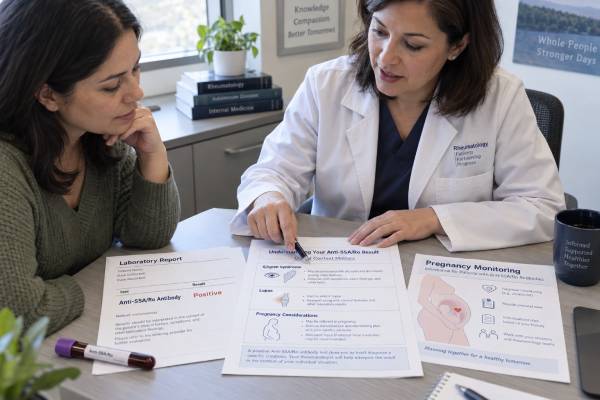
A positive result is an important clue, not a diagnosis. The meaning depends on dry-eye and dry-mouth symptoms, rashes, joint or organ findings, the ANA pattern, other antibodies, and objective tests of tear and saliva production. Anti-SSA/Ro also matters in pregnancy because maternal antibodies can cross the placenta and, rarely, cause neonatal lupus or fetal atrioventricular heart block. Most antibody-exposed pregnancies do not develop heart block, but early communication with rheumatology and maternal-fetal medicine allows appropriate medication review and fetal surveillance. Antibody levels are method-specific and should not be treated as a universal risk score.
- A positive anti-SSA/Ro result commonly supports Sjögren disease or lupus, but symptoms and objective testing are still required.
- Ro60 and Ro52 are different targets; separate results can provide more clinical context than a single combined SSA result.
- In a first anti-SSA-exposed pregnancy, fetal heart block occurs in roughly 2% of cases; risk is higher after a previously affected pregnancy.
- The test usually requires no fasting, and positive antibodies often remain detectable even when autoimmune disease is quiet.
- Pregnant or pregnancy-planning patients with anti-SSA/Ro should discuss hydroxychloroquine and fetal monitoring with their clinicians rather than stopping medicines on their own.
Table of Contents
- SSA, Ro60, and Ro52 Explained
- Conditions Linked to Anti-SSA/Ro
- Positive, Negative, and Borderline Results
- How the Test Fits Into a Sjögren Disease Evaluation
- Lupus, Skin Disease, and Other Systemic Features
- Pregnancy, Fetal Heart Block, and Neonatal Lupus
- Follow-Up Steps and Common Interpretation Mistakes
SSA, Ro60, and Ro52 Explained
Anti-SSA/Ro is a historical umbrella name rather than one single antibody. The two main antigen targets are:
- Ro60, a ribonucleoprotein-associated protein involved in RNA quality control
- Ro52, also called TRIM21, an intracellular protein involved in immune signaling and antibody handling
Ro52 and Ro60 are not parts of the same protein complex in the simple way their shared name implies. They became grouped historically because patient sera often reacted with both. Modern assays can separate them, and the distinction can matter.
Anti-Ro60 is strongly associated with Sjögren disease, lupus, subacute cutaneous lupus, and neonatal lupus risk. Anti-Ro52 occurs across a wider range of autoimmune diseases and may accompany myositis-specific antibodies, systemic sclerosis antibodies, autoimmune liver disease, or interstitial lung disease. Isolated anti-Ro52 is therefore less disease-specific than a classic Ro60-positive profile.
A report may use any of these labels:
- SSA antibody
- SS-A/Ro antibody
- Anti-Ro antibody
- Anti-Ro60 antibody
- Anti-Ro52 or anti-TRIM21 antibody
- SSA-52 and SSA-60
The laboratory method matters. Some ANA screening systems do not display Ro antibodies reliably, so a person can occasionally have clinically meaningful anti-SSA/Ro despite a negative or low-titer ANA by indirect immunofluorescence. When symptoms strongly suggest Sjögren disease or subacute cutaneous lupus, a clinician may order an ENA panel even if the ANA result is not strongly positive.
Anti-SSA/Ro is usually IgG measured in serum. The antibody is stable over time and is not normally used as a short-term treatment-response marker.
Conditions Linked to Anti-SSA/Ro
Anti-SSA/Ro appears in several autoimmune phenotypes. The antibody does not tell the clinician which one is present without the clinical picture.
| Clinical setting | How anti-SSA/Ro contributes | What else is needed |
|---|---|---|
| Sjögren disease | A major classification and diagnostic marker, often associated with systemic immune features | Dryness history, eye and salivary testing, examination, and sometimes lip biopsy |
| Systemic lupus erythematosus | Supports an autoimmune lupus profile, especially with photosensitive or subacute cutaneous disease | ANA, clinical criteria, blood counts, complement, urine testing, and other antibodies |
| Subacute cutaneous lupus | Frequently present and relevant to photosensitive annular or papulosquamous rashes | Dermatologic examination and sometimes skin biopsy |
| Inflammatory myositis or systemic sclerosis | Ro52 may modify the clinical phenotype and can accompany other disease-specific antibodies | Muscle, lung, skin, vascular, and organ-specific assessment |
| Pregnancy risk assessment | Identifies fetal exposure associated with neonatal lupus and atrioventricular block | Pregnancy history, medication planning, and maternal-fetal monitoring |
Some healthy people have anti-SSA/Ro without a diagnosed autoimmune disease. Others are identified during pregnancy after fetal rhythm abnormalities are found. A positive antibody can precede symptoms by years, but it cannot predict with certainty whether disease will develop.
The result should be interpreted with pretest probability. A strong anti-Ro60 result in someone with dry eyes, dental decay, parotid swelling, and inflammatory joint symptoms is more meaningful than an isolated weak anti-Ro52 band in a person with no autoimmune features.
Positive, Negative, and Borderline Results
There is no single anti-SSA/Ro normal range. Laboratories use enzyme immunoassay, chemiluminescence, multiplex bead testing, line immunoassay, immunoblot, or other platforms. Reports may give units per milliliter, an antibody index, signal intensity, or qualitative categories.
Positive result
A positive result means antibodies reacted with the SSA/Ro antigen used in that assay. It raises the probability of an autoimmune connective tissue disease but does not establish one by itself. The clinician should check whether the result is Ro60, Ro52, or both, and whether other autoantibodies are present.
A strong, reproducible anti-Ro60 result usually carries more disease-specific information than an isolated weak anti-Ro52 band. Dual Ro52/Ro60 positivity is common in Sjögren disease and lupus, but the exact profile varies.
Borderline or low positive
Near-cutoff results require caution. A weak signal may represent early or low-level autoimmunity, assay noise, or cross-reactivity. Confirmation with another platform can be useful when:
- The result does not fit the symptoms.
- The ANA and all other testing are negative.
- Only Ro52 is weakly positive on a line blot.
- A pregnancy monitoring plan or chronic disease label would depend on the result.
- The report combines SSA and SSB or does not identify the component.
Pregnancy decisions should not rely on casually repeating a questionable result without specialist input. A validated confirmatory assay and review of prior records may be more useful.
Negative result
A negative anti-SSA/Ro test does not exclude Sjögren disease or lupus. A meaningful minority of patients with Sjögren disease are seronegative and may require objective tear testing, salivary flow testing, ultrasound, or minor salivary gland biopsy. Lupus can also occur with other antibody profiles.
A negative combined SSA assay may not exclude all Ro52 or Ro60 reactivity if the platform uses limited antigen components. When the clinical stakes are high, the exact method and component coverage matter.
Does the antibody level show disease activity?
Usually not. Anti-SSA/Ro may stay positive during remission and may not fall with effective treatment. Clinicians track the affected organs instead: dryness severity, eye-surface injury, gland function, rash, blood counts, kidney tests, lung tests, and broader disease activity.
How the Test Fits Into a Sjögren Disease Evaluation
Sjögren disease is a systemic autoimmune condition that often attacks the tear and salivary glands. Common symptoms include gritty or burning eyes, needing liquids to swallow dry food, frequent sipping, dental decay, oral yeast infections, salivary-gland swelling, fatigue, and joint pain. The disease can also affect nerves, lungs, kidneys, blood vessels, and blood cells.
Anti-SSA/Ro carries substantial weight in the 2016 ACR/EULAR classification criteria for primary Sjögren disease. However, classification criteria apply to people with suggestive symptoms or signs and are not a general screening formula.
Objective evaluation can include:
- Schirmer testing to measure tear production
- Ocular surface staining by an eye specialist
- Unstimulated whole salivary flow measurement
- Salivary gland ultrasound in some centers
- Minor salivary gland biopsy to look for focal lymphocytic sialadenitis
- ANA, rheumatoid factor, immunoglobulins, complement, CBC, and urinalysis
A positive Sjögren syndrome antibody panel does not prove that every dryness symptom is autoimmune. Medications with anticholinergic effects, dehydration, diabetes, thyroid disease, hepatitis C, prior radiation, sleep apnea, aging, contact lenses, and other eye or mouth conditions can cause similar complaints.
Conversely, a person can have serious Sjögren disease without anti-SSA/Ro. Persistent objective dryness, recurrent gland swelling, neuropathy, unexplained low complement, cryoglobulins, or other systemic features may justify further evaluation despite negative antibodies.
What anti-SSA/Ro may suggest about phenotype
Anti-SSA-positive Sjögren disease is often associated with greater B-cell activation, including positive ANA, rheumatoid factor, elevated IgG, or other systemic manifestations. These are population-level patterns, not guarantees. Lymphoma risk in Sjögren disease is assessed using features such as persistent gland enlargement, lymph nodes, low complement C4, cryoglobulins, monoclonal proteins, purpura, and specific blood abnormalities—not anti-SSA alone.
Lupus, Skin Disease, and Other Systemic Features
Anti-SSA/Ro is common in lupus and particularly relevant to photosensitive skin disease. Subacute cutaneous lupus often causes red, scaly, ring-shaped or psoriasis-like lesions on sun-exposed areas. It tends to heal without deep scarring but can leave pigment change. Certain medicines can trigger a similar anti-Ro-associated eruption.
In systemic lupus, anti-SSA may accompany:
- Photosensitivity and cutaneous lupus
- Mouth ulcers
- Joint inflammation
- Low white blood cell counts
- Other autoantibodies, including anti-SSB/La
- Overlap with Sjögren disease
The antibody does not diagnose kidney inflammation, brain involvement, or a flare. A broader lupus blood test panel may include anti-dsDNA, anti-Sm, complement C3 and C4, CBC, creatinine, urinalysis, and urine protein measurement.
Ro52 also appears with inflammatory myopathies and may be associated with interstitial lung disease in some antibody combinations. For example, it can accompany anti-Jo-1 or other antisynthetase antibodies. In that setting, the disease-specific myositis antibody and the lung and muscle findings usually drive interpretation more than isolated Ro52 positivity.
The result should therefore be read as a crossroads marker: it can point toward several related autoimmune pathways, and the symptoms determine which road is clinically relevant.
Pregnancy, Fetal Heart Block, and Neonatal Lupus
Anti-SSA/Ro antibodies are IgG antibodies that can cross the placenta. Most exposed babies are healthy. A small proportion develop neonatal lupus, a passively acquired condition caused by maternal antibodies rather than by the baby developing lifelong systemic lupus.
Possible neonatal lupus findings include:
- A photosensitive rash, often around the eyes or on the scalp and body
- Temporary low blood counts
- Temporary liver-enzyme abnormalities
- Atrioventricular heart block or other cardiac disease
Skin, blood, and liver findings usually resolve as maternal antibodies clear from the infant over the first several months. Established complete congenital heart block is generally permanent and may require a pacemaker.
What is the heart-block risk?
For a person with anti-SSA/Ro antibodies and no previously affected child, the risk of fetal atrioventricular block is commonly estimated at about 2%. After a prior pregnancy affected by cardiac neonatal lupus, recurrence risk rises substantially, often cited around 13% to 18%.
These figures describe groups, not an individual guarantee. Risk may relate to antibody concentration, Ro52 and Ro60 profiles, maternal disease, genetic susceptibility, and fetal factors. Commercial laboratory values are not interchangeable, so a number from one assay should not be applied to a threshold developed for another.
Pregnancy planning
A patient with known anti-SSA/Ro should tell the obstetric clinician early, ideally before conception. Prepregnancy planning reviews disease control, kidney and blood-pressure status, previous pregnancy outcomes, and medication safety.
The 2020 ACR reproductive health guideline conditionally recommends hydroxychloroquine during pregnancy for women with anti-Ro/SSA and/or anti-La/SSB antibodies when appropriate. Hydroxychloroquine is also standard therapy for many patients with lupus and can reduce maternal disease activity. Do not start, stop, or change it without the prescribing clinician.
Fetal monitoring
Clinical protocols vary. Many specialists perform serial fetal echocardiography during the period when immune-mediated heart block is most likely to develop, often beginning around 16 weeks and continuing through about 26 weeks. Monitoring may be more frequent after a previously affected pregnancy.
Fetal echocardiography looks at heart rate, atrioventricular conduction, cardiac function, and related findings. Home fetal heart-rate monitoring is being studied and used in some programs, but it does not replace professional care unless incorporated into a specialist protocol.
A normal scan is reassuring for that moment but cannot guarantee the remainder of the pregnancy. At the same time, excessive testing can create anxiety and has not been proven to prevent every case. The surveillance plan should be individualized with maternal-fetal medicine, rheumatology, and pediatric cardiology when needed.
What if the mother has no autoimmune symptoms?
Some people first learn they carry anti-SSA/Ro after a fetal or newborn finding. The mother should receive a medical assessment because autoimmune symptoms can be subtle or may develop later. A positive antibody does not mean she will definitely develop Sjögren disease or lupus, but longitudinal primary care or rheumatology follow-up is reasonable.
Follow-Up Steps and Common Interpretation Mistakes
After a positive anti-SSA/Ro result, the next steps should answer three separate questions: Is there an autoimmune disease? Are any organs currently affected? Is pregnancy relevant now or in the future?
A practical evaluation may include:
- Confirming whether Ro52, Ro60, or both are positive and reviewing the assay strength.
- Asking about eye, mouth, skin, joint, nerve, lung, and gland symptoms.
- Reviewing ANA, anti-SSB/La, anti-dsDNA, anti-Sm, RNP, rheumatoid factor, complement, immunoglobulins, CBC, kidney function, and urine tests as indicated.
- Arranging objective eye and salivary testing when Sjögren disease is suspected.
- Discussing pregnancy planning or current pregnancy promptly.
- Referring to rheumatology, ophthalmology, dentistry, maternal-fetal medicine, or another specialist based on the presentation.
Mistakes to avoid
Assuming anti-SSA means Sjögren disease: The antibody also occurs in lupus and other autoimmune conditions.
Assuming a negative ANA cancels a positive anti-SSA: Some ANA methods are less sensitive to Ro-associated patterns.
Treating Ro52 and Ro60 as identical: They have overlapping but different clinical associations.
Using antibody units as a universal pregnancy-risk calculator: Assay-specific research thresholds cannot be transferred casually between laboratories.
Repeating the antibody to monitor a flare: Organ-specific tests and symptoms are more useful.
Ignoring pregnancy because the mother feels well: Fetal risk depends on antibody exposure, not on whether maternal autoimmune symptoms are active.
Seek urgent care for chest pain, severe shortness of breath, stroke-like symptoms, major weakness, or other acute illness. During pregnancy, contact the obstetric team urgently for reduced fetal movement, bleeding, fluid leakage, regular painful contractions, severe headache, visual changes, or any concern identified by the care plan.
The best interpretation of anti-SSA/Ro is precise rather than alarmist. It is a major autoimmune marker, a key part of Sjögren and lupus evaluation, and an important pregnancy-planning result. It does not by itself establish a diagnosis, predict every organ problem, or mean that an exposed baby will be affected.
References
- British Society for Rheumatology guideline on management of adult and juvenile onset Sjögren disease 2025 (Guideline)
- 2020 American College of Rheumatology Guideline for the Management of Reproductive Health in Rheumatic and Musculoskeletal Diseases 2020 (Guideline)
- Clinical Significance of Different Profiles of anti-Ro Antibodies in Connective Tissue Diseases 2023 (Clinical Study)
- Reducing the burden of surveillance in pregnant women with no history of fetal atrioventricular block using the negative predictive value of anti-Ro/SSA antibody titers 2022 (Clinical Study)
- Monitoring of Women with Anti-Ro/SSA and Anti-La/SSB Antibodies During Pregnancy 2024 (Review)
- 2016 American College of Rheumatology/European League Against Rheumatism Classification Criteria for Primary Sjögren’s Syndrome: A Consensus and Data-Driven Methodology Involving Three International Patient Cohorts 2017 (Classification Criteria)
Disclaimer
This article is educational and does not diagnose Sjögren disease, lupus, or pregnancy complications. Anti-SSA/Ro results should be interpreted by qualified clinicians using the exact assay, symptoms, examination, and other testing. Anyone who is pregnant or planning pregnancy should discuss the result and medication plan promptly with rheumatology and obstetric specialists.