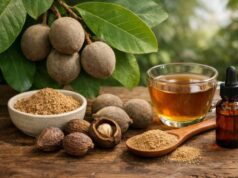
Black walnut (Juglans nigra) is a North American tree valued for two very different things: its richly flavored edible kernel and its traditional “green hull” preparations used in herbal practice. As a food, black walnuts offer healthy fats, minerals, and naturally occurring polyphenols that make them a nutrient-dense alternative to many processed snacks. As an herbal product, black walnut hull is best known for topical astringent uses and for folk protocols aimed at intestinal “cleansing,” including parasite-focused routines—claims that require a careful, evidence-aware lens.
Black walnut’s most notable properties come from its tannins and the naphthoquinone compound juglone, which can be biologically active but also irritating at higher exposures. That dual nature is why safe use depends on form and preparation: eating properly shelled, fresh kernels is not the same as taking a concentrated hull extract.
This guide walks you through what black walnut is, what it contains, realistic benefits, practical ways to use it, typical dosage ranges by form, and the safety details that matter most for everyday decisions.
Core Points
- Supports heart-healthy eating patterns when used as a nut serving in place of refined snacks.
- May offer mild astringent and antimicrobial support in traditional topical use, but strong clinical evidence is limited.
- Typical intake: 15–30 g kernels daily or 500–1,000 mg hull powder 1–2 times daily for short-term use.
- Avoid raw hulls and avoid all black walnut products if you have a tree-nut allergy; pregnant and breastfeeding people should generally avoid medicinal extracts.
Table of Contents
- What is black walnut?
- Key ingredients in black walnut
- Does black walnut help with parasites and fungus?
- Black walnut uses and best forms
- How much black walnut per day?
- Side effects, interactions, and who should avoid it
- What the evidence actually says
What is black walnut?
Black walnut (Juglans nigra) is a large hardwood tree native to eastern North America. If you have ever seen the fruit fall in late season, you know it is not a typical “nut” experience: the edible kernel sits inside a hard shell, which is wrapped in a thick outer husk (the green hull) that can stain hands and surfaces a deep brown-black. In kitchens, black walnut is prized for a bold, earthy flavor that is stronger than English (Persian) walnut. In herbal practice, the hull and sometimes the bark have been used in traditional preparations.
To use black walnut wisely, it helps to keep its parts straight:
- Kernel (the nut meat): eaten as food. This is where you get calories, healthy fats, protein, and minerals.
- Green hull (outer husk): used in tinctures, powders, and topical formulas. It is more astringent and chemically active than the kernel.
- Leaves and bark: occasionally used in traditional remedies, but less common in modern products and more prone to variability.
People often search for black walnut because they have heard it is “antiparasitic” or “antifungal.” Those uses generally refer to the hull, not the nut you bake into cookies. That distinction matters because the hull contains higher levels of tannins and juglone-like compounds that can be irritating if misused.
In everyday health terms, black walnut fits into two realistic roles. First, as a nut food, it can improve diet quality when it replaces refined snacks and sweets. Second, as a short-term traditional botanical, it may offer topical astringent support and modest antimicrobial activity, but it should not be treated as a stand-alone medical therapy for infections or intestinal parasites.
If you remember one thing, make it this: black walnut is not “one product.” It is a tree with multiple usable parts, and the safest approach starts by choosing the form that matches your goal.
Key ingredients in black walnut
Black walnut’s chemistry is the reason it shows up in both nutrition and herbal contexts. The kernel and the hull share some general plant compounds, but they differ in emphasis: kernels are primarily about fats and micronutrients, while hull products are primarily about tannins, bitter principles, and juglone-related activity.
Kernel nutrition: what you get as food
As a nut, black walnut provides:
- Unsaturated fats: including polyunsaturated fats that support heart-healthy eating patterns. Like other walnuts, black walnut contains alpha-linolenic acid (ALA), a plant omega-3 fat; if you want context for what ALA does in the diet, see an omega-3 fatty acids overview.
- Protein and fiber: helpful for satiety, especially when nuts replace refined snacks.
- Minerals and vitamins: commonly including magnesium, manganese, copper, phosphorus, and smaller amounts of other micronutrients. Nutrient levels can vary by cultivar, harvest, and storage conditions.
Because nuts are calorie-dense, their benefits are often substitution-based: they help most when they replace ultra-processed foods rather than “stacking” on top of an already high-calorie diet.
Polyphenols and phenolic acids
Black walnuts also contain polyphenols—plant compounds associated with antioxidant activity. In practical terms, polyphenols contribute to long-term dietary resilience more than immediate “medicinal” effects. Their impact tends to be cumulative and most noticeable when a diet includes a variety of plant foods.
Hull chemistry: tannins and juglone
The green hull is where black walnut becomes more like a classic herbal astringent:
- Tannins: bind to proteins and can create a tightening, drying sensation. That astringency helps explain traditional topical uses for weepy skin, minor irritation, and damp environments where microbes thrive.
- Juglone (a naphthoquinone): a biologically active compound associated with antimicrobial and antiproliferative effects in laboratory research. “Active” does not mean “safe at any dose,” though; juglone-rich materials can be irritating to skin and stomach.
- Other bitter and aromatic compounds: vary by harvest timing and processing.
Why ingredients matter for safety
A useful rule is that the hull behaves more like a medicinal botanical and the kernel behaves more like a nutrient-dense food. The more you concentrate hull compounds (strong tinctures, high-dose powders), the more you should think in terms of duration limits, careful dosing, and avoiding use in sensitive populations.
Does black walnut help with parasites and fungus?
This is the question that brings many people to black walnut, and it deserves a calm, honest answer. Black walnut hull has a long history in folk protocols for “cleansing,” including parasite-focused routines and topical approaches for fungal-looking skin issues. However, strong human evidence is limited, and the safest way to use black walnut is to keep expectations realistic and avoid replacing medical evaluation when it is needed.
Parasites: what is plausible, and what is missing
Traditional parasite protocols often combine black walnut hull with other botanicals and dietary changes. The proposed logic is usually one of these:
- Astringency: tannins may create an environment less favorable to certain organisms.
- Bioactive compounds: juglone-related chemistry may have antimicrobial actions in lab settings.
The limitation is that parasite infections in humans are diverse, and many require specific diagnosis and treatment. Lab or traditional plausibility is not the same as clinical effectiveness. If you suspect parasites due to persistent diarrhea, unexplained weight loss, blood in stool, severe fatigue, or recent high-risk travel or exposure, the most protective step is medical testing. A “cleanse” can delay appropriate care, and some symptoms attributed to parasites are actually food intolerances, inflammatory bowel conditions, or infections that need different treatment.
If you are exploring traditional parasite frameworks, black walnut is frequently discussed alongside wormwood; a useful comparison point is wormwood uses and safety guidance, especially because combining multiple bitter herbs can increase side effects and medication interactions.
Fungal concerns: where black walnut fits best
For superficial, localized skin concerns (for example, a small patch that looks like ringworm), black walnut hull preparations have been used topically in traditional practice. The most believable benefit here is supportive: the astringent effect may reduce moisture and irritation, and laboratory antimicrobial findings provide a rationale for why people historically reached for it.
Still, two cautions matter:
- Skin fungus is easy to misidentify. Eczema, contact dermatitis, psoriasis, and bacterial irritation can look similar.
- Topical irritation is common. Hull products can sting, stain skin, and cause redness in sensitive individuals.
Realistic outcomes to expect
A grounded expectation is that black walnut may offer mild, short-term supportive help for topical concerns and may be part of a traditional approach, but it is not a reliable stand-alone treatment for confirmed parasite infections or persistent fungal disease. If symptoms persist beyond 7–10 days, spread, or recur frequently, professional assessment is the smarter path.
Black walnut uses and best forms
Choosing the right form is the biggest driver of both outcomes and safety. Black walnut products vary widely, and two items labeled “black walnut” can behave very differently depending on whether they come from the kernel or the hull.
1) Kernel as food
Best for: long-term dietary support, satiety, and heart-healthy snack substitution.
Practical ideas:
- Add chopped black walnut to oatmeal, yogurt, or salads.
- Use as a strong-flavor accent in baking (it can dominate recipes, so small amounts go far).
- Pair with fruit or a protein source to make it a more balanced snack.
Storage matters with nuts because fats oxidize over time. Keep black walnuts sealed, cool, and preferably refrigerated or frozen for longer storage to preserve flavor and reduce rancidity.
2) Hull tincture
Best for: traditional short-term use when a liquid extract is preferred.
Key points:
- Hull tinctures are often made from fresh green hulls, which can be very strong and staining.
- Quality varies: some tinctures specify plant part and extraction ratio, while others do not.
- Because tinctures can be concentrated, dosing should stay conservative, and long-term daily use is not a good default.
3) Hull capsules or powders
Best for: short-term traditional protocols when measured dosing is needed.
Look for:
- Clear labeling that specifies hull rather than “whole plant.”
- A stated amount per capsule (mg) and suggested duration.
- Minimal “proprietary blend” packaging that hides actual dosing.
4) Topical preparations
Best for: localized skin support when tolerated.
Common approaches include diluted tinctures, salves, or creams containing hull extract. Because the hull can irritate skin, patch testing is essential. Many people looking for topical antimicrobial support also consider tea tree; for comparison of topical strategies and cautions, see tea tree topical benefits and safe-use basics.
Simple preparation rules that reduce problems
- Do not use raw hull material on skin without dilution and patch testing.
- Avoid DIY hull processing unless you are confident about identification and handling, since staining and irritation are common.
- Separate oral hull products from prescription medications by at least 2 hours to reduce the chance that tannins interfere with absorption.
In practice, the “best” form is usually the simplest: kernels for food goals, and carefully labeled hull products for short-term traditional use only.
How much black walnut per day?
Black walnut dosing depends on whether you are using it as a food or as a hull-based botanical. These are not interchangeable. The safest approach is to choose a form, set a clear goal, and set a clear stop date.
Kernel dosing as food
A practical everyday range for most adults is:
- 15–30 g per day (about 1 to 2 tablespoons chopped, or roughly a small handful)
If your goal is heart-healthy snacking, consistency matters more than a large dose. Many people do best by using nuts as a planned snack (mid-morning or mid-afternoon) to prevent grazing later. If weight management is a goal, start at the lower end and treat the serving as a replacement for chips, cookies, or sweetened granola bars.
Hull capsules or powder
Because products vary, label instructions come first. Still, many traditional-use products cluster around:
- 500–1,000 mg hull powder 1–2 times daily, typically for 7–14 days
If you are new to hull products, start at the lowest listed dose for 2–3 days to assess tolerance. Hull products can cause stomach upset, especially on an empty stomach.
Hull tincture
Tinctures vary by extraction ratio, so dosing must follow the specific label. A commonly used traditional range is:
- 1–2 mL, 1–3 times daily, for no more than 7–14 days without professional guidance
If your tincture uses droppers, measure in milliliters when possible rather than counting drops, since drop size varies by viscosity and dropper design.
Topical use
Topical dosing is best thought of as concentration and frequency:
- Start with once daily application of a diluted preparation for 48 hours
- Increase to twice daily only if the skin remains calm
- Stop if burning, worsening redness, blistering, or swelling occurs
Timing and cycling
- Food use does not require cycling; it is part of a diet.
- Hull-based use should be short-term, with breaks between courses. If you feel you “need” ongoing daily hull use, that is a signal to reassess the underlying problem and get clinical guidance.
Clear dosing, short duration, and careful observation are the three habits that keep black walnut use in the low-risk zone.
Side effects, interactions, and who should avoid it
Black walnut safety depends heavily on the form used. Most serious concerns relate either to tree-nut allergy (for kernels) or to irritation and intolerance (for hull products). Treat black walnut hull as a strong botanical, not as a casual “daily detox.”
Common side effects
Kernel (food) side effects:
- Allergic reactions in people with tree-nut allergy (can be severe)
- Digestive discomfort if eaten in large quantities or if nuts are rancid
Hull product side effects:
- Nausea, stomach cramps, diarrhea, or a “burning” stomach feeling
- Headache or lightheadedness in sensitive individuals
- Skin irritation, redness, or staining with topical use
If a hull product causes persistent GI upset, stop rather than pushing through. That reaction is a safety signal, not “die-off.”
Interactions and practical spacing
Hull products are tannin-rich, and tannins can bind to compounds in the gut. To reduce the chance of interfering with medications or supplements:
- Take oral hull products at least 2 hours away from prescription medications and iron-containing supplements.
If you take anticoagulants such as warfarin, dietary consistency matters more than avoiding nuts entirely. Black walnuts contain nutrients that can be part of a stable diet, but major shifts in diet should be discussed with your clinician.
Who should avoid black walnut products
Avoid black walnut kernels and hull products if you have:
- Known tree-nut allergy or a history of anaphylaxis to nuts
- A history of strong contact dermatitis to botanicals or dyes (hull products stain and can irritate)
Avoid medicinal hull products, and seek clinician guidance first, if you are:
- Pregnant or breastfeeding
- Giving products to young children
- Living with significant liver or kidney disease
- Taking immunosuppressants or multiple complex medications where GI absorption changes matter
For topical use, people sometimes reach for astringent botanicals to “dry out” irritation. Keep in mind that astringency can calm some situations but worsen others; a reference point for gentler astringent strategies is witch hazel topical use and safety, which also emphasizes patch testing and avoiding broken skin.
When to seek medical care
Seek urgent care for signs of a severe allergic reaction (hives, swelling of lips or throat, wheezing, trouble breathing). Seek medical evaluation for persistent GI symptoms, blood in stool, unexplained weight loss, fever, or skin lesions that spread, ooze, or do not improve within a week.
The safest black walnut use is simple: eat kernels as food if tolerated, and reserve hull products for short, conservative trials only.
What the evidence actually says
Black walnut sits in a common evidence pattern for traditional botanicals: we have strong information about composition (what is inside the plant), moderate information about biological activity in labs, and limited information from human clinical trials for most “medicinal” claims. A useful way to read the evidence is to separate kernel-as-food benefits from hull-as-remedy claims.
Kernel evidence: benefits are mostly “walnut as a category”
The best-supported health outcomes for walnuts come from dietary studies and randomized trials on walnut intake, typically using English walnut (Juglans regia). Black walnut kernels share the broader walnut profile—unsaturated fats, fiber, minerals, and polyphenols—so many diet-level conclusions are plausibly relevant, even though black walnut has its own distinct nutrient nuances and flavor chemistry.
The most realistic, evidence-aligned kernel benefits are:
- Supporting heart-healthy dietary patterns when nuts replace refined snack foods
- Improving satiety and dietary quality through nutrient density
- Adding polyphenol variety to an overall plant-forward diet
These are meaningful, but they are not “quick cures.” They work through consistency, substitution, and overall diet context.
Hull evidence: more lab science than clinical proof
Hull preparations are commonly discussed for parasites, fungus, and “detox.” Here, the evidence is thinner:
- Laboratory work supports antimicrobial activity of juglone and other walnut-associated compounds in controlled settings.
- Composition studies confirm that black walnut hull and related tissues contain diverse phenolics and bioactives.
What is largely missing are high-quality human trials showing that black walnut hull reliably treats intestinal parasites, clears fungal infections, or improves chronic inflammatory conditions on its own. That does not mean it has no value; it means claims should be framed as traditional use with limited clinical confirmation.
Why anecdotes can feel convincing
Parasite and “die-off” narratives are especially prone to confirmation bias because many things can temporarily change GI symptoms: shifting to lighter foods, stopping alcohol or sugar, adding fluids, changing meal timing, or using multiple botanicals at once. Improvement does not prove a parasite was present, and worsening symptoms does not prove “toxins leaving.” That is why clear diagnosis matters when symptoms are persistent or severe.
A practical, evidence-respecting takeaway
- Use kernels for nutrition goals with confidence and moderation.
- Use hull products cautiously, short-term, and only for modest supportive goals.
- Treat parasite and infection claims as a prompt to evaluate symptoms seriously, not as a reason to self-treat indefinitely.
When black walnut is used within those boundaries, it can be both practical and safe—without overstating what research can currently support.
References
- Quantification of Vitamins, Minerals, and Amino Acids in Black Walnut (Juglans nigra) – PMC 2022
- Comprehensive Characterization of Phytochemical Composition, Membrane Permeability, and Antiproliferative Activity of Juglans nigra Polyphenols – PMC 2024
- Antimicrobial activity and possible mechanisms of juglone against Escherichia coli, Staphylococcus aureus, and Salmonella pullorum – PMC 2025
- Effects of Walnut Consumption on Blood Lipid Profile and Apolipoproteins in Adults: A GRADE‐Assessed Systematic Review and Dose–Response Meta‐Analysis of 49 Randomized Controlled Trials – PMC 2026 (Systematic Review and Meta-Analysis)
- EAACI guidelines on the management of IgE-mediated food allergy – PubMed 2025 (Guideline)
Disclaimer
This article is for educational purposes only and does not provide medical advice, diagnosis, or treatment. Black walnut (Juglans nigra) products vary by plant part (kernel vs hull), strength, and preparation, so dosing and effects are not interchangeable across products. Do not use black walnut if you have a tree-nut allergy, and avoid raw or improperly prepared hull materials. If you are pregnant, breastfeeding, managing a chronic condition, or taking prescription medications, consult a qualified clinician before using black walnut hull extracts, tinctures, or powders. Seek urgent medical care for symptoms of anaphylaxis, severe or persistent gastrointestinal symptoms, or signs of serious infection.
If you found this guide useful, consider sharing it on Facebook, X (formerly Twitter), or your preferred platform so others can make safer, more informed choices.