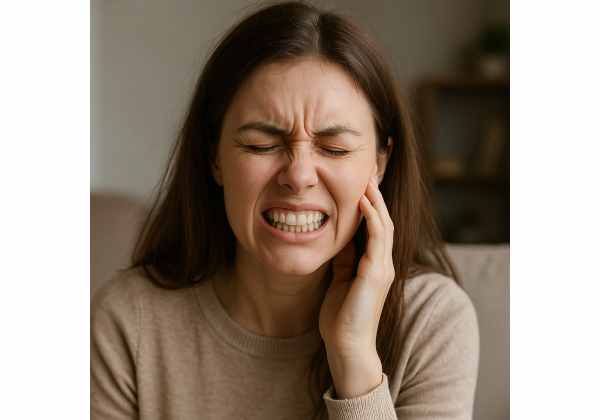
Bruxism is repeated jaw-muscle activity that may involve teeth grinding, teeth clenching, firm tooth contact, jaw bracing, or jaw thrusting. It can happen during sleep or while awake, and the person experiencing it may not always notice it. Some people first learn about it from a dentist who sees tooth wear, a sleep partner who hears grinding, or a pattern of morning jaw soreness and headaches.
Bruxism sits at the overlap of dentistry, sleep medicine, neurology, and mental health. It is not automatically a psychiatric disorder, and it is not always harmful. In many people, it is a behavior or muscle activity that becomes clinically important only when it causes pain, tooth damage, sleep disruption, jaw problems, or distress. Understanding the difference between normal jaw activity, awake clenching, and sleep-related grinding helps make the symptoms easier to recognize and the risks easier to interpret.
Table of Contents
- What Bruxism Means
- Awake Bruxism vs Sleep Bruxism
- Bruxism Symptoms and Signs
- Causes and Mechanisms
- Risk Factors and Linked Conditions
- Effects and Complications
- How Bruxism Is Recognized
- When Professional Evaluation Matters
What Bruxism Means
Bruxism means repeated activity of the chewing muscles, not simply “bad teeth grinding.” It may include grinding the teeth together, clenching the teeth, holding the jaw rigid, bracing the jaw without obvious tooth contact, or thrusting the lower jaw forward or sideways.
Modern definitions separate bruxism into two main forms: awake bruxism and sleep bruxism. This distinction matters because the two forms do not always have the same triggers, awareness level, clinical clues, or diagnostic methods. A person can have one form without the other, although some people have both.
Bruxism is sometimes described as a parafunction, meaning a mouth or jaw activity that is not part of normal chewing, speaking, swallowing, or facial expression. Still, the word “parafunction” can make bruxism sound automatically abnormal. Current expert thinking is more nuanced. Mild or occasional bruxism may be harmless. Bruxism becomes more important when it is frequent, intense, painful, damaging, or linked with sleep disruption or other health conditions.
It is also useful to separate “bruxism activity” from “bruxism damage.” A person may have active bruxism without obvious tooth wear, especially early on. Another person may have old tooth wear from past grinding but little current bruxism. Tooth wear alone does not prove that bruxism is still happening now. Dentists and clinicians usually look at the whole pattern: symptoms, jaw-muscle findings, dental changes, reports from a sleep partner, and, when necessary, device-based measurements.
Bruxism is common across age groups, but estimates vary widely because studies use different definitions and measurement methods. Self-report tends to capture awareness and symptoms, while sleep studies or muscle-monitoring devices measure activity more directly. A person who clenches during focused work may report frequent awake bruxism, while someone who grinds during sleep may deny symptoms unless another person hears it.
The condition also has an important mental health connection. Stress, anxiety, hyperarousal, sleep disturbance, and some psychiatric medications may be associated with bruxism in certain people. That does not mean bruxism is “all psychological.” Jaw-muscle activity is influenced by sleep physiology, the nervous system, medications, substances, breathing patterns, pain, and behavior. In many cases, several factors overlap.
Awake Bruxism vs Sleep Bruxism
Awake bruxism and sleep bruxism are best understood as related but distinct patterns. Awake bruxism is often linked with awareness, concentration, stress, or habit, while sleep bruxism occurs outside conscious control and is tied more closely to sleep-related muscle activity and brief arousals.
| Feature | Awake bruxism | Sleep bruxism |
|---|---|---|
| When it happens | During waking hours | During sleep |
| Common pattern | Jaw bracing, clenching, sustained tooth contact, jaw tension | Rhythmic grinding or clenching episodes, often noticed by sound or morning symptoms |
| Awareness | May be noticed during stress, focus, driving, screen use, or work | Often unnoticed unless a sleep partner hears it or symptoms appear on waking |
| Typical clues | Daytime jaw fatigue, tension, temple discomfort, awareness of clenching | Morning jaw soreness, tooth sensitivity, grinding sounds, sleep disruption |
| Clinical context | Often assessed through self-report and examination | May be assessed through history, examination, and, in selected cases, sleep or muscle-recording tests |
Awake bruxism may look less dramatic than nighttime grinding because it often involves sustained tension rather than loud tooth grinding. A person may hold the teeth together while concentrating, brace the jaw during stress, or keep the jaw muscles slightly contracted for long periods. Over time, that sustained muscle activity can contribute to fatigue, soreness, or headaches even without obvious grinding sounds.
Sleep bruxism is different because it occurs during sleep and often clusters around brief shifts in sleep depth or arousal. Some episodes involve rhythmic jaw-muscle contractions. Others may involve forceful clenching. The person may wake with tight jaw muscles, facial soreness, tooth sensitivity, or a dull headache near the temples, but many people have no clear morning symptoms.
The difference between the two forms also affects how people describe the problem. Someone with awake bruxism may say, “I catch myself clenching all day.” Someone with sleep bruxism may say, “My partner hears grinding,” or “My dentist says I’m wearing down my teeth.” Both can be accurate, but they point to different observation windows.
It is possible to overinterpret a single sign. Jaw tension after a stressful week does not automatically mean a chronic bruxism condition. Likewise, tooth wear can come from acid erosion, abrasive brushing, age-related wear, chewing habits, or past bruxism that is no longer active. A careful history helps distinguish current jaw-muscle activity from old or unrelated dental findings.
Bruxism Symptoms and Signs
The most common bruxism symptoms involve the teeth, jaw muscles, temples, face, and sleep quality. The clearest signs often come from patterns rather than one isolated symptom.
People with bruxism may notice:
- Teeth grinding sounds during sleep, often reported by a partner, parent, or roommate
- Jaw tightness, aching, or fatigue, especially on waking or after periods of concentration
- Tooth sensitivity, tenderness, or pain when biting
- Flattened, chipped, cracked, or worn teeth
- Sore temples or tension-type headaches, especially in the morning
- Facial muscle soreness around the cheeks or jaw angle
- Ear-area discomfort without an ear infection
- Clicking, popping, catching, or limited jaw opening
- Sleep disruption, restless sleep, or waking with jaw tension
- Cheek biting, tongue scalloping, or ridging along the sides of the tongue
Not all of these symptoms are specific to bruxism. Tooth sensitivity may come from cavities, gum recession, enamel erosion, cracked teeth, or dental procedures. Jaw pain may reflect temporomandibular disorders, arthritis, muscle strain, injury, infection, or referred pain from another area. Morning headaches can be linked with sleep problems, medication effects, dehydration, migraine, sleep apnea, or other causes.
The timing of symptoms gives useful clues. Morning jaw soreness can point toward sleep bruxism, especially when paired with grinding sounds or tooth wear. Daytime jaw fatigue that worsens during work, studying, driving, gaming, or stressful conversations may suggest awake bruxism. Symptoms that fluctuate with emotional stress may overlap with broader patterns of anxiety symptoms and triggers, although anxiety is only one possible contributor.
Dental signs may include polished wear facets on teeth, small fractures, damaged restorations, gumline notching, or increased tooth mobility in severe cases. Clinicians interpret these signs cautiously because teeth can show wear for several reasons. The pattern, age of the wear, symptom history, and current jaw-muscle findings all matter.
In children, sleep bruxism may be noticed as nighttime grinding sounds. Many children outgrow it, and occasional grinding is not always concerning. Persistent grinding with tooth damage, pain, sleep disruption, snoring, breathing pauses, daytime sleepiness, behavioral changes, or significant headaches deserves closer evaluation because sleep, airway, dental, and developmental factors may overlap.
Causes and Mechanisms
Bruxism usually has no single cause. It is better understood as a multifactorial pattern shaped by the nervous system, sleep arousal, jaw-muscle behavior, stress physiology, substances, medications, and individual vulnerability.
Older explanations often focused heavily on dental bite problems. Bite and tooth contact may still matter for some people, especially when dental changes affect comfort, but bruxism is not simply caused by an “uneven bite.” Current understanding places greater emphasis on central nervous system regulation, sleep physiology, and behavioral patterns.
Sleep bruxism appears to be related to brief arousals from sleep and activation of the autonomic nervous system. During these moments, heart rate, breathing, and muscle tone may shift. Jaw-muscle activity can occur as part of that brief arousal pattern. This helps explain why sleep bruxism is not usually a deliberate action and why people may be unaware of it.
Awake bruxism often involves sustained muscle tension. It may happen during concentration, emotional stress, physical effort, or prolonged screen-based work. Some people hold tension in the jaw the way others hold tension in the shoulders, neck, or hands. The behavior can become automatic, especially when repeated during high-focus or high-stress states.
Stress and anxiety can contribute, but they should not be treated as the only explanation. Bruxism may also occur in people who do not feel especially anxious. When stress is involved, the pathway is often indirect: increased muscle tension, heightened alertness, reduced sleep quality, or changes in daily habits. For some people, jaw clenching becomes one part of a larger body pattern of tension, hypervigilance, or difficulty downshifting after stress. Related patterns such as insomnia and anxiety at night may intensify the background arousal that makes sleep feel less settled.
Medications and substances can also influence jaw-muscle activity. Bruxism has been reported with some serotonergic antidepressants, stimulant medications, recreational stimulants, caffeine, alcohol, and nicotine. These associations do not mean that everyone using these substances will develop bruxism, and they do not prove causation in every case. They do matter when symptoms begin soon after a medication change or increase in stimulant exposure.
Genetics may play a role, especially in sleep bruxism. Family patterns are reported, and some people appear more prone to rhythmic jaw-muscle activity during sleep than others. The inherited part is not a simple one-gene trait; it likely reflects a mix of sleep, nervous system, and behavioral tendencies.
Medical and neurological factors can also be relevant. Sleep-related breathing disorders, movement disorders, reflux, pain conditions, and certain neurological conditions may coexist with bruxism. In many cases, the relationship is associative rather than clearly causal. The safest interpretation is that bruxism may be one signal in a wider clinical picture, not a stand-alone explanation for every symptom.
Risk Factors and Linked Conditions
Bruxism risk is higher when several vulnerability factors overlap. The most relevant risk factors include stress, sleep disturbance, certain substances or medications, younger age, family history, and coexisting pain or sleep conditions.
Age is one important factor. Sleep bruxism is often reported in children and younger adults, and prevalence tends to decline with age in many studies. Awake bruxism may be common in adults, but estimates vary because it depends heavily on self-awareness and reporting.
Stress, anxiety, and emotional strain are commonly associated with awake clenching and jaw bracing. People may notice clenching during deadlines, conflict, caregiving stress, financial worry, or periods of sustained mental effort. Related experiences such as chronic stress affecting focus and burnout can increase body tension more broadly, including in the jaw, neck, and shoulders.
Sleep quality is another major context. Poor sleep, frequent awakenings, insomnia symptoms, snoring, and sleep-related breathing complaints can coexist with bruxism. Obstructive sleep apnea has been studied closely because both sleep bruxism and apnea can involve arousals from sleep. Recent evidence is mixed and does not support a simple claim that sleep apnea directly causes bruxism in everyone. Still, loud snoring, witnessed pauses in breathing, gasping, morning headaches, and daytime sleepiness should not be ignored. A broader review of sleep apnea symptoms may be relevant when jaw symptoms occur alongside breathing-related sleep complaints.
Substance exposure may increase risk in some people. Caffeine, nicotine, alcohol, and recreational stimulants can affect arousal, sleep quality, or muscle activity. The timing and amount may matter. For example, evening stimulants may disrupt sleep, while nicotine and alcohol can fragment sleep architecture. These links are not identical for every person, but they are clinically relevant when symptoms appear or worsen after changes in use.
Medication-related bruxism is another important consideration. Case reports and reviews have described bruxism in association with selective serotonin reuptake inhibitors, serotonin-norepinephrine reuptake inhibitors, and some stimulant medications. This does not mean these medications are unsafe or should be stopped abruptly. It means that new jaw clenching, tooth grinding, or jaw pain after starting or changing a medication is worth documenting and discussing with the prescribing clinician.
Other linked conditions include temporomandibular disorders, chronic facial pain, headaches, reflux, restless sleep, and some neurodevelopmental or neurological conditions. Bruxism can also appear during periods of high sensory or emotional load. In some people, jaw tension may sit alongside other body-based stress patterns, such as shoulder elevation, shallow breathing, or hand clenching.
Effects and Complications
Bruxism can be harmless when mild, occasional, and not causing damage or pain. It becomes clinically important when repeated jaw-muscle activity affects teeth, dental work, jaw joints, muscles, sleep, or quality of life.
Dental complications are among the most visible effects. Repeated grinding or clenching can contribute to enamel wear, flattened biting surfaces, chipped teeth, cracked teeth, tooth sensitivity, gumline stress, and damage to fillings, crowns, veneers, implants, or other dental restorations. Severe forces can worsen existing dental vulnerabilities. A tooth with a large filling, crack, or weakened structure may be more likely to fracture under repeated load.
Muscle-related complications are also common. The masseter and temporalis muscles may become sore, enlarged, tender, or fatigued. Some people notice aching in the cheeks, temples, jaw angle, or around the ears. The pain may feel dull and heavy rather than sharp. Muscle tenderness can also contribute to morning headaches or tension-like head pain.
Bruxism can overlap with temporomandibular disorders, often called TMDs. These disorders involve the jaw joints, chewing muscles, and related structures. Bruxism does not explain every case of TMD, and not everyone with bruxism develops a jaw disorder. However, repeated clenching or grinding may increase load on the jaw system and can be associated with jaw pain, limited opening, clicking, locking, or chewing discomfort.
Sleep effects vary. Some people with sleep bruxism sleep through episodes and feel well. Others wake repeatedly, disturb a sleep partner, or wake with soreness and fatigue. Grinding sounds can be loud enough to affect household sleep. When bruxism occurs alongside snoring, breathing pauses, restless sleep, or daytime sleepiness, the sleep pattern deserves attention beyond the teeth alone.
There can also be emotional and social effects. People may feel embarrassed when a partner hears grinding, worried about dental damage, or frustrated by pain that seems to move between the jaw, head, and face. Some become hyperaware of jaw position and tooth contact. That awareness can be useful for recognizing patterns, but it can also increase worry when symptoms are persistent.
Complications are more likely when bruxism is frequent, forceful, long-lasting, or paired with other risk factors such as untreated dental disease, fragile restorations, chronic stress, poor sleep, stimulant exposure, or jaw-joint problems. The severity of tooth wear does not always match the severity of pain. Some people have significant wear with little discomfort, while others have intense muscle pain with minimal visible dental damage.
How Bruxism Is Recognized
Bruxism is usually recognized through a combination of history, symptoms, clinical examination, and, in selected cases, device-based assessment. No single clue is enough on its own.
Clinicians often think in levels of certainty. “Possible” bruxism may be based mainly on self-report, such as a person saying they grind their teeth, wake with a tight jaw, or catch themselves clenching. “Probable” bruxism adds clinical findings, such as tooth wear, jaw-muscle tenderness, or signs seen during a dental or medical exam. “Definite” bruxism requires instrumental assessment, such as sleep recording, electromyography, or other device-based measures.
A typical evaluation may consider:
- When symptoms occur: morning, daytime, during stress, during sleep, or throughout the day
- What the person notices: clenching, grinding, jaw tension, tooth sensitivity, headaches, or facial pain
- What others observe: grinding sounds, restless sleep, or changes in sleep breathing
- Dental findings: wear patterns, cracks, restorations, tooth mobility, gumline stress, or sensitivity
- Jaw findings: muscle tenderness, joint sounds, limited opening, locking, or chewing pain
- Sleep context: snoring, insomnia, restless sleep, daytime sleepiness, or witnessed breathing pauses
- Medication and substance history: antidepressants, stimulants, caffeine, nicotine, alcohol, or recreational drugs
- Mental health context: stress load, anxiety symptoms, trauma-related hyperarousal, mood symptoms, or recent major life changes
A sleep study is not needed for every person with suspected bruxism. It may be considered when sleep-related symptoms suggest another sleep disorder, when the diagnosis is unclear, or when clinicians need a more complete picture of sleep physiology. Polysomnography can record sleep stages, breathing, oxygen levels, limb movements, and jaw-muscle activity, depending on the setup. For more context, what a sleep study measures can help explain why sleep testing is broader than simply listening for tooth grinding.
Dental examination remains central because many complications are oral and structural. A dentist can distinguish patterns that suggest grinding from erosion, decay, gum recession, bite trauma, or old wear. Medical clinicians may become involved when symptoms point toward sleep apnea, medication effects, neurological concerns, significant headaches, or broader mental health symptoms.
Mental health assessment may be relevant when jaw clenching appears alongside persistent anxiety, panic symptoms, trauma-related hyperarousal, depression, substance use concerns, or medication side effects. A broader mental health evaluation may help clarify whether bruxism is part of a larger pattern of distress or arousal, but bruxism itself still requires attention to dental and sleep-related findings.
When Professional Evaluation Matters
Professional evaluation matters when bruxism causes pain, visible dental damage, sleep disruption, jaw locking, or symptoms that could point to another condition. Mild, occasional jaw tension may be temporary, but persistent or worsening symptoms deserve a closer look.
A dentist, physician, sleep specialist, or other qualified clinician may need to evaluate bruxism when there is:
- Tooth cracking, chipping, loosening, or rapidly worsening wear
- Persistent tooth sensitivity or pain with biting
- Morning jaw pain, facial soreness, or frequent temple headaches
- Jaw locking, limited opening, or trouble chewing
- Loud grinding that regularly disrupts a partner’s sleep
- Snoring, gasping, witnessed breathing pauses, or severe daytime sleepiness
- New bruxism after starting or changing a medication
- Jaw symptoms with neurological signs, unexplained facial weakness, or severe new headache
- Bruxism in a child with sleep disruption, breathing concerns, daytime behavioral changes, or significant dental wear
Urgent evaluation is especially important for severe facial swelling, fever with dental or jaw pain, trauma, inability to open or close the jaw, sudden severe headache, chest pain, fainting, weakness on one side of the body, or breathing difficulty. These symptoms are not typical uncomplicated bruxism and may signal a dental infection, injury, neurological event, cardiovascular problem, or another urgent condition.
It is also important not to assume that every headache, earache, or jaw sound is caused by bruxism. Ear disease, migraine, sinus problems, dental infection, trigeminal neuralgia, arthritis, and temporomandibular disorders can overlap in location. Accurate identification depends on the full pattern, not just where the discomfort is felt.
For people with mental health conditions, bruxism can be easy to dismiss as “just stress,” but that can miss dental damage, sleep disorders, medication effects, or jaw-joint problems. The opposite mistake is also possible: focusing only on the teeth while ignoring severe anxiety, insomnia, substance use, or hyperarousal. Bruxism is often most understandable when the mouth, jaw, sleep, and nervous system are considered together.
References
- Updating the Bruxism Definitions: Report of an International Consensus Meeting 2025 (Consensus Report)
- Global Prevalence of Sleep Bruxism and Awake Bruxism in Pediatric and Adult Populations: A Systematic Review and Meta-Analysis 2024 (Systematic Review and Meta-Analysis)
- Sleep bruxism (SB) may be not associated with obstructive sleep apnea (OSA): A comprehensive assessment employing a systematic review and meta-analysis 2024 (Systematic Review and Meta-Analysis)
- Is bruxism associated with temporomandibular joint disorders? A systematic review and meta-analysis 2023 (Systematic Review and Meta-Analysis)
- SSRI-associated bruxism: A systematic review of published case reports 2018 (Systematic Review)
- Bruxism Management 2024 (Clinical Review)
Disclaimer
This information is for general educational purposes only and is not a substitute for professional medical, dental, sleep, or mental health evaluation. Bruxism symptoms can overlap with dental disease, jaw disorders, sleep problems, medication effects, and other health conditions, so persistent, painful, worsening, or unusual symptoms should be assessed by a qualified professional.
Thank you for taking the time to read this; sharing it may help someone recognize jaw clenching, tooth grinding, or sleep-related symptoms that deserve proper attention.