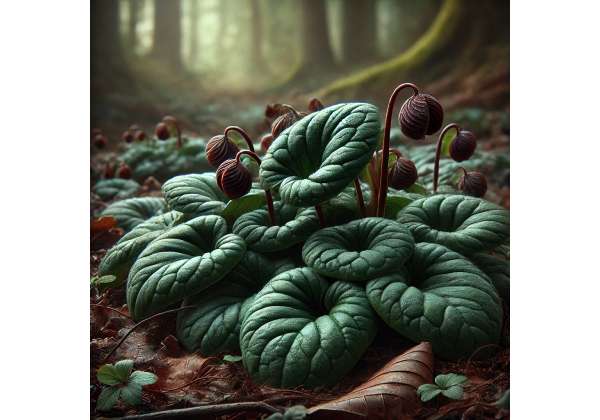
European wild ginger, Asarum europaeum, is a low evergreen woodland herb with glossy kidney-shaped leaves and a long, complicated medicinal history. Despite its common name, it is not related to culinary ginger. Instead, it belongs to the Aristolochiaceae family and has traditionally been used as a pungent rhizome herb for snuffs, errhine powders, emetic preparations, and older remedies aimed at clearing mucus, stimulating secretions, or provoking vomiting. That historical reputation explains why it appears in older European herbals and in Unani medicine under the name Asaroon.
Modern readers should approach it very differently. The plant does contain active volatile oils, flavonoids, phenylpropanoids, and other secondary metabolites, which help explain why it once attracted medicinal use. But it also carries serious safety concerns, especially because Asarum species can contain aristolochic acid analogs and compounds such as asarones that raise toxicology questions. So while European wild ginger has real ethnomedical interest and some preclinical pharmacology, it is not a herb that should be promoted casually for modern self-treatment. The key issue is not only what it may do, but whether any traditional benefit outweighs its toxic risk.
Quick Facts
- European wild ginger has a long traditional history for clearing secretions, stimulating circulation, and provoking sneezing or vomiting, but these uses are now considered high risk.
- Its main active constituents include volatile oils, phenylpropanoids such as α- and β-asarone, flavonoids, and aristolochic-acid-related compounds.
- There is no validated safe modern oral dose; historical texts mention about 650 to 780 mg as a stimulant and roughly 2 to 4 g as an emetic, but these uses are obsolete and not recommended.
- Internal use is unsafe because of nephrotoxic, carcinogenic, and potentially genotoxic compounds associated with Asarum chemistry.
- Pregnant or breastfeeding people, children, and anyone with kidney disease, cancer risk, or interest in self-dosing should avoid medicinal use completely.
Table of Contents
- What is European wild ginger
- Key ingredients and medicinal properties
- What can it realistically help with
- How European wild ginger is used
- How much European wild ginger per day
- Side effects, interactions, and who should avoid it
- What the evidence actually says
What is European wild ginger
European wild ginger is a shade-loving perennial herb native to much of central and southern Europe. Botanically, it is Asarum europaeum, often also called asarabacca or hazelwort in older English herbals. It forms a creeping rhizome under forest soil and sends up just a few glossy leaves close to the ground, along with small, brownish-purple flowers that often hide beneath the foliage. That modest appearance has always contrasted with the plant’s strong medicinal reputation.
It is important to separate European wild ginger from other plants that share the word “ginger.” It is not related to true culinary ginger, Zingiber officinale, and should never be assumed to behave like culinary ginger used for digestion and nausea. It is also distinct from North American wild ginger species, though those are also in the Asarum group. Confusion between these plants can lead people to assume similar culinary or medicinal safety when that is not justified.
Historically, European wild ginger was valued less as a daily tonic and more as a forceful medicinal tool. Older European and Eclectic sources describe the rhizome and leaves as acrid, irritating, and stimulating. The powdered root was used as an errhine, meaning a snuff intended to provoke sneezing and nasal discharge. Internally, it was used in very small amounts as a stimulant and in larger amounts as an emetic. Unani medicine also describes Asarum europaeum rhizome as a potent herb used in compound formulas for respiratory, neurological, hepatic, and musculoskeletal complaints.
This history reveals an important truth: the plant’s traditional value came largely from its irritant potency. It was not prized because it was gentle. It was prized because it could provoke a strong physiologic response. That makes sense when you look at old medicine, which often aimed to induce sneezing, vomiting, sweating, or fluid movement as a way of “clearing” illness. But modern herbal practice generally places much less value on such harsh actions, especially when safer plants are available.
Today, European wild ginger is more often of interest for three reasons:
- It has a long medicinal history in Europe and Unani practice.
- It contains chemically active volatile and phenylpropanoid compounds.
- It belongs to the same broader toxicological conversation as other aristolochic-acid-containing plants.
That third point matters most. European wild ginger is not simply an old-fashioned spice herb that fell out of fashion. It is a pharmacologically active and potentially dangerous plant whose traditional uses need to be re-read through modern toxicology. That is why a useful article on this herb must do more than repeat historical praise. It must explain where tradition ends and modern caution begins.
Key ingredients and medicinal properties
European wild ginger contains a mixture of volatile oils, phenylpropanoids, flavonoids, tannin-like compounds, and other plant metabolites. Older pharmacognosy work identified volatile oil, asarone, resinous material, and tannic components in the root, while modern reviews and analytical studies place greater emphasis on aristolochic-acid-related compounds, aristolactams, and volatile phenylpropenes with meaningful toxicology.
The best-known constituents are the asarones, especially α-asarone and β-asarone. These are aromatic phenylpropanoids that have attracted research attention because they can show biologic activity in preclinical systems, including neurologic, antimicrobial, and anti-inflammatory effects. However, this is only half of the story. The same compounds have also been associated with toxicologic concerns, including mutagenicity, genotoxicity, teratogenicity, and tumor formation in preclinical work. That means they are not simply “active ingredients” in the positive marketing sense. They are active compounds with both pharmacology and risk.
Older references also describe volatile oil constituents such as pinene and methyl-eugenol-related material, while modern Asarum essential oil studies across the genus highlight compounds such as safrole, methyl eugenol, and related aromatic substances. Not every Asarum species shares the same exact chemical balance, but this pattern helps explain why European wild ginger is pungent, irritant, and biologically forceful.
The most serious chemical issue, though, is the presence of aristolochic-acid analogs and aristolactams in Asarum species. These compounds are strongly associated with nephrotoxicity and carcinogenicity. Analytical work on medicinally used Asarum species has shown potentially nephrotoxic aristolochic-acid-related compounds in multiple plant parts and in both water and methanol extracts. That is why safety cannot be treated as a minor footnote with this herb.
From a medicinal-properties perspective, European wild ginger can reasonably be described as having these historical or preclinical traits:
- Irritant and secretory-stimulating action on mucous membranes.
- Emetic and errhine effects at higher exposures.
- Mild antimicrobial activity in older phytobiological studies.
- Possible anti-inflammatory or neurologically active effects through asarone-type compounds.
- Astringent and aromatic qualities from tannins and volatile constituents.
But these properties should not be romanticized. A plant may stimulate, irritate, or inhibit microbes in a lab and still be a poor choice for real-world self-care. In European wild ginger, potency and toxicity sit uncomfortably close together. Some of its apparent medicinal actions likely arise from the same chemistry that creates risk.
That is one reason safer herbs often make more sense for the same general goals. For example, if someone wants a gentler aromatic herb for digestive or upper-airway support, peppermint for digestive and respiratory relief offers a much more familiar and manageable profile. European wild ginger is not in that category.
So when readers ask about key ingredients, the honest answer is this: the herb contains a chemically active volatile and phenylpropanoid profile, but its signature compounds are as notable for toxicology as for traditional pharmacology. That sharply limits how any “benefits” should be interpreted.
What can it realistically help with
This is the section where caution matters most. If European wild ginger is described only through historical herbals, it can sound impressively versatile. Older sources and traditional systems link it with cough, bronchial congestion, sluggish circulation, headache, toothache, polyarthritis, gout, amenorrhea, paralysis-like disorders, and hepatic complaints. Modern summaries sometimes add antimicrobial, anti-inflammatory, antioxidant, and neuroactive language. But realistic benefit is not the same as historical breadth.
The most honest answer is that European wild ginger may have had practical value in earlier medicine because it was a strong irritant. That irritant action could provoke sneezing, nasal discharge, vomiting, or a sense of stimulation. In a pre-antibiotic and pre-pharmaceutical setting, such effects were often interpreted as therapeutic cleansing. Today, however, that same action is usually viewed as harsh and unnecessary, especially when less toxic herbs can produce milder support without the same toxic burden.
If we narrow the question to plausible effects, a few areas still stand out:
- Historically, it may have helped loosen or discharge secretions when used as snuff or errhine.
- It may have shown mild antimicrobial action in older laboratory-style phytobiological work.
- It may exert anti-inflammatory or neuroactive effects through asarone-related compounds in preclinical models.
- It may have acted as a forceful stimulant to the digestive and upper-respiratory mucosa.
Even so, “may” is doing a lot of work here. None of these points justify modern self-treatment with the herb. In current practice, the risk-benefit balance is poor. The strongest modern evidence around Asarum chemistry is not reassuring efficacy data but toxicology data involving kidneys, DNA damage, and cancer risk.
That changes what “realistically help with” means. In truth, European wild ginger is now more useful as a case study in historical medicine than as a recommended remedy. It can help us understand how old herbalism used powerful irritants, how volatile aromatic plants were once applied for catarrh and congestion, and how toxicology has changed the way some traditional plants are judged.
Where historical use still has interpretive value:
- Understanding old errhine and emetic practice.
- Studying pungent rhizome herbs in ethnomedicine.
- Exploring how preclinical bioactivity can coexist with serious toxicity.
Where it does not belong:
- Routine self-treatment for cough or congestion.
- Home use for nausea, vomiting, or digestive stimulation.
- Kidney, liver, or urinary complaints.
- Long-term tonic use.
- Any “natural detox” protocol.
If someone wants a topical or mucosal-supportive herb with a much better safety reputation, calendula for external soothing and tissue support or other better-known choices make much more sense. European wild ginger is simply too risky to be framed as a practical first-line remedy.
So the realistic answer is restrained: European wild ginger has historical and pharmacologic interest, but modern benefit is more theoretical than usable. It is not a plant that should be recommended because a few traditional or preclinical signals exist. In this case, safety concerns narrow the practical benefit almost to zero for unsupervised use.
How European wild ginger is used
European wild ginger has been used in several traditional forms, but most of them reflect older medical logic rather than modern best practice. The principal medicinal parts are the rhizome and, in some older descriptions, the leaves. These were prepared as powders, decoctions, extracts, oils, or snuffs depending on the desired effect.
Historically, the most distinctive use was as an errhine. The dried powdered root was inhaled through the nose to provoke sneezing and copious discharge. This was once considered useful for head congestion, lethargy, facial afflictions, or certain neurological complaints. In older medicine, forcing nasal secretion was thought to clear obstructed humors or stagnant fluids. Today, that kind of strong nasal irritation is rarely seen as a sensible therapeutic strategy.
The herb was also used internally in small doses as a stimulant and in larger amounts as an emetic. That means it was deliberately used to cause vomiting. Some historical records even note its use by people trying to induce vomiting after heavy drinking. Again, this reflects a very different therapeutic philosophy from modern herbal medicine, where gentler and safer herbs have replaced most deliberate emetics.
Traditional and historical forms include:
- Powdered rhizome
Used as a snuff or taken internally in very small amounts. - Decoction or infusion
Used in some traditional systems, including Unani practice, usually as part of broader compound formulas. - Oil or volatile extract
Relevant in pharmacognosy and older materia medica, though much less suitable for self-use. - Compound formulas
Older traditions often combined it with other herbs to modify or direct its effects.
These forms are not equivalent. A powdered rhizome acts differently from a decoction, and a concentrated volatile extract acts differently from either. More importantly, modern toxicology means none of them should be assumed safe just because they are traditional.
There is also a serious sourcing problem. A garden-grown or wild-collected Asarum europaeum plant is not a standardized medicinal product. The amount of aristolochic-acid-related compounds, volatile oil content, and asarone profile can vary. That makes home preparation especially hard to control. Even if someone wanted to imitate historical use, they would not know their true exposure.
In practice, modern use is better described than recommended. If a reader wants to understand how the herb was used, the answer is clear: as a pungent rhizome herb for sneezing powders, emetic preparations, and traditional compound medicines. If the reader wants to know how they should use it now, the answer is far more restrictive: generally, they should not self-use it internally at all.
For people drawn to the old idea of aromatic topical or astringent plants, witch hazel for topical astringent support is a much safer modern example of how traditional plant use can survive into current practice. European wild ginger has largely moved in the opposite direction: from admired remedy to cautionary herb.
How much European wild ginger per day
There is no validated safe modern oral dose for European wild ginger. That is the most important fact in any dosage discussion. Unlike mainstream medicinal herbs, Asarum europaeum does not have a comfortable modern dosing range that can be presented as routine self-care.
What exists instead are historical dose records and scattered traditional references. Older dispensatory literature describes the rhizome as a stimulant at about 10 to 12 grains, which is roughly 650 to 780 mg, and as an emetic at about 0.5 to 1 drachm, or roughly 2 to 4 g. These are not modern recommendations. They are historical data points showing how forcefully the herb was once used. In modern terms, those ranges mainly demonstrate why the plant is risky: a relatively small shift in dose moved it from “stimulant” to “vomit-inducing.”
Some traditional systems have also used broader gram-based rhizome doses in compound preparations, but this should not be mistaken for evidence of modern safety. Traditional dose records often come from medical systems that assumed close supervision, complex compounding, and a different risk tolerance than today’s herbal self-care.
A responsible modern dosage framework therefore looks like this:
- No validated oral self-care dose exists.
- Historical dose ranges are obsolete, not current guidance.
- Modern internal use should generally be avoided because toxic exposure is a more pressing concern than therapeutic effect.
- Essential oil or concentrated extracts should not be self-dosed.
Timing and duration are equally problematic. This is not a plant that lends itself to “take one capsule daily” style thinking. Historically it was used for forceful short-term effects, not as a nourishing tonic. Any attempt to repurpose it into a wellness routine would ignore the basic nature of the herb.
The same caution applies to form. A home tincture, powdered rhizome, and decoction do not deliver identical chemistry. Water extracts may still contain aristolochic-acid-related compounds, while alcohol or oil-based preparations may concentrate volatile constituents differently. Because the risk profile is complex, dosage cannot be discussed meaningfully without also discussing extraction and toxic load.
That is why the best modern dosage advice is unusually blunt: do not look for a routine oral dose. The question is not “how much European wild ginger per day?” so much as “is there any reasonable justification for daily use at all?” For most people, the answer is no.
If the goal is gentle digestive stimulation, nausea support, or warming herbal action, safer alternatives already exist and are far easier to dose. European wild ginger’s historical numbers may be of academic interest, but they should not be treated as usable health instructions.
Side effects, interactions, and who should avoid it
Safety is the defining issue with European wild ginger. The herb is not just “a little strong.” It belongs to a family and chemical context associated with serious toxicology, especially nephrotoxicity and carcinogenicity linked to aristolochic-acid-related compounds. It also contains volatile phenylpropanoids such as α- and β-asarone, which have their own preclinical toxicology concerns.
The most likely immediate side effects from traditional-style exposure include:
- Burning or irritation of the mouth, nose, and throat.
- Nausea and vomiting.
- Stomach pain or cramping.
- Excessive sneezing and nasal discharge.
- Skin or mucosal irritation from concentrated preparations.
More serious risks are longer-term and more medically important:
- Kidney injury related to aristolochic-acid exposure.
- Increased cancer risk, especially urothelial malignancy, within the broader aristolochic-acid toxicology picture.
- Possible genotoxicity or mutagenicity from certain constituents.
- Hepatic and developmental concerns linked to asarone toxicology in preclinical work.
This means “natural” is a deeply misleading label here. The herb may be natural, but some of its best-known compounds are exactly the reason it should not be used casually. In fact, European wild ginger is one of those plants where modern safety science narrows traditional herbal enthusiasm very sharply.
Interaction data specific to Asarum europaeum are limited, but caution is especially warranted with:
- Other nephrotoxic drugs or substances.
- Hepatically metabolized medications.
- Pregnancy-related medications or fertility-related treatment.
- Any regimen involving carcinogenic or genotoxic exposure concerns.
Who should avoid the herb completely unless under rare and specialized professional supervision:
- Pregnant people.
- Breastfeeding people.
- Children and adolescents.
- Anyone with kidney disease or reduced renal reserve.
- Anyone with a personal or strong family cancer risk profile involving the urinary tract.
- Anyone considering self-treatment for chronic symptoms.
- Anyone using homemade extracts or powders.
It is also important not to confuse a lack of frequent modern poisoning reports with proof of safety. One reason some older herbs seem “quiet” in the literature is that fewer people use them now precisely because of known toxic concerns. Reduced popularity is sometimes a sign of learned caution, not of lost value.
The broader clinical lesson is clear. A plant can have historical uses, active compounds, and even interesting preclinical benefits while still being a poor candidate for modern use. European wild ginger fits that pattern closely. The right safety message is not “use carefully.” It is closer to “avoid internal self-use unless there is a highly specific and professionally controlled reason.”
What the evidence actually says
The evidence on European wild ginger is stronger for chemistry and toxicology than for clinically useful benefits. That single sentence captures the current state of knowledge better than any long list of traditional claims.
What is reasonably well supported:
- Asarum europaeum has a genuine historical role in European and Unani medicine.
- The rhizome contains volatile oils, asarone-related phenylpropanoids, flavonoids, and other secondary metabolites.
- Asarum species can contain aristolochic-acid analogs and aristolactams.
- Aristolochic-acid exposure is strongly linked to aristolochic acid nephropathy and urothelial cancer.
- α- and β-asarone have interesting preclinical pharmacology but also meaningful toxicologic concerns.
What is not well supported:
- Any validated modern oral benefit of Asarum europaeum that clearly outweighs risk.
- Standardized dose guidance for safe internal use.
- Strong human clinical trials showing clear benefit in cough, arthritis, digestion, or neurologic complaints.
- A modern therapeutic niche that cannot be filled more safely by other herbs.
This imbalance matters. A plant may look impressive on paper if one combines centuries of traditional use with a long list of preclinical effects. But when the same plant also sits within the aristolochic-acid safety problem, those benefits must be judged against a much higher bar. European wild ginger does not seem to clear that bar for unsupervised modern use.
The 2022 evidence-based appraisal in Unani medicine is useful precisely because it reflects both interest and limitation. It describes broad traditional uses and multiple pharmacologic directions, yet it also notes that herb-specific studies remain sporadic and that more work is urgently needed on efficacy, dosage, and safety. That is not the language of a settled medicinal herb. It is the language of an incomplete evidence base.
Modern analytical work on medicinally used Asarum species also shifts the center of gravity away from benefit and toward risk. Detecting aristolochic-acid analogs in multiple plant parts and in multiple extract types changes how the whole herb must be interpreted. Meanwhile, broader toxicology reviews on aristolochic acids and asarones make it difficult to argue that the plant deserves routine use simply because it has volatile oils or traditional prestige.
So what is the most useful conclusion for readers?
European wild ginger is a plant of historical and pharmacologic interest, but not a comfortable modern self-care herb. It may still matter to ethnobotany, toxicology, and the study of older materia medica. It may even retain carefully limited use in some traditional systems. But for most modern readers, the evidence says less “here is a forgotten remedy” and more “here is a potent old herb whose risks now outweigh its practical usefulness.”
That is a worthwhile conclusion in itself. Sometimes the best herbal guidance is not to rediscover a plant, but to understand why it fell out of favor.
References
- Overview of aristolochic acid nephropathy: an update 2023 (Review)
- Ethno pharmacology, phytochemical analysis, safety profile, prophylactic aspects, and therapeutic potential of Asarum europaeum L. in Unani medicine: An evidence-based appraisal 2022 (Review)
- Comparative Analysis of Aristolochic Acids in Aristolochia Medicinal Herbs and Evaluation of Their Toxicities 2022 (Toxicology Study)
- Medicinally Used Asarum Species: High-Resolution LC-MS Analysis of Aristolochic Acid Analogs and In vitro Toxicity Screening in HK-2 Cells 2017
- Pharmacology and toxicology of α- and β-Asarone: A review of preclinical evidence 2017 (Review)
Disclaimer
This article is for educational purposes only and is not a substitute for medical advice, diagnosis, or treatment. European wild ginger is a historically important but toxicologically concerning herb, and internal use may expose users to nephrotoxic, carcinogenic, and potentially genotoxic compounds. Do not self-treat with this plant, especially if you are pregnant, breastfeeding, have kidney disease, or are considering long-term use. Seek qualified medical or pharmacognosy guidance before using any Asarum preparation.
If you found this article useful, please share it on Facebook, X, or your preferred platform.