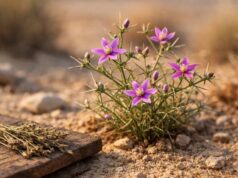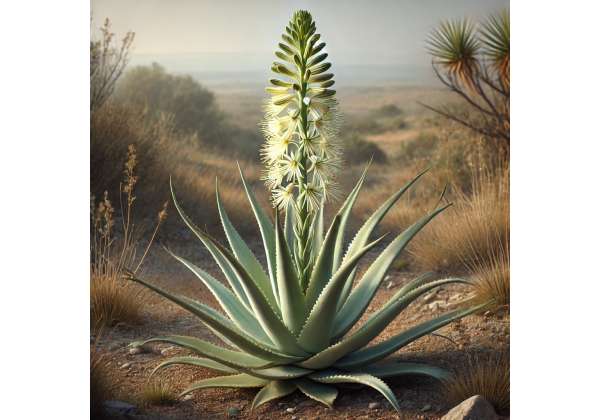
False aloe, usually identified botanically as Manfreda virginica, is a North American perennial that looks somewhat like aloe but belongs to the agave group rather than the true aloe genus. It is also called American aloe, Virginia agave, and sometimes rattlesnake master, which adds confusion because that common name is also used for a different native plant. Traditional records connect false aloe with root-based folk uses for digestive upset, intestinal spasm, gas, and external applications for bites. Modern readers should approach those claims with care. False aloe has a real ethnobotanical history, but it does not have the clinical research base, standardized extracts, or clearly defined dosing that people often expect from better-studied herbs.
That distinction matters. False aloe is best understood as a historically used medicinal plant with plausible agave-family chemistry, limited species-specific research, and a safety profile that remains too uncertain for casual internal use. For most people, the most reasonable mindset is respectful curiosity rather than confident self-treatment.
Core Points
- False aloe is a North American agave relative, not true aloe vera.
- Traditional use centers on root preparations for diarrhea, gas, intestinal spasm, and external bite washes.
- No evidence-based oral dose exists, so the safest unsupervised oral target is 0 mg per day.
- Patch-test any fresh preparation on a 1–2 cm skin area first and stop if burning, itching, or rash appears.
- Pregnant or breastfeeding people, children, and anyone treating a venomous bite should avoid self-use.
Table of Contents
- What is False Aloe
- Key ingredients and likely actions
- Can False Aloe help
- How False Aloe is used
- How much False Aloe
- Safety, side effects, and avoidance
- What the evidence shows
What is False Aloe
False aloe is a rhizomatous geophyte native to parts of the central and eastern United States and northeastern Mexico. It forms a basal rosette of fleshy, strap-like leaves and later produces tall flowering stalks with fragrant greenish to pale yellow flowers. In modern gardens it is often treated as a drought-tolerant ornamental, but older names reveal a parallel medicinal history. “American aloe” and “false aloe” came from appearance, not from chemical similarity. It resembles aloe at a glance, yet it is not the same plant and should not be used as though it were.
That difference is important for readers who assume false aloe works like true aloe vera for skin and digestive support. Aloe vera belongs to a different genus and has a much better described gel, latex fraction, and commercial product market. False aloe does not have that level of characterization. The root, rather than the leaf gel, is the part most often mentioned in historical medicinal records. Older herbal descriptions portray it as bitter and note that its active qualities were thought to move into water and alcohol preparations.
Naming remains another challenge. Some modern plant authorities accept Manfreda virginica, while some horticultural and regional sources still place it under Agave virginica. Both names are tied to the same plant in current discussion. Common names create even more confusion. “Rattlesnake master” is sometimes applied to false aloe because of its folk association with snakebite care, but that name more commonly refers to Eryngium yuccifolium, which is a different species altogether. Anyone collecting, buying, or discussing the herb should rely on the scientific name rather than the label alone.
In practical terms, false aloe sits in an unusual middle ground. It is clearly a real medicinal plant in the historical record, yet it is not a mainstream modern herbal product with monographs, standardized extracts, or familiar supplement formats. You are more likely to encounter it in native plant circles than in a supplement aisle. That alone is useful context. The plant has a documented traditional identity, but it has not been translated into a thoroughly validated modern remedy.
Key ingredients and likely actions
False aloe is one of those herbs where readers naturally ask about “key ingredients,” but the honest answer is more limited than the phrase suggests. Species-specific phytochemical mapping for Manfreda virginica is sparse. There is no widely used monograph that lists its principal medicinal constituents with the clarity seen in better-studied herbs such as ginger, turmeric, or true aloe. That does not mean the plant lacks active chemistry. It means the chemistry has not been described well enough to support confident, product-style claims.
The best clues come from the broader agave family. Reviews of related Agave species commonly discuss steroidal saponins, sapogenins, phenolic compounds, flavonoids, and other secondary metabolites. These groups can help explain why agave relatives are often explored for antimicrobial, antioxidant, anti-inflammatory, and surface-active properties. False aloe likely shares some of that broader chemical neighborhood, and readers who want a family-level comparison may find it useful to look at yucca and its saponin-rich profile for context. Even so, family-level resemblance is not the same as proof of a specific false aloe effect.
Historical descriptions offer a few indirect hints. Older herbal writing emphasizes the bitterness of the root and the fact that its active qualities were thought to extract into water and alcohol. Bitterness often aligns with traditional digestive use, especially where a plant was taken for gas, sluggish digestion, or bowel discomfort. If false aloe contains meaningful bitter or saponin-like compounds, that could help explain its reputation for influencing intestinal spasm or flatulence. Still, that remains a reasoned interpretation rather than a confirmed mechanism.
This uncertainty changes how the herb should be discussed. A careful article should focus on “likely actions” rather than “confirmed mechanisms.” The most reasonable working model is that false aloe may contain agave-family constituents with bitter, phenolic, and surface-active features that could contribute to digestive stimulation, mild topical activity, or general biological activity. What we cannot responsibly say is that a specific false aloe preparation delivers a defined concentration of a known active compound at a proven therapeutic threshold. The chemistry is interesting and plausible, but not mature enough to justify strong medicinal promises.
Can False Aloe help
The most realistic answer is yes in a historical sense, but not yet in the modern evidence-based sense most people mean when they search for “health benefits.” Traditional records repeatedly connect false aloe with a narrow cluster of uses: external application for snakebite, internal use for diarrhea, relief of flatulence, and easing intestinal spasm. Those uses are not random. They suggest a plant that was valued as a bitter, practical, locally available remedy for urgent field conditions and digestive discomfort.
Still, traditional use is not the same as proven clinical benefit. No one should read historical references as evidence that false aloe neutralizes venom, cures infection, or reliably treats chronic digestive disease. The strongest conclusion is more modest. False aloe earned a place in regional folk practice for bowel complaints and external bite care, and that pattern deserves to be acknowledged without exaggeration.
For a modern reader, the plausible benefit categories are limited and should be framed carefully:
- Mild traditional digestive support for gas or bowel discomfort.
- Historical external use in field medicine.
- Potential interest as a plant with topical or antimicrobial research value.
- Ethnobotanical importance as a record of regional medicinal practice.
It is just as important to define what false aloe should not be treated as. It should not be presented as a proven anti-snakebite herb, a substitute for emergency care, a standardized laxative, or a dependable treatment for irritable bowel symptoms. Readers who want a topical plant with a more familiar modern role may find more practical value in witch hazel for minor surface irritation and astringent use, because the route, purpose, and caution profile are much clearer there.
A good rule with obscure herbs is to translate benefits into realistic expectations. With false aloe, the reasonable outcome is “possible mild support suggested by traditional use,” not “established treatment.” The plant may hold clues worth studying, but its medicinal identity still rests far more on historical continuity than on controlled human research. That makes it meaningful, but not reliable enough to use with the same confidence given to well-studied herbs.
How False Aloe is used
False aloe has been used more as a fresh or simply prepared folk herb than as a modern standardized supplement. Historical descriptions mention the root most often. The preparations themselves are not elaborate. Accounts refer to fresh root, root decoction, root washed into liquid preparations, and external applications for bites or stings. Some records also mention chewing the root for diarrhea or using prepared root in liquid for conditions involving intestinal discomfort.
That pattern suggests two main routes: external use and internal root use. The external route is easier to understand in a traditional setting because it required less precision and less standardization. The internal route is much harder to translate into current practice because it depends on correct botanical identification, proper harvesting, variable extraction strength, and a chemistry profile that has never been well standardized.
In modern practice, most people do not encounter false aloe as a capsule, tea bag, extract, or cream. If they use it at all, it is more likely through personal cultivation, regional herbal tradition, or direct plant collection. That raises immediate quality-control questions. One plant may be harvested at a different stage than another. One preparation may be weak, another overly strong. A mislabeled plant may not even be false aloe.
For readers approaching false aloe from a practical herbal standpoint, the safest conclusion is that it is not a plug-and-play home remedy. It belongs to the category of historically used plants that require more botanical certainty and more restraint than casual herbal self-care usually allows. For people whose real goal is a gentler, more clearly demulcent digestive or throat-soothing plant, marshmallow root as a classic soothing herb is often easier to understand and use responsibly.
The most important use lesson involves emergencies. A historical snakebite wash belongs to medical history, not modern first aid. A venomous bite requires urgent medical assessment and, when indicated, antivenom. False aloe may remain interesting as part of regional healing traditions, but it should not be treated as a substitute for evidence-based emergency care. Learning how it was used is valuable. Copying those methods without context is not.
How much False Aloe
This is the question many readers want answered most clearly, and it is also where false aloe offers the least satisfying guidance. There is no evidence-based oral dosage for Manfreda virginica. No well-established human trials define a safe daily milligram range. No widely accepted monograph lays out standardized extract strength, timing, or treatment duration. Historical records describe uses and preparation styles, but they do not provide the kind of reproducible dosing framework modern readers expect.
For that reason, the safest practical answer for unsupervised oral use is 0 mg per day. That does not mean the herb has no activity. It means there is not enough reliable information to recommend an internal dose with confidence.
Several factors explain why dosing remains so uncertain:
- The plant may appear under more than one scientific name.
- The root is the part most often cited in old records, but root chemistry can vary with age and growing conditions.
- Fresh, dried, infused, and alcohol-extracted forms are not equivalent.
- There are no clear data linking amount used to benefit or toxicity.
- There are no solid modern data on medication interactions or use in vulnerable groups.
A more useful way to think about dose is by route.
For oral use:
- No validated amount can be recommended for routine self-care.
- Historical decoctions should not be copied as though they were standardized formulas.
- Internal use should be avoided unless guided by a qualified clinician with botanical training.
For external use:
- Do not begin with large-area application.
- Patch-test a very small amount on a 1–2 cm area of intact skin.
- Wait 24 hours before broader use.
- Stop immediately if redness, burning, itching, or rash develops.
For timing and duration:
- There is no established best time of day.
- There is no established safe continuous-use period.
- Any experiment with fresh plant material should be brief, conservative, and stopped at the first sign of irritation.
Sometimes the absence of dosing data is itself the most important dosage fact. With false aloe, the lack of standardization and clinical testing strongly suggests that the plant should be treated as an ethnobotanical herb of interest, not as a routine self-dosed remedy.
Safety, side effects, and avoidance
False aloe deserves a conservative safety profile because uncertainty itself creates risk. When a plant has incomplete chemistry, little clinical research, and mostly historical reports behind it, the responsible position is to avoid overconfidence. Older descriptions suggest that false aloe can affect the digestive tract, which makes bowel looseness, cramping, nausea, or irritation plausible side effects if it is taken internally. A bitter root with possible saponin-like constituents may be biologically active long before it becomes predictably therapeutic.
Topical use is not automatically risk-free. Fresh plant material can irritate sensitive skin, especially when identification is uncertain or the preparation is crude. Anyone trying an external application should start on intact skin, use a patch test first, and stop at the first sign of irritation. It should not be placed on deep wounds, infected skin, mucous membranes, or large inflamed areas.
The groups most likely to be harmed by casual experimentation are also the groups that need the clearest advice:
- Pregnant and breastfeeding people should avoid it because safety data are lacking.
- Children should avoid it because safe amounts are unknown.
- People with chronic digestive disorders should avoid internal use because bowel effects are not characterized.
- People taking regular medicines should avoid internal use because unknown constituents may affect tolerance or absorption.
- Anyone with a history of plant allergy, especially to agave-family plants, should be cautious.
- Anyone dealing with a venomous bite, serious sting, or rapidly worsening wound should seek urgent medical care rather than rely on herbal treatment.
There is also a hidden safety issue that deserves emphasis: plant-name confusion. Someone who believes they are using false aloe may actually have aloe vera, a differently labeled agave relative, or an entirely different species with a similar common name. Botanical certainty is part of safety. With obscure herbs, misidentification is often a greater threat than the plant’s known pharmacology.
As a comparison, herbs discussed for topical use with clearer route-specific warnings, such as comfrey in carefully limited external use, show what a mature safety discussion looks like. False aloe is not there yet. Until species-specific toxicology becomes clearer, the safest approach is selective avoidance, cautious external testing only, and no reliance on the herb in urgent medical situations.
What the evidence shows
The evidence base for false aloe is thin, uneven, and mostly indirect. At the foundation are botanical and taxonomic sources that confirm the identity of the plant. Above that are ethnobotanical records and historical herbals showing how the plant was used in earlier communities. After that, the trail becomes much less substantial. There are no robust human trials establishing false aloe as an effective treatment for digestive problems, skin conditions, or venomous bites. There is also no standardized pharmacopoeial profile that would allow it to be prescribed or self-used with confidence.
The strongest species-specific evidence is historical rather than clinical. That distinction matters because ethnobotanical evidence answers a different question from clinical evidence. It tells us what people used and, sometimes, what they believed it did. It does not tell us whether the herb outperformed placebo, what dose worked best, how often it failed, or which patients were harmed. Traditional use can generate research questions, but it cannot replace modern testing.
Most of the modern scientific rationale comes from the broader agave literature rather than from false aloe specifically. Reviews of related species describe biologically interesting compounds and experimental signals involving antioxidant, anti-inflammatory, and antimicrobial activity. That family-level background helps explain why false aloe is worth studying. It does not, however, justify treating false aloe as an evidence-backed medicinal herb today.
So where does that leave the reader? In a sensible middle position. False aloe is not a fictional remedy and not a meaningless folk name. It has a documented medicinal history and enough botanical relevance to deserve attention. At the same time, it is not a clinically established supplement, not a validated emergency treatment, and not a herb with a trustworthy self-care dosing framework.
The best modern summary is this: false aloe is an interesting ethnobotanical medicine with limited direct evidence, suggestive family chemistry, and a research profile that remains preliminary. It is more appropriate for careful study, historical interpretation, and cautious botanical discussion than for confident therapeutic use at home.
References
- Manfreda virginica (L.) Salisb. ex Rose 2026
- Huaco and amole: A survey of the uses of Manfreda and Prochnyanthes 1978 (Ethnobotanical Review)
- Manfreda Maculosa Leaf Extracts And Their Effects On Whole And Selected Myotoxic Components In Crotalid Venom 2019
- Hunting Bioactive Molecules from the Agave Genus: An Update on Extraction and Biological Potential 2021 (Review)
- Potential Use of Agave Genus in Neuroinflammation Management 2022 (Review)
Disclaimer
This article is for educational purposes only and is not medical advice. False aloe is an obscure medicinal plant with limited species-specific safety and efficacy data. It should not be used as a substitute for emergency treatment, especially for snakebite, infected wounds, severe abdominal symptoms, or allergic reactions. Always consult a qualified healthcare professional before using any unfamiliar herb internally or topically, particularly during pregnancy, breastfeeding, childhood, or while taking prescription medicines.
If you found this article useful, please share it on Facebook, X, or any other platform you prefer.