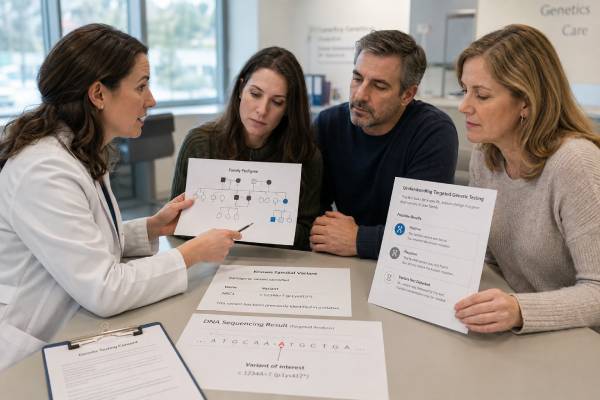
A familial variant genetic test checks for a specific DNA change that has already been identified in a biological relative. It is also called known familial variant testing, targeted mutation testing, or cascade testing. Because the laboratory is looking for one defined change rather than searching broadly across many genes, the test is usually faster, less expensive, and easier to interpret than a full gene panel. A positive result shows that the person carries the family variant; a true negative result shows that the person did not inherit it. The medical meaning depends on the gene, condition, inheritance pattern, penetrance, and whether the original family finding was pathogenic, likely pathogenic, or uncertain. The most important requirement is a copy of the relative’s laboratory report with the exact gene and variant notation. Testing based only on a family story or gene name can produce the wrong test and false reassurance. Results should be connected to a clear plan for medical care, reproductive counseling, and communication with other relatives.
- Targeted familial testing looks for one or more exact variants already documented in a blood relative.
- A positive result means the familial variant was found; it does not always mean the person currently has symptoms.
- A true negative result may return risk close to the general population, but only when the correct familial variant was tested.
- A variant of uncertain significance usually should not be used for predictive testing of healthy relatives.
- Blood, saliva, or a cheek swab can usually be used, and fasting is not required.
- The original relative’s complete report is essential because gene names, variant notation, and classifications can change.
Table of Contents
- What a Familial Variant Test Is
- Who May Benefit From Testing
- Information Needed Before the Test
- How Targeted Testing Works
- Positive, Negative, and Uncertain Results
- How Inheritance Changes the Meaning
- Medical and Reproductive Uses
- Limitations, Common Errors, and Next Steps
What a Familial Variant Test Is
A familial variant test is a focused DNA test designed to answer a narrow question: Did this person inherit the exact genetic variant found in a relative? The family member in whom the variant was first identified is often called the proband or index case. Once a pathogenic or likely pathogenic variant is established in that person, testing can move outward through the family in a process called cascade testing.
For example, a woman with breast cancer may have a pathogenic BRCA1 variant. Her adult siblings and children can then receive targeted testing for that exact BRCA1 change. A child with a metabolic disorder may have two pathogenic variants in a recessive gene, allowing parents and siblings to be tested for those specific variants. A person with inherited cardiomyopathy may have a disease-causing variant that helps identify relatives who need heart surveillance before symptoms appear.
Targeted testing differs from broad testing in several ways:
- It analyzes a defined variant rather than searching many genes.
- It usually produces a positive or negative result instead of a long list of findings.
- It has a lower chance of discovering unrelated variants or variants of uncertain significance.
- It may cost less and have a shorter turnaround time.
- It cannot identify a different disease-causing variant unless the laboratory was specifically asked to test for it.
The word “mutation” is still common in family letters and older reports, but “variant” is now preferred because not every DNA difference causes disease. The exact classification matters. Pathogenic and likely pathogenic variants can generally support predictive family testing. A benign or likely benign variant should not. A VUS usually lacks enough evidence for testing healthy relatives as though it were a known cause.
This test is a focused form of germline genetic testing. It looks for an inherited change in DNA obtained from blood, saliva, or cheek cells. It is different from testing a tumor alone, because some tumor variants are acquired only in cancer cells and are not present in the rest of the body.
Who May Benefit From Testing
Targeted familial variant testing is most useful for biological relatives of someone with a confirmed pathogenic or likely pathogenic germline variant. The relative’s degree of risk depends on how closely related the people are and how the condition is inherited.
People commonly offered testing include:
- Adult children of a person with an autosomal dominant condition
- Parents and siblings of a child with an autosomal recessive disorder
- Sisters, daughters, or maternal female relatives in a family with an X-linked condition
- Male relatives at risk for an X-linked disorder
- Maternal relatives when a mitochondrial DNA variant is present
- Partners of carriers when reproductive risk is being assessed
- Relatives who already have symptoms that could match the family condition
- Relatives considering pregnancy, embryo testing, or prenatal diagnosis
Testing often begins with the closest relatives because they have the highest probability of sharing the variant. In a typical autosomal dominant family, each child and full sibling of a carrier may have a 50% chance. In a recessive family, full siblings of an affected person may have a 25% chance of being affected and a 50% chance of being an unaffected carrier, assuming both parents are carriers.
Age and timing require judgment. Testing an adult can guide screening, preventive treatment, reproductive planning, or relief from unnecessary surveillance. Testing minors is generally appropriate when the result will change medical care during childhood. It is often postponed for adult-onset conditions when no childhood action is recommended, preserving the child’s future choice.
A symptomatic relative may need more than targeted testing. If the familial variant is absent but the symptoms strongly suggest an inherited disorder, a full gene analysis or multigene panel may be appropriate. Families can contain more than one genetic condition, and a relative’s illness may have a different cause.
Testing may also benefit relatives who live in different countries or receive care in different health systems. A concise family letter and the original report can reduce delays. The process is most effective when family members receive enough information to understand that testing is optional, confidential, and potentially relevant to their own health.
Information Needed Before the Test
The original laboratory report is the most important document. It should identify the gene, DNA-level variant, protein-level change when applicable, transcript, classification, laboratory, specimen type, and report date. A screenshot that cuts off these details may not be sufficient.
A reliable order may include notation such as:
- Gene: BRCA1
- Transcript: NM_007294.4
- DNA change: c.5266dup
- Protein change: p.Gln1756Profs*74
- Classification: pathogenic
- Test type: germline sequencing
Each part helps the testing laboratory confirm that it is examining the correct site. The same variant may have an older name, a different transcript description, or a historical protein label. Laboratories can usually reconcile these differences when they have the full report.
Before testing, confirm the following:
- Was the relative’s result germline? A tumor-only finding may or may not be inherited. Germline confirmation may be needed in the affected relative first.
- Is the variant pathogenic or likely pathogenic? Predictive testing for a VUS usually does not provide a medically actionable positive or negative answer.
- Does the reported gene match the family diagnosis? Some reports contain secondary findings unrelated to the reason for testing.
- Is the tested person biologically related through the relevant side of the family? A variant found on the paternal side does not increase risk for a maternal half-sibling.
- Could the family carry more than one variant? Large families, consanguinity, mixed diagnoses, or multiple affected branches may require broader analysis.
- Has the classification changed? An old report should be checked for reclassification before testing relatives.
A family history covering at least three generations improves interpretation. Record who is affected, age at diagnosis, major symptoms, cause of death, ancestry, and which side of the family connects each person. Documentation such as pathology reports or specialist records may help when the family diagnosis is uncertain.
Do not substitute a commercial ancestry result or raw-data file for a clinical report. Consumer tests may use different coordinates, limited marker arrays, or nonclinical interpretation. A clinically important finding should be confirmed in an accredited laboratory.
When the original report cannot be obtained, testing the affected relative again is often more informative than testing a healthy relative with a broad panel. Starting with the person most likely to carry the cause improves the chance of a meaningful result.
How Targeted Testing Works
The test usually requires blood, saliva, or a cheek swab. Fasting is not needed, and ordinary medicines do not change inherited DNA. For saliva, the person may need to avoid food, drink, gum, smoking, and toothbrushing for a short period before collection.
The laboratory designs or selects an assay that can detect the documented variant. The method depends on the variant type:
- Sanger sequencing or targeted next-generation sequencing for a single-nucleotide change or small insertion or deletion
- Polymerase chain reaction for certain repeat expansions or founder variants
- Copy-number methods for exon-level or whole-gene deletions and duplications
- Methylation-sensitive testing for imprinting disorders
- Mitochondrial analysis that accounts for heteroplasmy
- Chromosome or structural methods for translocations, inversions, or other rearrangements
A simple sequence assay cannot detect every variant type. The ordering clinician and laboratory must match the method to the familial finding. This is one reason the original report is essential.
The workflow usually includes:
- Review the family report and pedigree.
- Obtain informed consent and discuss possible results.
- Collect the DNA sample.
- Test the specified variant or variants.
- Confirm the result according to laboratory policy.
- Issue a report stating whether the familial variant was detected.
- Connect the result to surveillance, treatment, or reproductive guidance.
Turnaround time is often one to three weeks, although urgent prenatal testing may be faster and technically complex variants may take longer. Some laboratories offer reduced-cost family testing for a limited period after the original result.
The report should explicitly name the familial variant tested. Wording such as “negative genetic test” without the gene and variant is inadequate. It should also state whether the assay could detect mosaicism and whether the sample type creates limitations.
A targeted test is not the same as a multigene panel. A panel is appropriate when the cause is unknown or several genes could explain the condition. Targeted testing is preferred when a well-established familial cause is already known and the question is inheritance of that specific finding.
Positive, Negative, and Uncertain Results
The medical meaning of the result depends on the familial variant’s classification and the condition’s inheritance pattern. A result should never be interpreted from the word “detected” alone.
| Result | What it usually means | Common next step |
|---|---|---|
| Familial pathogenic variant detected | The person inherited the family variant. This may indicate disease, increased risk, or carrier status. | Follow condition-specific management and discuss relatives and reproductive implications. |
| Familial variant not detected | The person is a true negative for that variant if the family result and relationship are correct. | Stop variant-specific surveillance when appropriate, while continuing ordinary population care. |
| Inconclusive or failed test | The laboratory could not make a reliable call because of sample or technical limitations. | Repeat the sample or use another validated method. |
| Unexpected additional finding | Rare in a strictly targeted assay but possible if broader analysis was performed. | Clarify test scope and obtain genetics review. |
| Familial VUS detected or absent | Usually does not establish or exclude inherited disease risk. | Base care on personal and family history while awaiting better evidence. |
Positive result
A positive result means the tested person carries the familial variant. It does not necessarily mean that symptoms are present or inevitable. In a highly penetrant childhood disorder, the result may establish or strongly predict disease. In an adult-onset susceptibility condition, it may indicate increased risk that changes screening but cannot predict whether or when disease will occur. In a recessive condition, one variant may simply establish carrier status.
Penetrance is the proportion of people with a variant who develop the associated condition. Expressivity describes how symptoms differ among people who do develop it. A 50% inheritance probability should not be confused with 50% penetrance; they are separate concepts.
True negative result
A true negative means the person did not inherit the known familial variant. This can be more informative than a negative broad panel because the family cause is already established. For many dominant conditions, risk related to that variant returns close to population risk, and specialized surveillance may no longer be needed.
The word “true” matters. A negative result is only definitive when:
- The correct familial variant was tested
- The relative’s original finding was valid and germline
- The tested person is biologically related through the relevant family branch
- The assay could detect that variant type
- The family does not have another unrecognized cause that also explains disease
A true negative does not protect against unrelated disease. A person without the family BRCA1 variant can still develop sporadic breast cancer and should follow standard screening based on age and other risk factors.
VUS-related result
Testing healthy relatives for a VUS can sometimes help a laboratory gather evidence, but the result is usually not predictive. If a healthy relative lacks the VUS, that does not prove the relative is safe; if the VUS is present, that does not prove disease risk. Segregation testing should be coordinated by genetics professionals and interpreted as evidence-building rather than routine clinical cascade testing.
The distinction among pathogenic, benign, and uncertain variants should be clear before family members are tested.
How Inheritance Changes the Meaning
The same positive laboratory finding can have very different consequences depending on inheritance.
Autosomal dominant
One pathogenic variant can be sufficient to cause disease or increase risk. Each child of a carrier usually has a 50% chance of inheriting it. Full siblings may also have up to a 50% chance if one parent carries the variant. Examples include many hereditary cancer syndromes, Marfan syndrome, Huntington disease, and inherited cardiomyopathies.
A positive result may trigger surveillance even when the person feels well. A negative result can release the person from variant-specific monitoring if the family diagnosis is secure.
Autosomal recessive
Disease usually requires pathogenic variants in both gene copies. A person with one familial variant is generally a carrier. When both reproductive partners carry pathogenic variants in the same gene, each pregnancy often has a 25% chance of an affected child, a 50% chance of a carrier child, and a 25% chance of a child with neither variant.
Targeted testing may need to check two different familial variants. If an affected relative is compound heterozygous, testing only one variant can miss the other. Partner testing may require full-gene analysis rather than checking only the family’s variant.
X-linked
The effect depends on the gene, the person’s sex chromosomes, and the disorder. A male who inherits a pathogenic variant on his single X chromosome may be affected. A female carrier may be unaffected, mildly affected, or significantly affected because of variable X-chromosome inactivation. Transmission risks differ for sons and daughters.
Mitochondrial
Mitochondrial DNA is usually inherited through the mother. All children of a woman with a mitochondrial variant may inherit it, while children of a man generally do not. The proportion of altered mitochondrial DNA, called heteroplasmy, can vary among tissues and family members, making prediction difficult.
Imprinting, repeat expansion, and structural variants
Some conditions depend on which parent transmitted the variant, whether a repeat expanded between generations, or whether a chromosome rearrangement is balanced. A simple positive or negative explanation may be inadequate. Condition-specific counseling is essential.
An autosomal dominant test result and an autosomal recessive test result can therefore use the same testing method while creating very different medical and reproductive plans.
Medical and Reproductive Uses
A familial variant result is valuable only when it leads to an appropriate action. For medically actionable conditions, a positive result may change the age or frequency of screening, prompt imaging or laboratory monitoring, support preventive medication or surgery, influence treatment, or identify symptoms that deserve urgent review.
Examples include:
- Earlier colonoscopy for a hereditary colorectal cancer variant
- Breast MRI for certain hereditary breast cancer genes
- Heart imaging and rhythm monitoring for inherited cardiomyopathy
- Aortic imaging for connective tissue disorders
- Neurologic examination for inherited neuropathies
- Avoidance of specific anesthetic or medication risks
- Carrier-partner testing for recessive disease
Not every positive result leads to prevention. For conditions without a proven way to delay onset, such as Huntington disease, testing may primarily inform life planning, reproductive choices, and psychological preparation. Predictive testing protocols often include counseling and deliberate consent because the information can have major emotional effects.
A true negative can also change care. It may end repeated specialty visits, reduce imaging, remove uncertainty for children, and prevent unnecessary testing of descendants. The clinician should document which surveillance can stop and which ordinary health screening should continue.
Reproductive uses include partner testing, prenatal diagnosis, and IVF with preimplantation genetic testing for monogenic disease. These options usually require a well-defined pathogenic or likely pathogenic variant. A VUS may not be accepted for embryo or prenatal testing because its disease relationship is unresolved.
During pregnancy, chorionic villus sampling or amniocentesis can test fetal or placental DNA for a known variant. The result can show whether the variant was inherited, but it may not predict severity when penetrance or expression is variable. Prenatal testing should be coordinated early because laboratory setup and records can take time.
Family communication is part of the medical use. The original patient commonly receives a letter explaining the condition, variant, relatives who may be at risk, and how they can seek testing. The patient usually decides whom to contact, although privacy laws and professional duties vary by country and circumstance.
Limitations, Common Errors, and Next Steps
Targeted testing is precise, but its narrow scope is also its main limitation. It answers the question asked and little more.
Mistake: ordering by gene name alone. A gene can contain thousands of variants. The laboratory needs the exact familial change, not merely “test the BRCA gene” or “check the heart mutation.”
Mistake: using a tumor result as proof of inheritance. Tumor variants may be somatic. Germline testing of blood or saliva may be required before relatives receive cascade testing.
Mistake: testing a VUS as though it were pathogenic. A VUS should not direct preventive surgery, lifelong surveillance, or reproductive decisions unless it is reclassified or other compelling evidence exists.
Mistake: assuming a negative result explains symptoms. A relative with concerning symptoms may have another variant, another gene, or a nongenetic condition. Broader evaluation may still be needed.
Mistake: overlooking two familial variants. Recessive disorders, compound genotypes, and complex rearrangements may require testing more than one change.
Mistake: forgetting reclassification. Variant interpretation can change. Check an older report with the original laboratory or a genetics clinic before testing relatives.
Mistake: sharing only a portal summary. A result labeled “positive” without the full report can lead to duplicate or incorrect testing.
After a result, the next steps should be written and specific:
- Confirm whether the result is positive, true negative, inconclusive, or VUS-related.
- Review penetrance, age of onset, and condition-specific surveillance.
- Identify which relatives are on the relevant side of the family.
- Provide a copy of the report and a family letter.
- Discuss reproductive implications and partner testing when relevant.
- Record the result in the medical history and share it with appropriate specialists.
- Ask who is responsible for variant reclassification updates.
- Reassess if the family history changes or a second diagnosis appears.
Genetic counseling can help with decisions about testing minors, privacy, insurance, emotional readiness, family communication, and reproductive options. It is especially useful when the condition has reduced penetrance, no preventive treatment, uncertain onset, or major implications for children.
The most reliable familial variant test starts with a validated family result and ends with a tailored care plan. Its value comes from precision: the right person, the right variant, the right laboratory method, and the right interpretation.
References
- Cascade counselling and testing. Recommendations of the European Society of Human Genetics 2025 (Position Statement)
- Cascade genetic testing: an underutilized pathway to equitable cancer care? 2024 (Review)
- Cascade genetic counseling and testing in hereditary syndromes: inherited cardiovascular disease as a model: a narrative review 2024 (Review)
- National Experiences from 30 Years of Provider-Mediated Cascade Testing in Lynch Syndrome Families—The Danish Model 2024
- Points to consider for the reporting of variants of uncertain significance in germline genetic and genomic testing: A statement of the American College of Medical Genetics and Genomics (ACMG) 2026 (Position Statement)
- Standards and guidelines for the interpretation of sequence variants: a joint consensus recommendation of the American College of Medical Genetics and Genomics and the Association for Molecular Pathology 2015 (Guideline)
Disclaimer
This article is educational and does not replace genetic counseling, diagnostic evaluation, or condition-specific medical care. The meaning of a familial variant result depends on the exact variant, classification, inheritance pattern, penetrance, family relationship, and laboratory method. Do not change screening, treatment, or reproductive plans based on a copied result or family story without professional review of the original report.