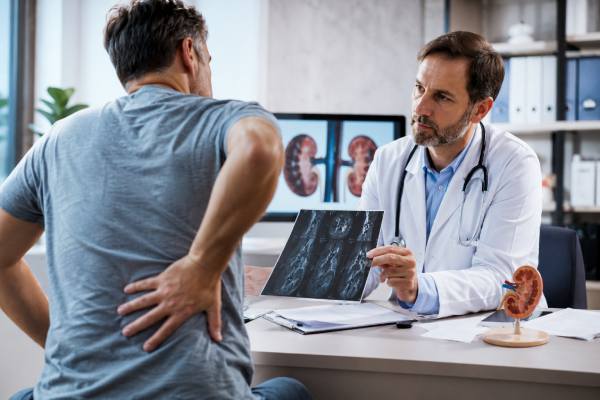
Flank pain is pain on the side of your body between the lower ribs and the top of the hip. It often raises one urgent question: is this coming from the kidney, or is it ordinary back or muscle pain?
The answer matters because the same area hurts for very different reasons. A pulled muscle after lifting a heavy box usually improves with rest, gentle movement, and time. A kidney stone, kidney infection, or blocked urinary tract needs medical attention, especially when pain comes with fever, vomiting, blood in the urine, or trouble passing urine.
This guide explains what flank pain feels like, how kidney-related pain differs from muscle strain, which symptoms deserve urgent care, and what tests doctors use to find the cause.
Table of Contents
- What flank pain means
- Kidney causes of flank pain
- Muscle strain and other back-related causes
- How to compare kidney pain and muscle pain
- When to seek medical care
- What doctors check and which tests help
- What to do while you are deciding
- Prevention and next steps after the pain improves
What flank pain means
Flank pain sits higher and more to the side than typical low back pain. Picture the area below the back ribs, wrapping around toward the side of the waist. The kidneys sit deep in this region, one on each side of the spine, but muscles, ribs, nerves, the spine, the bowel, and nearby organs also share the same pain map.
Kidney pain is usually deep. It often feels as if it is coming from inside the body rather than from the skin or surface muscles. Muscle pain is often easier to point to with one finger and often changes when you twist, bend, cough, lift, or press on the sore spot.
The location alone does not prove the cause. A kidney stone can cause pain that starts in the flank and travels toward the lower abdomen or groin. A tight or strained muscle near the ribs can hurt so sharply that it feels internal. Shingles can begin as burning side pain before a rash appears. Digestive problems, gallbladder pain, ovarian conditions, testicular problems, and serious blood vessel problems sometimes overlap with flank or back pain.
A useful first step is to look at the whole pattern: how the pain started, whether it comes in waves, whether movement changes it, whether urinary symptoms are present, and whether you feel systemically ill.
Kidney causes of flank pain
Kidney-related flank pain usually comes from stretching, swelling, inflammation, infection, or blockage in the urinary tract. The urinary tract includes the kidneys, ureters, bladder, and urethra. The ureters are the narrow tubes that carry urine from each kidney to the bladder.
Kidney stones
A kidney stone often causes sudden, intense flank pain when it moves from the kidney into the ureter. The ureter is narrow, so the stone irritates the tube and blocks urine flow. That pressure causes classic renal colic: severe pain that rises and falls in waves.
Stone pain often starts below the ribs on one side. It can travel around the side, into the lower belly, groin, testicle, or labia as the stone moves downward. People often feel restless and cannot find a comfortable position. Nausea and vomiting are common. Blood in the urine, burning with urination, urgency, or frequent small urinations also occur.
Not every stone causes unbearable pain. A stone sitting inside the kidney without blocking urine flow can be quiet or cause a dull ache. A small stone can still cause severe pain if it gets stuck in a tight spot. A larger stone is more likely to need treatment if it does not pass or if it blocks urine drainage. For a closer look at the pain pattern, see kidney stone pain symptoms.
Kidney stone pain becomes more urgent when it comes with fever, chills, repeated vomiting, inability to urinate, a known single kidney, kidney disease, pregnancy, or pain that stays uncontrolled despite reasonable pain relief.
Kidney infection
A kidney infection, also called pyelonephritis, is more serious than a bladder infection. It usually happens when bacteria move up from the bladder into one or both kidneys. The pain is often a steady ache or tenderness in the flank rather than the sharp waves of a stone.
Typical signs include fever, chills, feeling very unwell, nausea, vomiting, flank tenderness, burning when peeing, urinary urgency, frequent urination, cloudy urine, strong-smelling urine, or blood in the urine. Some people, especially older adults, pregnant people, and those with diabetes or weakened immune systems, have less typical symptoms.
A kidney infection needs prompt treatment with antibiotics. It becomes an emergency when infection is paired with a blocked kidney, because infected urine trapped behind an obstruction can lead to sepsis. Learn more about warning signs in kidney infection symptoms.
Urinary blockage and hydronephrosis
Hydronephrosis means swelling of the kidney because urine cannot drain normally. A stone is a common reason, but blockage also comes from scar tissue, tumors, enlarged prostate, pregnancy-related compression, or congenital narrowing.
The pain ranges from dull pressure to severe flank pain. It is often one-sided. If both kidneys are blocked, or if a person has only one working kidney, urine output drops. Very low urine output, swelling, weakness, confusion, or shortness of breath raises concern for kidney function problems and needs urgent evaluation.
Kidney cysts, bleeding, and less common kidney problems
Simple kidney cysts are common and usually painless. Pain becomes more likely when a cyst grows large, bleeds, ruptures, or becomes infected. Polycystic kidney disease can cause flank fullness, pain, blood in the urine, kidney stones, or recurrent infections.
Kidney cancer is a less common cause of flank pain. It is more concerning when pain comes with visible blood in the urine, unexplained weight loss, a lump in the side or abdomen, persistent fatigue, or unexplained fever. Most flank pain is not cancer, but blood in the urine always deserves proper evaluation. A practical next step is to review blood in urine red flags.
Muscle strain and other back-related causes
Muscle strain is one of the most common non-kidney reasons for pain near the flank. It often follows lifting, twisting, reaching, coughing hard, exercising differently than usual, sitting awkwardly, or doing yard work. The pain usually stays in the back or side muscles and gets worse when those muscles contract or stretch.
A strained muscle often feels sore, tight, cramping, or sharp with movement. Pressing on the area often reproduces the pain. Getting out of bed, rolling over, bending sideways, taking a deep breath, or lifting the knee on the painful side can make it worse. Resting in a supported position usually eases it.
Rib joint irritation, bruised ribs, spinal arthritis, disc problems, and nerve irritation can also cause side or back pain. A pinched nerve often brings burning, tingling, numbness, or shooting pain that travels around the rib cage, into the buttock, or down the leg. Shingles can begin as burning or stabbing pain on one side before a blistering rash appears.
Muscle strain usually improves over days to a couple of weeks. It should not cause fever, chills, burning urination, blood in the urine, vomiting, or a major change in urine output. Those symptoms point away from a simple strain.
Back-related pain still has red flags. Seek urgent care for new weakness, numbness in the groin or saddle area, loss of bladder or bowel control, severe pain after a fall or crash, fever with spine pain, a history of cancer with new unexplained back pain, or pain with unexplained weight loss.
How to compare kidney pain and muscle pain
No home checklist gives a perfect answer, but the pattern often points strongly in one direction. Think of kidney pain as deep pain with urinary or whole-body clues. Think of muscle pain as mechanical pain: it changes when the body moves, twists, lifts, stretches, or gets pressed.
| Feature | More typical of kidney-related pain | More typical of muscle strain |
|---|---|---|
| Location | Deep pain below the ribs, often one-sided | Sore area in the back, side, or rib muscles |
| Pain pattern | Waves of severe pain with stones; steady ache with infection | Sharp or aching pain linked to movement or position |
| Movement | Changing position often does not relieve stone pain | Bending, twisting, lifting, coughing, or pressing worsens it |
| Urine symptoms | Burning, urgency, blood, cloudy urine, or reduced urine output | Usually absent |
| Whole-body symptoms | Fever, chills, nausea, vomiting, feeling very ill | Usually absent unless pain is severe or another illness is present |
| Trigger | Often starts without a clear movement injury | Often follows lifting, exercise, twisting, or prolonged posture |
A common mistake is assuming kidney pain must be directly over the kidney. Stone pain moves as the stone moves. It can start in the flank and later feel lower in the abdomen or groin. Another mistake is assuming back pain is harmless because it started after activity. A person can strain a muscle and also have a UTI or stone, especially if urinary symptoms appear later.
Also avoid relying on pain severity alone. Muscle spasms can be intense. A kidney infection can start as a mild ache before fever and illness develop. The safest approach is to match pain severity with associated symptoms and personal risk factors.
For a deeper side-by-side explanation, see kidney pain vs back pain.
When to seek medical care
Flank pain needs emergency care when it points to infection, blockage, internal bleeding, a major abdominal problem, or nerve compression. Do not wait for pain to “declare itself” if the warning signs are clear.
Seek emergency care now for flank pain with:
- Fever, chills, shaking, confusion, or feeling seriously ill
- Repeated vomiting or inability to keep fluids down
- Severe pain that does not ease or comes in intense waves
- Blood in the urine with clots, or urine that looks red or cola-colored
- Trouble peeing, no urine, or a major drop in urine output
- Known single kidney, kidney transplant, advanced kidney disease, or recent urinary tract procedure
- Pregnancy
- Diabetes, immune suppression, chemotherapy, or high-dose steroid use with possible infection
- Severe pain after a fall, crash, or direct blow
- New leg weakness, numbness in the groin area, or loss of bladder or bowel control
- Sudden ripping or tearing pain in the back, chest, or abdomen, especially with fainting, sweating, or weakness
Call a clinician the same day for flank pain with burning urination, urgency, cloudy urine, mild fever, new nausea, a past history of kidney stones, or pain that is not improving after 24 to 48 hours. Same-day advice is also wise if you are older, have recurrent UTIs, take blood thinners, or have a condition that raises kidney risk.
If the pain clearly follows lifting or twisting, stays tender to touch, improves with rest, and has no urinary symptoms or fever, it is reasonable to treat it as a likely strain at first. Get checked if it worsens, spreads, lasts beyond a couple of weeks, or starts interfering with sleep, walking, or daily activities.
What doctors check and which tests help
A clinician starts by sorting urgent causes from common ones. The questions matter: when the pain started, where it travels, whether it comes in waves, what movement does to it, whether you have urinary symptoms, whether you have fever or vomiting, and whether pregnancy, kidney disease, a single kidney, or immune suppression changes the risk.
The physical exam often includes checking temperature, heart rate, blood pressure, hydration, abdominal tenderness, back and rib movement, and costovertebral angle tenderness. That last check means gently tapping the back near the kidney area. Pain with this tap supports kidney irritation or infection, but it does not prove the diagnosis by itself.
Urine tests
A urinalysis looks for blood, white blood cells, nitrites, bacteria, protein, crystals, and urine concentration. Blood supports a stone but also appears with infection, tumors, trauma, heavy exercise, and other urinary problems. White blood cells and nitrites support infection, but results still need context. A urine culture identifies bacteria and helps choose an antibiotic when infection is suspected or complicated. For details on common urine markers, see urinalysis result meanings.
A pregnancy test is important for anyone who could be pregnant because pregnancy changes imaging choices, medication choices, and the urgency of certain diagnoses.
Blood tests
Blood work often includes kidney function tests such as creatinine and eGFR, electrolytes, and a complete blood count. A high white blood cell count supports infection or inflammation. Abnormal creatinine suggests kidney stress, dehydration, blockage, or underlying kidney disease. Blood cultures are used when a person appears very ill or septic.
Imaging
Imaging is chosen based on the likely cause and the person’s risk. A non-contrast CT scan is highly accurate for kidney stones and also shows many other abdominal causes of severe pain. Ultrasound avoids radiation and is often preferred first in pregnancy, children, and some recurrent stone situations. Ultrasound is useful for kidney swelling and some stones, but it misses small ureter stones more often than CT.
Doctors balance accuracy, radiation exposure, pregnancy status, age, prior stone history, infection risk, and how sick the person looks. A person with severe flank pain, fever, and a blocked kidney needs faster action than someone with mild pain and a known history of small stones. For a practical comparison, see kidney ultrasound vs CT scan.
What to do while you are deciding
If you have severe symptoms or red flags, seek care instead of trying to manage the pain at home. Pain medicine and fluids do not fix an infected blockage, sepsis, internal bleeding, or a serious nerve problem.
For mild flank or side pain that looks like muscle strain, reduce heavy lifting and twisting for a short period, but avoid strict bed rest. Gentle walking, light movement, heat, and supported positions often work better than staying still all day. If pressing the muscle reproduces the pain, heat for 15 to 20 minutes at a time can ease spasm. Resume activity gradually when movement becomes easier.
For possible kidney stone pain without red flags, drink enough fluid to avoid dehydration, but do not force large amounts of water during severe nausea or vomiting. Forcing fluids does not push out a stuck stone and can make vomiting worse. Use a strainer if a clinician told you to catch the stone; stone analysis helps prevent future stones.
Pain relief choices need caution. Acetaminophen is often easier on the stomach and kidneys when used as directed. Nonsteroidal anti-inflammatory drugs, such as ibuprofen or naproxen, are often effective for stone pain and muscle strain, but they are not safe for everyone. Avoid them unless a clinician says they are safe if you have chronic kidney disease, reduced kidney function, stomach ulcers, are on blood thinners, have significant heart disease, are dehydrated, are pregnant, or have been told to avoid them. See NSAID kidney risks for more detail.
Do not take leftover antibiotics for flank pain. The wrong antibiotic can partially treat an infection, hide symptoms, and make culture results harder to interpret. It also does nothing for stones, muscle strain, shingles, or noninfectious causes.
Track practical details before you call or go in: temperature, urine color, whether you can keep fluids down, when you last urinated, where the pain travels, medicines taken, pregnancy possibility, kidney stone history, and any kidney disease history. These details speed up triage and testing.
Prevention and next steps after the pain improves
What you do after flank pain improves depends on the cause. A one-time muscle strain needs a different plan than a kidney stone, infection, or unexplained blood in the urine.
After a likely muscle strain, rebuild gradually. The goal is not complete rest; it is controlled return to normal movement. Start with walking, gentle range-of-motion, and light daily tasks. Avoid repeating the exact lift, twist, or workout that triggered the pain until you can move without guarding. If pain keeps returning, a physical therapist can check hip strength, core control, lifting mechanics, rib mobility, and work posture.
After a kidney stone, prevention is worth the effort because stones often recur. The most useful next steps are stone analysis when possible, review of imaging, and a prevention plan based on stone type and risk. Many people need higher daily fluid intake, less sodium, normal dietary calcium with meals, and targeted changes based on urine results. Recurrent stones, large stones, stones in both kidneys, kidney disease, or unusual stone types often call for a metabolic evaluation, sometimes including a 24-hour urine collection.
After a kidney infection, finish antibiotics exactly as prescribed and follow up if fever, flank pain, vomiting, or urinary symptoms do not improve as expected. Recurrent kidney infections need a search for contributing factors such as stones, obstruction, incomplete bladder emptying, reflux, prostate problems, or resistant bacteria.
After visible blood in the urine, do not ignore it even if pain improves. Stones and infections are common explanations, but clinicians still need to confirm the cause. Blood without pain, repeated blood on urine testing, clots, smoking history, or age-related risk often needs urology evaluation.
Flank pain that keeps returning deserves a clearer diagnosis. Keep a simple log of pain side, triggers, urinary symptoms, fever, activity, menstrual timing if relevant, hydration, and foods or supplements. Patterns help separate repeated muscle strain from urinary tract problems and other causes.
References
- ACR Appropriateness Criteria® Acute Onset Flank Pain-Suspicion of Stone Disease (Urolithiasis): 2023 Update 2023 (Guideline)
- EAU Guidelines on Urolithiasis 2025 (Guideline)
- Urinary Tract Infections: Core Curriculum 2024 2024 (Review)
- Recent clinical practice guidelines for the management of low back pain: a global comparison 2024 (Review)
- Ultrasonography versus Computed Tomography for Suspected Nephrolithiasis 2014 (RCT)
- WHO guideline for non-surgical management of chronic primary low back pain in adults in primary and community care settings 2023 (Guideline)
Disclaimer
This article is for education and does not diagnose the cause of flank pain. Flank pain with fever, vomiting, blood in the urine, pregnancy, reduced urine output, severe uncontrolled pain, or known kidney disease needs prompt medical advice. A qualified clinician can decide whether urine testing, blood work, imaging, antibiotics, stone treatment, or emergency care is needed.