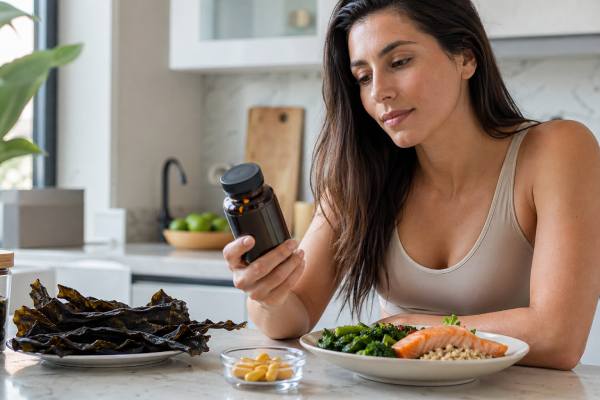
Fucoxanthin is a carotenoid found in brown seaweeds and some microalgae, and it is often marketed as a natural fat-burning supplement. The idea is appealing: a seaweed extract that may help increase fat oxidation, support metabolism, and make weight loss easier. The problem is that the marketing is usually much stronger than the human evidence.
At this point, fucoxanthin looks more promising in animal and laboratory research than it does in real-world weight-loss trials. That does not make it useless, but it does mean the supplement should be judged carefully. The sections below explain what fucoxanthin is, how it is supposed to work, what human studies actually show, where the evidence is still thin, and whether it makes sense as part of a realistic fat-loss plan.
Table of Contents
- What fucoxanthin is
- How fucoxanthin is supposed to work
- What human studies actually show
- Why the evidence is still limited
- Safety, side effects and who should be careful
- How to judge a fucoxanthin supplement
- Where fucoxanthin fits in a real weight loss plan
- A realistic verdict on fucoxanthin
What fucoxanthin is
Fucoxanthin is a naturally occurring pigment that gives many brown seaweeds and certain microalgae part of their color. It is not a vitamin, not a prescription drug, and not a proven obesity treatment. In supplements, it is usually sold as part of a brown seaweed extract or microalgae extract rather than as a widely standardized single-ingredient pharmaceutical-style compound.
That distinction matters.
When people hear “seaweed extract,” they often imagine a simple food-derived ingredient with predictable effects. In reality, supplements can vary a lot. One product may use brown algae, another may use microalgae, another may combine fucoxanthin with oil-based carriers, and another may include multiple compounds under the same marketing language. That makes it harder to compare labels and even harder to compare study results with what is actually sold online.
Fucoxanthin gets attention because it sits at the intersection of three very marketable ideas:
- It is marine-derived and sounds natural.
- It has mechanistic data suggesting anti-obesity effects.
- It is associated with brown seaweed, which already carries a “healthy food” halo.
Those points help explain why it keeps appearing in fat-burning blends, metabolism supplements, and “thermogenic” formulas. But they also create a gap between the ingredient’s reputation and the actual clinical evidence.
Another source of confusion is that fucoxanthin is not the same thing as eating seaweed in your diet. Whole seaweed contains fiber, minerals, iodine, polyphenols, and many other compounds besides fucoxanthin. A supplement may isolate or concentrate part of that picture, but it does not automatically reproduce the effects of whole-food seaweed intake, and whole-seaweed research does not automatically prove fucoxanthin itself is the active driver.
This is one of the first practical lessons with marine supplements: the label story is usually much cleaner than the biology. The word “seaweed” can make a product sound food-like and simple, but the actual question is narrower. Does the form, dose, and formulation of fucoxanthin used in a supplement meaningfully help human fat loss?
That is where the article needs to stay focused, because the main search intent is not “Is fucoxanthin interesting?” It is “Can it help people lose weight in a useful, reliable way?” So far, the answer is more cautious than most supplement ads suggest.
How fucoxanthin is supposed to work
The theoretical case for fucoxanthin is easy to understand. In preclinical research, it has been linked to changes that sound relevant to fat loss: increased energy expenditure, higher fat oxidation, less fat accumulation, altered lipid metabolism, and possible effects on adipocyte function. Some studies also suggest it may influence pathways related to thermogenesis and metabolic flexibility.
That is why fucoxanthin is often described as a “fat-burning” seaweed compound. In theory, it may help the body handle stored fat differently rather than merely acting as a stimulant or appetite suppressant.
A few mechanisms are discussed repeatedly in the literature:
- Support for fatty acid oxidation
- Reduced adipocyte differentiation and fat storage
- Possible effects on uncoupling proteins and thermogenesis
- Improvements in lipid handling and triglyceride metabolism
- Potential effects on insulin sensitivity and metabolic markers
On paper, that sounds strong. In practice, two problems show up quickly.
The first is that most of this evidence comes from cell studies and animal models. That is not meaningless, but it does not answer the real-world question most readers care about. Many compounds look impressive in mechanistic research and then produce little or no meaningful weight-loss effect in humans.
The second problem is bioavailability. Fucoxanthin is not a simple compound for the human body to absorb, preserve, and use efficiently. Reviews repeatedly point out that it is relatively unstable and has limited bioavailability. In other words, even if the mechanism is promising, getting enough intact compound into the body in a consistent, usable form is not straightforward.
That is one reason formulation matters so much. Fucoxanthin is often paired with oils, encapsulation systems, or algae extracts intended to improve delivery. But this creates another layer of uncertainty. When a study uses a specific delivery system or a multi-ingredient blend, it becomes harder to know whether the outcome came from fucoxanthin itself, the formulation, the carrier, the background diet, or some combination.
This is also why it is risky to jump from “may influence metabolism” to “helps break a weight-loss plateau.” Plateaus are rarely caused by a single missing fat-burning compound. More often they come from smaller calorie deficits, reduced daily movement, portion creep, inconsistent tracking, lower protein intake, sleep disruption, or weekend drift. If that sounds familiar, the issue is usually better solved by checking a weight loss plateau decision tree than by assuming a seaweed extract is the missing piece.
So the theory around fucoxanthin is interesting, but theory is not the same as dependable clinical effect. This is a supplement where the mechanism can sound more settled than the outcomes really are.
What human studies actually show
This is the most important section, because the human evidence is far more limited than most people expect.
There is one older trial that gets cited repeatedly in fucoxanthin marketing. It used a product called Xanthigen, which combined fucoxanthin from brown seaweed with pomegranate seed oil in premenopausal women with obesity, some of whom also had fatty liver. Participants followed a calorie-controlled diet, and the supplement group lost more weight than placebo over 16 weeks. That result is the main reason fucoxanthin built a reputation as a possible weight-loss ingredient.
But there are two major catches. First, the product was a combination formula, not fucoxanthin alone. Second, the participants were on a structured calorie-restricted diet. That means the study cannot cleanly prove that fucoxanthin by itself caused the result.
More recent human data are less exciting. A 2024 trial in overweight women tested a microalgae extract from Phaeodactylum tricornutum containing fucoxanthin during a 12-week exercise and diet program. The supplement did not produce additional weight loss or additional fat loss beyond the effects of the diet and exercise intervention itself. That does not mean fucoxanthin has zero activity, but it does weaken the idea that it meaningfully enhances an already sensible fat-loss plan.
There is also broader seaweed research to consider. A more recent systematic review and meta-analysis on dietary seaweed found modest improvements in BMI, fat mass, and some lipid markers in certain settings, especially with refined or extracted brown seaweed used for at least several weeks. The problem is that this still does not isolate fucoxanthin cleanly. Whole seaweed and brown seaweed extracts contain multiple potentially active compounds, so those results are supportive of the general seaweed-obesity research area, not conclusive proof for fucoxanthin as a standalone fat-loss ingredient.
A practical summary looks like this:
| Evidence type | What it found | Main limitation |
|---|---|---|
| Older positive combination trial | Greater weight loss than placebo during a calorie-controlled program | Used fucoxanthin plus pomegranate seed oil, not fucoxanthin alone |
| Recent microalgae extract trial | No additional weight loss or fat loss over diet and exercise alone | Specific formulation and population; still not definitive for every product |
| Seaweed meta-analysis | Some modest improvements in BMI, fat mass, and lipids | Does not isolate fucoxanthin from other seaweed compounds |
| Preclinical research | Strong mechanistic anti-obesity signal | Animal and lab findings do not guarantee human fat-loss effects |
So the honest reading is this: fucoxanthin is not backed by robust, repeatable human weight-loss evidence yet. It has one often-cited positive combination study, one more recent trial that did not show added fat-loss benefit in a structured program, and a broader seaweed evidence base that is suggestive but not specific enough to settle the question.
Why the evidence is still limited
Fucoxanthin is a good example of how a supplement can sound more proven than it really is.
The first reason the evidence is limited is simple: there are not many human trials. For a supplement sold as a metabolism aid or fat burner, the clinical database is surprisingly thin. That alone should make readers cautious. If an ingredient is heavily marketed but lightly studied in humans, confidence should stay modest.
The second reason is study design. The better-known positive study did not test fucoxanthin as a pure standalone intervention. It used a combination product and included a calorie-controlled diet. That does not invalidate the result, but it makes interpretation messy. When multiple changes happen at once, the clean answer to “Did fucoxanthin help?” becomes harder to extract.
The third reason is formulation variability. Fucoxanthin is not a simple off-the-shelf compound with universally comparable products. Supplements differ in source, concentration, carrier oils, delivery systems, and companion ingredients. One trial might use a microalgae extract, another a brown seaweed blend, another a proprietary formula. This makes it difficult to pool results and difficult for consumers to know whether the bottle they buy resembles anything actually studied.
The fourth reason is that body weight is a noisy outcome. If a trial includes calorie restriction, exercise, improved adherence, counseling, or better routine, those variables can swamp the contribution of a relatively subtle supplement effect. That does not mean the supplement is irrelevant, but it does mean any extra benefit needs to be clear and repeatable to matter in practice.
The fifth reason is that seaweed research is broader than fucoxanthin research. Seaweed contains several classes of bioactive compounds that may affect satiety, digestion, glucose handling, lipid metabolism, and inflammation. When a brown seaweed intervention improves an outcome, fucoxanthin might be part of the story, but not necessarily the whole story.
This is why supplement interpretation benefits from a more disciplined mindset. A product should not be treated as “effective” just because:
- it has a plausible mechanism,
- it has positive animal data,
- it belongs to a healthy-sounding food category, or
- one study found a benefit in a mixed formulation.
That same mindset is useful with almost every supplement marketed for fat loss. A page on weight loss claims and red flags is often more valuable than a long ingredient list, especially when a label leans hard on words such as thermogenic, metabolic, clinically proven, or scientifically backed without showing exactly what was studied.
The bottom line is not that fucoxanthin has been disproven. It has not. The problem is that the evidence is still too limited, too formulation-specific, and too inconsistent to justify strong real-world promises.
Safety, side effects and who should be careful
Fucoxanthin does not currently look like one of the more alarming weight-loss ingredients on the market, but that is not the same as saying it is well established as safe for everyone in all forms.
A careful way to put it is this: short-term human studies have not raised major widespread safety alarms, but the human safety database is still limited. That matters, because weak safety evidence and weak efficacy evidence often travel together in newer or niche supplement categories.
A few practical cautions make sense.
First, many fucoxanthin products are not pure pharmaceutical-grade fucoxanthin. They are seaweed or microalgae extracts, sometimes blended with other compounds. That means safety can depend not just on fucoxanthin itself, but also on the source material, extraction process, and any added stimulants or oils.
Second, brown seaweed-derived products can vary in iodine content unless the product is specifically standardized and clearly described. That is relevant for people with thyroid disease, people using thyroid medication, and anyone who is already consuming multiple seaweed-based supplements or foods. This does not mean every fucoxanthin product is high in iodine, but it is one more reason not to assume “seaweed-based” automatically means simple.
Third, safety in pregnancy, breastfeeding, adolescence, and complex medical conditions is not well established. For those groups, a supplement with thin efficacy data and limited long-term human safety data is usually a poor first choice.
Fourth, if a person already has digestive sensitivity, gallbladder concerns, or multiple supplements in the mix, adding another marine extract may add complexity without adding meaningful benefit. The risk may not be dramatic, but the upside may also be too small to justify the experiment.
Reasonable caution is especially warranted if you:
- have thyroid disease or take thyroid medication,
- are pregnant or breastfeeding,
- take multiple supplements at once,
- want to use a product with proprietary blends or unclear dosing,
- have a history of reacting badly to marine or algae-based products,
- expect the supplement to substitute for medical treatment or proven lifestyle change.
There is also the broader supplement-quality issue. Some products may underdose the active ingredient, overstate what is standardized, or rely on clinical language that is technically true but practically misleading. That is not unique to fucoxanthin, but it is especially relevant when the evidence base is narrow enough that small formulation differences matter.
This is one reason a supplement that looks gentle can still be a poor buy. The main problem may not be danger. It may be uncertainty. If the expected benefit is modest and the real composition is unclear, the product can still be hard to justify. Learning how to read labels and how to value independent quality checks matters here, which is why guides to reading supplement labels and third-party testing are more useful than marketing copy.
How to judge a fucoxanthin supplement
If someone still wants to try fucoxanthin after hearing the evidence limitations, the next step should be product judgment, not impulse buying.
The first question is whether the label makes the form clear. Is it a brown seaweed extract, a microalgae extract, or a multi-ingredient blend? Does it list actual fucoxanthin content in milligrams, or only the weight of a larger proprietary extract? Those are very different things.
The second question is whether the product resembles anything that has been studied. Most supplements borrow the language of research without matching the actual formulation, dose, or context. A label may mention “clinically studied seaweed extract” while selling a blend that adds multiple other ingredients and uses a different delivery system. That makes the study citation much less useful than it first appears.
The third question is whether the product asks you to believe too much from too little. Fucoxanthin is often sold with claims about burning stubborn fat, boosting metabolism, activating brown fat, curbing appetite, supporting thyroid-friendly energy, and improving metabolic health at once. When a product promises several major fat-loss effects from an ingredient with sparse human evidence, that is usually a sign to slow down.
A practical screening checklist helps:
- Does the label state actual fucoxanthin content?
- Is the source named clearly?
- Is the formula simple enough to interpret?
- Is there third-party testing or a credible quality standard?
- Does the product avoid exaggerated “fat-burning” language?
- Does the seller explain what human evidence exists and what does not?
It also helps to look at what is not on the label. If a supplement leans heavily on before-and-after imagery, proprietary blends, and bold metabolism claims but says little about formulation quality, that is rarely reassuring.
Cost is another underappreciated factor. Many people try niche supplements for months without a clear way to judge whether anything is happening. If the expected effect is small and uncertain, a higher monthly price raises the bar substantially. The question should not be only “Could this work a little?” It should be “Is this the best use of time, attention, and money for my specific plateau or fat-loss problem?”
That question becomes even more important when someone is already chasing progress with several supplements at once. Stacking uncertain ingredients rarely creates certainty. It usually creates expense, noise, and confusion about what is doing what.
In real life, the best fucoxanthin supplement is not the one with the most dramatic label. It is the one that is transparent enough for a skeptical person to judge. And even then, the evidence should still be treated as tentative, not as a sign that the product is a proven fat-loss tool.
Where fucoxanthin fits in a real weight loss plan
For most people, fucoxanthin belongs in the “possible but nonessential” category, not the “missing key” category.
That is especially true when progress has slowed. Plateaus usually feel mysterious, but they often come from familiar causes: smaller calorie deficits after weight loss, decreased daily movement, more restaurant meals, liquid calories, missed protein targets, weekend overeating, poor sleep, or gradual portion creep. In that setting, a mildly promising supplement is rarely the strongest lever.
A more useful order of operations is:
- Confirm whether the plateau is real.
- Check calorie intake, portions, protein, fiber, and movement.
- Review sleep, stress, alcohol, and routine consistency.
- Fix the highest-probability bottlenecks first.
- Only then decide whether a supplement experiment is worth the effort.
This matters because supplements often become a distraction from the basics that still explain most results. A person may spend weeks comparing seaweed extracts while overlooking the fact that their calorie deficit has quietly shrunk, their steps dropped, or their weekend intake erased weekday progress. If that sounds familiar, pages on adjusting calories and macros or hidden calories that stall weight loss are usually more actionable than another bottle.
That does not mean supplements never help. It means the threshold for usefulness should be realistic. A supplement with limited human evidence should only be expected to play a supporting role, and only after higher-probability issues are already in order.
There is also a mindset issue here. People often want a supplement to feel like progress. Buying something can feel easier than tightening a food environment, improving protein distribution, or being more honest about weekends. But perceived effort and effective effort are not the same thing.
A more grounded way to think about fucoxanthin is this:
- It is not a replacement for a calorie deficit.
- It is not a replacement for protein, fiber, and food structure.
- It is not a replacement for movement or sleep.
- It may be an optional experiment, but only after the basics are working.
That makes fucoxanthin very different from truly established obesity treatments. It is closer to a speculative add-on than a central strategy. For some readers, that alone answers the question. They are not looking for another marginal experiment. They are looking for what actually moves results.
A realistic verdict on fucoxanthin
Fucoxanthin is a plausible but still unproven weight-loss supplement.
The most accurate way to summarize it is this: the mechanism is interesting, the human evidence is limited, the one famous positive study used a combination product, and a more recent controlled trial did not show added weight-loss benefit when fucoxanthin-containing microalgae extract was layered onto a structured diet and exercise plan.
That puts fucoxanthin in an awkward middle ground. It is not pure hype in the sense that there is no rationale at all. But it is also not supported well enough to deserve the kind of “fat-burning” certainty that many labels imply.
For most people, the right expectation is modest at best. A sensible reader should assume one of three outcomes:
- no noticeable effect,
- a subtle effect that is hard to separate from other changes, or
- a benefit too small to matter compared with better-established habits.
That does not make it irrational to try. It just changes the standard for trying it. If someone chooses to experiment with fucoxanthin, the decision should be grounded in low expectations, careful product selection, and a clear understanding that the evidence does not currently support dramatic claims.
It is also worth noticing what the supplement market often teaches unintentionally. Ingredients that look best in theory are not always the ones that matter most in practice. Fat loss still responds more reliably to energy balance, food quality, satiety management, activity, and adherence than to niche compounds with thin human data.
So can seaweed extract help burn fat? Maybe a little in some contexts, but the current evidence does not justify treating fucoxanthin as a dependable or high-impact solution for weight loss. If someone wants the simplest, most honest answer, it is this: interesting ingredient, limited proof, low confidence as a game-changing supplement.
References
- Dietary Supplements for Weight Loss – Health Professional Fact Sheet 2022 (Official Fact Sheet)
- A Systematic Review on Marine Algae-Derived Fucoxanthin: An Update of Pharmacological Insights 2022 (Systematic Review)
- Fucoxanthin, a Functional Food Ingredient: Challenges in Bioavailability 2023 (Review)
- Effects of Supplementation with Microalgae Extract from Phaeodactylum tricornutum (Mi136) to Support Benefits from a Weight Management Intervention in Overweight Women 2024 (RCT)
- Effects of dietary seaweed on obesity-related metabolic status: a systematic review and meta-analysis of randomized controlled trials 2025 (Systematic Review and Meta-Analysis)
Disclaimer
This article is for general educational purposes only. Fucoxanthin supplements are not a substitute for medical advice, diagnosis, or treatment, and their safety, formulation quality, and usefulness can vary depending on your health history, medications, thyroid status, and overall weight-loss plan.
If this article helped, consider sharing it on Facebook, X, or another platform where it may help someone judge a supplement claim more carefully.