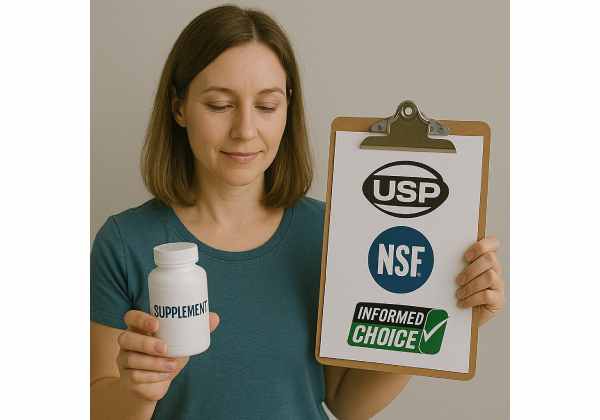
Third-party testing is one of the most useful quality filters in supplement shopping, but it is also one of the most misunderstood. A certification seal can mean a product was checked for label accuracy, contaminants, manufacturing quality, or banned substances. It does not automatically mean the supplement is effective, necessary, or safe for every person.
That distinction matters most in weight-loss supplements, sports products, and mixed “metabolism” formulas, where labels can look polished while the product itself is poorly supported or poorly controlled. The best way to read a seal is to treat it as one part of the decision, not the whole decision.
This article explains what third-party testing actually means, what USP, NSF, and Informed Choice are designed to do, what these seals do not promise, and how to use them in real buying decisions without giving them more authority than they deserve.
Table of Contents
- What third-party testing actually means
- Why it matters more for weight-loss supplements
- USP NSF and Informed Choice explained
- What these seals do not prove
- How to check whether a seal is real
- When third-party testing should carry the most weight
- A practical buying checklist
What third-party testing actually means
Third-party testing means an independent organization, rather than the supplement brand itself, has evaluated some part of a product’s quality. That can include identity, purity, strength, contaminant limits, manufacturing controls, or screening for banned substances. The exact meaning depends on the program.
That last point is the one most shoppers miss. “Third-party tested” is not one universal standard. It is an umbrella phrase. One program may focus on whether the label matches the bottle. Another may emphasize contaminants. Another may be especially relevant for athletes worried about substances that could trigger a failed drug test. The logo on the front is only useful if you understand what sits behind it.
This matters because supplements are regulated differently from drugs. In practical terms, supplements do not go through the same premarket approval process that prescription drugs and over-the-counter medicines do. That is one reason quality programs matter: they can add an extra layer of checking in a marketplace where consumers often assume more oversight exists than actually does. If a reader is comparing supplements with prescription treatment, it helps to understand that supplements and weight loss medications live under very different standards.
A good third-party certification can help answer questions such as:
- Does the product contain the listed ingredients?
- Does it appear to contain unacceptable contaminants?
- Was it made under a quality system that has been reviewed?
- Has it been screened for substances that matter in sports or drug-testing settings?
A good certification does not answer every important question. It does not tell you whether the ingredient has strong evidence for fat loss. It does not tell you whether the dose is ideal for your goal. It does not tell you whether the product interacts with your medications or fits your health history. It does not guarantee the brand’s other products are equally well controlled.
The most useful mindset is to treat third-party testing as a quality screen, not a performance promise. It is closer to saying, “This product cleared certain manufacturing or testing standards,” not “This supplement will work for you.” That still makes it valuable. In many supplement categories, quality is the first problem to solve before you even get to the evidence question.
Why it matters more for weight-loss supplements
Third-party testing matters in almost every supplement category, but it matters even more in weight-loss products because this part of the market tends to attract the boldest claims and the riskiest formulations.
Weight-loss supplements are often sold around urgency: faster fat loss, better metabolism, more energy, less appetite, or a flatter stomach in less time. That commercial pressure creates a setting where labels can become crowded with proprietary blends, stimulant stacks, trendy botanicals, or underexplained ingredient combinations. It is also a category where the gap between marketing language and real evidence is often wide. That is why learning to spot weak claims matters just as much as learning to spot good seals. Readers who want to build that broader skill set should also understand common weight-loss claims and red flags.
Products marketed for fat loss, pre-workout energy, “clean thermogenesis,” or appetite control often deserve more scrutiny than basic single-ingredient supplements. That does not mean every weight-loss supplement is dangerous. It means the downside of poor quality control is bigger when a formula contains stimulants, concentrated botanicals, or many active compounds in one capsule.
Examples of categories where quality checks become more important include:
- stimulant-heavy “fat burner” formulas
- products combining caffeine with multiple plant extracts
- appetite-control blends
- body-composition formulas sold through aggressive online marketing
- sports supplements where banned-substance contamination matters
- multi-ingredient products with vague proprietary blends
This is one reason people are wise to be especially cautious with categories such as fat burner supplements or higher-risk stimulant ingredients like yohimbine. Even when an ingredient has some research behind it, the finished product can still be a problem if the label is inaccurate, the dose is not what it claims to be, or contaminants enter during manufacturing.
There is another reason third-party testing matters here: many weight-loss products are used by people who are already frustrated, plateaued, or tempted by “last 10 pounds” promises. That makes it easier to overvalue a certification mark. A seal can lower one category of risk, but it cannot turn a weak idea into a strong one. A well-made supplement can still be unnecessary. A clean label can still sit on top of poor evidence.
So in weight-loss shopping, the right order is:
- Is the goal realistic?
- Is the ingredient or formula itself sensible?
- Is the dose transparent?
- Has the product been independently checked?
Shoppers often start with number four. It is helpful, but it should not come first.
USP NSF and Informed Choice explained
USP, NSF, and Informed Choice are all well-known names in supplement quality, but they are not interchangeable. They overlap, yet each emphasizes slightly different things.
| Program | Main focus | What shoppers usually take from it | Important limitation |
|---|---|---|---|
| USP Verified | Product quality against defined standards, including identity, composition, contaminants, and manufacturing controls | The product has been reviewed for quality and conformance, not just branding | It does not prove the supplement is effective for weight loss or right for your situation |
| NSF | Label claim review, toxicology review, contaminant review, and certification against supplement standards; some NSF programs also focus on sport | The label is more trustworthy and the product has gone through a structured certification process | Not every NSF mark means the same thing, and not every product is screened for sport-related banned substances |
| Informed Choice | Supplement testing, retail monitoring, and manufacturing oversight with attention to impurities and banned-substance risk | The product has been checked through a recognized quality assurance program and may be especially relevant for active consumers | It is still not a guarantee of effectiveness, zero risk, or perfect fit for every user |
USP refers to the U.S. Pharmacopeia, an organization that sets public quality standards and also runs verification programs. In plain language, USP is about whether a product meets meaningful quality expectations, not whether the marketing is compelling. That distinction is especially useful in supplements because a polished label and a solid product are not the same thing.
NSF is one of the most recognized names consumers see on vitamins, sports supplements, and performance products. Its supplement certification work is built around verifying that the label matches the contents, reviewing toxicology, and checking for contaminants. It also runs sport-specific certification programs, which is why some consumers know the NSF name mainly from athlete-focused products.
Informed Choice is particularly familiar in active-lifestyle and sports-adjacent supplement markets. Its program focuses on testing and quality assurance, and it is often especially relevant when a buyer is concerned about impurities or banned-substance exposure. That does not mean it is only for elite athletes. It means the program’s value is easy to understand in categories where contamination concerns are high.
The most practical takeaway is simple: the logo matters, but the program name matters too. “NSF” is not enough if you do not know which NSF certification is being referenced. “Informed” is not enough if you do not confirm which Informed program the product is actually using. “USP quality” language is not the same as a verified mark.
That is why experienced shoppers do not stop at the badge. They ask, “Which exact program is this, and what does that program actually test for?”
What these seals do not prove
This is the section most consumers need, because certification marks are often overread.
A third-party seal does not prove that a supplement works for fat loss. It does not prove that the dose is clinically effective. It does not mean the product is FDA approved. It does not mean the formula is ideal just because the manufacturing or testing process was stronger than average.
That is a big deal in weight management. Many products are technically clean but practically underwhelming. A well-made supplement with weak evidence is still weak. A correctly labeled capsule with a trendy ingredient is still subject to the same question: does this ingredient meaningfully help most people lose weight in the real world?
This is also where shoppers confuse quality with safety. Quality testing can reduce the chance of some problems, such as mislabeling or unacceptable contaminants, but it does not erase normal supplement risks. Caffeine can still worsen anxiety or sleep. A fiber product can still cause bloating. A botanical can still interact with medication. A stimulant-containing product can still be a poor fit for someone with blood pressure issues, heart symptoms, or a history of panic. A third-party seal cannot personalize the decision for you.
There is another common mistake: assuming that a seal applies to the whole brand. Usually, certification applies to a specific product or line, not every item that company sells. A brand may carry a certified protein powder and an uncertified stimulant blend at the same time. If you only remember the logo, you can end up extending trust more broadly than the evidence allows.
The other limit is that not every good product carries a seal. Certification costs money, time, and ongoing compliance work. Some strong single-ingredient products may come from reputable brands and still choose not to participate in a formal certification program. So the absence of a seal is not automatic proof of low quality. It just means you lose one useful shortcut.
A smart way to frame it is this:
- A certification mark can raise confidence in quality control.
- It cannot replace evidence for effectiveness.
- It cannot replace judgment about dose, goal, or personal safety.
That is especially important in supplement categories where people are already prone to chasing shortcuts. Reading the label carefully, keeping claims in perspective, and knowing what a quality seal does not say will usually save more money than memorizing logos alone. That same skill becomes even more useful when you start comparing ingredient-specific products such as green tea extract or broader formulas that promise several effects at once.
How to check whether a seal is real
The most common mistake after spotting a seal is stopping there.
A trustworthy buying process goes one step further: verify the product in the certifier’s database or public listing. That sounds tedious, but it usually takes only a minute and can tell you whether the seal actually belongs to the exact item in your hand.
Here is a simple process that works well:
- Read the exact seal name. Do not rely on colors or shapes alone.
- Go to the certifier’s official website. Search for the product, not just the brand.
- Match the full product details. Check the exact name, flavor, form, and sometimes even lot or batch details if available.
- Confirm the certification is current. A past certification or a vague brand relationship is not the same as a current listing.
- Compare the label in hand with the listing online. Packaging changes can create confusion.
This is especially important because supplement packaging often uses quality language in slippery ways. “Manufactured in a GMP facility,” “lab tested,” “quality assured,” and “made with USP-grade ingredients” are not automatically the same as a finished product carrying a formal third-party certification. Some of those phrases may be true, but they mean something different.
A second good habit is to read beyond the front label. The back panel still matters. Third-party testing does not make weak labeling acceptable. If the product hides amounts inside a proprietary blend, overuses structure-function claims, or makes you work hard to identify the active ingredients, that is still a usability problem. This is where broader label literacy becomes valuable. If you want a more systematic way to assess formulas, it helps to review the basics of reading supplement labels for weight loss so you do not treat the seal as the whole story.
There is also a practical consumer insight here: real quality programs tend to be easier to verify than fake confidence signals. A brand that truly participates in third-party certification usually wants you to confirm it. A brand that leans on vague “tested for purity” language without naming the testing body often makes verification harder.
When you cannot verify a certification, confidence should go down. Not necessarily to zero, but enough to slow the purchase. Good supplements can survive a few seconds of scrutiny. Weak ones usually depend on impulse.
When third-party testing should carry the most weight
Third-party testing is useful across the board, but it should carry the most weight when the downside of poor quality control is high.
That includes products with one or more of these features:
- multiple active ingredients
- stimulant-heavy formulas
- botanicals or plant extracts with variable composition
- products used around training or competition
- products sold for aggressive goals like rapid fat loss, pre-workout intensity, or appetite suppression
- products purchased through marketplaces where listing quality varies
By contrast, some lower-complexity categories may be easier to evaluate even without a certification seal, especially if the ingredient is straightforward, the dose is clear, and the brand has a strong track record. That does not make independent testing unimportant. It just means the relative benefit of certification gets bigger as product complexity and downside risk rise.
A useful real-world comparison is this:
- A simple protein powder or creatine from a transparent company is usually easier to assess than a 14-ingredient “thermogenic shred matrix.”
- A well-labeled probiotic or fiber supplement is usually easier to think through than a proprietary metabolism capsule full of stimulants and extracts.
- A basic vitamin D or magnesium product is a different buying problem from a fat-loss blend promising appetite control, cortisol support, energy, and lipolysis in one serving.
This is why many careful shoppers are stricter about third-party testing in sports powders, pre-workouts, recovery blends, and fat-loss stacks than they are in simpler products such as protein shakes or more modest categories like probiotics. The more complex the formula, the more useful an independent quality check becomes.
Athletes, drug-tested professionals, and military personnel have an extra reason to care. In those settings, even a small contamination problem can have outsized consequences. That is where knowing the exact program and verifying the exact product becomes much more than a nice extra.
One more nuance is worth keeping in mind: quality certification is a stronger tiebreaker when you are already deciding among otherwise reasonable products. It should not rescue a bad idea. If two comparable products both make sense and one carries a trusted, verifiable certification, that is a meaningful advantage. But if the formula itself is poorly justified, the seal should not talk you into it.
A practical buying checklist
The easiest way to use third-party testing well is to fold it into a short decision checklist. That keeps the seal in proportion and stops it from becoming a shortcut for the entire evaluation.
Use this order before you buy:
- Clarify the goal. Are you trying to fill a nutrient gap, support training, improve convenience, or chase fat loss faster?
- Check whether the ingredient itself makes sense. A certified weak formula is still weak.
- Read the active ingredients and amounts. Avoid treating the front label as the product.
- Look for a recognizable, verifiable quality program.
- Confirm the exact product online.
- Check the basics of fit: stimulant load, dose size, medication interactions, personal tolerability, and cost.
- Decide whether this product solves a real problem or just sounds reassuring.
For most readers, a smart buying standard sounds like this:
- Prefer transparent labels over proprietary blends.
- Prefer specific doses over vague marketing language.
- Prefer verifiable certification over generic “lab tested” claims.
- Prefer simple, well-rationalized formulas over overloaded ones.
- Prefer a realistic role for supplements within an overall nutrition plan.
This last point matters more than it gets credit for. Many people spend the most attention on supplement quality while underinvesting in the bigger drivers of body composition: calorie intake, food quality, protein, satiety, sleep, training consistency, and daily movement. Supplements are easier to shop for than habits are to change, so they often get disproportionate attention.
That does not mean quality seals are a minor detail. They are genuinely useful. But the best use of third-party testing is not as a badge that ends the decision. It is as a filter that helps you rule out weaker options and keep your standards high.
If you remember only one sentence from this article, make it this: a certification seal is best used as proof of better quality control, not proof of better results. That mindset is what keeps USP, NSF, and Informed Choice useful instead of misleading.
References
- Dietary Supplements: What You Need to Know – Consumer 2023 (Fact Sheet)
- Dietary Supplements for Weight Loss – Health Professional Fact Sheet 2022 (Fact Sheet)
- What Should Clinicians Know About Dietary Supplement Quality? | Journal of Ethics | American Medical Association 2022 (Review)
- Dietary Supplement and Vitamin Certification | NSF 2026 (Certification Overview)
- Certified Dietary Supplements | Informed Choice 2025 (Certification Overview)
Disclaimer
This article is for general educational purposes only and is not a substitute for medical advice, diagnosis, or treatment. If you have a medical condition, take prescription medicines, compete in a drug-tested sport, or are considering weight-loss supplements, speak with a qualified clinician or pharmacist before starting a product.
If you found this article useful, consider sharing it on Facebook, X, or your preferred platform.