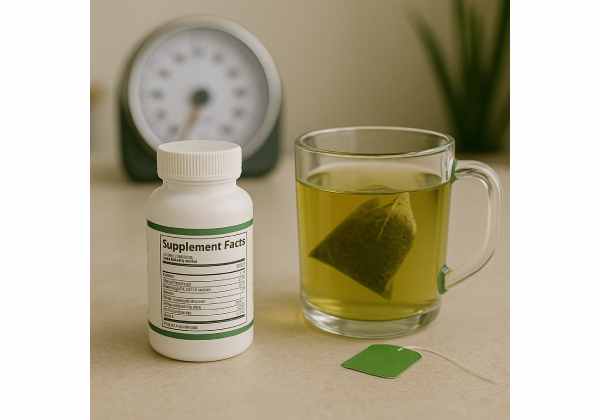
When weight loss slows, concentrated “fat-burning” supplements start to look more appealing. Green tea extract, especially its best-known catechin EGCG, is one of the most commonly marketed options. It is often promoted as a metabolism booster, appetite helper, and plateau breaker.
The evidence is more limited than the marketing suggests. Green tea extract may produce a small effect on body weight or body fat markers in some people, especially when it is paired with diet and exercise, but it is not a dependable shortcut and it does not solve the usual reasons fat loss stalls. It also comes with a more important downside than many people realize: concentrated green tea extract has been linked to rare but well-documented liver injury, particularly at higher doses and when taken on an empty stomach.
Table of Contents
- What Green Tea Extract Actually Does
- What the Weight Loss Evidence Shows
- Dose, Form and How to Use It
- Side Effects and Safety Risks
- Who Should Be Cautious or Avoid It
- Is EGCG Worth Trying for a Plateau?
- Better Ways to Support Fat Loss
What Green Tea Extract Actually Does
Green tea extract is a concentrated supplement made from Camellia sinensis. Its main active compounds are catechins, and the most discussed catechin is epigallocatechin gallate, usually shortened to EGCG. Many products also contain caffeine unless they are specifically labeled decaffeinated.
In theory, green tea extract could support fat loss in a few ways:
- It may slightly increase energy expenditure.
- It may increase fat oxidation under some conditions.
- It may give a mild alertness boost because of caffeine.
- It may make some people feel more “on plan” when it replaces a more indulgent routine.
That sounds promising, but the gap between mechanism and real-world results matters. A supplement can have measurable biochemical effects and still produce very little visible change on the scale. That is often the case here.
Green tea extract is also very different from drinking green tea. A brewed drink delivers a food-like exposure in a slower, more diluted form. A capsule can deliver a concentrated bolus of catechins all at once. That difference matters because the safety profile of tea as a beverage is much better than the safety profile of high-dose extract supplements.
Another practical issue is label variability. Two products can both say “green tea extract” on the front and still provide very different amounts of EGCG, total catechins, caffeine, and other plant compounds. A 500 mg capsule does not necessarily mean 500 mg of EGCG. It often means 500 mg of total extract, with the active fraction varying by brand and standardization method.
This is why green tea extract is best viewed as a modest adjunct, not a core weight-loss tool. The real drivers of fat loss are still calorie balance, diet adherence, protein intake, daily movement, resistance training, sleep, and how long you have actually been consistent. If those factors are weak, EGCG will not rescue the plan.
What the Weight Loss Evidence Shows
The fairest summary of the research is this: green tea extract may help a little, but the average effect is usually small.
Some trials and meta-analyses show reductions in body weight, BMI, or body fat percentage. That sounds impressive until you look at the size of the change. In many cases, the improvement is statistically significant but not dramatic enough to transform results on its own. Other outcomes, such as waist circumference or fat mass, are less consistent. Older reviews have also suggested that catechins alone are not especially effective when separated from the broader context of diet, activity, and caffeine.
That pattern makes sense in practice. A supplement that nudges energy expenditure by a small amount can help around the edges, but it cannot compensate for an eating pattern that has drifted upward, a drop in daily movement, or a deficit that has simply become too small as body weight decreases.
For people stuck at a plateau, this matters even more. A plateau is usually not a sign that you suddenly need a special ingredient. It is more often a sign that one of the fundamentals has changed:
- body size is lower now, so energy needs are lower
- step count or daily activity has quietly dropped
- food portions have crept up
- weekends are erasing the weekday deficit
- fatigue is making adherence worse
- water retention is masking progress for a few weeks
That is why a supplement should never be the first thing you troubleshoot. Before blaming a lack of EGCG, it is usually smarter to check whether protein intake is too low or whether better high-volume eating tactics would improve satiety and adherence more than any capsule could.
There is also a behavioral benefit to keeping expectations realistic. People often buy green tea extract hoping for a visible acceleration in fat loss within a week or two. That expectation sets them up for disappointment, dose escalation, or stacking multiple stimulants. A better expectation is that, at most, it may provide a small assist when the rest of the plan is already solid.
So does it “work”? In a narrow sense, it can have a measurable effect. In the sense most people mean when they ask the question, the answer is more restrained: it is not a powerful weight-loss aid, and it is not a reliable plateau breaker.
Dose, Form and How to Use It
There is no universally accepted “best dose” of green tea extract for weight loss. Human studies have used a wide range of catechin doses, and products on the market vary even more. That alone should make you cautious about any article or label that claims a single perfect dose.
A practical way to think about green tea exposure is by form rather than by hype.
| Form | What it is | Main upside | Main drawback |
|---|---|---|---|
| Brewed green tea | A beverage with variable catechin and caffeine content | Lower-risk, familiar, easy to fit into a routine | Less concentrated and less predictable |
| Standardized extract capsule | A supplement listing extract strength and sometimes EGCG percentage | More predictable than tea | Higher exposure per dose and more safety concern |
| Decaffeinated extract | Green tea extract with most caffeine removed | Less stimulant load | Liver risk is still about catechin dose, not just caffeine |
| Multi-ingredient fat burner | Green tea mixed with caffeine and other stimulants | Often feels stronger subjectively | Harder to judge effect, dose, and side effects safely |
If you decide to try green tea extract, the safest mindset is conservative:
- Start with a low dose from a brand that clearly lists total catechins or EGCG.
- Take it with food, not while fasted.
- Avoid stacking it with multiple stimulant products.
- Keep total caffeine intake in mind, including coffee, pre-workout powders, and energy drinks.
- Judge results over several weeks, not a few days.
A useful reality check is that higher dose does not automatically mean better fat loss. Once the dose gets aggressive, the safety tradeoff worsens faster than the likely benefit improves. That is especially true with products that deliver a large amount of EGCG in a single serving.
Quality matters too. Choose brands that make it possible to read supplement labels clearly and that provide evidence of third-party testing. Avoid proprietary blends, hidden stimulant combinations, and labels that emphasize “thermogenesis” without telling you how much EGCG or caffeine is actually inside.
For most people, a green tea habit is more sensible than a high-dose extract habit. A supplement should only be considered when you understand exactly what dose you are taking and why.
Side Effects and Safety Risks
The biggest mistake people make with green tea extract is treating it like harmless tea in pill form. It is not the same exposure.
The common side effects are not surprising. Because many products contain caffeine, users may notice:
- jitteriness
- faster heartbeat
- trouble sleeping
- restlessness
- headache
- increased blood pressure
- anxiety or shakiness
Digestive side effects are also common. Nausea, abdominal discomfort, constipation, and general stomach upset show up more often than dramatic “fat-burning” results.
The more serious issue is liver injury. This is uncommon, but it is real enough to change the risk-benefit equation. The concern is strongest with concentrated extracts, especially at higher doses and especially when they are taken on an empty stomach. That seems to increase catechin exposure and may raise toxicity risk in susceptible people. There is also substantial person-to-person variability, which means a dose that seems tolerable for one user may still be a bad fit for another.
This is why green tea extract deserves more caution than its “natural” label suggests. Natural compounds can still be potent, dose-dependent, and occasionally harmful.
Warning signs that should never be ignored include:
- dark urine
- yellowing of the eyes or skin
- right upper abdominal pain
- unusual fatigue
- persistent nausea or vomiting
- unexplained itching or loss of appetite
If those symptoms appear, the supplement should be stopped and medical care should be sought promptly.
Green tea compounds may also reduce iron absorption, which matters for people with low iron intake, iron deficiency, or anemia. This is more relevant when tea or extracts are taken close to iron-rich meals or iron supplements.
Finally, do not underestimate interaction risk. Green tea and green tea extract can affect certain medications, and some of the better-documented concerns involve drugs such as nadolol, atorvastatin, and raloxifene. That does not mean everyone on those medications will have a problem, but it does mean “it’s just tea” is not a safe assumption.
Who Should Be Cautious or Avoid It
Green tea extract is not a good “try it and see” supplement for everyone. The people who should be most cautious are the ones most likely to assume a supplement is low-risk because it is sold over the counter.
Avoid green tea extract, or use it only with clear clinical guidance, if any of the following apply:
- you have liver disease or a history of abnormal liver enzymes
- you have previously reacted badly to a supplement
- you are pregnant or breastfeeding
- you are very sensitive to caffeine
- you have significant anxiety, palpitations, uncontrolled hypertension, or sleep problems
- you have iron deficiency or are actively treating anemia
- you take medications that may interact with green tea compounds
- you follow aggressive fasting routines and plan to take it on an empty stomach
People trying to lose the last few pounds are another group that should think carefully. The closer you get to goal weight, the smaller the expected benefit becomes, while the downside risk does not disappear. That makes concentrated extract harder to justify.
The same goes for people who are already using multiple supplements or a prescription weight-loss medication. Once several products are in the mix, it becomes much harder to identify what is helping, what is causing side effects, and what is altering appetite, sleep, heart rate, or digestion. The cleanest plan is usually the safest one.
A final point: decaffeinated does not automatically mean risk-free. Some users switch to decaf extract to avoid jitters, which can be reasonable, but that does not remove concerns related to high catechin exposure. The stimulant burden may be lower, but the extract can still be concentrated.
When in doubt, the safer assumption is that concentrated EGCG deserves the same respect you would give any other active supplement with a known organ-specific risk.
Is EGCG Worth Trying for a Plateau?
Usually, no. Or at least, not first.
For a true plateau, green tea extract ranks low on the list of fixes that reliably matter. Before you spend money on it, work through a structured plateau decision tree and remember that your deficit shrinks as you lose weight. Those two ideas explain far more stalled progress than any missing supplement does.
A sensible plateau review usually includes these questions:
- Has average scale weight truly been flat for at least two to four weeks?
- Has food tracking become less precise?
- Has restaurant eating, weekend intake, or snacking increased?
- Has step count fallen because of fatigue or routine changes?
- Has gym performance dropped, leading to lower training quality?
- Has sodium, menstrual-cycle water retention, or constipation masked fat loss?
- Have calories simply not been recalculated in a while?
Green tea extract does not fix those problems. At best, it may slightly improve the margins while you fix them.
This is especially important for people prone to “supplement substitution,” where buying a new product feels like action even though the real issue is inconsistent nutrition, lower activity, or diet fatigue. That pattern is common during long fat-loss phases because the basics feel boring and a new capsule feels promising.
If your plan is already strong, the extract might be a modest add-on. If your plan is shaky, it is mostly a distraction.
That does not make EGCG useless. It just means it belongs in the optional category, not the essential category. It is a small lever, and plateaus are usually caused by bigger ones. A well-run nutrition plan, enough protein, resistance training, sleep, daily movement, and honest tracking beat green tea extract almost every time.
Better Ways to Support Fat Loss
If your goal is to get some of the potential upside of green tea extract without taking on unnecessary risk, there are usually better options.
The first is plain brewed green tea. It can replace sugary drinks, provide a mild caffeine lift, and fit into a calorie deficit more easily than soda, juice, or high-calorie coffee beverages. It is not a miracle tool, but it is often a safer and more sustainable habit than concentrated extract.
The second is tightening the basics that actually move the needle:
- hit a reliable protein target
- build meals around filling whole foods
- keep step count from drifting down
- protect sleep so appetite stays easier to manage
- watch weekend calories and liquid calories
- use a small number of clear habits instead of chasing new products
If you do want an appetite-supportive supplement strategy, learn how caffeine dose and timing affect results and side effects, and consider whether evidence-based fiber supplements would solve the real problem more directly. For many people, hunger control is the actual issue, not a lack of thermogenesis.
It also helps to match the tool to the job:
- Need more energy for training? Sleep, meal timing, and caffeine management are usually more effective.
- Need better fullness? Protein, fiber, and food volume matter more.
- Need fewer calories without more hunger? Beverage swaps and simpler meals help.
- Need better consistency? A repeatable routine beats a rotating supplement stack.
The bottom line is straightforward. Green tea extract is not worthless, but it is oversold. The most realistic benefit is small, the best version of it is still optional, and the risks become more meaningful as the dose gets more aggressive. For most people trying to lose weight, especially those dealing with a plateau, it is smarter to optimize the plan first and treat EGCG as a cautious maybe, not a missing key.
References
- Dietary Supplements for Weight Loss 2022 (Health Professional Fact Sheet)
- Summary of Health Canada’s Safety Assessment of Green Tea Extract for Use as a Supplemental Ingredient 2024 (Safety Assessment)
- The effects of green tea extract supplementation on body composition, obesity-related hormones and oxidative stress markers: a grade-assessed systematic review and dose–response meta-analysis of randomised controlled trials 2024 (Systematic Review and Meta-Analysis)
- Hepatotoxicity with High-Dose Green Tea Extract: Effect of Catechol-O-Methyltransferase and Uridine 5′-Diphospho-glucuronosyltransferase 1A4 Genotypes 2023 (Study)
- United States Pharmacopeia (USP) comprehensive review of the hepatotoxicity of green tea extracts 2020 (Review)
Disclaimer
This article is for general educational purposes only. Green tea extract and EGCG can affect the liver, blood pressure, sleep, iron absorption, and certain medications, so it is not a substitute for personalized medical advice, diagnosis, or treatment. If you have liver disease, take prescription medications, are pregnant or breastfeeding, or develop symptoms such as dark urine, jaundice, or persistent nausea, speak with a qualified clinician before using it.
If you found this article useful, please share it on Facebook, X, or any other platform where it may help someone make a safer, more informed decision.