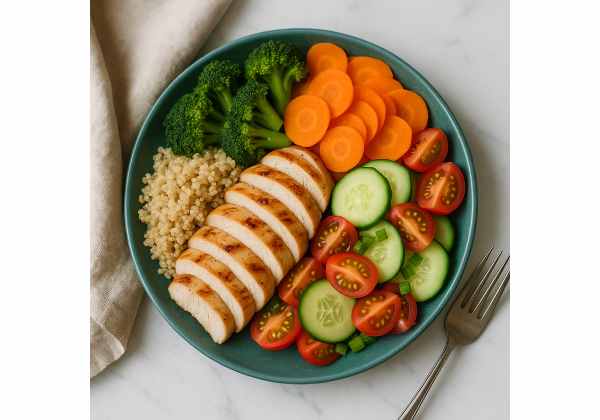
When weight loss slows down, cutting calories harder is often the first impulse and usually the least sustainable fix. Plateaus tend to come with more hunger, less room for error, and a smaller calorie budget than you had at the start, so the same meals that worked before can suddenly feel unsatisfying. High-volume eating can help, but not all “big” meals are useful. During a plateau, protein and fiber do most of the real work: protein helps protect lean mass and keeps meals more satisfying, while fiber adds bulk, slows eating, and makes lower-calorie foods feel like a proper meal. The goal is not to eat endlessly. It is to make your deficit easier to stick to, with meals that feel generous instead of punishing.
Table of Contents
- Why plateaus make hunger harder
- Set protein first
- Use fiber strategically
- Build meals that feel big
- Where volume eating goes wrong
- A two-week reset plan
Why plateaus make hunger harder
A plateau is not always a sign that fat loss has stopped. Sometimes it is water retention, sodium swings, menstrual-cycle changes, harder training, constipation, or a few high-calorie meals that erased the week’s deficit. But even when the plateau is real, it usually does not mean your body is “broken.” It means the same calorie target has become harder to sustain as your body adapts and your routine gets looser around the edges.
Several things change during a stall:
- You weigh less than before, so your body generally burns fewer calories.
- Diet fatigue increases, which makes portions creep up and unplanned bites more frequent.
- Hunger can feel sharper, especially later in the day.
- Daily movement often drops without you noticing, especially steps, posture changes, and general fidgeting.
That is why high-volume eating can be useful during plateaus. Its main job is not to “boost metabolism.” Its job is to protect adherence. When your meals are physically larger, slower to eat, and more satisfying, you are less likely to drift into grazing, nighttime snacking, or weekend catch-up eating. That is especially important if you are trying to determine whether you are in a true stall or just seeing normal scale noise. A more detailed check can help in that situation, especially if you want to compare your current trend with the signs of a true plateau over two to four weeks.
The key idea is energy density. Foods with lots of water, air, and fiber usually give you more bite volume for fewer calories. Think broth-based soups, potatoes, beans, fruit, Greek yogurt, lean protein, and large servings of vegetables. But volume alone is not enough. A giant bowl of lettuce with almost no protein may look impressive, yet leave you raiding the pantry an hour later. During a plateau, the most useful high-volume meals combine three things at once: solid protein, meaningful fiber, and enough texture and bulk to make the meal feel substantial.
This is also why “eat more vegetables” is incomplete advice. Vegetables matter, but they work best when they sit on top of a protein target and are paired with fiber-rich carbs or legumes. Otherwise, you can end up very full for 20 minutes and still biologically unsatisfied.
If your current diet feels like white-knuckling between meals, that is your signal. The fix may not be fewer calories. It may be a better use of the calories you already have.
Set protein first
Protein is usually the first dial to check during a plateau because it affects both body composition and appetite. In plain terms, it helps you keep more lean mass while dieting and makes meals stick with you longer. That combination matters when progress has slowed. If your calorie budget is tighter than it was at the start of your weight-loss phase, every meal needs to do more work.
For many adults actively trying to lose fat, a useful protein target lands around 1.2 to 1.6 grams per kilogram of body weight per day. People who are older, strength training regularly, very active, or already fairly lean often do better near the higher end. You do not need to hit the number perfectly on day one, but you do need a clear target. A vague plan like “I’ll try to eat more protein” usually turns into one good meal and two carb-heavy meals with snacks in between.
Spreading protein across the day helps. Rather than saving most of it for dinner, aim to make each meal matter. A practical range is 25 to 40 grams per meal, depending on body size and total daily needs. That makes breakfast especially important. Starting the day with toast or cereal alone is one reason hunger shows up hard by midmorning. A more protein-forward breakfast often improves the rest of the day without changing much else. If mornings are a weak point, a guide to quick high-protein breakfasts can make the switch easier.
A few reliable protein anchors:
- Greek yogurt or skyr
- Eggs plus egg whites
- Cottage cheese
- Chicken breast or thigh, turkey, lean beef, pork tenderloin
- Tuna, salmon, shrimp, white fish
- Tofu, tempeh, edamame
- Lentils, beans, and high-protein pastas
- Protein shakes used strategically, not automatically
The phrase “used strategically” matters. Protein helps, but it does not cancel calories. Some high-protein foods are also high in fat and easy to overeat. Cheese, nut-based protein bars, fatty cuts of meat, and dessert-style “protein” snacks can eat up your calorie budget fast. During a plateau, it is usually smarter to get most of your protein from foods that are both satisfying and relatively efficient in calories.
This is where many people get unstuck: they stop asking, “What fits my calories?” and start asking, “What will keep me full for the next four hours?” That shift changes meal decisions in a helpful way. A lunch built around 35 grams of protein plus bulky vegetables and beans performs very differently from a lunch that technically fits your calories but is low in protein and easy to digest fast.
If you are not sure where your target should land, start by tightening up the basics and compare your daily intake with a more detailed overview of protein intake for weight loss. Then measure results by hunger control, consistency, and your weekly weight trend, not by whether the number looks impressive on paper.
Use fiber strategically
Fiber is the other half of plateau-friendly volume eating. It makes meals physically larger, slows gastric emptying, often improves satiety, and usually pushes your food choices toward items with lower energy density. But fiber works best when it is used deliberately rather than sprinkled in through random “healthy” foods.
A strong practical target is at least 25 grams per day for most women and 30 to 38 grams per day for most men, or roughly 14 grams per 1,000 calories as a general benchmark. Many people trying to lose weight think they are eating a lot of fiber because they have one salad or one high-fiber cereal. In reality, their day is still light on legumes, fruit, intact grains, and bulky vegetables.
The most useful fiber sources during a plateau tend to be the ones that give you both fullness and meal size:
- Beans, lentils, split peas, and chickpeas
- Oats, barley, and higher-fiber cereals
- Potatoes with the skin
- Berries, apples, pears, oranges, and kiwi
- Vegetables you can eat in large servings, such as broccoli, carrots, zucchini, cabbage, cauliflower, mushrooms, tomatoes, green beans, and leafy greens
- Seeds such as chia or ground flax, used in controlled portions
Not all fiber behaves the same way. Some forms, especially viscous fibers, seem especially useful for satiety. But you do not need to become a supplement expert to benefit. For most people, getting more fiber from food first is the better move because whole foods bring water, chewing time, micronutrients, and visual volume. A bowl of lentil soup and fruit usually does more for satisfaction than a tiny drink mixed with a fiber powder.
That said, the dose matters. Going from 12 grams a day to 35 overnight can leave you bloated, gassy, and convinced fiber “doesn’t work.” Increase gradually. Add 5 grams or so every few days, drink enough fluids, and pay attention to what your gut tolerates best. Cooked vegetables may work better than raw for some people. Beans may be easier in smaller portions at first. Oats may sit better than bran. Consistency beats heroic doses.
The most effective pairing is protein plus fiber in the same meal or snack. Examples include Greek yogurt with berries and chia, chicken with roasted vegetables and beans, tuna with an apple and high-fiber crackers, or tofu stir-fry with edamame and vegetables. That combination tends to reduce the “bottomless pit” feeling that often appears during plateaus and can also help with the evening urge to keep eating. If cravings are a major problem, a more targeted list of protein and fiber fixes for cravings is worth borrowing from.
If you want a simple rule, use this one: every main meal should contain a clear protein source and at least one genuinely fiber-rich food, not just a token leaf of lettuce or a garnish of vegetables.
Build meals that feel big
Once protein and fiber targets are clear, the next step is meal design. The easiest way to use high-volume eating during a plateau is to stop thinking in terms of “good foods” and “bad foods” and start building meals in layers. A meal that feels big usually has a protein anchor, a bulky produce base, a fiber-rich carb or legume, and a controlled amount of calorie-dense extras.
| Meal part | What to aim for | Examples |
|---|---|---|
| Protein anchor | 25 to 40 grams | Greek yogurt, eggs and whites, chicken, fish, tofu, cottage cheese, beans plus lean meat |
| Volume base | At least 1 to 2 large servings | Soup, salad, roasted vegetables, stir-fry vegetables, fruit, cooked greens, mushrooms |
| Fiber source | 5 to 10 grams when possible | Beans, lentils, oats, potatoes, berries, apples, high-fiber wraps, barley |
| Extras | Measured, not guessed | Dressings, oils, nuts, avocado, cheese, sauces, granola |
That last row matters more than people expect. Many “healthy” plateau meals stop being helpful because the toppings quietly double the calories. Olive oil, nuts, nut butter, shredded cheese, creamy dressings, granola, and dried fruit are all fine foods, but they need a measured hand when your progress has stalled.
A few practical meal builds:
- Breakfast: Greek yogurt bowl with berries, high-fiber cereal, and chia seeds.
Big bowl, high protein, plenty of texture, and much better staying power than toast alone. - Lunch: Chicken or tofu salad that eats like a meal, not a side.
Use a large bowl, add crunchy vegetables, beans or chickpeas, and a measured dressing. Keep the protein obvious. - Dinner: Lean protein, potatoes, and two vegetables.
Potatoes are especially useful here because they are filling, familiar, and easier to portion than many snack foods. - Snack: Pair protein with produce or fiber.
Cottage cheese and fruit, edamame, a protein shake with an apple, or hummus with crunchy vegetables usually works better than a “healthy” muffin.
Soups are underrated during plateaus. A broth-based vegetable soup with chicken, beans, or lentils can create a lot of fullness for relatively few calories. So can stir-fries, sheet-pan dinners, taco bowls built on lettuce and salsa instead of lots of oil, and loaded baked potatoes topped with lean chili or Greek yogurt.
If you need more ideas, use the same logic behind high-volume, low-calorie foods and apply it to full meals rather than single ingredients. For dinner specifically, it also helps to borrow from a list of high-protein, high-fiber dinners so the plan survives weeknights and decision fatigue.
The point is not to eat “diet food.” The point is to make normal meals bigger, more satisfying, and harder to overrun with snacks later.
Where volume eating goes wrong
High-volume eating sounds simple, but it can fail in predictable ways. Most are not about motivation. They are about choosing foods that look filling without actually solving hunger, or about adding enough extras that the “volume” strategy stops creating a useful deficit.
The biggest mistakes look like this:
- Huge meals with too little protein.
A mountain of vegetables can stretch the stomach, but without enough protein the meal may not hold you for long. - “Health halo” calories.
Smoothie bowls, trail mix, granola, energy bites, nut-heavy snacks, and restaurant salads can carry far more calories than expected. - Fiber without tolerance.
Going from low fiber to very high fiber overnight can cause bloating, constipation, cramping, or diarrhea. People then abandon the approach before it has a fair chance to work. - Liquid calories that bypass fullness.
Fancy coffees, juice, alcohol, and frequent nibbling can wipe out the calorie savings from your big meals. - Weekend drift.
Many plateaus are not caused by weekday meals at all. They come from relaxed portions, takeout, drinks, desserts, and “earned it” eating on Friday through Sunday. If that pattern sounds familiar, the issue may be closer to weekend overeating that erases your deficit than to meal size itself. - Using protein bars as the whole strategy.
Convenience foods can help, but a plateau usually improves faster when most meals are built from ordinary foods with water, fiber, and chewing volume. - Ignoring sleep and movement.
Poor sleep can make hunger feel louder and self-control feel weaker. Low daily movement narrows your calorie buffer. You can eat all the cabbage in the world and still struggle if recovery is poor and your step count has quietly collapsed. In that case, some attention to sleep debt and stalled fat loss may help more than another food swap.
Another mistake is expecting volume eating to let you eat unlimited amounts. It does not remove the need for a deficit. It just makes that deficit easier to live with. If you are adding giant amounts of hummus, nuts, cheese, oils, peanut butter, avocado, and “healthy” sauces to every bowl, your meals may still be calorie dense even if they look clean.
A better mindset is this: use high-volume foods to buy breathing room, then spend that room on the protein and fiber that actually improve satiety. That keeps the strategy honest and makes it more likely to survive long enough to matter.
A two-week reset plan
If you want to know whether protein and fiber tactics can help your plateau, test them for two weeks in a structured way. Do not change ten things at once. Keep training, meal timing, and general calorie intake roughly stable so you can tell whether better food composition improves hunger control and consistency.
Use this reset:
- Set your protein target.
Choose a daily range, usually 1.2 to 1.6 g/kg/day, and divide it across three or four eating occasions. - Raise fiber gradually.
If your current intake is low, build toward at least 25 to 35 grams per day instead of jumping there overnight. - Require one protein source and one fiber source at every main meal.
No exceptions. This rule alone fixes a lot of plateaus caused by low-satiety eating. - Make lunch and dinner physically large.
Add at least one or two large servings of vegetables, fruit, soup, or other water-rich foods. - Measure the calorie-dense extras.
Oils, dressings, nuts, cheese, granola, and sauces should be portioned, not eyeballed. - Track outcomes that matter.
Weigh daily if that helps you see the trend, rate hunger from 1 to 10, and note late-night snacking, cravings, digestion, and energy. - Keep the environment easy.
Prep a few defaults: cooked protein, washed fruit, chopped vegetables, soup, yogurt, potatoes, or a bean-based dish. A short weekend routine like one-hour meal prep can be enough.
What should improve first? Usually hunger, cravings, and adherence. The scale may take longer, especially if higher fiber briefly changes gut contents or if you are retaining water from training or hormones. That is why it is useful to judge the result over at least 14 days and, if needed, compare it with a broader calorie and macro adjustment rather than reacting to one weigh-in.
At the end of two weeks, ask:
- Are meals keeping me full longer?
- Has late-night or between-meal eating decreased?
- Is my average weight trend moving again?
- Do portions feel easier to control?
- Is digestion comfortable enough to continue?
If the answer is yes, keep going. If the answer is no, do not automatically slash calories. First check weekend intake, restaurant meals, drinks, sleep, steps, and consistency. Protein and fiber are powerful tools, but they work best as part of an honest plateau audit. Used well, they make fat loss feel less like constant restraint and more like a routine you can actually maintain.
References
- Enhanced protein intake on maintaining muscle mass, strength, and physical function in adults with overweight/obesity: A systematic review and meta-analysis 2024 (Systematic Review and Meta-analysis)
- Protein requirement in obesity 2024 (Review)
- Can dietary viscous fiber affect body weight independently of an energy-restrictive diet? A systematic review and meta-analysis of randomized controlled trials 2020 (Systematic Review and Meta-analysis)
- Overweight and obesity management 2025 (Guideline)
- Management of Weight Loss Plateau 2024 (Review)
Disclaimer
This article is for general educational purposes only. Nutrition targets, plateau strategies, and higher protein or fiber intake may need to be adjusted for kidney disease, gastrointestinal conditions, pregnancy, a history of disordered eating, bariatric surgery, or medication side effects, so use a clinician or registered dietitian for individualized advice when needed.
If this article was useful, share it on Facebook, X, or any platform where someone else might need a practical, sustainable plateau fix.