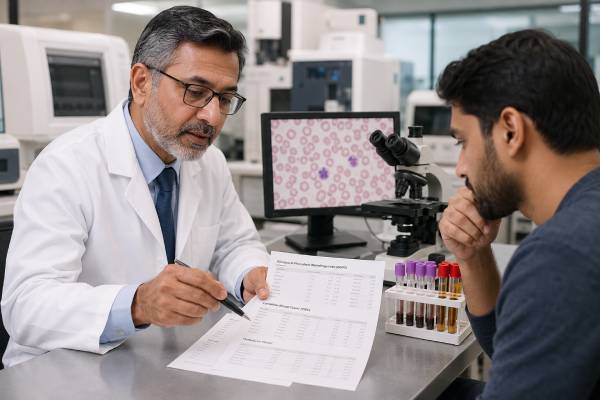
A G6PD blood test measures the activity of glucose-6-phosphate dehydrogenase, an enzyme that helps red blood cells handle oxidative stress. When G6PD activity is low, red blood cells can break apart too easily after certain triggers, such as infections, fava beans, naphthalene mothballs, or specific medicines. This breakdown is called hemolysis, and it can cause anemia, jaundice, dark urine, fatigue, shortness of breath, and in newborns, serious high bilirubin levels.
Most people with G6PD deficiency feel well between episodes and may not know they have it until a blood test is done. The result is most useful when it is interpreted with symptoms, ancestry, family history, a complete blood count, reticulocyte count, bilirubin, haptoglobin, LDH, and medication exposure. A normal result during or soon after a hemolytic episode may need repeat testing because young red blood cells can make enzyme activity look higher than it truly is.
- Low G6PD usually means inherited G6PD deficiency, which raises the risk of hemolytic anemia after oxidative stress.
- Normal G6PD ranges vary by lab, but results are commonly reported in U/g hemoglobin or as a percent of normal enzyme activity.
- No fasting is usually needed for a G6PD blood test; it is a standard blood draw.
- False-normal results can happen during acute hemolysis, after recent transfusion, or when many reticulocytes are present.
- Urgent care is needed for dark urine, jaundice, severe weakness, shortness of breath, fainting, or rapidly worsening anemia symptoms.
- Newborn jaundice can be more dangerous with G6PD deficiency and needs prompt bilirubin assessment.
Table of Contents
- What the G6PD Blood Test Measures
- Why the Test Is Ordered
- Normal, Low, and Borderline G6PD Results
- Hemolysis Risk and Common Triggers
- Follow-Up Blood Tests That Clarify the Pattern
- Newborns, Families, and Genetic Patterns
- What to Do After a Low G6PD Result
- Common Mistakes and Result Clarifications
What the G6PD Blood Test Measures
The G6PD blood test measures how much functional glucose-6-phosphate dehydrogenase enzyme is present in red blood cells. This enzyme supports the pentose phosphate pathway, which helps make NADPH. NADPH helps keep glutathione in its active, protective form. In plain terms, G6PD helps red blood cells defend themselves against chemical stress.
Red blood cells need this protection because they carry oxygen and cannot repair themselves as well as many other cells. Mature red blood cells do not have a nucleus or the same protein-making machinery that other cells have. When their antioxidant defenses fail, hemoglobin and the red cell membrane become damaged. The spleen may remove damaged parts of the cell, creating “bite cells,” or the entire red blood cell may break apart earlier than expected.
G6PD deficiency is not the same as diabetes, high glucose, or a problem with blood sugar control. The word “glucose” appears in the enzyme name because the enzyme acts on glucose-6-phosphate inside cells. It does not mean the test measures fasting glucose, A1c, or insulin resistance.
Most G6PD testing is enzyme activity testing. The lab may report the result as:
- Units per gram of hemoglobin, often written as U/g Hb
- Units per trillion red blood cells, depending on the method
- A qualitative result such as “normal,” “deficient,” or “intermediate”
- A percent of normal activity, especially in some screening or public health settings
A quantitative enzyme assay gives more detail than a simple screening test. This matters because some people have partial deficiency rather than a clearly normal or clearly very low result. Partial deficiency can still matter when a person faces a strong trigger, such as a high-risk medicine.
The test is usually done from a venous blood sample. Fasting is not usually required. The most important preparation is telling the clinician and lab about recent hemolysis, recent transfusion, pregnancy, severe anemia, and any medicines or infections around the time of testing.
Why the Test Is Ordered
A G6PD test is ordered when a clinician wants to know whether red blood cells are vulnerable to oxidative hemolysis. It may be done after symptoms, before certain medications, during a newborn jaundice evaluation, or because of family history.
Common reasons include:
- A past episode of sudden anemia after infection, fava beans, or medication
- Yellowing of the skin or eyes with dark urine
- Unexplained hemolytic anemia
- Newborn jaundice that is severe, early, prolonged, or rising unexpectedly
- A family member with known G6PD deficiency
- Ancestry from a region where G6PD deficiency is more common
- Safety screening before drugs such as rasburicase, primaquine, tafenoquine, dapsone, or other higher-risk oxidant medications
G6PD deficiency is found worldwide, but it is more common in people with ancestry from parts of Africa, the Mediterranean, the Middle East, South Asia, and Southeast Asia. This distribution is partly related to malaria history. Some G6PD variants appear to have offered partial protection against severe malaria, so those variants became more common in malaria-endemic regions.
A clinician may also order the test as part of an anemia workup. When red blood cells are being destroyed, the complete blood count may show low hemoglobin or hematocrit, while other markers show the body is trying to replace lost red cells. In that setting, G6PD testing helps separate enzyme-related hemolysis from other causes such as autoimmune hemolytic anemia, hereditary spherocytosis, sickle cell disease, thalassemia, blood loss, or drug toxicity.
Testing is especially important before some medicines because waiting until hemolysis occurs can be dangerous. Rasburicase, for example, can cause severe hemolysis and methemoglobinemia in people with G6PD deficiency. Primaquine and tafenoquine, used in malaria treatment strategies, also require careful G6PD assessment because the risk depends on both the drug and the degree of enzyme deficiency.
Normal, Low, and Borderline G6PD Results
G6PD results must be interpreted with the lab’s own reference range. There is no single universal “normal” number because methods, instruments, temperature conditions, and reporting units differ.
Many labs report G6PD activity in U/g Hb. A result in the lab’s normal range suggests enough enzyme activity at the time of testing. A low result supports G6PD deficiency. A borderline or intermediate result means enzyme activity is reduced but not absent, and the clinical risk depends on the person, the trigger, and the situation.
| Result pattern | Common meaning | Important cautions |
|---|---|---|
| Normal enzyme activity | G6PD deficiency is less likely at the time of testing. | A normal result may be misleading during recovery from hemolysis or after transfusion. |
| Low enzyme activity | Consistent with G6PD deficiency and higher hemolysis risk after oxidative stress. | The result should be documented clearly for future prescribing and emergency care. |
| Borderline or intermediate activity | Partial deficiency is possible, especially in people with two X chromosomes or mixed red cell populations. | Medication decisions may still require caution, repeat testing, or specialist input. |
| Qualitative “deficient” screen | Suggests reduced G6PD activity. | Quantitative testing may be needed to estimate severity. |
| Qualitative “normal” screen | Suggests no major deficiency. | Some screening tests miss intermediate activity, especially in heterozygous females. |
Percent activity can be easier to understand than raw units. Severe deficiency has traditionally been described as very low enzyme activity, while moderate deficiency means the enzyme works partly but not fully. Newer variant classification uses activity thresholds and clinical pattern together rather than relying only on old class names.
In practical terms, a person with very low activity has a higher risk of hemolysis from known triggers. A person with intermediate activity may be well most of the time but can still be at risk from high-dose or high-risk oxidant exposures. A person with normal activity usually has lower G6PD-related risk, but the result must fit the timing and clinical picture.
Why a normal result can be wrong after hemolysis
During an acute hemolytic episode, the oldest and most enzyme-deficient red blood cells are often destroyed first. The blood then contains a higher share of young red blood cells, called reticulocytes. Reticulocytes naturally have higher G6PD activity than older red cells. This can make the measured enzyme activity look normal or less abnormal than it truly is.
A recent blood transfusion can also confuse the result because donor red blood cells may have normal G6PD activity. If suspicion remains high, clinicians often repeat G6PD testing after recovery, commonly several weeks to about three months later, depending on the situation and transfusion history.
When genetic testing helps
Genetic testing can identify variants in the G6PD gene, but it does not replace enzyme activity testing in every case. Some genetic panels test only common variants. A negative genetic test may miss rare variants. In heterozygous females, enzyme activity may vary because of X-chromosome inactivation, so the measured enzyme level may be more useful for real-world risk.
Genetic testing is most helpful when family counseling is needed, the enzyme result is hard to interpret, the person had a recent transfusion, or a specific variant may affect medication decisions.
Hemolysis Risk and Common Triggers
G6PD deficiency causes problems mainly when red blood cells face oxidative stress. Many people with the deficiency have normal energy, normal daily function, and normal blood counts between episodes. The risk rises when a trigger overwhelms the red cells’ limited antioxidant protection.
The most common trigger is often infection. Viral and bacterial illnesses can increase oxidative stress through fever, inflammation, immune activity, and metabolic strain. This is why hemolysis may happen even when no risky medicine or food exposure is found.
Fava beans are another classic trigger. Favism can cause sudden hemolysis in susceptible people, and the reaction may be more severe with certain G6PD variants. Not everyone with G6PD deficiency reacts the same way, but people with confirmed deficiency are usually advised to avoid fava beans.
Naphthalene, found in some mothballs and deodorizing products, can trigger hemolysis and is especially dangerous for children. Exposure can happen through inhalation, ingestion, or contaminated clothing and bedding.
Some medicines are high risk in G6PD deficiency. The exact list depends on dose, indication, route, and evolving evidence, so medication decisions should come from a clinician or pharmacist using an updated drug-safety resource. Still, several drugs are widely recognized as important concerns.
| Trigger type | Examples | Practical meaning |
|---|---|---|
| Infections | Respiratory infections, gastrointestinal infections, other febrile illnesses | Can trigger hemolysis even without a risky medicine. |
| Foods | Fava beans | Best avoided after confirmed G6PD deficiency. |
| Chemicals | Naphthalene mothballs | Can be dangerous, especially for infants and children. |
| High-risk medicines | Dapsone, methylene blue, phenazopyridine, primaquine, tafenoquine, rasburicase, pegloticase | May need avoidance, alternative therapy, or specialist-directed use. |
| Medium-risk or context-dependent medicines | Some drugs may require caution depending on dose and clinical setting. | Do not assume every warning list is current; check with a clinician or pharmacist. |
Hemolysis symptoms can appear hours to days after a trigger. Mild episodes may cause fatigue and yellow eyes. More serious episodes may cause tea-colored urine, rapid heartbeat, dizziness, shortness of breath, back or abdominal pain, and marked weakness.
Dark urine during hemolysis is not the same as simple dehydration. It can reflect hemoglobin released from destroyed red blood cells. A person with known or suspected G6PD deficiency who develops dark urine and jaundice after a trigger should seek urgent medical care.
G6PD deficiency can also increase risk from medicines used to treat methemoglobinemia. Methylene blue is a standard treatment for many cases of methemoglobinemia, but it may be ineffective or harmful in G6PD deficiency and can worsen hemolysis. This is one reason a known G6PD result should be visible in medical records.
Follow-Up Blood Tests That Clarify the Pattern
A G6PD result tells whether enzyme activity is low, but it does not show the full severity of an active hemolytic episode. Other blood tests show whether anemia is present, how quickly red cells are being destroyed, and whether the bone marrow is responding.
The CBC is usually the starting point. Hemoglobin and hematocrit show the degree of anemia. Red blood cell indices may be normal unless another condition is present. A sudden drop in hemoglobin and hematocrit after a trigger supports clinically significant hemolysis.
The reticulocyte count shows whether the bone marrow is sending out new red blood cells. In hemolysis, the reticulocyte count often rises after the marrow responds. A high reticulocyte count with falling hemoglobin often means the body is trying to replace red cells that are being lost too quickly.
Bilirubin, especially indirect bilirubin, often rises when red blood cells break down. This can cause yellow eyes and yellow skin. A high indirect bilirubin result fits hemolysis, although liver and bile duct problems can also affect bilirubin patterns.
LDH often rises because it is released from damaged cells, including red blood cells. Haptoglobin often falls because it binds free hemoglobin released into the bloodstream. A low haptoglobin result can support hemolysis, but it may be affected by inflammation, liver disease, and other factors.
A peripheral blood smear can show red cell changes. In G6PD-related hemolysis, the smear may show bite cells or blister cells. Heinz bodies, which are clumps of oxidized hemoglobin, require a special stain and may not appear on a routine smear report. A peripheral blood smear can also help identify other causes of anemia, such as spherocytes, sickle cells, schistocytes, or abnormal white blood cells.
Clinicians may also order a direct antiglobulin test, often called a direct Coombs test, to check for autoimmune hemolytic anemia. G6PD-related hemolysis is not caused by antibodies against red blood cells, so this test is typically negative unless another condition is present.
Newborns, Families, and Genetic Patterns
G6PD deficiency is inherited through the G6PD gene on the X chromosome. People with one X chromosome, commonly males, are more likely to show a clear deficient result if they inherit a disease-causing variant. People with two X chromosomes, commonly females, may be carriers, fully deficient, intermediate, or normal on enzyme testing, depending on their genetic pattern and X-chromosome inactivation.
This inheritance pattern can surprise families. A mother may have no symptoms but pass a G6PD variant to a son who has clear deficiency. A daughter may have intermediate enzyme activity and still be at risk in certain situations. Family testing can help identify relatives who need medication precautions.
Newborns need special attention because G6PD deficiency can increase the risk of significant jaundice. Newborn jaundice happens when bilirubin builds up. Mild jaundice is common, but high bilirubin can become dangerous if it rises quickly or reaches levels that threaten the brain.
G6PD-related newborn jaundice may not always match obvious signs of hemolysis on the CBC. A baby can have concerning bilirubin even when anemia is not dramatic. Testing is especially important when jaundice appears early, rises despite phototherapy, returns after initial improvement, occurs in a baby with family history, or is unexplained.
Parents should seek urgent newborn care if a baby has deepening yellow skin or eyes, poor feeding, unusual sleepiness, limpness, high-pitched crying, fever, or fewer wet diapers. A newborn with possible G6PD deficiency should not be managed by observation alone when jaundice is worsening.
Family planning discussions may include:
- Which relatives may benefit from testing
- How to document the result in a child’s medical record
- Which medicines and exposures should be avoided
- When to repeat testing if the first result was done during illness
- Whether genetic counseling is useful for a family with severe variants or recurrent newborn jaundice
G6PD deficiency does not mean a child is fragile in everyday life. Most children with the condition can exercise, attend school, receive routine care, and live normally. The main protection is awareness: avoiding known triggers, treating infections promptly, and checking medicine safety before use.
What to Do After a Low G6PD Result
A low G6PD result should be treated as important health information, even if the person feels well. The result can prevent avoidable hemolysis later.
Start by asking for a copy of the lab report. The report should show the result, units, reference range, date, and whether the test was quantitative or qualitative. Keep this information in personal medical records, and make sure it appears in the medication allergy or safety-alert section of the medical chart when appropriate. G6PD deficiency is not a true allergy, but it is often documented in alert fields because it changes prescribing safety.
Medication review is the next step. A clinician or pharmacist should review prescription medicines, over-the-counter drugs, and planned treatments. People should not stop necessary medicines on their own, because some warnings are dose-specific, context-dependent, or outdated. The safer approach is to ask: “Is this medicine safe with my G6PD result and my level of enzyme activity?”
During an acute hemolytic episode, care focuses on removing the trigger and supporting the body while red blood cells recover. This may include stopping the offending medicine, treating infection, hydration, monitoring urine output, and repeating blood tests. Severe anemia may require hospital care and sometimes blood transfusion. Oxygen, intravenous fluids, and close monitoring may be needed if symptoms are significant.
A practical personal plan can include:
- Avoid fava beans after confirmed deficiency.
- Avoid naphthalene mothballs and keep them away from infants and children.
- Check with a clinician or pharmacist before starting new antibiotics, malaria drugs, urinary pain medicines, cancer-support drugs, or oxidant therapies.
- Seek urgent care for dark urine, jaundice, fainting, chest pain, shortness of breath, or severe weakness.
- Tell emergency clinicians about G6PD deficiency before receiving urgent medications.
- Ask whether repeat testing is needed if the first result was done during hemolysis or after transfusion.
Diet does not “cure” G6PD deficiency. Supplements also do not correct the enzyme defect. Folate may be used in some people with chronic or recurrent hemolysis, but routine high-dose supplementation is not a substitute for avoiding triggers. Iron should not be taken unless iron deficiency is proven, because hemolysis itself does not automatically mean the body lacks iron. If iron deficiency is suspected, ferritin and iron studies are more informative than guessing from symptoms alone.
Common Mistakes and Result Clarifications
A common mistake is assuming that G6PD deficiency always causes chronic anemia. Most people with common G6PD variants are not anemic every day. They develop anemia mainly after a trigger. A normal CBC between episodes does not rule out G6PD deficiency.
Another mistake is assuming that every “sulfa,” antibiotic, pain reliever, or fever medicine is automatically unsafe. Some older lists are overly broad, and evidence for many drugs is weaker than people expect. This does not mean medication risk should be ignored. It means decisions should be specific: the exact drug, dose, reason for use, severity of G6PD deficiency, age, infection status, kidney and liver function, and alternatives all matter.
A third mistake is relying on a normal G6PD result drawn at the wrong time. Testing during acute hemolysis can miss deficiency because the most vulnerable red cells have already been destroyed. Testing soon after transfusion can also miss it because donor cells dilute the patient’s red cell population. When the story strongly suggests G6PD deficiency, repeat testing is reasonable.
People also confuse G6PD deficiency with other inherited blood conditions. G6PD deficiency is an enzyme disorder, not a hemoglobin structure disorder. Sickle cell disease and thalassemia are different conditions and may need tests such as hemoglobin electrophoresis. A person can have more than one inherited blood condition, so unexplained anemia should be interpreted carefully.
A low G6PD result does not predict exactly how severe a future episode will be. Severity depends on the variant, enzyme activity, trigger strength, dose, infection, age, other medical conditions, and how quickly the trigger is removed. Two people with the same label of “G6PD deficiency” may have very different risk levels.
The result also does not mean red blood cells are always breaking apart. Hemolysis is an event or process, not the same thing as the inherited enzyme status. G6PD deficiency is the vulnerability; hemolysis is what may happen after the wrong stressor.
For a clear interpretation, bring these details to the clinician:
- The G6PD result with units and reference range
- Whether testing happened during illness, jaundice, or anemia
- Any recent transfusion
- Recent foods, medicines, supplements, and chemical exposures
- CBC, reticulocyte count, bilirubin, LDH, and haptoglobin results
- Family history of G6PD deficiency, neonatal jaundice, anemia, gallstones, or transfusions
- Ethnic or geographic ancestry that may guide variant interpretation
The most useful interpretation connects the lab number to real-life risk. A low result should lead to safer prescribing, quicker recognition of hemolysis symptoms, and better newborn and family awareness. It should not lead to unnecessary fear, broad medication avoidance without evidence, or unneeded supplements.
References
- Glucose-6-Phosphate Dehydrogenase Deficiency 2025 (Review)
- Laboratory diagnosis of G6PD deficiency 2020 (Guideline)
- Expanded Clinical Pharmacogenetics Implementation Consortium (CPIC) Guideline for Medication Use in the Context of G6PD Genotype 2023 (Guideline)
- New WHO classification of genetic variants causing G6PD deficiency 2024 (Review)
- Population screening for glucose-6-phosphate dehydrogenase deficiency using quantitative point-of-care tests: a systematic review 2023 (Systematic Review)
- Glucose-6-Phosphate Dehydrogenase Deficiency and Neonatal Hyperbilirubinemia: Insights on Pathophysiology, Diagnosis, and Gene Variants in Disease Heterogeneity 2022 (Review)
Disclaimer
G6PD deficiency can affect medication safety, newborn jaundice risk, and the evaluation of hemolytic anemia. This information is educational and should not replace medical care from a qualified clinician. Seek urgent care for dark urine, jaundice, severe weakness, shortness of breath, fainting, or concerning newborn jaundice.