Great mullein is a tall, soft-leaved biennial herb best known for its long history in traditional respiratory care. Many people recognize it by its velvety leaves and upright yellow flower spike, but in herbal practice the part matters: flowers have the clearest traditional medicinal standing for soothing throat irritation linked with dry cough and colds, while leaves and flower oil appear more often in folk remedies and commercial teas. What makes mullein appealing is not one dramatic effect, but a gentle pattern of support. It is valued for coating and calming irritated tissues, easing the feel of dryness in the throat, and providing a mild expectorant and softening action.
Still, great mullein is easy to overstate. It is not a proven cure for bronchitis, pneumonia, asthma, or ear infection, and it should not delay medical care when breathing symptoms are serious. The most useful way to understand mullein is as a traditional herb with a narrow official use, broader folk use, and early but incomplete research on topical healing, antimicrobial activity, and inflammation.
Quick Overview
- Great mullein is used mainly for soothing sore throat symptoms linked with dry cough and colds.
- Its flowers and leaves contain mucilage, flavonoids, iridoids, saponins, and phenylethanoid compounds such as verbascoside.
- A traditional flower infusion commonly uses 1.5 to 2 g in 150 mL of boiling water, taken 3 to 4 times daily.
- Pregnancy, breastfeeding, and use in children under 12 are generally avoided because safety data are limited.
- Worsening cough, fever, shortness of breath, or thick discolored mucus should be medically assessed rather than self-treated.
Table of Contents
- What is great mullein and what is in it?
- Does great mullein help cough and throat irritation?
- Other uses for skin and topical care
- How to use great mullein
- How much great mullein per day?
- Side effects, interactions, and who should avoid it
- What the evidence really says
What is great mullein and what is in it?
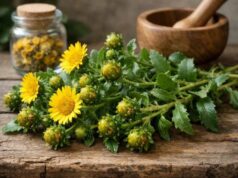
Great mullein, or Verbascum thapsus, is a biennial herb native to Europe, western and central Asia, and North Africa, now naturalized in many other regions. In its first year it forms a low rosette of large fuzzy leaves. In the second year it sends up a tall flowering stalk that can make the plant easy to spot even from a distance. The whole plant has a soft, woolly texture, and that texture matters practically as well as visually. The flowers are the best-defined medicinal part in traditional official herbal use, while leaves, flowers, and flower oil are all common in folk practice and modern over-the-counter products.
That distinction is one of the most useful things buyers can know. Many people speak about “mullein” as though all parts of the plant are interchangeable, but they are not. Flower-based tea has a more clearly described traditional indication, while leaf teas, tinctures, capsules, and smoke blends often lean more on folk use than on standardized guidance. If you want the most conservative, evidence-aligned choice, the flowers are the part with the clearest traditional framework.
Chemically, great mullein is richer than its mild reputation suggests. Reviews describe a broad mix of constituents, including:
- mucilage, which helps explain its soothing, coating feel on irritated tissues
- flavonoids such as apigenin, luteolin, quercetin, and kaempferol
- iridoid compounds such as catalposide and specioside
- saponins, which may contribute to its mild expectorant action
- phenylethanoid and phenylpropanoid glycosides such as verbascoside and poliumoside
- smaller amounts of coumarin, vitamin C, and minerals
These compounds likely work together rather than as a single “magic ingredient.” Mucilage is especially relevant to the herb’s traditional respiratory role because it can coat dry, irritated mucous membranes. Saponins may help loosen secretions. Flavonoids and phenylethanoid compounds are often discussed for antioxidant and anti-inflammatory actions. That combination helps explain why mullein has long been used for coughs, throat irritation, and inflamed skin, even though human trials are still limited.
Another practical note is that great mullein is not the same as a modern fast-acting cough medicine. Its value is gentler and more mechanical: soften, soothe, coat, and modestly support clearance. Readers who want to compare other plant-based throat-soothing herbs often also look at marshmallow for demulcent support, which works through a similarly calming feel on irritated tissues.
Does great mullein help cough and throat irritation?
This is the main reason most people reach for great mullein, and it is where the herb makes the most sense. Its most defensible use is for relieving symptoms of sore throat associated with dry cough and cold. That phrasing matters. It points to irritation, dryness, and mild upper respiratory discomfort, not to pneumonia, severe bronchitis, or uncontrolled asthma.
Why might it help? The simplest explanation is physical rather than dramatic. Great mullein appears to act as a soothing herb first. Its mucilage can coat irritated tissues, which may reduce the scratchy, raw sensation of a dry throat. Saponins and other compounds are often discussed in relation to its mild expectorant character, which is why many traditional preparations are used when a cough feels dry at first and then sticky later. Folk medicine also uses mullein in syrups, infusions, and blends for hoarseness, tonsillitis, chesty coughs, and seasonal respiratory irritation.
Realistic outcomes are modest:
- the throat may feel less dry or raw
- coughing may feel less irritating
- mucus may seem easier to clear in some people
- the urge to keep clearing the throat may lessen
What you should not expect is an antibiotic effect, an inhaler-like effect, or a guaranteed benefit for every kind of cough. Great mullein is not a substitute for medical evaluation when symptoms point to infection or airway distress. If a cough is paired with wheezing, fever, shortness of breath, chest pain, or thick green or rusty mucus, the question is no longer whether tea might help. The question is what is causing the symptoms.
A helpful way to think about mullein is that it is best suited to irritated airways, not dangerous airways. It fits the early phase of a cold, a dry sore throat after heavy voice use, or a lingering sense of mild throat irritation after an illness. It is less convincing when the condition is deeper, more inflamed, or clearly infectious.
This is also where product choice matters. A carefully prepared tea or syrup is more aligned with its traditional role than smoking the herb. Some people still smoke mullein leaf for “lung cleansing,” but that idea does not fit the herb’s gentler logic. Burning plant material creates airway irritants. If the goal is to soothe tissues, inhaling smoke works against that goal.
For readers exploring other herbs for sticky coughs or chest congestion, grindelia for respiratory support is often compared with mullein because it is typically discussed in a more resinous, expectorant context. Mullein, by contrast, is usually the softer, more calming option.
Other uses for skin and topical care
Great mullein has a broader folk record than its respiratory reputation suggests. Traditional use includes skin irritation, minor wounds, inflamed areas, chilblains, and earache remedies made from flowers infused in oil. A practical article should mention these uses, but it should also rank them honestly by certainty.
The strongest non-respiratory modern signal is probably wound-related topical use, not ear oil. A small randomized trial in women recovering from episiotomy found better healing scores by day 10 with a Verbascum cream than with placebo. That does not prove mullein is a general wound-healing solution for every situation, but it does suggest the plant’s anti-inflammatory and tissue-repair potential deserves attention. Early laboratory and formulation research also points in the same direction, with interest in mullein extracts for antibacterial and wound-dressing applications.
That said, context matters. The topical evidence is still early, narrow, and product-specific. A cream prepared for a clinical study is not the same thing as a homemade poultice or an unstandardized oil from the internet. A reasonable takeaway is that mullein has plausible topical benefits, but they are not yet established strongly enough to justify broad treatment claims.
Earache is even trickier. Great mullein flowers have a long folk history in ear oil, often macerated in olive oil. The problem is that human studies usually involve mixed-herb ear drop formulas rather than mullein alone. That makes it hard to say whether mullein itself is the active driver, a supporting ingredient, or simply part of a traditional blend. Because of that uncertainty, and because ear pain can involve infection, eardrum damage, or referred pain from the throat or teeth, homemade mullein oil should not be treated as a harmless default remedy.
A sensible way to think about other uses is:
- minor skin soothing: plausible
- wound support: promising but still limited
- earache: traditional, but not well isolated in human evidence
- broad anti-infective claims: interesting in the lab, not proven in people
If your goal is gentle skin calming rather than respiratory support, a more established topical herb such as calendula for irritated skin may be easier to match to the intended use. Great mullein can still have a place, but it should be used with more restraint and less certainty than many marketing pages suggest.
How to use great mullein
The best way to use great mullein depends on why you are using it. For most readers, the simplest and most sensible form is a tea or infusion. This matches the herb’s traditional role and allows you to judge whether it actually helps a dry, irritated throat. It also keeps the experience close to the plant’s gentler style rather than turning it into a highly concentrated experiment.
Common forms include:
- dried flowers for tea
- leaf and flower tea blends
- syrups
- tinctures
- capsules
- flower-infused oils for external use only
Tea is usually the best starting point. A warm infusion is easy to tolerate, easy to stop, and well suited to temporary throat discomfort. Syrups are popular when the throat feels especially dry or when the herb is blended with other soothing plants. Some commercial products combine mullein with honey, thyme, licorice, or marshmallow. These blends can be practical, but they also make it harder to tell which herb is helping.
Capsules and tinctures are less straightforward. They may be convenient, but they move you away from the plant’s most clearly described traditional use and into a space where products vary widely. If you choose one, prioritize a reputable brand that identifies the plant part used and gives plain dosing directions.
One practical point deserves more attention than it usually gets: strain mullein tea carefully, especially if leaves are included. The plant’s fine hairs can be irritating to the mouth or throat in some preparations. Many people solve this with a very fine strainer, cheesecloth, or paper filter.
A simple trial works best:
- Choose one clear product form.
- Use it for a short, defined purpose, such as a dry cough during a cold.
- Track whether your throat feels less dry and whether coughing becomes less irritating.
- Stop if it seems useless, irritating, or hard to tolerate.
What about steaming, vaping, or smoking? Steaming may feel soothing because warm moisture can be soothing, but it is not a proven mullein-specific therapy. Smoking mullein is not recommended. It conflicts with the herb’s soothing profile and can irritate the very tissues people are trying to calm.
If you prefer multi-herb cough teas, licorice in traditional throat blends is often paired with mullein because it adds sweetness and a stronger demulcent effect. That combination can make more sense than forcing mullein to do everything on its own.
How much great mullein per day?
For great mullein, the clearest dosage guidance is traditional and tea-based, not capsule-based. The most useful adult reference range is a flower infusion made with 1.5 to 2 g of the herbal substance in 150 mL of boiling water, taken 3 to 4 times daily. That gives a total daily amount of about 4.5 to 8 g.
This dosing pattern is helpful for two reasons. First, it anchors the herb in the form most closely tied to its traditional use. Second, it helps prevent the common mistake of assuming that “more concentrated” automatically means “more effective.” With mullein, gentler use is often the point.
A practical daily routine could look like this:
- one cup in the morning when the throat feels driest
- one cup in the afternoon
- one cup in the evening
- a fourth cup only if the product directions and your tolerance support it
Timing is flexible. Some people prefer mullein between meals so the soothing feel is more noticeable. Others find it easier on the stomach after food. Either approach is reasonable if the tea sits well.
There are a few important limits to keep in mind:
- the best-defined dosing applies to the flowers, not every extract on the market
- there is no universally accepted standardized dose for capsules, tinctures, or oils
- long-term routine use has less support than short, symptom-based use
- if symptoms last more than about 1 week, it is better to reassess than to keep increasing intake
For children, the picture is even narrower. Use in children under 12 is generally not recommended because adequate data are lacking. That is especially important because mullein often shows up in “natural cough” conversations where parents assume a traditional herb must automatically be gentle enough for young children.
If you are choosing between mullein and a more warming herb for a cold, ginger for warming digestive and cold support offers a different style of action. Mullein is softer and more coating; ginger is more stimulating and warming. The better choice depends on whether the main problem is dryness and irritation or chills and sluggishness.
The most honest dosing advice is simple: use a traditional flower infusion first, stay within a defined range, and do not improvise high doses of extracts just because the herb has a mild reputation.
Side effects, interactions, and who should avoid it
Great mullein is often described as gentle, and overall that is fair. But “gentle” should never be confused with “risk-free” or “appropriate for everyone.”
Known serious problems are not prominent in traditional guidance, and no specific drug interactions are firmly established there. Even so, several practical cautions matter.
The first is allergy or hypersensitivity. Anyone who reacts to the plant should stop using it. The second is mechanical irritation from the plant’s fine hairs, especially in leaf-heavy teas or poorly filtered preparations. For some people, that means a scratchy throat instead of a soothed one. The plant’s fuzz can also irritate skin when handled directly.
The main groups who should avoid self-treatment with great mullein are:
- people who are pregnant
- people who are breastfeeding
- children under 12
- anyone with a known allergy to mullein or related plants
- anyone with serious or rapidly worsening respiratory symptoms
This last group matters most. A person with dry throat irritation is different from a person with shortness of breath, fever, wheezing, chest pain, or purulent sputum. Those symptoms may signal a condition that should not be managed with tea and patience.
Because modern interaction data are sparse, a cautious rule is better than a false reassurance. If you take prescription medication, especially for chronic lung disease, or if you use multiple herbal products at once, it is sensible to review the full list with a clinician or pharmacist. The absence of well-documented interactions is not exactly the same as proof that interactions never happen.
Topical use also deserves restraint. Do not put homemade mullein oil into the ear canal if there is any chance of eardrum perforation, drainage, severe pain, or infection. Do not rely on mullein cream for a wound that is deep, spreading, hot, or clearly infected. A traditional herb can still be misused.
The simplest safety framework is this:
- use it for mild symptoms
- use clearly identified products
- keep the trial short
- stop if it irritates rather than soothes
- seek care early when breathing or infection symptoms escalate
Great mullein earns its place best when it is treated as a measured, low-drama herb. Problems tend to start when people ask it to do the work of antibiotics, steroids, ear procedures, or proper medical assessment.
What the evidence really says
The evidence on great mullein is best described as traditional, plausible, and still incomplete.
Its strongest footing is not a stack of large modern clinical trials. It is a combination of long-standing traditional use, a narrow but recognized role for throat irritation with dry cough, a chemical profile that makes that role biologically plausible, and a smaller body of laboratory and topical human research that points toward anti-inflammatory, antimicrobial, and wound-supporting potential.
That means two things can be true at once.
First, great mullein is not mere folklore. It contains compounds that reasonably fit its long-standing uses, and a few modern findings support that broader story. Small clinical work on topical wound healing is encouraging. Laboratory studies showing antibacterial and anti-inflammatory activity help explain why mullein kept its place in herbal practice for so long.
Second, the evidence is not strong enough to justify the big claims often made online. There is still a gap between “traditionally used for cough and throat irritation” and “proven for lung cleansing, bronchitis, asthma, ear infections, and deep airway disease.” Human research is thin, products vary widely, and many commercial claims outrun the herb’s actual proof.
So where does that leave a thoughtful reader?
Great mullein makes sense when:
- the symptoms are mild
- the goal is soothing rather than strong pharmacologic action
- the product is simple and clearly labeled
- the user understands that improvement may be modest
It makes less sense when:
- the illness looks infectious or severe
- the condition has lasted too long
- the product is marketed with dramatic claims
- the herb is being used instead of evaluation rather than alongside common sense
The most honest bottom line is that great mullein is a useful traditional herb for selected, mild complaints, especially dry throat and cough discomfort. It also has emerging topical interest. But it remains a herb where humility is part of safe use. It can support comfort. It should not substitute for diagnosis.
References
- European Union herbal monograph on Verbascum thapsus L., V. densiflorum Bertol. (V. thapsiforme Schrad) and V. phlomoides L., flos 2018 (Guideline)
- Searching for Scientific Explanations for the Uses of Spanish Folk Medicine: A Review on the Case of Mullein (Verbascum, Scrophulariaceae) 2021 (Review)
- Health-promoting and disease-mitigating potential of Verbascum thapsus L. (common mullein): A review 2022 (Review)
- The effect of the Verbascum Thapsus on episiotomy wound healing in nulliparous women: a randomized controlled trial 2021 (RCT)
- Bioassay-guided fractionation of Verbascum thapsus extract and its combination with polyvinyl alcohol in the form electrospun nanofibrous membrane for efficient wound dressing application 2024 (Preclinical Study)
Disclaimer
This article is for educational purposes only and is not a substitute for medical advice, diagnosis, or treatment. Great mullein may be inappropriate in pregnancy, breastfeeding, or for children, and it should not be used to self-treat serious breathing symptoms, fever, suspected ear infection, or infected wounds. Always review persistent symptoms, prescription medicines, and herbal supplement use with a qualified healthcare professional before starting a new remedy.
If this article was useful, please share it on Facebook, X, or any other platform you prefer.