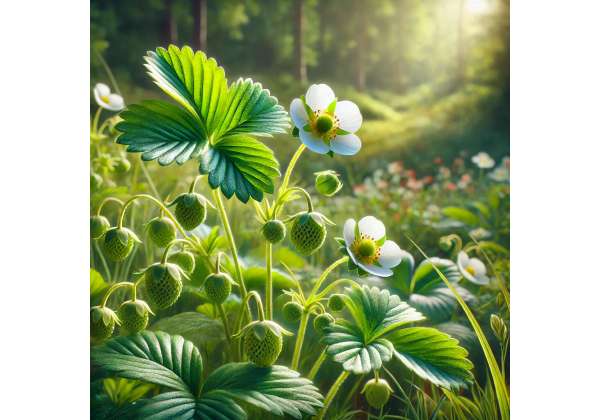
Green strawberry, botanically known as Fragaria viridis, is a lesser-known wild strawberry species native to parts of Europe and Asia. It is sometimes called creamy strawberry because its fruits may stay pale greenish, yellow-white, or lightly pink even when ripe. That unusual appearance often makes people overlook it, yet the plant has a long history as both a food and a folk remedy. The sweet, fragrant fruits are valued for vitamin C, polyphenols, and tannins, while the leaves have been used traditionally as a mild herbal tea.
What makes green strawberry interesting is its double role. The fruit belongs in the kitchen as a nutrient-rich wild berry, but the leaf belongs more to traditional herbal practice, where it has been used for mild diarrhea and urinary flushing. Modern research suggests the plant contains ellagitannins, flavonoids, phenolic acids, and other compounds with antioxidant potential. At the same time, direct human evidence remains limited.
That balance matters. Green strawberry is promising, useful, and pleasantly approachable, but it is best understood as a traditional plant with emerging science rather than a proven medicinal treatment.
Essential Insights
- Green strawberry fruit provides polyphenols, vitamin C, and tannins that may support antioxidant and digestive balance.
- The leaf has traditional use as a mild urinary-flushing and astringent herbal tea, but clinical evidence is limited.
- A practical fruit serving is about 50 to 150 g fresh fruit, while medicinal leaf tea is typically 4 to 8 g in 200 mL water for urinary use.
- Avoid medicinal leaf use during pregnancy, breastfeeding, and in children under 12 years.
- People with strawberry allergy, birch-pollen cross-reactivity, or severe heart or kidney disease should use extra caution or avoid it.
Table of Contents
- What is green strawberry
- Key compounds and properties
- Green strawberry benefits and uses
- How to use green strawberry
- How much per day
- Safety, side effects, and who should avoid it
- What the evidence actually says
What is green strawberry
Green strawberry is a perennial wild species in the rose family, Rosaceae. Although it belongs to the same genus as woodland strawberry and the modern cultivated strawberry, it has a character of its own. The plant is usually smaller and more discreet than garden strawberries, with dense, dark-green leaves, modest runners, and rounded fruits that often remain greenish or creamy rather than turning bright red. In some regions, that has earned it the common name creamy strawberry.
One of the most helpful ways to understand Fragaria viridis is to separate the two parts people actually use. The fruit is mainly a food with nutritional and functional value. The leaves, by contrast, belong to older herbal traditions. This distinction prevents confusion. A person eating the berries for nourishment is doing something very different from someone brewing the leaves as a medicinal tea.
Traditionally, the fruits were eaten fresh, dried, or cooked, especially in regions where wild berries formed part of seasonal diets. Their flavor is often described as sweet, fragrant, and slightly richer than their pale color suggests. The leaves were used more deliberately. In European folk practice, wild strawberry leaves, including those from Fragaria viridis, were taken as a mild diuretic tea, an astringent herb for loose stools, and sometimes as a gentle household remedy for minor urinary discomfort.
Botanically, green strawberry also stands out because it is somewhat less runner-heavy than woodland strawberry and often relies more on seeds for spread in the wild. Its fruits are firmer and more transportable than many delicate wild strawberries, which may help explain why local populations valued them as both edible and practical.
For modern readers, the plant fits into three overlapping categories:
- a wild edible berry,
- a source of polyphenol-rich fruit compounds,
- and a traditional leaf tea with mild medicinal use.
That last point is important because online articles often blur food use and medicinal use into one story. In reality, green strawberry is best approached in layers. The fruit is the safer, more food-like part. The leaves have a place too, but they call for more respect, clearer dosing, and more modest expectations.
If you are new to the plant, the easiest starting point is to think of it as a close wild relative of the strawberry you know, but with a paler fruit, a somewhat firmer texture, and a stronger identity in folk herbal medicine than in modern clinical practice.
Key compounds and properties
The medicinal and nutritional interest in green strawberry comes from its broad mix of plant compounds rather than one single “active ingredient.” That matters because the fruit and the leaves do not behave exactly the same way. The fruit contributes more food-based antioxidants, organic acids, sugars, fiber, and vitamin C, while the leaves are richer in tannins and astringent polyphenols that help explain their older herbal uses.
Among the most notable compounds identified in Fragaria viridis fruit are ellagitannins, flavonols, phenolic acids, anthocyanins, triterpenes, organic acids, and ascorbic acid. Researchers have found especially high interest in ellagitannins such as agrimoniin and lambertianin C, along with ellagic acid derivatives. These are the kinds of polyphenols often discussed in berries because they contribute to antioxidant behavior and may influence inflammatory signaling.
Flavonoids are another major piece of the story. Green strawberry fruit contains quercetin and kaempferol derivatives, catechin-related compounds, and other phenolics that shift as the fruit ripens. In practical terms, this means the chemistry is not static. Unripe and ripe fruit do not offer the same exact profile, and storage can reduce some beneficial compounds, particularly vitamin C and delicate polyphenols.
The leaves appear to contain tannins, flavonoids, and vitamin C, though the direct chemical literature on Fragaria viridis leaves is still thinner than the literature on strawberry leaves as a broader category. That limited evidence is one reason it makes sense to talk about the leaves carefully. We can say they are plausibly rich in astringent and antioxidant compounds, but the exact standardized profile is not as well mapped as in more commonly studied herbs.
These compounds help explain the plant’s main medicinal properties:
- antioxidant activity,
- mild astringent action,
- possible anti-inflammatory support,
- and mild urinary-flushing use in leaf form.
The astringent quality is especially relevant. Tannins tighten and tone mucosal tissue, which helps explain why strawberry leaves have been used traditionally for mild diarrhea and sometimes for mouth and throat rinses. The fruit is gentler and more nutritional, but it still carries some of that tannin character, particularly when less ripe.
There is also a useful comparison point. Like other polyphenol-rich berries, green strawberry seems to offer overlapping benefits from a network of phenolics rather than from a stimulant or alkaloid-driven effect. That makes it more of a supportive plant than a fast-acting one.
The most honest summary is that green strawberry has credible chemistry. Its fruit clearly contains compounds associated with antioxidant potential and nutritional value, and its leaves fit the profile of a mild traditional herbal tea. What chemistry cannot do on its own, however, is prove a clinical effect. The compounds explain why the herb is worth studying, but they do not automatically prove that every traditional claim is strongly effective in modern practice.
Green strawberry benefits and uses
The benefits of green strawberry are best understood in two separate lanes: the fruit as a functional food and the leaf as a traditional herb. Keeping those lanes distinct makes the plant much easier to use well.
As a fruit, green strawberry may support health in the same broad way many wild berries do. Its combination of vitamin C, ellagitannins, flavonoids, and organic acids suggests value for antioxidant balance, dietary variety, and general nutritional support. This does not make it a miracle berry, but it does make it a useful seasonal food for people who want more naturally polyphenol-rich plant foods in the diet.
Realistic fruit-based benefits may include:
- support for overall antioxidant intake,
- a gentle contribution to digestive regularity through fiber and pectins,
- a nutrient-dense wild fruit option during the growing season,
- and a lower-intensity way to add berry polyphenols without depending on supplements.
The leaf has a more medicinal reputation. Traditional European use points mainly to two actions. The first is mild urinary flushing, especially in minor urinary complaints where increasing urine flow is the main goal. The second is astringent support for mild diarrhea. These are conservative uses, and that is exactly how the plant should be understood. Green strawberry leaf is not a strong diuretic drug and not a treatment for infection or inflammatory bowel disease. It belongs in the category of mild herbal support.
A few practical uses stand out as the most reasonable:
- leaf tea during short episodes of mild loose stool,
- leaf tea used cautiously for minor urinary flushing,
- fruit eaten fresh for seasonal nourishment,
- and fruit preparations such as dried berries or preserves used as a food-first wellness option.
Some readers may also come across historical references to use in gout, kidney complaints, liver support, or general weakness. These old claims are part of the plant’s history, but they are not equally convincing today. The most defensible modern uses are still the mild digestive and urinary roles of the leaf, and the food-based antioxidant role of the fruit.
There is also an important “what not to expect” side. Green strawberry is not a proven treatment for urinary infection, kidney stones, chronic inflammatory disease, or metabolic disease. If someone wants a more studied example of berry-based support for urinary wellness, cranberry for urinary tract support has a clearer modern evidence base.
That does not make green strawberry unimportant. It simply places it correctly. The plant is useful where gentle, traditional support makes sense and where the user values food-based or tea-based care. It is much less suitable when someone is hoping for pharmaceutical-strength effects from a wild berry plant.
Used with that mindset, green strawberry becomes more appealing, not less. It offers a modest but authentic kind of value: real plant chemistry, real traditional use, and realistic benefits that fit everyday life better than hype.
How to use green strawberry
Green strawberry can be used in practical ways that are simple and seasonal. The fruit works best as food, while the leaf works best as a short-term herbal tea. This “food first, herb second” approach keeps the plant in its safest and most sensible range.
The fruit can be used much like other small wild strawberries. Fresh berries are the most straightforward option. They can be eaten on their own, added to yogurt, folded into porridge, or used in small-batch preserves. Because the fruit is often firmer than woodland strawberry, it also handles drying and gentle cooking reasonably well. Dried green strawberries can be used in fruit mixes or steeped lightly in hot water for flavor, though their main role remains culinary rather than medicinal.
Leaf use is different. When used as an herb, the leaves are typically taken as a tea, infusion, or decoction. Traditional use favors water preparations rather than strong alcohol extracts. That makes sense because the leaf’s main role is gentle and local: mild flushing of the urinary tract and mild astringent support in loose stools.
Common real-life ways to use the plant include:
- Fresh fruit as a seasonal wild berry.
- Dried fruit in food or simple herbal-fruit blends.
- Leaf infusion for mild diarrhea.
- Leaf decoction for traditional urinary-flushing use.
- A cooled leaf tea as an occasional mouth rinse, though this is less common in modern use.
A helpful way to match form to purpose is this:
- Use the fruit when the goal is nourishment and daily plant diversity.
- Use the leaf when the goal is short-term traditional support.
- Avoid mixing food use and medicinal use into one vague routine.
That third point matters more than it may seem. When people read that a plant is “good for health,” they often start using multiple forms at once without a clear reason. With green strawberry, clearer use usually works better. Eat the fruit because it is a good wild berry. Brew the leaf because you have a specific mild reason to do so.
This is also a plant that benefits from gentle preparation. A long, harsh boil is rarely necessary for the fruit, and even the leaves should not be treated as if they were a tough root. If your main goal is a soothing after-meal herbal drink, a softer herb such as chamomile for digestive comfort may feel more immediately calming. Green strawberry leaf is less aromatic and more astringent.
In practical household use, the best candidates for green strawberry are people who enjoy wild foods, want a mild traditional leaf tea rather than a strong medicinal herb, and are comfortable with the idea that the benefits may be subtle. That makes it a thoughtful plant rather than a dramatic one, which is often exactly why people continue to value it.
How much per day
Dosage is the area where green strawberry requires the most distinction between fruit use and leaf use. There is no single “correct” medicinal dose for the whole plant because the fruit functions mostly as food, while the leaf has a more formal traditional herbal role.
For the fruit, a practical serving is similar to other wild berries. Around 50 to 150 g of fresh fruit is a sensible daily food portion for most adults when in season. Dried fruit can be used in smaller amounts because it is more concentrated. This is not a medically standardized dose. It is simply a useful nutritional range that fits normal food use.
For the leaves, there is more concrete traditional guidance. European herbal monograph dosing for wild strawberry leaf, which includes Fragaria viridis, gives two main patterns.
For traditional urinary flushing use:
- 4 to 8 g of comminuted leaf in 200 mL of water as a decoction,
- divided into 2 to 4 single doses during the day.
For symptomatic treatment of mild diarrhea:
- 1 g of comminuted leaf in 200 mL boiling water as an infusion,
- taken 2 to 3 times daily.
Duration matters just as much as dose. The leaf is not meant for indefinite self-treatment.
A practical timing guide looks like this:
- For minor urinary complaints, reassess if symptoms persist beyond 2 weeks.
- For mild diarrhea, reassess if symptoms last beyond 3 days.
- Stop sooner and seek care if warning signs appear.
Those warning signs include fever, pain on urination, spasms, blood in the urine, recurrent diarrhea, or bloody stools. In those situations, the issue is no longer a routine herbal self-care problem.
There are also a few variables that can change what the best amount looks like:
- preparation method,
- leaf cut size,
- age and sensitivity of the person,
- and the reason for use.
Someone using the leaf tea for mild loose stool may prefer the lighter infusion pattern. Someone using it as a traditional urinary tea may use the decoction format. Either way, more is not necessarily better. With astringent herbs in particular, excessive use can become uncomfortable rather than more effective.
If reduced fluid intake has been recommended because of severe heart or kidney disease, medicinal leaf use is not appropriate. That matters because urinary-flushing herbs depend on adequate fluid intake to make sense in the first place.
For readers who mainly want a wellness food rather than a medicinal herb, the easiest rule is simple: eat the fruit in moderate food portions, and only use the leaf in defined, short-term situations. If your main goal is simple mild fluid support rather than astringency, herbs such as dandelion for gentle diuretic use are often the more familiar choice.
That keeps green strawberry dosage practical and proportionate. Fruit can be used like food. Leaf use should be measured, short-term, and purpose-driven.
Safety, side effects, and who should avoid it
Green strawberry is generally easier to use safely when it is treated as a fruit first and a medicinal leaf second. The fruit, eaten in ordinary food amounts, is the lower-risk form for most people. The leaf is still considered relatively gentle, but it carries more formal precautions because it is used medicinally and because the data remain limited.
The first major issue is allergy. People with known strawberry allergy should avoid both fruit and leaf. There is also possible cross-reactivity within the rose family and in people with birch-pollen related fruit allergy patterns. That does not mean every pollen-allergic person will react, but it is reason for caution, especially if oral itching, rash, or previous reactions to strawberries are part of the history.
Who should avoid or be cautious with medicinal leaf use:
- people with strawberry allergy,
- children under 12 years,
- pregnant or breastfeeding adults,
- people with severe heart disease or kidney disease when fluid restriction is recommended,
- and anyone with unexplained urinary or digestive symptoms.
Safety during pregnancy and lactation has not been established for medicinal leaf use, so avoidance is the conservative choice. The same caution applies to children, not because strong harm is well documented, but because adequate safety data are lacking.
Known side effects are limited, and official herbal sources report no well-established adverse effects under specified traditional conditions of use. Still, “none known” is not the same as “risk free.” Mild stomach upset, allergic reaction, or discomfort from overuse remain possible. Astringent teas can also be too drying or binding for some people.
There are also clear situations where self-treatment should stop:
- fever,
- dysuria,
- spasms,
- blood in the urine,
- recurrent diarrhea,
- bloody stools,
- or symptoms that keep returning.
These are medical evaluation problems, not signs to keep increasing an herbal tea.
Drug interaction data are limited. No specific interactions are well established in the traditional monograph literature, but limited data do not equal zero risk. When the plant is used as food, this is usually not a major concern. With medicinal leaf tea, caution is sensible if the person already uses several herbs, has chronic disease, or is trying to self-manage recurrent urinary symptoms.
Another practical safety point is form. Fruit use and leaf use should not be confused with concentrated extracts sold online. There is no strong, widely standardized supplement tradition for Fragaria viridis extract in the way there is for more commercial berry products. If a product looks highly concentrated, branded as a cure, or vague about plant part and species, caution is wise.
Overall, green strawberry has a favorable traditional safety profile when used properly, but that profile depends on modest expectations and correct use. Respect the fruit as food. Respect the leaf as a mild medicinal herb. Do not use either one to postpone care when symptoms suggest something more serious.
What the evidence actually says
The evidence for green strawberry is uneven, and understanding that unevenness is the key to using the plant intelligently. In short, the strongest evidence is for composition and traditional use. The weakest evidence is for direct human clinical outcomes specific to Fragaria viridis.
On the composition side, the evidence is quite good. Researchers have identified a broad set of metabolites in the fruit, including ellagitannins, flavonols, anthocyanins, organic acids, and triterpenes. That gives the plant a credible biochemical basis for antioxidant activity and helps explain why it belongs in conversations about functional berries.
On the traditional herbal side, the evidence is respectable but different in nature. European herbal authorities recognize long-standing traditional use of wild strawberry leaf, including Fragaria viridis, for mild urinary flushing and symptomatic treatment of mild diarrhea. This is not the same as saying high-quality clinical trials prove those uses. It means the uses are historically documented, plausible, and considered acceptable within a traditional herbal framework.
Human clinical evidence is where things narrow sharply. There is very little robust clinical research specifically on Fragaria viridis in patients. One often-cited fruit study included a small pilot human experiment showing improvement in serum total antioxidant capacity after fruit consumption, which is interesting but still far from proving a disease-level benefit. That is best treated as an early signal, not a final answer.
This leads to a fair hierarchy of confidence:
- High confidence that the fruit contains meaningful polyphenols and vitamin C.
- Moderate confidence that the fruit has antioxidant potential.
- Moderate confidence in traditional leaf use as a mild urinary and astringent tea.
- Low confidence in strong therapeutic claims for modern disease treatment.
- Very low confidence in any claim that presents green strawberry as a proven remedy for serious conditions.
The limits are just as important as the strengths. Much of the broader “strawberry health” literature focuses on other species, especially Fragaria vesca or cultivated strawberry. Some of that literature is helpful for context, but it cannot automatically be mapped onto green strawberry without caution. This is one reason overconfident articles can mislead readers. They quietly borrow evidence from the whole strawberry genus and present it as if it were all direct evidence for Fragaria viridis.
So where does that leave the plant in practice? In a good place, as long as the claims stay proportionate. Green strawberry deserves attention as an underused wild berry with interesting phytochemistry and legitimate traditional leaf use. It does not yet deserve strong clinical promises. Readers who appreciate that balance will get the most from it: a meaningful wild food, a mild traditional herb, and a plant with promising but still incomplete modern evidence.
References
- A Review of Botany, Phytochemistry, and Biological Activities of Fragaria vesca and Fragaria viridis Widespread in Kazakhstan 2025 (Review)
- Uncovering fruit flavor and genetic diversity across diploid wild Fragaria species via comparative metabolomics profiling 2024
- Fragaria viridis Fruit Metabolites: Variation of LC-MS Profile and Antioxidant Potential during Ripening and Storage 2020
- European Union herbal monograph on Fragaria vesca L., Fragaria moschata Weston, Fragaria viridis Weston and Fragaria x ananassa (Weston) Duchesne ex Rozier, folium 2019 (Monograph)
- From by-products to new application opportunities: the enhancement of the leaves deriving from the fruit plants for new potential healthy products 2024 (Review)
Disclaimer
This article is for educational purposes only and does not replace medical advice, diagnosis, or treatment. Green strawberry fruit used as food is different from green strawberry leaf used medicinally, and the two should not be treated as interchangeable. Speak with a qualified healthcare professional before using green strawberry leaf medicinally if you are pregnant, breastfeeding, under 12, have heart or kidney disease, have a strawberry allergy, or take medicines for chronic conditions. Seek prompt medical care for fever, blood in urine, painful urination, recurrent diarrhea, bloody stools, or any persistent or worsening symptoms.
If this article helped you, please consider sharing it on Facebook, X, or another platform you prefer.