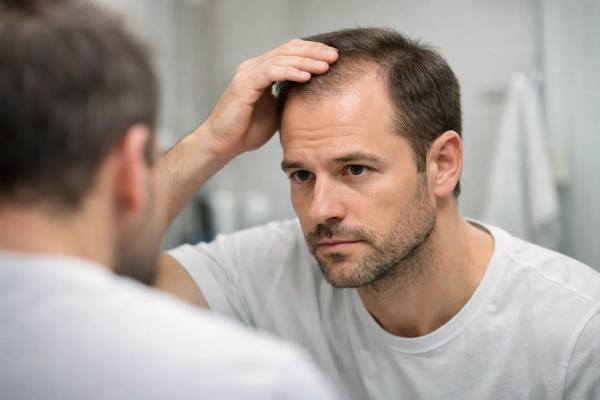
Hair loss in men is common, but it is not all the same problem. A slowly receding hairline, a widening thin spot at the crown, sudden shedding after illness, and patchy bald spots each point to different causes and different solutions. That is why the most useful first step is not buying another shampoo. It is figuring out which type of hair loss is actually happening.
For most men, the main culprit is androgenetic alopecia, also called male pattern hair loss. This condition is driven by genetics and the hair follicle’s sensitivity to dihydrotestosterone, or DHT. The process is gradual, which is both the challenge and the opportunity. Once follicles miniaturize for too long, recovery becomes harder. But when treatment starts early, many men can slow loss, keep more hair, and sometimes regain visible density.
The strongest treatment plans focus on proven options, realistic timelines, and steady use. The sections below explain the causes, the stages, the red flags that suggest another diagnosis, and the treatments most supported by clinical evidence.
Key Insights
- Male pattern hair loss usually progresses slowly, which creates a better window for treatment when started early.
- The best-supported medical options for most men are topical minoxidil and oral finasteride, often used long term.
- Devices and procedures can help selected patients, but they usually work best as add-ons rather than replacements.
- Sudden shedding, patchy loss, scalp pain, or scarring signs should not be assumed to be routine male pattern baldness.
- Take consistent photos every 1 to 3 months in the same lighting so changes are easier to judge than by memory alone.
Table of Contents
- Why Hair Loss Happens in Men
- How Male Pattern Hair Loss Progresses
- When It Might Be Something Else
- First-Line Treatments With the Best Evidence
- Adjuncts, Devices, and Procedures
- Setting Realistic Expectations and Next Steps
Why Hair Loss Happens in Men
In men, the most common cause of ongoing scalp hair loss is androgenetic alopecia, often called male pattern baldness. It is not caused by poor circulation, wearing hats, washing too often, or ordinary shampoo use. The central issue is that certain follicles are genetically sensitive to DHT, a hormone made from testosterone. Over time, that sensitivity causes those follicles to shrink. Dermatologists call this miniaturization.
Miniaturization changes the hair in a predictable way. Thick terminal hairs become finer, shorter, and less pigmented. The growth phase gets shorter, the resting phase becomes proportionally longer, and each cycle produces a weaker strand. Understanding the hair growth cycle makes this easier to picture: instead of staying in a long productive growth phase, affected follicles start ending that phase too early.
Why do the temples and crown thin first while the sides often stay dense? Follicles in different scalp zones do not behave the same way. Frontotemporal and vertex follicles are more vulnerable to androgen-related miniaturization, while the occipital donor area at the back of the head is usually more resistant. That pattern is the reason hair transplantation is even possible.
Genetics matter a great deal, but inheritance is not as simple as getting it from one parent. A strong family history on either side raises the odds, yet some men with obvious family risk keep good density for years, while others thin early. Age also matters. Even when hair loss begins in the twenties, the process usually becomes more visible with time.
Other factors can worsen the picture without being the root cause. These include high inflammatory burden on the scalp, untreated seborrheic dermatitis, major stress, rapid weight loss, low iron stores, thyroid disease, and some medications. In those cases, a man may have male pattern hair loss plus a second trigger that increases shedding on top of it.
This distinction matters because treatment goals differ. With classic androgenetic alopecia, the aim is usually to slow miniaturization, preserve strong follicles, and improve density where follicles are still alive. Once a follicle has been inactive for a long time and the scalp is slick and shiny, medicines are less likely to bring back meaningful coverage. That is why early action usually gives the best chance of a visible result.
How Male Pattern Hair Loss Progresses
Male pattern hair loss is usually described with the Norwood-Hamilton scale. You do not need to memorize the chart, but it helps explain why early thinning looks so different from advanced baldness and why treatment plans change by stage.
A simplified view looks like this:
- Stage 1: Little or no visible recession.
- Stage 2: Mild recession at the temples, often called an early mature hairline by some men, though not every mature hairline is balding.
- Stage 3: Deeper temple recession becomes obvious. For many men, this is the point where the hairline starts to look clearly thinner rather than simply more adult.
- Stage 3 Vertex: The hairline may still be decent, but crown thinning becomes noticeable.
- Stage 4: Frontal recession and crown loss are both more pronounced, usually with a bridge of hair between them.
- Stage 5: The bridge gets narrower and density drops further.
- Stage 6 and 7: The front and crown areas connect, leaving hair mainly on the sides and back.
Not every man moves neatly from one stage to the next. Some men mainly lose density behind the hairline. Others keep a decent front but thin at the crown for years. Some develop diffuse thinning across the top, which can make hair look weak and see-through even before the hairline has receded dramatically.
This is where careful observation beats guesswork. In true male pattern hair loss, the change is usually gradual. You may notice more scalp showing under bright light, shorter or finer hairs around the temples, or a crown that looks flatter in photos. Miniaturized hairs are a major clue. These are the wispy, weaker strands that signal the follicle is still active but under pressure.
What often confuses men is the difference between a receding hairline and temporary shedding. A receding hairline tends to creep back over months or years and often leaves finer hairs at the edge. Telogen effluvium, by contrast, is more likely to produce a sudden jump in shedding from all over the scalp. The shower drain may look alarming, but the pattern is less selective.
Catching progression early matters because stage predicts what medicine can realistically do. In early stages, treatment often focuses on stabilization and thickening. In mid stages, combination therapy becomes more important. In advanced stages, medicine may still help preserve remaining hair, but restoring a youthful hairline without surgery becomes less realistic.
One practical habit helps more than most men expect: take standardized photos. Use the same room, lighting, hairstyle, and angles every month. Front, both temples, top, crown, and side views are best. Hair loss is slow enough that memory is unreliable. Photos make progression visible, and they also help you tell whether treatment is working.
When It Might Be Something Else
Not every man with thinning hair has classic androgenetic alopecia. That matters because the wrong assumption delays the right treatment. Male pattern hair loss is common, but so are mixed cases in which a second problem adds shedding, irritation, or patchy loss on top of it.
One common look-alike is telogen effluvium. This is a shift in the hair cycle that causes more hairs than usual to enter the shedding phase. It often shows up 2 to 3 months after a trigger such as a high fever, severe stress, surgery, major weight loss, or a harsh calorie deficit. Men describe more hair on the pillow, in the shower, or on the desk, but the scalp often thins diffusely rather than just at the temples and crown. If the shedding is abrupt, a guide on sudden hair shedding triggers can help frame the discussion with a clinician.
Alopecia areata is different again. It usually causes sharply defined bald patches and may involve the beard or eyebrows too. The scalp skin often looks fairly normal. Because it is autoimmune rather than androgen driven, the treatment approach is not the same as for male pattern baldness.
Other possibilities include:
- Traction-related loss: More common with tight braids, locs, or styles that pull on the hairline.
- Fungal infection: More likely if there is scaling, broken hairs, inflammation, or tender spots.
- Seborrheic dermatitis or psoriasis: These conditions do not typically cause permanent balding on their own, but inflammation and scratching can worsen apparent density.
- Medication-related shedding: Some antidepressants, retinoids, anticoagulants, stimulants, and hormone-altering drugs can contribute.
- Nutritional deficiency or endocrine issues: Low iron stores, low protein intake, thyroid dysfunction, and severe vitamin excess or deficiency may contribute to shedding.
- Scarring alopecia: Less common, but important because it can destroy follicles permanently if not treated early.
Certain red flags deserve prompt assessment rather than another six months of watchful waiting. These include sudden rapid shedding, patchy bare areas, scalp pain, burning, pustules, thick scale, broken hairs, eyebrow loss, or shiny scar-like skin. Those findings suggest something beyond routine male pattern loss.
A medical evaluation may include a scalp exam, trichoscopy, and selected blood tests when the history points that way. Not every man needs a large lab panel. But a doctor may check thyroid markers, iron status, vitamin levels, or other tests when symptoms and timing suggest a systemic trigger.
The key idea is simple: slow patterned thinning fits male pattern hair loss; sudden, patchy, painful, inflamed, or scar-like loss does not fit as neatly. When the pattern is atypical, a precise diagnosis is often more valuable than any over-the-counter product.
First-Line Treatments With the Best Evidence
For most men with androgenetic alopecia, the best-supported medical treatments are topical minoxidil and oral finasteride. They work in different ways, which is why combination therapy often performs better than using either one alone.
Topical minoxidil helps keep follicles in the growth phase longer and can enlarge miniaturized follicles enough to produce thicker hairs. In practical terms, it is one of the most accessible first-line options because it does not require hormone manipulation. Men commonly use 5% foam or solution. Labels often direct twice-daily use, though many real-world routines are simplified for adherence. The main drawback is consistency: missing applications repeatedly reduces the odds of success.
Minoxidil does not work overnight. Many men need at least 3 to 6 months before judging early response, and 6 to 12 months is a more realistic window for visible cosmetic improvement. Early shedding can happen in the first weeks. That can be discouraging, but it does not automatically mean the treatment is failing.
Oral finasteride reduces conversion of testosterone to DHT, the hormone most central to follicle miniaturization in male pattern hair loss. This makes it especially useful for preserving hair at the crown and mid-scalp, though it can help the frontal scalp too. The usual prescription dose for male pattern hair loss is 1 mg daily. Its greatest strength is stabilization. Many men focus on regrowth, but stopping further loss is often the bigger long-term win.
Side effects are the reason some men hesitate. Sexual adverse effects, mood concerns, and breast tenderness are the issues most often discussed. The real-world experience varies. Some men tolerate finasteride well, while others prefer not to use it. Shared decision-making matters here. For readers comparing formulations, a guide to topical compared with oral finasteride can be useful, especially when the goal is to think through trade-offs rather than chase hype.
A sensible first-line plan often looks like this:
- Early thinning: topical minoxidil, with finasteride discussed if the pattern is clearly progressive.
- More established miniaturization: minoxidil plus finasteride.
- Men unwilling to use finasteride: minoxidil as the base, with realistic expectations and discussion of adjuncts.
The biggest mistake is changing treatments too quickly. Hair grows slowly. A product used for six weeks has not had a fair trial. The second biggest mistake is stopping as soon as things improve. These treatments manage the condition; they do not cure the genetic tendency behind it. Once treatment stops, the gains usually fade over time.
Adjuncts, Devices, and Procedures
Once the basics are in place, many men want to know what else helps. This is where nuance matters. There are useful adjuncts, but the evidence is less consistent than it is for minoxidil and finasteride, and marketing often runs far ahead of data.
Low-dose oral minoxidil is one of the most discussed off-label options. It may help men who dislike topical products, who struggle with scalp irritation, or who want a more convenient routine. It is prescription only and not appropriate for everyone. Because it can affect blood pressure, heart rate, fluid balance, or hair growth on the face and body, it belongs in a clinician-guided plan rather than casual self-experimentation.
Dutasteride is another off-label option in many settings. It suppresses DHT more strongly than finasteride, which is why some doctors consider it for men who continue to progress despite standard treatment. The flip side is that stronger hormonal suppression can mean a different side-effect discussion. It is not a first choice for every patient.
Microneedling has moved from trend to plausible adjunct. The best evidence suggests it may improve results when combined with medical therapy rather than used by itself. Technique matters. Needle depth, frequency, sterility, and scalp condition all influence safety. Too much intensity can irritate the scalp without improving outcomes.
Low-level laser therapy is another reasonable add-on for some patients. The overall signal is promising, especially for mild to moderate androgenetic alopecia, but outcomes depend on device quality, use schedule, and patience. A closer look at low-level laser therapy for hair growth helps separate device-based therapy from exaggerated claims.
Platelet-rich plasma, or PRP, may improve density in selected men, but study protocols vary widely. That variation makes it harder to predict who will benefit most. It is usually considered an adjunct, not a replacement for core medical therapy.
Ketoconazole shampoo can be useful when dandruff or seborrheic dermatitis is present. It is not a stand-alone cure for male pattern baldness, but reducing inflammation and scale may improve scalp comfort and help a broader regimen work more smoothly.
What usually deserves skepticism? Expensive serums with vague peptide blends, “DHT-blocking” supplements without strong trial data, and any product that promises dramatic regrowth in a few weeks. The more dramatic the promise, the more cautious you should be.
A practical rule is to build from strongest evidence outward: first-line medicine first, then one carefully chosen adjunct if needed, then procedures only when the diagnosis is clear and expectations are realistic.
Setting Realistic Expectations and Next Steps
The best hair-loss plan is not the most aggressive one. It is the one you can follow consistently, afford long term, and judge honestly. Hair growth is slow, and disappointment often comes from expecting the timeline of skin care from a condition that changes on a much longer cycle.
A useful way to think about success is in layers:
- Stabilization: Less ongoing loss and slower progression.
- Thickening: Existing miniaturized hairs become stronger.
- Regrowth: Some visible return in areas where follicles are still viable.
- Coverage: A cosmetic improvement, which is not always the same thing as major biological regrowth.
For many men, stabilization is already a good outcome. If you preserve density for years, you often postpone the need for more invasive or expensive interventions.
Expectations should also fit the stage. In early disease, medicine may do a lot. In mid-stage disease, combination treatment often matters more. In advanced Norwood stages, medication can still preserve remaining hair and improve the appearance of the top, but restoring a dense adolescent hairline is less realistic. That is where transplantation enters the conversation.
Hair transplantation works best when the donor area is stable, the pattern is understood, and the medical plan is already controlling further miniaturization. If surgery is being considered, understanding FUE and FUT transplant methods is more useful than focusing only on the clinic’s before-and-after photos. Surgical planning is about donor management, not just hairline design. An aggressive hairline in your thirties can create problems later if native hair keeps thinning behind it.
The treatment timeline should also be clear:
- Commit to a diagnosis.
- Start a simple evidence-based routine.
- Reassess with photos at about 3, 6, and 12 months.
- Add only one major variable at a time when possible.
- Reconsider surgery only after stabilization is underway.
When should you see a dermatologist? Early is better than late if the loss is clearly progressive, emotionally distressing, or unusual in pattern. A specialist visit becomes especially important if you have sudden shedding, patchy loss, scalp symptoms, or no improvement despite a solid trial of treatment.
Hair loss in men is easier to manage when you stop treating it as a mystery and start treating it as a pattern-recognition problem. Identify the type, choose the strongest evidence-based options first, and give the plan enough time to work.
References
- Management of androgenic alopecia: a systematic review of the literature 2024 (Systematic Review)
- Evidence-based (S3) guideline for the treatment of androgenetic alopecia in women and in men – short version 2018 (Guideline)
- Efficacy of the association of topical minoxidil and topical finasteride compared to their use in monotherapy in men with androgenetic alopecia: A prospective, randomized, controlled, assessor blinded, 3-arm, pilot trial 2024 (RCT)
- Efficacy and safety of combined microneedling therapy for androgenic alopecia: A systematic review and meta-analysis of randomized clinical trials 2024 (Systematic Review and Meta-Analysis)
- Low-Level Laser and LED Therapy in Alopecia: A Systematic Review and Meta-Analysis 2025 (Systematic Review and Meta-Analysis)
Disclaimer
This article is for educational purposes only and is not a diagnosis or a substitute for medical care. Hair loss in men can have more than one cause, and treatment choices depend on the pattern, scalp findings, medical history, and risk tolerance. Prescription medicines and procedures can have side effects, limitations, and monitoring needs. If you have sudden shedding, patchy loss, scalp pain, inflammation, scarring signs, or concerns about medication safety, seek evaluation from a qualified clinician or dermatologist.
If this guide helped you, consider sharing it on Facebook, X, or another platform your friends, family, or readers use most.