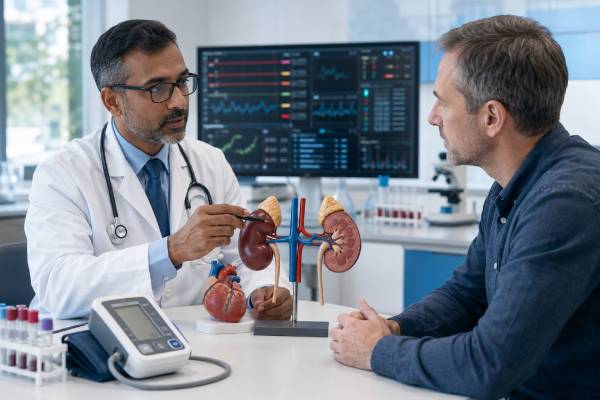
A high aldosterone blood test means your adrenal glands are making more aldosterone than expected for the situation. Aldosterone is a hormone that helps control blood pressure, sodium, potassium, and body fluid balance. A high result is most concerning when it appears with high blood pressure, low potassium, and low renin, because that pattern can point to primary aldosteronism, a treatable form of hormone-related hypertension. But aldosterone can also rise for normal reasons, such as standing upright, eating very little salt, dehydration, pregnancy, or using certain diuretics.
Aldosterone is rarely interpreted by itself. Doctors usually compare it with renin, potassium, blood pressure, kidney function, medications, body position, and salt intake. A single high value may need repeat testing under controlled conditions before it has a clear meaning.
- High aldosterone with low renin often suggests primary aldosteronism, especially when blood pressure is high.
- High aldosterone with high renin usually points to secondary aldosteronism, such as reduced kidney blood flow, diuretic use, or fluid-volume signals.
- Low potassium can happen with high aldosterone, but many people with primary aldosteronism have normal potassium.
- Aldosterone ranges vary widely by lab, posture, time of day, sodium intake, and whether the test used blood or urine.
- Follow-up often includes renin, aldosterone-renin ratio, electrolytes, kidney tests, and sometimes confirmatory testing.
- Urgent care is needed for severe weakness, fainting, chest pain, confusion, severe headache, or symptoms of dangerous potassium imbalance.
Table of Contents
- What a High Aldosterone Result Means
- How Aldosterone Affects Blood Pressure and Potassium
- Primary Aldosteronism and Low Renin
- Secondary Aldosteronism and High Renin
- Test Preparation and Factors That Change Results
- How Doctors Follow Up a High Result
- Treatment Options and When Results Matter Most
- Common Mistakes When Reading Aldosterone Results
What a High Aldosterone Result Means
A high aldosterone result means the measured amount of aldosterone in your blood is above the lab’s expected range for the way the sample was collected. That last part matters. Aldosterone changes with posture, salt intake, time of day, hydration, potassium level, menstrual cycle phase, pregnancy, and medications. A value that looks high after standing may not mean the same thing as the same value after lying down.
Aldosterone is made in the outer layer of the adrenal glands, which sit above the kidneys. Its main job is to help the body hold onto sodium and water while getting rid of extra potassium and acid. This helps maintain blood volume and blood pressure. When aldosterone rises appropriately, it is usually responding to a signal that the body needs to protect circulation. When it rises inappropriately, it can drive high blood pressure and potassium loss.
Aldosterone is often measured as part of a blood pressure hormone evaluation, especially when someone has:
- high blood pressure at a young age
- resistant hypertension, meaning blood pressure remains high despite several medications
- unexplained low potassium
- an adrenal nodule found on imaging
- sleep apnea with difficult blood pressure control
- a family history of early stroke or primary aldosteronism
- worsening kidney function with unusual electrolyte findings
The most useful interpretation compares aldosterone with renin. Renin is a kidney hormone that rises when the kidneys sense low blood flow, low sodium delivery, or low effective blood volume. A related guide to renin and aldosterone patterns can help explain why doctors usually order both hormones together.
In broad terms, high aldosterone can follow two main patterns:
| Pattern | Common meaning | Typical clues |
|---|---|---|
| High aldosterone, low renin | Aldosterone may be too autonomous, meaning the adrenal glands are making it despite low kidney signaling. | High blood pressure, sometimes low potassium, high aldosterone-renin ratio. |
| High aldosterone, high renin | Aldosterone may be responding to kidney or circulation signals. | Diuretic use, low salt intake, dehydration, renal artery narrowing, heart failure, cirrhosis, or kidney blood-flow problems. |
| High aldosterone with normal renin | May reflect posture, sodium intake, medications, borderline physiology, or early disease. | Often needs repeat testing under clearer conditions. |
Aldosterone alone does not diagnose primary aldosteronism, kidney disease, adrenal tumors, or any single condition. It points to a hormone pattern that needs context.
How Aldosterone Affects Blood Pressure and Potassium
Aldosterone works mainly in the kidney’s distal tubules and collecting ducts. These are small channels where the body fine-tunes sodium, water, potassium, and acid balance after the kidney has filtered the blood. When aldosterone rises, the kidney reabsorbs more sodium. Water often follows sodium, which can expand blood volume and raise blood pressure.
At the same time, aldosterone pushes the kidney to excrete more potassium into the urine. This is why high aldosterone can cause hypokalemia, the medical term for low blood potassium. A related article on low potassium blood test results explains why potassium changes can affect muscles, nerves, and heart rhythm.
High aldosterone can also increase acid loss in the urine. When this is strong enough, blood bicarbonate can rise and cause metabolic alkalosis, a pattern where the blood becomes more alkaline than usual. This is one reason some people with aldosterone excess have a cluster of high blood pressure, low potassium, and high bicarbonate or carbon dioxide on a chemistry panel.
Aldosterone does not usually make sodium look dramatically high on a standard blood test. The body has several escape mechanisms that help prevent severe sodium overload, including increased sodium excretion through other pathways. A person can have significant aldosterone excess with a normal blood sodium level.
Symptoms, when they occur, often come from high blood pressure, low potassium, or both. Possible symptoms include:
- muscle weakness, cramps, heaviness, or unusual fatigue
- frequent urination, especially at night
- increased thirst
- headaches or pounding pressure sensations
- tingling, palpitations, or skipped beats
- constipation from slower muscle activity
- severe weakness or temporary paralysis when potassium is very low
Many people have no obvious symptoms. That is one reason primary aldosteronism can be missed for years. A person may simply have “essential hypertension” that needs more medications over time.
Potassium level changes also depend on diet, kidney function, medications, and how severe the aldosterone effect is. Some people with clear primary aldosteronism have normal potassium because they eat enough potassium, have milder hormone excess, take medications that raise potassium, or have not yet developed measurable potassium loss. Normal potassium should not automatically rule out aldosterone-related high blood pressure.
Primary Aldosteronism and Low Renin
Primary aldosteronism is one of the most important causes of a high aldosterone blood test. It happens when one or both adrenal glands produce too much aldosterone without needing a strong renin signal from the kidneys. Because the extra aldosterone expands blood volume and raises blood pressure, the kidneys usually respond by lowering renin. That creates the classic pattern: aldosterone is high or inappropriately normal, renin is low, and the aldosterone-renin ratio is high.
The word “primary” means the main problem starts in the adrenal aldosterone-producing tissue. It does not mean the condition is mild. Untreated primary aldosteronism can increase the risk of atrial fibrillation, stroke, heart enlargement, kidney strain, and harder-to-control blood pressure compared with similar blood pressure caused by non-hormonal hypertension.
The most common causes are:
- Bilateral adrenal hyperplasia: both adrenal glands make excess aldosterone.
- Aldosterone-producing adenoma: a usually benign adrenal growth makes aldosterone from one side.
- Unilateral adrenal hyperplasia: one adrenal gland overproduces without a classic single adenoma.
- Familial primary aldosteronism: inherited forms, especially when hypertension starts young or runs strongly in a family.
- Adrenal cancer: rare, but considered when imaging or hormone levels look concerning.
Primary aldosteronism is especially worth considering when high blood pressure is paired with low renin. The aldosterone level may be clearly high, but sometimes it is only “normal-high.” That can still be abnormal if renin is strongly suppressed, because aldosterone should usually fall when renin is very low.
Why the aldosterone-renin ratio is often more useful than aldosterone alone
The aldosterone-renin ratio, often called ARR, compares aldosterone with renin. A high ratio suggests aldosterone is too high relative to the body’s renin signal. Many labs flag an ARR above a certain cutoff, but cutoffs vary because renin can be measured as plasma renin activity or direct renin concentration, and aldosterone can be reported in different units.
A common screening pattern is an ARR above the lab cutoff with aldosterone above a minimum level, often around 10–15 ng/dL, depending on the protocol. Some patients with milder disease fall near the borderline range, so doctors may repeat testing rather than make a decision from one sample.
The ARR can be falsely high when renin is extremely low for reasons unrelated to primary aldosteronism. It can also be falsely low if medications or salt restriction raise renin. That is why preparation and medication review matter.
Who is commonly screened
Doctors often screen for primary aldosteronism when someone has resistant hypertension, hypertension with low potassium, hypertension plus an adrenal mass, early-onset hypertension, sleep apnea with difficult control, or a family history suggesting hormone-related blood pressure. People with severe hypertension, especially if it starts younger than expected, may also be screened.
A normal basic metabolic panel does not exclude the condition. If creatinine, sodium, and potassium are normal but blood pressure remains difficult to control, aldosterone and renin can still be relevant. The relationship between potassium and kidney markers is discussed more broadly in potassium and creatinine patterns.
Secondary Aldosteronism and High Renin
Secondary aldosteronism means aldosterone is high because renin is high. The adrenal glands are responding to signals from the kidneys or circulation rather than acting independently. This pattern can be appropriate, partly appropriate, or harmful depending on the cause.
The kidney releases renin when it senses reduced blood flow, lower pressure in the kidney arteries, low sodium delivery, or reduced effective circulating volume. Renin then activates the renin-angiotensin-aldosterone system, often shortened to RAAS. Angiotensin II rises, blood vessels tighten, and aldosterone increases. This helps preserve blood pressure during dehydration or sodium loss, but it can worsen hypertension when the signal is chronic.
Common causes of high aldosterone with high renin include:
- Diuretic use: water pills can increase sodium and fluid loss, raising renin and aldosterone.
- Low salt intake: very low sodium intake can raise renin and aldosterone even in healthy people.
- Dehydration or fluid loss: vomiting, diarrhea, sweating, or poor intake can trigger a compensatory rise.
- Renal artery stenosis: narrowing of an artery to a kidney can make the kidney sense low pressure.
- Heart failure: the body may sense low effective circulation even when fluid is present.
- Cirrhosis or nephrotic syndrome: fluid shifts can reduce effective arterial blood volume.
- Pregnancy: RAAS activity normally rises during pregnancy.
- Bartter or Gitelman syndromes: inherited salt-wasting kidney conditions can raise renin and aldosterone, often with low potassium and normal or low blood pressure.
Secondary aldosteronism is not interpreted the same way as primary aldosteronism. In primary aldosteronism, renin is suppressed because aldosterone is driving sodium and water retention on its own. In secondary aldosteronism, renin is part of the reason aldosterone is high.
A high renin result can point the evaluation in a different direction. For example, a person with high blood pressure, high renin, high aldosterone, and an abdominal bruit may need evaluation for renovascular disease. A person taking a loop diuretic may need medication timing reviewed before the result is considered meaningful. A person with low blood pressure and chronic low potassium may need evaluation for salt-wasting kidney disorders rather than adrenal overproduction.
A related article on high renin blood test results can help place this pattern in context.
Test Preparation and Factors That Change Results
Aldosterone is a sensitive test. A high result may reflect biology, but it may also reflect how the sample was collected. Before making decisions, clinicians usually check whether the testing conditions were appropriate for the question being asked.
Posture has a major effect. Aldosterone is often higher after standing or sitting upright and lower after lying down. Many protocols collect a morning sample after the person has been awake for at least two hours and seated for several minutes. Other protocols use specific upright or supine collection rules. The correct comparison range depends on the protocol.
Salt intake also matters. Very low sodium intake can raise renin and aldosterone. High sodium intake can suppress them. For screening primary aldosteronism, many clinicians prefer that the person not be sodium restricted before testing unless there is a medical reason to limit sodium.
Potassium should be corrected when possible. Low potassium can suppress aldosterone production and may hide the full degree of aldosterone excess. That means a person with primary aldosteronism and low potassium might have a less impressive aldosterone level than expected. Potassium correction should be done under medical guidance, especially in people with kidney disease or those taking medications that raise potassium.
Medications can strongly affect aldosterone, renin, and ARR. Important examples include:
| Medication type | Possible effect on testing |
|---|---|
| Spironolactone, eplerenone, amiloride, triamterene | Can greatly affect renin and aldosterone because they block aldosterone action or potassium channels. |
| Thiazide or loop diuretics | Often raise renin and aldosterone by causing salt and fluid loss. |
| ACE inhibitors and ARBs | Usually raise renin and may lower aldosterone, which can reduce ARR. |
| Beta blockers | Can suppress renin and make ARR look higher. |
| NSAIDs | May suppress renin in some people and complicate interpretation. |
| Oral estrogen therapy or some hormonal medications | Can affect renin measurement depending on the assay and medication form. |
Doctors may switch blood pressure medicines before testing, but this is individualized. Some people should not stop or change medication because blood pressure could become unsafe. When medication changes are not possible, the test can still provide useful information if interpreted carefully.
Other factors that can raise aldosterone or change the result include intense exercise, acute illness, stress, kidney impairment, menstrual cycle phase, and lab assay differences. For this reason, a borderline high aldosterone result often leads to repeat testing rather than immediate imaging or treatment.
For general reference ranges and posture-related variation, see aldosterone blood test normal range.
How Doctors Follow Up a High Result
Follow-up depends on the pattern. The most important first step is usually to review the aldosterone result with renin, potassium, blood pressure, medication list, sodium intake, and collection conditions.
If the pattern suggests primary aldosteronism, the next steps may include repeat aldosterone and renin testing, ARR calculation, and confirmatory testing. Confirmatory tests check whether aldosterone stays high when it should suppress. Common options include saline infusion testing, oral sodium loading, captopril challenge, and fludrocortisone suppression testing. The best choice depends on local expertise and safety factors such as kidney function, heart failure risk, and blood pressure severity.
Some people with a very strong pattern may not need every confirmatory step. For example, a person with spontaneous low potassium, suppressed renin, and clearly high aldosterone may have a high enough probability that a specialist moves forward more directly. This decision is made case by case.
After biochemical confirmation, doctors often use adrenal imaging, usually CT, to look for an adrenal nodule or enlargement. Imaging helps identify anatomy but does not always prove which adrenal gland is making aldosterone. Small adrenal nodules are common with age and may not be functional. A person can have a visible nodule on one side while both glands are actually producing aldosterone.
When surgery is being considered, adrenal venous sampling may be recommended. This procedure samples blood from veins draining each adrenal gland to see whether one side is overproducing aldosterone. It is technically demanding and usually done by experienced interventional radiologists. It can help separate unilateral disease, which may be treated with adrenalectomy, from bilateral disease, which is usually treated with medication.
Follow-up also includes checking related blood tests:
- potassium
- sodium
- bicarbonate or carbon dioxide
- creatinine and eGFR
- magnesium in selected cases
- urine albumin or protein if kidney risk is a concern
- glucose and cardiovascular risk markers when long-standing hypertension is present
A broader kidney function blood test panel may help show whether high blood pressure or aldosterone excess has affected kidney filtration or electrolyte balance.
If the pattern suggests secondary aldosteronism, follow-up looks for the reason renin is high. That may involve medication review, hydration assessment, urine electrolytes, kidney artery evaluation, heart or liver assessment, or testing for salt-wasting kidney disorders.
Treatment Options and When Results Matter Most
Treatment depends on whether aldosterone is high because of primary aldosteronism, secondary aldosteronism, medications, or a temporary physiologic trigger.
For confirmed unilateral primary aldosteronism, laparoscopic adrenalectomy may be considered. Removing the overactive adrenal gland can improve blood pressure, raise potassium, reduce medication needs, and sometimes cure hypertension. Blood pressure does not normalize in everyone, especially if hypertension has been present for many years or there are other risk factors. Even when medications are still needed, potassium and hormone burden may improve.
For bilateral primary aldosteronism, treatment usually uses mineralocorticoid receptor antagonists. These medications block aldosterone’s effects. The most common are spironolactone and eplerenone. Spironolactone is often effective and affordable, but it can cause breast tenderness, menstrual changes, sexual side effects, or gynecomastia because it also interacts with sex hormone receptors. Eplerenone is more selective and may cause fewer hormone-related side effects, but it is often more expensive and may need twice-daily dosing.
Amiloride may be used in some situations because it blocks sodium channels affected by aldosterone, though it is not a mineralocorticoid receptor antagonist. Potassium supplements may be used temporarily or alongside treatment, but replacing potassium without treating the aldosterone problem may not control the underlying blood pressure risk.
Treatment monitoring is important. After starting aldosterone-blocking therapy, doctors usually recheck potassium and kidney function. Potassium can rise too high, especially in people with reduced kidney function or those taking ACE inhibitors, ARBs, or other potassium-raising medicines. Creatinine may also change as blood pressure and kidney blood flow adjust.
For secondary aldosteronism, treatment focuses on the cause. That may mean adjusting diuretics, treating dehydration, managing heart failure or liver disease, evaluating renal artery stenosis, or addressing a kidney salt-wasting condition. The goal is not always to suppress aldosterone directly; sometimes aldosterone is a response to another circulation problem.
High aldosterone matters most when it is persistent and paired with one or more of these clues:
- high blood pressure that is hard to control
- low potassium without a clear explanation
- suppressed renin
- adrenal nodule
- early-onset hypertension
- family history of severe hypertension or early stroke
- atrial fibrillation or heart enlargement with hypertension
- worsening kidney markers linked to long-standing blood pressure strain
Seek urgent medical help for symptoms that could reflect severe hypertension or dangerous potassium imbalance, including chest pain, fainting, severe shortness of breath, new confusion, severe one-sided weakness, sudden vision changes, severe headache with very high blood pressure, paralysis-like weakness, or sustained palpitations.
Common Mistakes When Reading Aldosterone Results
One common mistake is treating aldosterone as a simple high-or-low marker. It is not like a sodium or hemoglobin result with one relatively stable interpretation. Aldosterone is dynamic. The same person can have different values depending on posture, sodium intake, potassium level, and medications.
Another mistake is assuming low potassium must be present. Low potassium is an important clue, but many people with primary aldosteronism have normal potassium. When potassium is low, the case becomes more suspicious. When potassium is normal, the condition may still be present if renin is suppressed and blood pressure is high.
A third mistake is ignoring renin. A high aldosterone value with high renin usually means something different from high aldosterone with low renin. Renin shows whether aldosterone is responding to a kidney signal or acting more independently. A related guide to low renin blood test results explains why suppressed renin can be a major clue in hormone-driven hypertension.
It is also easy to overinterpret adrenal imaging. An adrenal nodule does not automatically mean that nodule is producing aldosterone. Nonfunctioning adrenal nodules are common, especially with age. Biochemical testing comes first, and adrenal venous sampling may be needed before surgery.
A fourth mistake is changing medications without medical supervision. Some blood pressure medicines affect aldosterone testing, but stopping them abruptly can be dangerous. Testing can often be planned around medication realities rather than forcing a risky washout.
Finally, a high aldosterone result should not be ignored when the pattern is strong. Primary aldosteronism is treatable. Finding it can change therapy from simply adding more blood pressure drugs to targeting the hormone mechanism itself.
References
- The Management of Primary Aldosteronism: Case Detection, Diagnosis, and Treatment: An Endocrine Society Clinical Practice Guideline 2016 (Guideline)
- The Unrecognized Prevalence of Primary Aldosteronism: A Cross-sectional Study 2020 (Cross-sectional Study)
- Diagnostic accuracy of adrenal imaging for subtype diagnosis in primary aldosteronism: systematic review and meta-analysis 2020 (Systematic Review)
- Laboratory investigation of primary aldosteronism 2010 (Review)
- Laboratory investigation of primary aldosteronism 2010 (PubMed)
Disclaimer
A high aldosterone result should be interpreted by a qualified clinician who can review your blood pressure, renin, potassium, kidney function, medications, posture during testing, and sodium intake. Do not stop blood pressure medicines, diuretics, potassium supplements, or hormone medications just to repeat testing unless your clinician tells you how to do so safely. Seek urgent care for severe weakness, fainting, chest pain, confusion, stroke-like symptoms, or very high blood pressure with concerning symptoms.