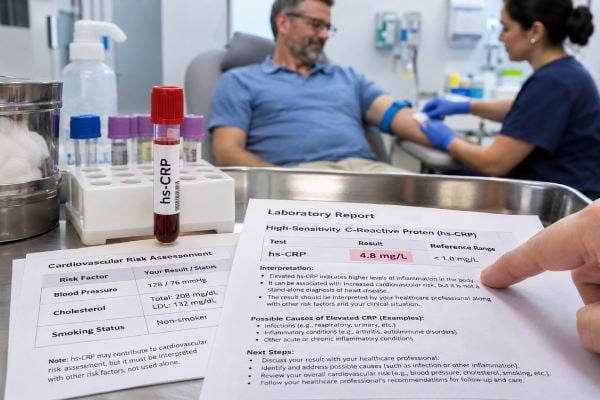
A high C-reactive protein result means inflammation is present somewhere in the body, but it does not automatically mean you have heart disease. For cardiovascular risk, the most useful version of the test is usually high-sensitivity CRP (hsCRP), which can detect the low-grade inflammation linked with atherosclerosis. Higher hsCRP is associated with a greater risk of heart attack, stroke, and recurrent cardiovascular events even after cholesterol is considered. The result still needs context because infection, injury, autoimmune disease, obesity, smoking, and many other conditions can raise CRP. A value measured while you have a cold or another acute illness should not be interpreted as your stable heart-risk level. The practical response is to identify obvious causes of inflammation, repeat testing when appropriate, and address proven cardiovascular risks such as LDL cholesterol, blood pressure, diabetes, smoking, inactivity, and excess weight. CRP is a risk marker and sometimes a useful treatment clue—not a number to lower with supplements at any cost.
Table of Contents
- CRP vs hsCRP: What the Test Measures
- What High hsCRP Means for Heart Risk
- Common Reasons CRP Is High
- How to Interpret Your CRP Result
- What to Do About High CRP
- Medications and Residual Inflammatory Risk
- When High CRP Needs More Medical Evaluation
CRP vs hsCRP: What the Test Measures
C-reactive protein is made mainly by the liver in response to inflammatory signaling, especially the interleukin-6 pathway. It rises when the immune system is activated by infection, tissue injury, inflammatory disease, and many other stressors.
A standard CRP test is useful for detecting and following moderate or substantial inflammation. It may be ordered when a clinician is evaluating infection, inflammatory disease, or treatment response.
A high-sensitivity CRP, or hsCRP, test measures the same protein with a method designed to detect much lower concentrations. That lower range is what makes hsCRP useful for studying chronic low-grade inflammation related to atherosclerotic cardiovascular disease.
CRP is not a heart-specific protein. Your heart does not need to be inflamed for the value to rise, and a high result cannot tell you where the inflammation is located. That is why a CRP result should never be treated like a diagnosis by itself.
Inflammation does play a real role in atherosclerosis. Cholesterol-containing particles enter the artery wall, and the immune system participates in plaque formation, progression, and destabilization. hsCRP is a practical blood marker that reflects part of this inflammatory environment. It is better thought of as a signal of inflammatory risk than as the substance directly causing all of the damage.
This distinction matters because LDL and inflammation are separate but interacting pathways. A person can have well-controlled LDL cholesterol and still have residual inflammatory risk. Likewise, a high hsCRP does not make LDL unimportant. If your cholesterol is part of the concern, LDL, HDL, and triglycerides explains what each part of the lipid panel represents.
What High hsCRP Means for Heart Risk
Higher hsCRP is associated with higher cardiovascular risk, but the number should modify a broader risk assessment rather than replace it.
Historically, hsCRP values below 1 mg/L have been described as lower cardiovascular risk, 1 to 3 mg/L as intermediate, and above 3 mg/L as higher risk. Modern prevention discussions often pay particular attention to hsCRP of 2 mg/L or higher as evidence of increased or residual inflammatory risk. These thresholds are not hard biological borders. A result of 1.9 mg/L is not fundamentally different from 2.0 mg/L.
Recent large population data support the relationship. In people without known atherosclerotic cardiovascular disease, hsCRP of at least 2 mg/L has been associated with higher rates of major cardiovascular events and mortality even after other risk factors were considered. In people who already have coronary disease, persistently elevated hsCRP can identify residual risk despite statin treatment and lower LDL levels.
The strongest interpretation comes from combining hsCRP with other information:
- Age and sex
- Blood pressure
- LDL cholesterol, non-HDL cholesterol, and sometimes ApoB
- Diabetes and blood sugar
- Smoking status
- Kidney disease
- Family history of early cardiovascular disease
- Lipoprotein(a)
- Existing coronary, carotid, or peripheral artery disease
- Imaging findings such as coronary artery calcium when clinically appropriate
This explains why hsCRP may matter most when a treatment decision is uncertain. An elevated inflammatory marker can add weight to an already concerning risk profile. It is less useful when the treatment decision is obvious for other reasons, such as established cardiovascular disease or very high LDL cholesterol.
If you are working through particle-related cholesterol risk, ApoB testing compared with LDL can provide complementary information. ApoB reflects the number of atherogenic particles; hsCRP reflects inflammatory activity. They answer different questions.
Common Reasons CRP Is High
A high CRP is nonspecific, and many causes have nothing to do with atherosclerosis.
Acute infection: Viral and bacterial infections can raise CRP, sometimes dramatically. A cardiovascular-risk hsCRP should not be interpreted while you are acutely ill.
Recent injury, surgery, or intense inflammation: Tissue damage activates inflammatory pathways and can temporarily increase CRP.
Autoimmune or inflammatory disease: Rheumatoid arthritis, inflammatory bowel disease, lupus, psoriasis, and other chronic inflammatory conditions can keep CRP elevated.
Obesity, especially visceral fat: Adipose tissue is metabolically active and can produce inflammatory signals. Higher body fat, particularly central fat, is often associated with higher hsCRP.
Smoking: Tobacco exposure promotes vascular inflammation and can raise inflammatory markers while also directly increasing cardiovascular risk.
Poor metabolic health: Insulin resistance, type 2 diabetes, fatty liver disease, and elevated triglycerides often cluster with low-grade inflammation.
Poor sleep and sleep apnea: Repeated sleep disruption and intermittent low oxygen can contribute to sympathetic activation and inflammatory signaling.
Dental and periodontal disease: Gum inflammation can contribute to systemic inflammatory markers, although treating the mouth should be done for oral health rather than as a guaranteed way to prevent heart attacks.
Chronic kidney disease: Kidney disease is associated with both higher cardiovascular risk and a greater inflammatory burden.
Some cancers and other medical conditions: CRP can rise in many serious illnesses, which is another reason an unexplained high value may require medical evaluation.
A single elevated result therefore asks a second question: Was this measured during your usual state of health? If you had fever, respiratory symptoms, a recent injury, a flare of inflammatory disease, or surgery, the result may mainly reflect that event.
Women may also see CRP vary with hormonal and reproductive factors, and medications can influence inflammatory markers. These influences do not make the test useless; they simply reinforce that hsCRP is interpreted in context rather than as a stand-alone diagnosis. If a value seems inconsistent with your health or previous results, reviewing the circumstances around the blood draw is often more useful than immediately assuming a new cardiovascular problem.
Lifestyle-related inflammation is real, but it should not be reduced to one “inflammatory food.” Overall dietary pattern, smoking, adiposity, activity, sleep, and metabolic health matter more than banning a single ingredient. An anti-inflammatory diet for heart health is best built around minimally processed foods rather than supplement claims.
How to Interpret Your CRP Result
First, confirm which test you had. Standard CRP and hsCRP may be reported in the same units, usually mg/L, but they are ordered for different clinical purposes.
For cardiovascular risk, a stable hsCRP result is generally more informative when you are free from acute infection or injury. Because CRP can vary, clinicians may repeat an unexpectedly high value before using it in a prevention decision.
A result above about 10 mg/L should usually trigger a search for acute or substantial inflammation rather than be interpreted simply as “very high heart risk.” Infection, inflammatory disease, injury, or another active process may be present. Once the acute issue has resolved, repeating hsCRP can show whether low-grade inflammation remains.
Do not interpret CRP without the rest of the laboratory picture. For example:
- High hsCRP + high LDL/ApoB: both lipid burden and inflammation may be contributing.
- High hsCRP + normal LDL: inflammation may still add risk, but treatment depends on overall cardiovascular profile.
- Normal hsCRP + high LDL: a low inflammatory marker does not cancel the risk from a high concentration of atherogenic particles.
- High CRP during pneumonia: the number mainly reflects the acute infection and is not a clean cardiovascular-risk measurement.
Trend can matter, but repeated testing should have a purpose. There is little value in checking hsCRP every few weeks simply to watch it fluctuate. The test is most useful when it can change risk interpretation or guide a clinician’s next step.
CRP also does not tell you whether a coronary plaque is present, how narrowed an artery is, or whether a heart attack is occurring. Those questions require different tools. Troponin is the key blood biomarker for suspected acute heart-muscle injury; cholesterol tests characterize lipid-related risk; coronary calcium imaging can quantify calcified plaque in selected prevention decisions. hsCRP adds information about inflammatory risk but does not replace any of them.
Laboratories can report CRP in mg/L or, less commonly, mg/dL. The units matter: 1 mg/dL equals 10 mg/L. A result can look ten times different on paper if the unit is overlooked. Always compare the value with the reference range and units printed by that laboratory rather than copying a threshold from another report.
Biologic variability also explains why a clinician may repeat hsCRP. Exercise that is unusually strenuous, a dental infection, a flare of arthritis, or a mild respiratory illness can temporarily shift the value. When the goal is cardiovascular risk assessment, a stable measurement taken during your usual state of health is more meaningful than the highest number ever recorded.
Also avoid comparing values from different situations as if they were equivalent. A fasting state is not essential for hsCRP itself, but being acutely ill, injured, or in the middle of an inflammatory flare can change the result far more than whether you ate breakfast.
What to Do About High CRP
The best response is to reduce the underlying cardiovascular and inflammatory risks, not to chase CRP with unproven “detox” products.
1. Rule out an obvious acute cause. If you were sick or injured, wait until you have recovered and follow your clinician’s advice about repeating the test.
2. Get the standard cardiovascular risks under control. LDL cholesterol, blood pressure, diabetes, smoking, and physical inactivity have proven treatment pathways. A high CRP should make you more attentive to these basics, not distract you from them. If LDL is elevated, causes and treatment of high LDL cholesterol is a useful next step.
3. Exercise regularly. Aerobic activity and resistance training improve blood pressure, insulin sensitivity, body composition, and cardiovascular fitness. Consistency matters more than an extreme workout program.
4. Address excess visceral fat when appropriate. Even modest sustainable weight loss can improve multiple cardiometabolic markers. The focus should be on health and waist-related risk, not rapid dieting.
5. Stop smoking and avoid tobacco exposure. Smoking is both inflammatory and directly atherogenic. Quitting produces cardiovascular benefits that far outweigh any supplement marketed specifically to lower CRP.
6. Build a high-quality dietary pattern. Emphasize vegetables, fruit, legumes, whole grains, nuts, seeds, fish, and unsaturated fats, while reducing heavily processed foods, refined carbohydrates, and excess saturated fat according to your overall lipid profile.
7. Treat sleep problems. If you snore loudly, stop breathing during sleep, wake unrefreshed, or have resistant hypertension, ask about sleep apnea evaluation.
8. Manage chronic inflammatory disease. Effective treatment of rheumatoid arthritis, psoriasis, inflammatory bowel disease, or other inflammatory conditions matters for overall health and can affect cardiovascular risk.
The goal is not necessarily to reach a particular CRP number. It is to reduce the disease processes that make the number high and the person vulnerable.
It can help to set outcome-based goals instead of biomarker-only goals: stop smoking, reach the LDL or ApoB target appropriate for your risk, bring blood pressure under control, improve glucose if diabetes is present, exercise most weeks, and treat sleep apnea or inflammatory disease when indicated. If hsCRP falls as those changes take effect, that is encouraging, but the clinical benefits of the changes matter even when the marker does not move dramatically.
Medications and Residual Inflammatory Risk
Some cardiovascular medicines affect inflammation as well as their primary target, but treatment should be chosen for proven clinical benefit rather than for a CRP-lowering effect alone.
Statins are the clearest example. Their main job is to lower LDL-related atherosclerotic risk, but they also tend to reduce hsCRP. Trials have shown cardiovascular benefit in selected people with elevated hsCRP even when LDL was not markedly high. An elevated hsCRP can therefore support a statin discussion when overall primary-prevention risk is borderline or uncertain.
For people with established atherosclerotic cardiovascular disease, persistent hsCRP elevation despite good LDL control is often called residual inflammatory risk. This has become an active treatment target.
Low-dose colchicine has reduced cardiovascular events in certain secondary-prevention trials and has an approved cardiovascular indication in the United States. It is not an over-the-counter anti-inflammatory strategy. Colchicine can interact with other drugs and can cause gastrointestinal, muscle, blood-cell, or toxicity problems in susceptible people, especially with kidney or liver impairment. Whether it is appropriate should be decided by a clinician familiar with the patient’s cardiovascular history and medication list.
Other targeted anti-inflammatory therapies have produced mixed results. Canakinumab reduced cardiovascular events in a major trial but is not used routinely for cardiovascular prevention because of cost, infection risk, and practical limitations. Methotrexate did not reduce cardiovascular events in a trial where it also failed to suppress the relevant inflammatory pathway. These differences show why “lowering inflammation” is not one simple treatment category.
Do not self-treat high CRP with high-dose aspirin, ibuprofen, steroids, or supplements. A drug can reduce inflammation in one context while causing cardiovascular, gastrointestinal, kidney, bleeding, or immune problems in another.
When High CRP Needs More Medical Evaluation
A mildly elevated hsCRP in an otherwise well person is usually not an emergency. It is a reason to put the result into a broader cardiovascular and medical context.
Prompt follow-up is more important when CRP is markedly elevated, keeps rising, remains unexplained on repeat testing, or comes with symptoms such as fever, unexplained weight loss, persistent pain, joint swelling, severe fatigue, night sweats, shortness of breath, or other signs of systemic illness.
You may also need a more focused cardiovascular discussion if hsCRP remains at or above 2 mg/L and you have other risk factors, a strong family history, or known coronary disease. The clinician may review your lipids, ApoB, lipoprotein(a), blood pressure, glucose, kidney function, smoking, medications, and whether imaging such as coronary artery calcium would change management.
CRP should not become the only number you watch. Someone with hsCRP of 4 mg/L and untreated LDL of 190 mg/dL has a major lipid problem that needs treatment regardless of whether the inflammatory marker later falls. Likewise, someone with established coronary disease needs intensive secondary prevention even if hsCRP is low.
The useful question is not “How do I get my CRP into the green zone?” It is “Why might inflammation be elevated, and does this result change what I should do to reduce cardiovascular risk?” That framing keeps the test in its proper role: a valuable marker that can sharpen risk assessment without replacing the bigger clinical picture.
References
- Inflammation and Cardiovascular Disease: 2025 ACC Scientific Statement: A Report of the American College of Cardiology 2026 (Position Statement)
- C-reactive protein and cardiovascular risk in the general population 2025
- High-sensitivity C-reactive Protein in Atherosclerotic Cardiovascular Disease: To Measure or Not to Measure? 2025 (Review)
- Targeting residual inflammatory risk: The next frontier for atherosclerosis treatment and prevention 2023 (Review)
- High-Sensitivity C-Reactive Protein and Residual Inflammatory Risk in Coronary Artery Disease: The Pathophysiology, Prognosis, and Emerging Therapies 2026 (Review)
Disclaimer
CRP and hsCRP are nonspecific inflammation markers and cannot diagnose heart disease or identify the source of inflammation by themselves. Discuss markedly elevated, persistent, or unexplained results with a healthcare professional, especially if you have fever, systemic symptoms, or known cardiovascular disease. Do not start anti-inflammatory medication or supplements solely to lower CRP without medical guidance.