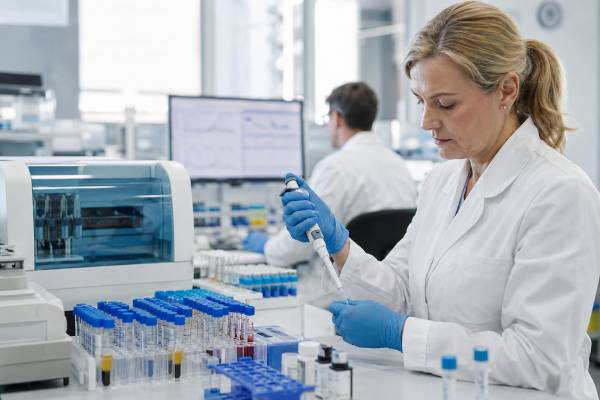
A high thrombin time means the last step of clot formation is taking longer than expected. In this test, the lab adds thrombin to plasma and measures how many seconds it takes fibrinogen to turn into fibrin, the protein mesh that helps form a stable clot. Because thrombin is added directly, the test looks mainly at fibrinogen function and substances that block thrombin or fibrin formation. A high result does not point to one single disease. It most often reflects heparin in the sample, a direct thrombin inhibitor such as dabigatran or argatroban, low fibrinogen, abnormal fibrinogen, fibrin breakdown products, severe liver disease, disseminated intravascular coagulation, or rarely an antibody that interferes with thrombin. The result becomes most useful when compared with fibrinogen activity, reptilase time, PT, aPTT, D-dimer, platelet count, medication history, and bleeding symptoms.
- A high thrombin time means plasma takes too long to form fibrin after thrombin is added.
- Common causes include heparin, direct thrombin inhibitors, low fibrinogen, abnormal fibrinogen, and fibrin breakdown products.
- Many laboratories report thrombin time in seconds, but the reference interval varies by method; examples include roughly 12–19 seconds or 15.8–24.9 seconds.
- A normal reptilase time with a high thrombin time points toward heparin or a thrombin inhibitor rather than a fibrinogen problem.
- Urgent follow-up matters when a high thrombin time occurs with active bleeding, very low fibrinogen, DIC, severe liver disease, trauma, major surgery, or anticoagulant overdose.
Table of Contents
- What a High Thrombin Time Means
- How the Test Works
- Common Causes
- Fibrinogen Problems
- Test Patterns That Help Find the Cause
- Symptoms, Bleeding Risk, and When It Matters
- Follow-Up Testing and Practical Next Steps
- Sample and Result Issues That Can Mislead
What a High Thrombin Time Means
A high thrombin time means fibrin formation is delayed after thrombin is added to the blood plasma sample. Thrombin time is also called TT or thrombin clotting time. It focuses on the final conversion of fibrinogen into fibrin, so it behaves differently from PT and aPTT.
PT and aPTT test earlier parts of the clotting system. Thrombin time bypasses most of those earlier steps because the lab adds thrombin directly. That makes TT especially sensitive to problems at the fibrinogen-to-fibrin stage and to substances that block thrombin itself.
A high result usually means one of four broad things:
- Thrombin is being blocked by a medication or inhibitor.
- Fibrinogen is too low.
- Fibrinogen is present but does not work normally.
- Fibrin formation is being disrupted by fibrin breakdown products or certain abnormal proteins.
The result is reported in seconds. Some laboratories consider values above about 19 or 20 seconds high, while others use a higher upper limit, such as about 25 seconds. The correct range is the one printed on the report because thrombin concentration, analyzer type, reagent source, and lab method change the number.
A mildly high thrombin time often needs repeat testing and context. A very prolonged or “no clot detected” result raises stronger concern for heparin contamination, direct thrombin inhibitor effect, severe fibrinogen deficiency, afibrinogenemia, or a strong thrombin inhibitor.
A high thrombin time does not automatically mean a person is bleeding or about to bleed. Some people with abnormal fibrinogen have no symptoms. Others have easy bruising, nosebleeds, heavy menstrual bleeding, bleeding after dental work, or surgical bleeding. A smaller group has clotting problems instead, especially with certain inherited or acquired fibrinogen disorders.
For a general comparison of where thrombin time fits among related tests, a coagulation panel often includes PT, INR, aPTT, fibrinogen, platelet count, and D-dimer rather than thrombin time alone.
How the Test Works
Thrombin time measures how long plasma takes to clot after a measured amount of thrombin is added. Plasma is the liquid part of blood after cells are removed. The sample is usually collected in a light-blue-top tube that contains sodium citrate, an anticoagulant that prevents clotting before the test.
In the lab, the plasma is separated from blood cells. The analyzer adds thrombin. If fibrinogen works normally and no strong inhibitor is present, fibrin strands form within the expected time. If the clot forms slowly, the thrombin time is prolonged.
The test mainly checks the final step of clotting:
- Thrombin acts on fibrinogen.
- Fibrinogen releases small fibrinopeptides.
- Fibrin monomers form.
- Fibrin monomers join into a visible clot.
Because the lab supplies thrombin, the test does not depend much on whether the body generated thrombin properly through the intrinsic, extrinsic, or common clotting pathways. That is why a person can have a normal PT and a normal aPTT but still have a high thrombin time.
A normal result makes some causes less likely, especially strong heparin effect or clinically meaningful dabigatran effect at the time of testing. A high result does not identify the cause by itself. It tells the clinician where to look next.
Thrombin time often overlaps with the normal thrombin time article topic, but a high result deserves its own interpretation because prolonged TT is usually a problem of interference, fibrinogen amount, fibrinogen function, or clot breakdown.
Common Causes
A high thrombin time has a focused list of causes. Medication effects and sample contamination are common, while rare inherited fibrinogen disorders become more likely when the result stays abnormal on repeat testing and fits the personal or family history.
| Cause | How it raises thrombin time | Helpful clues |
|---|---|---|
| Heparin | Blocks thrombin through antithrombin activity | Recent IV line flush, heparin drip, catheter draw, normal reptilase time |
| Direct thrombin inhibitors | Directly inhibit thrombin in the test tube | Dabigatran, argatroban, bivalirudin, hirudin exposure |
| Low fibrinogen | Not enough fibrinogen is available to form fibrin efficiently | Low fibrinogen activity, bleeding, DIC, severe liver disease, massive bleeding |
| Dysfibrinogenemia | Fibrinogen is present but structurally abnormal | Low activity-to-antigen ratio, personal or family history of bleeding or thrombosis |
| Fibrin degradation products | Clot breakdown fragments interfere with fibrin polymerization | High D-dimer or FDP, DIC, thrombolytic therapy |
| Paraproteins | Abnormal proteins interfere with fibrin formation | Multiple myeloma, amyloidosis, unexplained abnormal protein tests |
| Thrombin antibodies | Antibodies interfere with test thrombin | Rare; may follow exposure to bovine thrombin products |
Heparin is one of the first causes clinicians consider. Unfractionated heparin strongly prolongs thrombin time. Low-molecular-weight heparin usually affects TT less, but high levels or unusual sensitivity can still prolong it. Heparin contamination also occurs when blood is drawn from a line that was flushed with heparin.
Direct thrombin inhibitors also prolong TT because the test depends on thrombin activity. Dabigatran is an oral direct thrombin inhibitor. Argatroban and bivalirudin are injectable direct thrombin inhibitors used in specific hospital settings. When these drugs are present, thrombin time often becomes very sensitive, sometimes too sensitive to estimate the drug level accurately.
Low fibrinogen is another major cause. Fibrinogen is made in the liver and circulates in plasma. If levels fall enough, fibrin forms slowly or poorly. Low fibrinogen occurs in DIC, severe liver disease, massive bleeding, major trauma, obstetric hemorrhage, advanced consumption of clotting factors, and rare inherited fibrinogen deficiency.
Dysfibrinogenemia means fibrinogen is structurally abnormal. The fibrinogen level may look normal by antigen testing, but the protein does not clot normally. This pattern often needs both fibrinogen activity and fibrinogen antigen testing.
Fibrin breakdown products can also prolong TT. These fragments interfere with fibrin polymerization, especially when clot formation and clot breakdown are both highly active. This is why TT can be abnormal in DIC or during thrombolytic therapy.
A high TT from warfarin alone is not expected. Warfarin affects vitamin K-dependent clotting factors and mainly prolongs PT/INR. It does not directly block the thrombin-fibrinogen reaction. If a person on warfarin has a high thrombin time, another explanation should be considered.
Fibrinogen Problems
Fibrinogen problems are central to a high thrombin time because fibrinogen is the protein thrombin acts on. The lab may add enough thrombin, but clot formation still slows when fibrinogen is missing, reduced, abnormal, or blocked from polymerizing.
Low fibrinogen
Low fibrinogen is called hypofibrinogenemia when fibrinogen is reduced and afibrinogenemia when fibrinogen is essentially absent. Thrombin time often becomes prolonged when functional fibrinogen is very low, especially below about 100 mg/dL in many clot-based systems.
Common acquired causes include:
- Disseminated intravascular coagulation
- Severe liver disease
- Major trauma or massive bleeding
- Obstetric hemorrhage
- Severe sepsis
- Thrombolytic therapy
- Large-volume transfusion without enough fibrinogen replacement
- Rare inherited fibrinogen deficiency
Fibrinogen activity is the most useful next test when low fibrinogen is suspected. A separate fibrinogen blood test gives a more direct measure of how much functional fibrinogen is available.
Abnormal fibrinogen function
Dysfibrinogenemia means fibrinogen does not work normally. The amount of fibrinogen may be normal, but the clot forms slowly, forms weakly, or breaks down in an unusual way. Some people have no symptoms and discover it after abnormal coagulation testing. Others have bleeding, thrombosis, pregnancy complications, or a family history of abnormal clotting tests.
A helpful pattern is low fibrinogen activity with normal or near-normal fibrinogen antigen. Activity measures clotting function. Antigen measures the amount of fibrinogen protein. When activity is much lower than antigen, the protein is present but not working well.
Dysfibrinogenemia comes in inherited and acquired forms. Inherited cases involve variants in fibrinogen genes. Acquired cases occur with liver disease, autoimmune disease, malignancy, plasma cell disorders, and some medications.
High fibrinogen and thrombin time
High fibrinogen usually reflects inflammation, infection, tissue injury, pregnancy, smoking, obesity, estrogen exposure, or chronic inflammatory disease. High fibrinogen more often relates to clotting risk than prolonged TT. Still, some lab methods or unusual fibrinogen behavior can produce abnormal clotting patterns. The clinical question is usually whether the fibrinogen is high as an acute-phase reactant or whether fibrinogen function is abnormal.
High fibrinogen is covered separately in high fibrinogen blood test, while bleeding-focused patterns fit better with low fibrinogen blood test.
Liver disease and fibrinogen quality
The liver makes fibrinogen and many other clotting proteins. Advanced liver disease can lower fibrinogen, alter fibrinogen structure, raise fibrin breakdown products, and prolong PT or aPTT. This produces confusing patterns because standard clotting tests do not fully describe bleeding or clotting balance in liver disease.
A high thrombin time in severe liver disease needs careful interpretation. It may reflect low fibrinogen, acquired dysfibrinogenemia, DIC-like consumption, medication effects, or several of these together.
Test Patterns That Help Find the Cause
A high thrombin time becomes much clearer when read with related tests. No single clotting test gives the full answer. Clinicians usually compare TT with reptilase time, fibrinogen activity, fibrinogen antigen, PT/INR, aPTT, platelet count, and D-dimer.
| single clotting test gives the full answer. Clinicians usually compare TTPattern | Most likely explanation | Typical next step |
|---|---|---|
| High TT, normal reptilase time | Heparin or direct thrombin inhibitor | Review medications, check anti-Xa or drug-specific assay when needed |
| High TT, high reptilase time | Low fibrinogen, dysfibrinogenemia, or fibrin breakdown products | Check fibrinogen activity, antigen, D-dimer, FDP |
| High TT, low fibrinogen activity | Low functional fibrinogen or abnormal fibrinogen function | Compare with fibrinogen antigen |
| High TT, low activity but normal antigen | Dysfibrinogenemia | Hematology review, family history, possible genetic testing |
| High TT, prolonged PT/aPTT, low platelets, high D-dimer | DIC or severe systemic illness | Urgent clinical assessment and repeat coagulation panel |
| High TT after a line draw | Heparin contamination | Repeat sample from a clean peripheral vein |
Reptilase time is often the most useful partner test. Reptilase is a thrombin-like enzyme derived from snake venom. It converts fibrinogen toward fibrin formation but is not inhibited by heparin the way thrombin is. That difference helps separate heparin effect from fibrinogen problems.
When TT is prolonged but reptilase time is normal, heparin or a thrombin inhibitor moves high on the list. When both TT and reptilase time are prolonged, fibrinogen deficiency, dysfibrinogenemia, and fibrin breakdown products become more likely. A dedicated reptilase time test explains this comparison in more detail.
PT and aPTT add broader context. A high thrombin time with normal PT and aPTT often points toward a focused thrombin-fibrinogen problem or medication interference. A high TT with prolonged PT and aPTT suggests a wider coagulation problem, such as DIC, severe liver disease, massive transfusion, or multiple factor deficiencies. Readers comparing patterns may also find high prothrombin time and high aPTT useful for understanding the broader clotting picture.
D-dimer and fibrin degradation products help detect clot breakdown. A high TT with high D-dimer, low fibrinogen, low platelets, and prolonged PT can fit DIC, especially in severe infection, trauma, cancer, obstetric emergencies, or shock. A D-dimer blood test does not diagnose DIC by itself, but it helps show whether fibrin formation and breakdown are active.
Symptoms, Bleeding Risk, and When It Matters
A high thrombin time matters most when it matches symptoms, medication exposure, or a high-risk medical setting. The same lab abnormality has different meaning in a stable outpatient with no symptoms, a hospitalized patient on argatroban, and a bleeding trauma patient with low fibrinogen.
Possible bleeding symptoms include:
- Frequent or hard-to-stop nosebleeds
- Easy bruising without clear injury
- Heavy menstrual bleeding
- Bleeding after dental work
- Bleeding after surgery or childbirth
- Large soft-tissue bruises or muscle bleeding
- Blood in urine or stool
- Ongoing bleeding from IV sites, wounds, or drains
Urgent care is important when a high thrombin time appears with active heavy bleeding, black stools, vomiting blood, sudden severe headache, weakness on one side, fainting, major trauma, recent surgery, childbirth bleeding, or suspected anticoagulant overdose.
A high TT linked to heparin or a direct thrombin inhibitor often reflects the intended drug effect, excessive drug effect, kidney-related drug buildup, wrong timing of the blood draw, or line contamination. The clinical response depends on why the person is receiving the medication and whether bleeding is present.
A fibrinogen-related high TT can create either bleeding or clotting risk. That sounds contradictory, but abnormal fibrinogen disorders are biologically complex. Some abnormal fibrinogens form weak clots and cause bleeding. Others alter clot structure, fibrinolysis, or thrombin regulation in ways that increase thrombosis risk. Some people experience both.
Pregnancy and childbirth need special care. Fibrinogen normally rises during pregnancy. A “normal” nonpregnant fibrinogen value during major obstetric bleeding may be concerning because pregnant patients usually run higher. A prolonged TT with falling fibrinogen during postpartum hemorrhage needs fast clinical attention.
DIC is another high-risk setting. DIC is not a single disease; it is a severe coagulation reaction caused by another condition. Sepsis, trauma, cancer, obstetric complications, and shock can trigger widespread clotting activation. Platelets and clotting factors get consumed, fibrin breakdown increases, and bleeding can occur. TT may become prolonged when fibrinogen falls or fibrin breakdown products interfere with clot formation.
Follow-Up Testing and Practical Next Steps
Follow-up starts with one simple question: is the high thrombin time real and clinically relevant? The answer comes from medication review, sample quality, repeat testing when needed, and related coagulation results.
A practical follow-up plan often includes:
- Review anticoagulants and recent procedures. Heparin, line flushes, dabigatran, argatroban, bivalirudin, thrombolytic drugs, and recent catheter draws can explain the result.
- Repeat the sample if contamination is likely. A fresh peripheral venipuncture can resolve a falsely high result caused by heparin in a line.
- Check fibrinogen activity. This helps identify low functional fibrinogen.
- Add fibrinogen antigen when activity is low or the result does not fit. A low activity-to-antigen ratio supports dysfibrinogenemia.
- Compare TT with reptilase time. This helps separate heparin or thrombin inhibitor effects from fibrinogen-related problems.
- Review PT, INR, aPTT, platelets, D-dimer, and clinical status. This identifies broader patterns such as DIC, liver disease, or consumption coagulopathy.
- Consider hematology referral for persistent unexplained abnormalities. This is especially important with bleeding, thrombosis, pregnancy complications, family history, or suspected inherited fibrinogen disorder.
The exact next test depends on the pattern. If a patient is taking dabigatran and TT is high, drug timing and kidney function become important. If the patient has no anticoagulant exposure and both TT and reptilase time are prolonged, fibrinogen activity and antigen are more important. If the patient is critically ill with low platelets and high D-dimer, DIC evaluation takes priority.
Genetic testing is not the first step for most people. It becomes useful when repeated testing suggests an inherited fibrinogen disorder, especially when fibrinogen activity and antigen do not match or when there is a family history of abnormal clotting tests, bleeding, thrombosis, or pregnancy loss.
Treatment is not based on thrombin time alone. Clinicians treat the cause and the patient’s condition. Examples include correcting heparin contamination by redrawing the sample, adjusting or holding an anticoagulant when clinically appropriate, treating DIC by treating the trigger, replacing fibrinogen during major bleeding, or planning surgery with a hematologist when a fibrinogen disorder is known.
Sample and Result Issues That Can Mislead
Thrombin time is sensitive to collection and handling problems. A result that does not match the patient’s situation should be checked before major decisions are made.
The most common pre-analytical issue is heparin contamination. Blood drawn from a central line, arterial line, dialysis catheter, or IV line recently flushed with heparin can produce a prolonged TT even when the person’s circulating blood is not truly over-anticoagulated. Drawing from a clean peripheral vein helps avoid this problem.
Tube fill matters. Coagulation tubes need the correct blood-to-citrate ratio. Underfilling the blue-top tube leaves too much citrate relative to blood and can distort clotting results. Very high hematocrit, often above 55%, also changes the plasma-to-citrate ratio and requires citrate adjustment.
Specimen processing matters too. Platelet-poor plasma is preferred for many coagulation assays. Delays, poor centrifugation, improper freezing, hemolysis, lipemia, or sample mix-ups can affect accuracy. Laboratories usually reject visibly unsuitable samples, but milder issues can still create confusing results.
The reagent matters. Thrombin time reference ranges differ because labs use different thrombin sources and concentrations. Bovine thrombin and human thrombin assays do not behave identically. A result of 22 seconds may be high in one lab and normal in another. Always interpret the number against the lab’s own reference interval.
The timing of anticoagulant testing also matters. Dabigatran levels rise and fall after each dose, and kidney function affects drug clearance. A high TT soon after a dose has a different meaning than a high TT long after the last dose. Hospital drugs such as argatroban and bivalirudin require timing and dose context.
Finally, thrombin time is a screening tool, not a full diagnosis. It points to a problem in fibrin formation or thrombin inhibition. It does not measure clot strength, platelet function, vessel health, or the whole balance between bleeding and clotting. That is why clinicians interpret it with symptoms, medications, medical history, and a broader set of tests.
References
- International council for standardisation in haematology recommendations on fibrinogen assays, thrombin clotting time and related tests in the investigation of bleeding disorders 2024 (Guideline)
- Laboratory Evaluation of Coagulopathies 2024 (Review)
- Interpretation of Blood Clotting Studies and Values (PT, PTT, aPTT, INR, Anti-Factor Xa, D-Dimer) 2025 (Review)
- 2025 Guidelines for direct oral anticoagulants: a practical guidance on the prescription, laboratory testing, peri‐operative and bleeding management 2025 (Guideline)
- Disseminated intravascular coagulation 2025 (Review)
- How I treat dysfibrinogenemia 2021 (Review)
Disclaimer
This article is educational and does not replace care from a qualified healthcare professional. A high thrombin time needs interpretation with your medication history, bleeding symptoms, sample collection details, and other coagulation tests. Seek urgent medical care for active heavy bleeding, suspected anticoagulant overdose, severe injury, or new neurological symptoms.