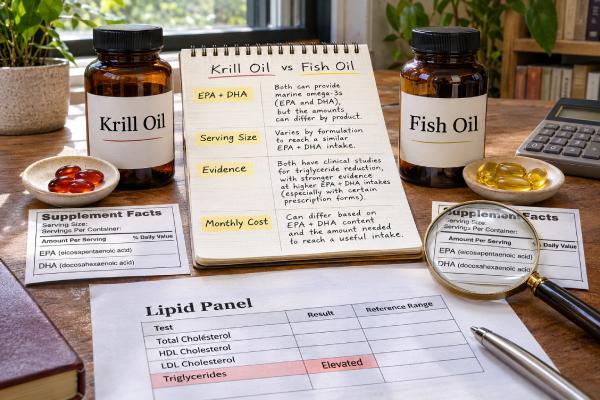
Fish oil is the better-established choice for lowering high triglycerides, while krill oil may produce modest lipid improvements but has less evidence at clinically useful omega-3 doses. The most important number is not the milligrams of “oil” on the front of the bottle. It is the actual amount of EPA plus DHA you receive each day. Prescription omega-3 products can deliver several grams of EPA and/or DHA in a standardized dose and have the strongest evidence for substantial triglyceride lowering. Many over-the-counter fish oil and krill oil products provide far less. Krill oil packages omega-3s largely in phospholipids and may be absorbed efficiently at lower labeled doses, but that does not prove it lowers triglycerides as much as a high-dose prescription fish oil product. Cost also matters: krill oil is often more expensive per gram of EPA+DHA. For mildly elevated triglycerides, either supplement may play a small supporting role, but food choices, alcohol intake, weight, diabetes control, and medication decisions usually matter more.
Table of Contents
- The Main Difference Between Krill Oil and Fish Oil
- Which One Lowers Triglycerides Better?
- How to Read the Dose Correctly
- Cost and Value Tradeoffs
- Side Effects, Interactions, and Safety
- When Supplements Are Not Enough
- How to Choose Between Krill and Fish Oil
The Main Difference Between Krill Oil and Fish Oil
Both products can supply the long-chain omega-3 fatty acids EPA and DHA, but they package them differently.
Standard fish oil is usually made from oily fish such as anchovies, sardines, mackerel, or similar marine sources. Depending on the product, EPA and DHA may be present as triglycerides, re-esterified triglycerides, free fatty acids, or ethyl esters. Prescription products are purified and standardized so the amount of active omega-3 is predictable.
Krill oil comes from tiny crustaceans, most commonly Antarctic krill. A meaningful proportion of its EPA and DHA is attached to phospholipids rather than triglycerides. Krill oil also naturally contains astaxanthin, a red-orange carotenoid antioxidant. These differences have led to claims that krill oil is inherently superior because the omega-3s may be absorbed efficiently.
Absorption, however, is only one part of the decision. What matters clinically is whether a product delivers enough EPA and DHA to produce the desired effect on triglycerides. A small softgel with 1,000 mg of “krill oil” may contain only a fraction of that amount as EPA+DHA. A 1,000 mg fish oil capsule can also contain surprisingly little EPA+DHA unless it is concentrated.
For heart-related decisions, compare the active omega-3 amount, not the total oil weight. The broader differences between these fatty acids are covered in EPA versus DHA for heart health.
Which One Lowers Triglycerides Better?
Fish oil has much stronger evidence for meaningful triglyceride lowering because high-dose EPA and EPA+DHA products have been studied extensively in people with hypertriglyceridemia.
At pharmacologic doses, omega-3 fatty acids reduce the liver’s production and secretion of triglyceride-rich very-low-density lipoprotein particles and increase clearance of triglyceride-rich particles. In people with high or very high triglycerides, prescription omega-3 therapy at 4 g/day can commonly lower triglycerides by roughly 20%–30% or more, with the exact response depending on baseline levels and formulation. People starting with very high triglycerides often see larger absolute reductions.
Krill oil can also lower triglycerides. A 2023 systematic review and meta-analysis of randomized trials found improvements in triglycerides, LDL cholesterol, and total cholesterol with krill oil supplementation. But the krill studies were smaller, used varying formulations and doses, and generally were not designed as direct substitutes for prescription-dose omega-3 therapy in severe hypertriglyceridemia.
That means the evidence does not support a simple claim such as “one krill capsule works as well as several grams of fish oil.” Some studies suggest that phospholipid-bound omega-3s can achieve similar blood EPA/DHA levels with lower quantities, but blood incorporation is not identical to proven triglyceride-lowering efficacy at treatment doses.
There is another important distinction: lowering triglycerides is not the same as preventing cardiovascular events. High-dose purified EPA in the prescription drug icosapent ethyl has outcome evidence in selected high-risk, statin-treated patients. Ordinary fish oil supplements, mixed EPA+DHA products, and krill oil should not be assumed to provide the same cardiovascular benefit. For the practical difference between drug-strength products and store-bought capsules, see prescription omega-3 versus OTC fish oil.
If your goal is specifically to treat a measured triglyceride problem, fish oil—especially prescription omega-3 when medically indicated—has the clearer evidence base.
One reason direct comparisons are difficult is that krill trials often use products with different phospholipid concentrations, astaxanthin content, EPA:DHA ratios, and total omega-3 doses. Fish oil studies also vary, but there is a much larger body of dose-response data at therapeutic intakes. When two products are compared at unequal EPA+DHA doses, the result tells you about those specific products rather than proving that one marine source is universally better.
The baseline triglyceride level also changes the apparent effect. A 15% reduction from 180 mg/dL lowers the value by 27 mg/dL, while the same percentage reduction from 600 mg/dL lowers it by 90 mg/dL. This is why a study in healthy adults with near-normal triglycerides cannot answer the same question as a trial in people with severe hypertriglyceridemia. When reading supplement claims, check who was studied and where their triglycerides started.
How to Read the Dose Correctly
The most common supplement mistake is counting total oil instead of EPA plus DHA.
Suppose a bottle says “1,000 mg fish oil” per softgel. The supplement facts panel might show only 180 mg EPA and 120 mg DHA. That is 300 mg of EPA+DHA, not 1,000 mg. A person taking two capsules would get 600 mg of EPA+DHA.
Now consider a krill oil product labeled “500 mg krill oil.” It might provide, for example, 60 mg EPA and 30 mg DHA. Two capsules would provide 180 mg of EPA+DHA even though the front label suggests 1,000 mg of krill oil.
For triglycerides, clinically studied omega-3 treatment often uses gram-level amounts of EPA and/or DHA rather than a few hundred milligrams. This is one reason trying to reproduce a prescription dose with regular supplements can require many capsules and become expensive.
| What the label says | What it actually tells you | What to check next |
|---|---|---|
| “1,000 mg fish oil” | Total oil weight | EPA mg + DHA mg per serving |
| “500 mg krill oil” | Total krill oil weight | EPA mg + DHA mg per serving |
| “1,200 mg omega-3” | Potentially useful, but still incomplete | How much is EPA, DHA, and other omega-3s? |
| “4 g prescription omega-3” | Standardized medication dose | Whether it is EPA-only or EPA+DHA |
DHA deserves a separate note. DHA-containing formulations can sometimes raise LDL-C in people with very high triglycerides even as triglycerides fall. EPA-only prescription therapy generally does not have that same LDL-raising tendency. The change is not guaranteed, but it is one reason a follow-up lipid panel matters after starting high-dose omega-3.
Do not increase an over-the-counter supplement to several grams per day based only on a web calculator. Concentration, quality, oxidation, other ingredients, medications, and the reason for treatment all matter. If your triglycerides are high enough to warrant gram-level therapy, that is a good point to involve a clinician.
Cost and Value Tradeoffs
Krill oil is usually the more expensive way to buy EPA and DHA.
A useful comparison is cost per 1,000 mg of EPA+DHA, not cost per bottle or cost per softgel. The lowest-priced bottle can be poor value if each capsule contains very little active omega-3.
For example, imagine two products:
- Fish oil costs $24 for 120 capsules and provides 600 mg EPA+DHA per two-capsule serving.
- Krill oil costs $30 for 60 capsules and provides 180 mg EPA+DHA per two-capsule serving.
At those hypothetical label amounts, the fish oil provides far more EPA+DHA for each dollar. Even if krill’s phospholipid form improves absorption somewhat, it would be difficult to justify treating the two products as dose-equivalent.
Krill oil can still be reasonable for someone who wants a low-dose omega-3 supplement, prefers smaller capsules, tolerates it better, or specifically values the phospholipid form. Some users also report fewer fishy burps, although product quality and timing with meals affect that symptom for fish oil too.
Prescription products are a different cost calculation. They may be more expensive at retail but can be covered by insurance, provide a consistent therapeutic dose, and avoid the uncertainty of trying to assemble a medical dose from multiple supplements. If treatment is being used for documented hypertriglyceridemia rather than general nutrition, standardization has real value.
A simple way to compare supplement value
Take the EPA milligrams plus the DHA milligrams in one serving, multiply by the number of servings in the bottle, and divide the bottle price by the total grams of EPA+DHA. That gives you an approximate cost per gram of the active omega-3s. It is not a measure of quality, but it prevents the front-label oil weight from distorting the comparison.
For example, a $25 bottle that contains a total of 36 g of EPA+DHA costs about $0.69 per gram. A $30 krill bottle containing 7.2 g of EPA+DHA costs about $4.17 per gram. The exact numbers vary widely by brand, but the method makes the tradeoff visible. Then consider capsule count, third-party testing, tolerability, and whether you actually need a therapeutic dose.
Also compare supplementation with food. Eating oily fish two times per week supplies EPA and DHA along with protein, selenium, vitamin D in some species, and other nutrients. For many people who do not have severe hypertriglyceridemia, fatty fish for heart health is a better foundation than relying on capsules.
Side Effects, Interactions, and Safety
Both krill oil and fish oil are usually well tolerated at ordinary supplement doses, but they are not risk-free.
Common side effects include fishy aftertaste, burping, nausea, loose stools, and stomach discomfort. Taking the product with food, dividing the dose, or using a better-concentrated product can reduce the number of capsules and sometimes improve tolerance.
High-dose omega-3 therapy can modestly increase bleeding tendency, although serious bleeding is uncommon in most trials. People taking anticoagulants or multiple antiplatelet drugs should discuss large supplemental doses with the clinician managing those medications rather than stopping or changing prescriptions on their own.
Large cardiovascular trials of high-dose omega-3 therapies have also reported an increased rate of atrial fibrillation in some settings. The absolute risk is generally small, but it matters more for someone with a history of atrial fibrillation or another arrhythmia. New sustained palpitations, dizziness, fainting, or an irregular rapid pulse should be medically evaluated.
Krill is a crustacean. Anyone with a shellfish allergy should be cautious and should not assume krill oil is safe simply because it is purified. Allergy risk depends on residual proteins and individual sensitivity, so a clinician or allergist is the appropriate source of personalized advice.
Quality matters for both supplement types. Oils can oxidize, and supplement content may vary from label claims. Look for a reputable manufacturer and independent quality testing when available. Store products according to label directions and discard capsules that smell strongly rancid rather than merely marine.
Purity claims deserve context too. “Molecularly distilled,” “pharmaceutical grade,” or “sustainably sourced” can be useful manufacturing or environmental descriptors, but they do not tell you whether the dose will lower your triglycerides. Likewise, astaxanthin in krill oil is biologically interesting, but the amount in typical supplements should not be treated as evidence that krill oil prevents heart attacks or replaces established lipid-lowering treatment.
Pregnancy, surgery, bleeding disorders, liver disease, and complex medication regimens are other situations in which a clinician should review high-dose supplementation.
When Supplements Are Not Enough
Triglycerides respond strongly to lifestyle and metabolic factors, so an omega-3 capsule should not distract from the bigger causes.
If triglycerides are 150–499 mg/dL, common priorities include reducing excess weight if needed, controlling diabetes, limiting added sugar and refined carbohydrate, reducing or avoiding alcohol, exercising regularly, and reviewing medications that can raise triglycerides. The article on high triglyceride causes and treatment explains why fixing the driver often matters more than choosing between two supplements.
If triglycerides are 500 mg/dL or higher, the conversation changes because pancreatitis risk becomes a concern. Levels around 1,000 mg/dL or above can be particularly dangerous. Severe elevations warrant medical evaluation for uncontrolled diabetes, heavy alcohol intake, hypothyroidism, kidney or liver disease, medications, and genetic disorders.
Prescription therapy may include fibrates, prescription omega-3 fatty acids, statins when indicated for cardiovascular risk, or other targeted treatment. The goal in severe hypertriglyceridemia is not simply to improve a lab number; it is to reduce pancreatitis risk and address the underlying disorder.
For mild elevations, a diet-first approach is often powerful. Cutting sugar-sweetened beverages, reducing alcohol, choosing minimally processed carbohydrates, losing even modest excess weight, and increasing physical activity can produce larger benefits than a low-dose supplement. Foods that help lower triglycerides can be combined with omega-3 therapy when appropriate.
Always recheck a lipid panel after a meaningful intervention. A supplement that “should” work is not useful if your measured triglycerides do not improve.
How to Choose Between Krill and Fish Oil
Choose based on your goal rather than on marketing claims.
If you have normal triglycerides and simply want more marine omega-3, food should come first. If you rarely eat fish, either a reputable fish oil or krill oil can increase EPA and DHA intake, but compare the actual active dose and price.
If you have mildly elevated triglycerides, a concentrated fish oil product usually gives more EPA+DHA per dollar. Still, first address alcohol, excess calories, refined carbohydrates, weight, diabetes control, and activity. A modest supplement dose may support those changes but should not replace them.
If you have triglycerides at or above 500 mg/dL, do not self-treat with krill oil. Medical evaluation is appropriate, and prescription-strength omega-3 or another medication may be recommended depending on your situation.
If you have known cardiovascular disease and persistent elevated triglycerides despite statin therapy, ask whether you meet criteria for prescription icosapent ethyl. That is a specific medication with outcome data in selected high-risk patients, not a benefit that can be transferred automatically to ordinary fish oil or krill oil.
If you have shellfish allergy, fish oil may be a more practical option, though any supplement allergy concern deserves individualized advice.
If you have atrial fibrillation, take anticoagulants, or use several antiplatelet medications, discuss high-dose omega-3 with your clinician before starting it.
The best-value product is therefore not always the cheapest bottle. For triglyceride treatment, value means verified EPA/DHA content, an appropriate evidence-based dose, tolerability, and measurable improvement on repeat testing. On those criteria, concentrated fish oil—and prescription omega-3 when indicated—usually has an advantage over krill oil.
Whichever option you choose, set a time to reassess. A repeat fasting lipid panel after roughly 6–12 weeks can show whether triglycerides moved enough to justify the cost and pill burden. If the response is small, do not keep escalating capsules blindly. Recheck the diagnosis, lifestyle drivers, adherence, and whether a prescription approach would be more appropriate.
References
- Clinical effectiveness of krill oil supplementation on cardiovascular health in humans: An updated systematic review and meta-analysis of randomized controlled trials 2023 (Systematic Review)
- The effect of omega-3 fatty acids and its combination with statins on lipid profile in patients with hypertriglyceridemia: A systematic review and meta-analysis of randomized controlled trials 2022 (Systematic Review)
- Update on Omega-3 Polyunsaturated Fatty Acids on Cardiovascular Health 2022 (Review)
- Management of Mild-to-Moderate Hypertriglyceridemia 2022 (Review)
- Omega-3 Fatty Acids for the Management of Hypertriglyceridemia: A Science Advisory From the American Heart Association 2019 (Scientific Advisory)
Disclaimer
This article is for general educational purposes and does not replace medical advice. High or very high triglycerides, a history of atrial fibrillation, shellfish allergy, bleeding disorders, pregnancy, or use of anticoagulant or antiplatelet medication should be discussed with a qualified clinician before using high-dose omega-3 supplements.