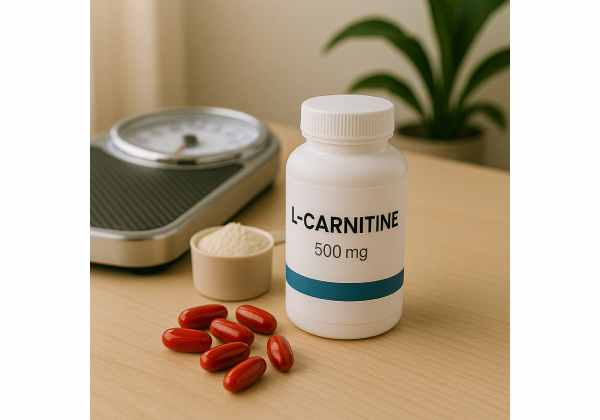
L-carnitine is one of those supplements that sounds almost tailor-made for fat loss. It helps transport fatty acids into mitochondria, so the marketing leap is easy: more fat transport must mean more fat burning. In practice, the evidence is less exciting. Some studies and meta-analyses suggest L-carnitine can produce small reductions in body weight, BMI, or fat mass, especially in people with overweight, obesity, diabetes, or other metabolic problems. But the effect is usually modest, not dramatic, and it does not work like a prescription weight-loss drug.
That gap between mechanism and real-world results is the most important thing to understand before buying it. This article explains what L-carnitine is, what the weight-loss evidence actually shows, what doses studies have used, what side effects are most relevant, and when this supplement is more likely to disappoint than help.
Table of Contents
- What L-carnitine is and why people take it
- What the weight loss evidence actually shows
- Dose, forms and what studies have used
- Side effects and safety concerns
- Who should be cautious
- How to decide if it is worth trying
- What L-carnitine can and cannot do for a plateau
What L-carnitine is and why people take it
L-carnitine is a compound involved in energy metabolism. Its main job is to help move long-chain fatty acids into mitochondria, where they can be oxidized for energy. That function is biologically real, and it is why L-carnitine is often marketed as a “fat-burning” supplement. The problem is that a plausible mechanism does not automatically translate into meaningful weight loss in humans living normal lives.
Healthy adults usually make enough carnitine on their own, and carnitine is also found in foods, especially red meat and dairy. That means most people buying L-carnitine for fat loss are not correcting a true deficiency. They are hoping that extra intake will improve metabolism enough to move the scale.
There are a few reasons this idea has stayed popular:
- the mechanism sounds intuitive
- the supplement has been around for a long time
- some studies do show small benefits on weight or body composition
- it is often sold as a gentler option than stimulant-heavy products
It is also promoted for exercise performance, recovery, fertility, and cardiometabolic support. That wide marketing range can make it seem more versatile than the evidence really supports.
Another point that often gets missed is that “carnitine” is not always the same thing on a label. Common forms include:
- L-carnitine
- acetyl-L-carnitine
- propionyl-L-carnitine
- L-carnitine L-tartrate
These forms are not interchangeable for every purpose. The weight-loss discussion usually centers on plain L-carnitine, not every carnitine form equally.
A practical way to think about L-carnitine is this: it is not nonsense, but it is also not a shortcut. It may have a small supportive role in specific settings, especially in people with metabolic dysfunction, but it is not a supplement that reliably produces large fat-loss results on its own. That matters because many people buying it are not looking for small support. They are looking for visible scale change, appetite control, or help breaking a stall.
What the weight loss evidence actually shows
The evidence on L-carnitine and weight loss is better than for many trendy supplements, but it still points to modest results rather than major ones.
Several systematic reviews and meta-analyses have found that L-carnitine supplementation can reduce body weight, BMI, and sometimes fat mass to a small degree. One of the most cited findings is an average weight reduction of roughly 1 to 1.5 kilograms compared with placebo across pooled trials. That is not nothing, but it is far below what most people imagine when they buy a supplement specifically for fat loss.
The better question is not “Does it work at all?” The better question is “How much does it work, for whom, and under what conditions?”
That is where the picture gets more complicated. Many of the positive trials involve people who already have obesity, type 2 diabetes, insulin resistance, or other metabolic issues. Some trials also combine L-carnitine with diet changes, medications, or structured exercise. As a result, the average effect may look more impressive on paper than it would in a healthy adult expecting the supplement alone to create a visible body-composition change.
What the research tends to suggest
Across meta-analyses, the most consistent pattern is:
- small reductions in body weight
- small reductions in BMI
- possible reductions in fat mass
- less consistent effects on waist circumference and body fat percentage
That pattern is important. It suggests L-carnitine may nudge the system, but it does not reliably create large changes in body shape or a dramatic drop in scale weight.
Some analyses also suggest the effects may be stronger in people with overweight or obesity than in leaner individuals. Others suggest the benefits may be more noticeable when the dose is at least around 2 grams per day or when the intervention lasts several weeks. Even then, the expected result is still usually modest.
Why the evidence often gets overstated
Supplement marketing tends to present any statistically significant result as if it were clinically large. Those are not the same thing. A supplement can beat placebo by a little and still fall short of what most people would consider a meaningful fat-loss tool.
This is especially relevant if someone is comparing L-carnitine with more evidence-based treatment paths, such as medical weight loss options. The expected magnitude of effect is simply not in the same league.
It is also worth remembering that body weight is only one outcome. If a trial shows a small reduction in weight while the participant is also dieting, exercising more, or receiving metabolic treatment, it can be hard to know how much of the effect belongs to the supplement itself.
For that reason, the fairest summary is that L-carnitine may help a little in some settings, but it is not a reliable stand-alone answer for people seeking substantial fat loss.
Dose, forms and what studies have used
One of the most common questions is how much L-carnitine to take for weight loss. The honest answer is that there is no single proven “best” dose for fat loss.
In studies, researchers have used a fairly wide range. For weight-related outcomes, doses often fall somewhere between about 1.8 and 4 grams per day, with some trials clustering around 2 grams per day. A nonlinear dose-response analysis from a major meta-analysis suggested that the greatest effect might occur around 2 grams per day, but that does not mean 2 grams is a guaranteed sweet spot for everyone. The overall evidence is not precise enough to turn that finding into a universal recommendation.
A second issue is that more is not necessarily better. Once supplement doses get higher, the side-effect burden can increase without a clearly proportional benefit on body weight.
| Form or pattern | What it is usually used for | What to keep in mind |
|---|---|---|
| L-carnitine | Most common form in weight-loss studies | Main form behind most fat-loss marketing claims |
| Acetyl-L-carnitine | Often marketed more for cognition and nerve support | Not the main form behind typical weight-loss evidence |
| L-carnitine L-tartrate | Often used in sports and recovery products | Common in performance blends rather than pure weight-loss formulas |
| About 2 g/day | Common dose range in trials | Sometimes associated with the most favorable weight signal, but not proven as an ideal universal dose |
| 3 g/day and above | Seen in some studies and commercial products | Higher side-effect risk, especially gastrointestinal symptoms and fishy odor |
Another practical limitation is absorption. Oral supplement bioavailability is relatively low compared with carnitine from food, which helps explain why swallowing more capsules does not automatically produce a strong effect.
This is also where product quality starts to matter. A label may advertise an impressive dose, but that does not guarantee the actual contents are accurate or that the formula has been tested independently. Anyone considering long-term use should know how to read supplement labels and why third-party testing matters before assuming one brand is equivalent to another.
Side effects and safety concerns
L-carnitine is often described as well tolerated, but that phrase can hide the real trade-off. It is generally not thought of as a dangerous supplement for most healthy adults at common doses, yet it can still cause unpleasant side effects, and the benefit may not be large enough to justify them.
The most common side effects are gastrointestinal:
- nausea
- vomiting
- abdominal cramps
- diarrhea
At higher intakes, around 3 grams per day, another side effect becomes more notable: a fishy body odor. That can be a deal-breaker for some users, especially because it may appear before any meaningful change in body weight does.
There are also population-specific concerns. People with seizure disorders are often advised to use caution because carnitine supplementation may worsen seizure risk in susceptible individuals. People with uremia can also develop muscle weakness.
The TMAO question
One of the more debated safety issues is trimethylamine-N-oxide, or TMAO. Some oral L-carnitine that is not absorbed can be metabolized by gut bacteria into trimethylamine and then converted to TMAO. This has raised concern because higher TMAO levels have been associated with cardiovascular risk in some research.
The key word is associated. This does not prove that taking L-carnitine supplements directly causes cardiovascular events in the average healthy user. But it does mean the long-term risk conversation is more complicated than the usual “natural and safe” marketing suggests. That is one reason L-carnitine is not a supplement to take casually for months on end without a clear reason.
The best balanced position is that the TMAO issue should not cause panic, but it should prevent overconfidence. If a supplement offers only a small average weight-loss effect, even a partially unsettled long-term risk question matters more.
It is also smart to be skeptical of aggressive multi-ingredient products that combine L-carnitine with stimulants, thermogenics, or proprietary blends. Those formulas make it harder to tell what is causing benefit or side effects and often belong in the broader category of higher-risk fat burner supplements rather than a simple, transparent trial of one ingredient.
Who should be cautious
Not everyone considering L-carnitine has the same risk profile. For some people, the question is mainly whether it is worth the money. For others, it is whether taking it is sensible at all.
People who should be more cautious include:
- those with seizure disorders
- people with kidney disease or uremia
- those taking multiple medications
- anyone using complex pre-workout or “metabolism” stacks
- people who are expecting medication-like weight loss and may keep escalating the dose
The drug-interaction picture is not as headline-grabbing as it is with some other supplements, but that does not mean interaction concerns are irrelevant. Some medications, including valproic acid and other anticonvulsants, can affect carnitine status. Pivalate-conjugated antibiotics can also alter carnitine balance. That is not the same as saying everyone on these medications should take carnitine. It means the supplement should not be treated as something too trivial to mention.
Pregnant or breastfeeding individuals should also be cautious with self-prescribed supplements in general, especially when the expected benefit is uncertain and the product quality may vary.
Who is most likely to be disappointed
This is the more useful practical question. L-carnitine is most likely to disappoint people who:
- want rapid visible scale loss
- are already doing very little right with diet or activity
- are using it instead of fixing the biggest drivers of stalled progress
- assume a fat-transport mechanism guarantees real-world fat loss
In those cases, the supplement often becomes a distraction. It feels proactive, but it does not address the actual bottleneck. The more common reasons progress stalls are still things like calorie creep, low protein intake, poor food quality, inconsistent routines, low daily movement, and compensation after workouts. Those issues are usually better explained by common diet mistakes that stall weight loss than by a lack of L-carnitine.
How to decide if it is worth trying
L-carnitine is probably not the first lever most people should pull. But that does not mean there is never a reasonable case for trying it.
A cautious trial may make more sense when someone:
- understands the likely effect is small
- wants a supplement with less stimulant burden than caffeine-heavy products
- has a specific metabolic reason for interest, not just desperation
- plans to use one simple product rather than a stack
- is willing to stop if side effects outweigh the benefit
It makes less sense when the decision is driven mostly by hype, comparison to popular drugs, or frustration with a plateau that has not been analyzed properly.
A good screening question is this: if the best realistic result were a small improvement over several weeks, would that still feel worthwhile? If the answer is no, L-carnitine is probably the wrong tool.
A practical way to evaluate it
If someone still wants to try it, the process should be disciplined:
- Pick a single-ingredient product, not a blend.
- Keep the trial window limited instead of taking it indefinitely by default.
- Do not change ten other things at the same time.
- Track weight trends, tolerance, and whether appetite or adherence actually improve.
- Stop if side effects appear or if nothing meaningful changes.
That kind of structured trial matters because supplement use is often too sloppy to evaluate honestly. People add a product during a stressful week, combine it with caffeine or a new training phase, then credit or blame the supplement for everything.
This is also where skepticism helps. If the advertising relies on dramatic language, before-and-after promises, or vague claims about “unlocking fat metabolism,” it usually belongs in the same category as other weight loss claims with obvious red flags.
What L-carnitine can and cannot do for a plateau
Plateaus are exactly where supplements get overused. Progress slows, frustration rises, and a product that sounds scientific becomes appealing. L-carnitine can fit that pattern because its biology is easy to summarize in one sentence. But what it can do for a real plateau is limited.
What it may do:
- provide a small supportive effect in some people
- modestly improve certain metabolic markers
- help a few users feel they are adding structure to their plan
What it cannot reliably do:
- erase a shrinking calorie deficit
- compensate for underestimating intake
- overcome low activity or low protein intake
- create medication-level appetite suppression
- reverse a poorly designed plan by itself
That distinction matters because many true plateaus are not supplement problems. They are math, behavior, or routine problems. The deficit is smaller than it used to be. Portions have drifted up. Weekends erase weekdays. Activity fell without anyone noticing. Recovery and sleep got worse. In those situations, L-carnitine may become a side quest rather than a solution.
There is also an opportunity-cost issue. Time, attention, and money spent chasing small-edge supplements can sometimes be better spent on a higher-value intervention, whether that is improving protein intake, tightening food logging for two weeks, or simply revisiting how to lose weight safely with a more realistic plan.
The most accurate final judgment is that L-carnitine sits in the “possible but limited” category. It has more evidence than many supplement fads, but the expected payoff is still modest. That makes it a supplement to consider carefully, not a fat-loss strategy to build around.
References
- Carnitine – Health Professional Fact Sheet 2023 (Official Resource)
- Effects of l-carnitine supplementation on weight loss and body composition: A systematic review and meta-analysis of 37 randomized controlled clinical trials with dose-response analysis 2020 (Systematic Review)
- The bright and the dark sides of L-carnitine supplementation: a systematic review 2020 (Systematic Review)
- The effects of L-carnitine supplementation on cardiovascular risk factors in participants with impaired glucose tolerance and diabetes: a systematic review and dose–response meta-analysis 2024 (Systematic Review)
- The Effect of the L-Carnitine Supplementation on Obesity Indices: An Umbrella Meta-Analysis 2025 (Umbrella Meta-Analysis)
Disclaimer
This article is for general educational purposes only and is not a substitute for personal medical advice, diagnosis, or treatment. If you have a medical condition, take prescription medications, or are unsure whether L-carnitine is appropriate for you, speak with a qualified clinician or pharmacist before using it.
If you found this article helpful, consider sharing it on Facebook, X, or your preferred platform.