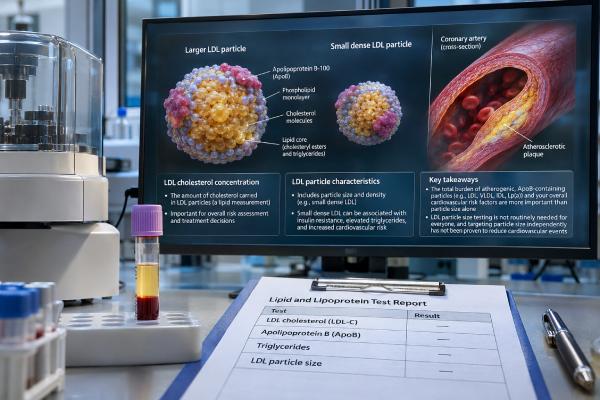
A result showing “small dense LDL” can signal a more atherogenic lipid pattern, but LDL particle size is rarely the most important number to treat. Small, dense LDL particles are associated with higher cardiovascular risk because they often occur alongside high triglycerides, insulin resistance, low HDL, and a larger number of ApoB-containing particles. The key word is associated. A “large, fluffy LDL” result does not make a high burden of LDL particles harmless, and a small-particle pattern does not require a special detox or supplement protocol. In most people, standard LDL cholesterol, non-HDL cholesterol, triglycerides, and especially ApoB provide more actionable information. Particle-size methods also differ between laboratories, which makes thresholds less standardized than routine lipid tests. If your report shows many small LDL particles, the practical response is to assess overall atherosclerotic risk, address high triglycerides and metabolic health, lower LDL/ApoB when indicated, and improve diet, activity, weight, sleep, and smoking status. Treat the risk pattern—not the particle-size label by itself.
Table of Contents
- What Small Dense LDL Actually Means
- Why Small Particles Are Associated With Risk
- How LDL Particle Size Is Measured
- Particle Size vs ApoB and LDL Particle Number
- What Causes a Small Dense LDL Pattern
- What to Do About a Small Dense Result
- When Advanced Lipid Testing Is Useful
What Small Dense LDL Actually Means
LDL is not one uniform particle. Low-density lipoproteins vary in size, density, lipid content, and composition. Some laboratory tests divide them into larger, more buoyant particles and smaller, denser particles. Reports may describe a “pattern A” dominated by larger LDL, a “pattern B” dominated by smaller LDL, or give a measured particle diameter or small-LDL concentration.
Small dense LDL refers to the smaller, denser portion of this spectrum. These particles often appear when triglyceride-rich lipoprotein metabolism is disturbed. High triglycerides encourage exchanges of triglyceride and cholesterol between lipoproteins. Enzymes then remodel triglyceride-enriched LDL into smaller particles.
That is why a small-dense pattern frequently travels with:
- Higher triglycerides.
- Lower HDL cholesterol.
- Insulin resistance or type 2 diabetes.
- Abdominal obesity or metabolic syndrome.
- Higher numbers of ApoB-containing particles.
The important mistake to avoid is interpreting particle size as a separate disease. It is better understood as one feature of a broader lipoprotein pattern.
A second mistake is assuming that large LDL particles are “safe.” All LDL particles contain one molecule of ApoB and can enter the artery wall. Large LDL may be less strongly associated with some metabolic abnormalities, but having a very high number of large LDL particles can still create substantial atherosclerotic risk.
If you are new to the basic lipid panel, LDL, HDL, and triglycerides explained is the right starting point. Particle size is an advanced detail layered on top of those fundamentals.
Why Small Particles Are Associated With Risk
Small dense LDL has several biological features that may make it more atherogenic under some conditions. Reviews describe longer circulation time, greater susceptibility to oxidation, altered receptor interactions, and easier penetration or retention in the artery wall as possible mechanisms.
Observational studies also consistently link small dense LDL with coronary disease and other cardiovascular outcomes. That association is real enough to take seriously.
The challenge is determining how much independent information particle size adds after accounting for ApoB particle number, triglycerides, HDL, diabetes, and other risk factors. Small dense LDL is strongly correlated with these variables. If one person has many small LDL particles and another has fewer large LDL particles, the first person may look higher risk partly because the total number of atherogenic particles is higher—not simply because each particle is smaller.
This statistical overlap is called collinearity. It makes it difficult to prove that particle diameter itself should drive treatment decisions.
ApoB helps clarify the issue because each atherogenic ApoB-containing particle carries one ApoB molecule. Measuring ApoB therefore approximates the number of circulating atherogenic particles, including LDL, IDL, VLDL remnants, and lipoprotein(a). LDL cholesterol, by contrast, measures how much cholesterol is being carried inside LDL particles.
When particles are small and cholesterol-poor, LDL-C may look relatively ordinary even while ApoB is high. That is one reason advanced lipid discussions often focus more on particle number than particle size.
The bottom line is not that small dense LDL is meaningless. It is that its risk signal often points toward a high particle burden and metabolic dysfunction that can be measured more directly.
How LDL Particle Size Is Measured
There is no single universal “LDL particle size test.” Laboratories use several technologies, and their categories are not perfectly interchangeable.
Common methods include nuclear magnetic resonance spectroscopy, ion mobility, gradient gel electrophoresis, ultracentrifugation, and other techniques that separate or infer lipoprotein subclasses. Some reports provide LDL particle number plus size. Others report the concentration of small LDL, peak LDL diameter, or a pattern category.
This matters because a “small LDL” cutoff from one platform may not match the cutoff from another. Pre-analytic factors, fasting status, triglyceride level, and the specific algorithm used by the laboratory can also influence subclass results.
A 2024 guidance document from the Association for Diagnostics & Laboratory Medicine emphasized the need for standardized lipid measurement and included specific discussion of LDL subfraction testing. Routine lipid measurements such as LDL-C and non-HDL-C are far more standardized across clinical practice.
If you receive an advanced lipid report, look for these separate items rather than treating them as one number:
- LDL cholesterol, reported in mg/dL or mmol/L.
- Non-HDL cholesterol.
- Triglycerides.
- ApoB, if measured.
- LDL particle number, if measured.
- Small LDL particle concentration or percentage.
- Average or peak LDL particle size.
Do not compare particle-size values from different laboratories as if they were the same assay. If a clinician is following a particular advanced marker over time, using the same laboratory and method improves comparability.
Also remember that advanced testing can create more numbers without creating more useful decisions. The purpose of testing is to change risk assessment or treatment, not simply to produce a more detailed lipid printout.
Particle Size vs ApoB and LDL Particle Number
For most risk decisions, the number of atherogenic particles is more actionable than whether those particles are predominantly small or large.
ApoB is especially useful when LDL-C and the rest of the metabolic picture disagree. Suppose two people both have an LDL-C of 120 mg/dL. One carries that cholesterol in fewer cholesterol-rich particles; the other carries it in many cholesterol-poor particles. The second person can have a higher ApoB even though LDL-C is identical.
That “discordance” is common in people with high triglycerides, diabetes, obesity, or metabolic syndrome. These are also the settings where small dense LDL is common.
LDL particle number measured by NMR is another way to estimate particle burden, but ApoB is widely used and has growing support in guidelines and expert statements. If you already have ApoB, non-HDL-C, triglycerides, and standard risk information, particle size often adds little that changes management.
A useful way to read an advanced panel is to separate content from count. LDL-C describes cholesterol mass carried inside LDL. ApoB or LDL particle number describes how many atherogenic particles are circulating. Particle size describes a physical characteristic of those particles. Those three measurements can move together, but they do not have to.
For example, a person with triglycerides of 250 mg/dL may have many cholesterol-poor LDL particles. LDL-C might be 105 mg/dL—hardly dramatic—while ApoB is clearly elevated and the report shows abundant small LDL. In that situation, the small-particle result supports the idea that LDL-C is understating particle burden. But ApoB is what quantifies that burden more directly.
The reverse situation is possible too. Someone can have predominantly large LDL but still have high LDL-C and high ApoB. Calling that pattern “good” because the particles are large misses the central issue: many ApoB-containing particles are circulating and can enter the artery wall. Particle size modifies the picture; it does not erase particle number.
This is why the phrase “large fluffy LDL is harmless” is misleading. Imagine a highway. Particle size is like the size of the vehicles, while ApoB reflects how many vehicles are on the road. Even if each vehicle is larger, a very crowded highway still creates more opportunities for contact with the artery wall.
For a direct explanation of the more clinically useful marker, see why ApoB testing can matter more than LDL. If both LDL-C and ApoB are high, there is usually no need for a particle-size result to prove that atherogenic lipoprotein burden needs attention.
Likewise, if ApoB is controlled to an appropriate level for your risk category, chasing a larger average particle diameter is usually not a separate therapeutic goal.
What Causes a Small Dense LDL Pattern
A small-dense LDL pattern often reflects the way the body is processing triglyceride-rich particles.
Insulin resistance increases the flow of fatty acids to the liver and can increase VLDL production. VLDL carries triglycerides. Through lipid-exchange and lipase processes, this environment can remodel LDL into smaller, denser particles and HDL into smaller particles that are cleared more rapidly.
Common contributors include:
- High triglycerides from excess calories, refined carbohydrates, or alcohol.
- Insulin resistance, prediabetes, or type 2 diabetes.
- Visceral or abdominal fat.
- Physical inactivity.
- Genetics that affect triglyceride and lipoprotein metabolism.
- Hypothyroidism or other secondary causes of abnormal lipids.
- Some medications.
A person can also have small dense LDL without obesity, especially when genetics are important. Conversely, not everyone with insulin resistance will have the same lipoprotein pattern.
The triglyceride-to-HDL relationship sometimes gives a rough clue to this metabolic phenotype, but it is not a diagnostic replacement for ApoB or validated clinical risk assessment. See what the triglyceride/HDL ratio means for its strengths and limitations.
If triglycerides are high, ask why. Alcohol, sugary beverages, refined starches, uncontrolled diabetes, hypothyroidism, kidney disease, excess weight, and certain medicines can all contribute. Correcting the cause can improve triglycerides and often shifts the LDL distribution toward larger particles as a side effect.
That shift may look satisfying on an advanced panel, but the treatment goal is not cosmetic improvement of the graph. The goal is lower atherogenic particle exposure and lower cardiovascular risk.
What to Do About a Small Dense Result
A small-dense LDL result should prompt a systematic risk review rather than a hunt for a supplement that “makes LDL fluffy.”
Start with the standard lipid and metabolic picture. Review LDL-C, non-HDL-C, triglycerides, HDL-C, ApoB if available, blood pressure, glucose or A1C, smoking status, kidney function, family history, age, and any known cardiovascular disease.
Then target the abnormalities that have proven treatment pathways.
Lower ApoB and LDL when they are above the appropriate goal. Depending on overall risk, this may involve dietary changes, statins, ezetimibe, PCSK9-targeting drugs, or other therapies. If your LDL is high, causes and treatment of high LDL cholesterol explains the broader approach.
Reduce high triglycerides. Cut back on alcohol, sugary drinks, refined carbohydrates, and excess calories. Improve diabetes control where relevant. Eat more minimally processed foods and increase activity. The fastest useful food changes are summarized in foods that help lower triglycerides.
Improve fat quality. Replacing saturated fat with unsaturated fats from olive oil, nuts, seeds, avocado, and fish can lower LDL-C. Simply lowering carbohydrate while replacing it with large amounts of butter, coconut oil, and fatty processed meat may worsen LDL or ApoB in some people.
Increase soluble fiber. Oats, barley, beans, lentils, psyllium, fruit, and some vegetables can help lower LDL by increasing bile-acid loss. See how much soluble fiber helps cholesterol.
Exercise and address excess body fat when relevant. Regular aerobic activity and resistance training improve insulin sensitivity and triglyceride metabolism. Weight loss can markedly improve a small-dense pattern in people with visceral adiposity.
Diet can change the particle-size pattern without necessarily reducing cardiovascular risk in the same direction. Very-low-carbohydrate diets often lower triglycerides and may shift LDL toward larger particles, yet LDL-C and ApoB can rise substantially in some people. A larger average LDL diameter does not neutralize a large increase in ApoB. When diet changes move these markers in opposite directions, treatment decisions should focus on validated risk markers rather than the visually reassuring part of the advanced panel.
Similarly, niacin and certain other therapies can change lipoprotein subclasses, but changing a subclass marker is not enough to prove fewer cardiovascular events. Modern prevention emphasizes interventions with evidence that lowering atherogenic particle exposure reduces risk. This is another reason not to chase particle-size targets in isolation.
If medication is appropriate, do not reject it because a particle-size report says your LDL is “large.” Outcome trials are based on lowering atherogenic lipoprotein exposure, not achieving a particular particle diameter.
When Advanced Lipid Testing Is Useful
LDL particle-size testing is not routinely necessary for everyone who gets a cholesterol panel.
It may be most useful in selected situations where standard numbers seem discordant, where a lipid specialist is evaluating an unusual pattern, or where an advanced panel already includes ApoB or particle number and subclass data that help explain the phenotype.
Examples include:
- Normal or borderline LDL-C with unexpectedly high ApoB or non-HDL-C.
- High triglycerides with suspected insulin resistance.
- Premature cardiovascular disease despite apparently acceptable standard lipids.
- Complex familial lipid disorders being managed by a specialist.
- Research or detailed metabolic assessment in which the specific subclass pattern matters.
Even then, ask a simple question before paying for repeat testing: “What would we do differently if the particle size is small versus large?” If the answer is still “lower ApoB, improve triglycerides, stop smoking, control blood pressure, exercise, and treat diabetes,” then the test may add explanation rather than a new treatment decision.
That can still be valuable. Some people find that seeing a small-dense pattern motivates them to address metabolic health. But motivation should not be confused with unique clinical necessity.
If you have a strong family history of premature heart disease, unexplained high cholesterol, or established atherosclerotic disease, a clinician may prioritize ApoB and lipoprotein(a) over LDL particle size. These markers often provide clearer information about particle burden and inherited risk.
One practical example shows why context matters. Suppose an advanced panel reports “pattern B,” but triglycerides are 90 mg/dL, ApoB is 72 mg/dL, non-HDL-C is controlled, blood pressure is normal, and there is no diabetes or smoking. That isolated size label is much less alarming than the same pattern in someone with triglycerides of 260 mg/dL, ApoB of 125 mg/dL, A1C in the diabetic range, and hypertension. The laboratory phrase is identical, but the treatment priority is completely different because the overall particle burden and risk are different.
This is also why repeat testing should be purposeful. If an intervention lowers ApoB, non-HDL-C, and triglycerides substantially, there is usually little clinical value in repeatedly paying to prove that the average LDL diameter has shifted. If the standard markers remain discordant, however, a lipid specialist may use advanced measurements to clarify what is happening.
The practical takeaway is straightforward and clinically useful: use particle size as context, not as permission to ignore a high ApoB or LDL burden. small dense LDL is a real risk-associated phenotype, but it is not a separate target that outranks LDL-C, non-HDL-C, ApoB, triglycerides, and total cardiovascular risk. Use the result to ask better questions about particle number and metabolic health, then treat the factors with the strongest evidence.
References
- Small dense low-density lipoprotein particles: clinically relevant? 2022 (Review)
- ADLM Guidance Document on the Measurement and Reporting of Lipids and Lipoproteins 2024 (Guideline)
- Atherogenic low-density lipoprotein and cardiovascular risk 2025 (Review)
- LDL atherogenicity determined by size, density, oxidation, apolipoprotein(a), and electronegativity: an updated review 2025 (Review)
- Exploring the Association between Low-Density Lipoprotein Subfractions and Major Adverse Cardiovascular Outcomes-A Comprehensive Review 2023 (Review)
Disclaimer
This article is for general education and does not replace individualized cardiovascular risk assessment. Advanced lipid tests can be interpreted differently depending on assay method, medications, triglycerides, diabetes, and personal risk, so discuss results with a qualified clinician. Do not start, stop, or avoid cholesterol-lowering medication based only on LDL particle size.