High lipoprotein(a), or Lp(a), is frustrating because it behaves differently from ordinary cholesterol. Your level is driven mainly by genetics, so losing weight, exercising more, or eating perfectly usually does not make Lp(a) fall very much. That does not mean nothing can be done. The practical goal today is to identify the extra risk, control every other modifiable risk factor aggressively, and use medications that reduce overall cardiovascular risk even if they do not normalize Lp(a) itself.
A few existing treatments lower Lp(a) modestly, while lipoprotein apheresis can lower it sharply in selected high-risk patients. Several purpose-built drugs can reduce Lp(a) by roughly 80% to more than 90% in trials, but the key question is whether those dramatic laboratory changes prevent heart attacks and strokes. That question became more complicated in 2026, when the first major phase 3 outcomes trial of a targeted Lp(a) drug did not meet its primary cardiovascular endpoint.
Table of Contents
- Why Lp(a) treatment is different
- What lowers Lp(a) today
- What does not lower Lp(a) much
- How to reduce risk right now
- New Lp(a) drugs in development
- How to read the new trial results
- A practical plan for high Lp(a)
Why Lp(a) treatment is different
Lp(a) is an LDL-like particle with an extra protein called apolipoprotein(a) attached to it. That extra component gives Lp(a) properties that are linked with atherosclerosis, inflammation, and calcification. Higher levels are associated with greater risk of atherosclerotic cardiovascular disease and calcific aortic valve stenosis.
Unlike LDL cholesterol, Lp(a) is largely inherited. Levels are generally stable throughout adult life, although illness, kidney disease, hormonal changes, and some other conditions can shift them. For most people, one well-performed measurement is enough to identify a genetically high level. If you are still learning what your number means, a separate guide to Lp(a) testing and cardiovascular risk can help put the result in context.
Many professional groups consider approximately 125 nmol/L or 50 mg/dL and above to represent elevated risk, although Lp(a) is best understood as a continuous risk factor rather than a simple safe-versus-dangerous cutoff. The two units are not directly interchangeable because apo(a) particle size varies from person to person, so a fixed conversion factor can be misleading.
The most important treatment concept is this: the Lp(a) number is only one part of your total cardiovascular risk. A person with high Lp(a), low LDL cholesterol, normal blood pressure, no diabetes, and no smoking history has a different near-term risk from someone with the same Lp(a) who has already had a heart attack. Treatment intensity should reflect the whole picture.
Lp(a) also complicates LDL interpretation. Because an Lp(a) particle contains cholesterol, part of the cholesterol reported as “LDL-C” can actually be carried inside Lp(a). That is one reason clinicians may also look at non-HDL cholesterol and apolipoprotein B testing when deciding how much atherogenic particle burden remains.
What lowers Lp(a) today
No currently approved medication is used solely to normalize Lp(a), but several available therapies change the number to some degree. Their value depends much more on proven cardiovascular benefit and the person’s overall risk than on the percentage reduction in Lp(a) alone.
| Treatment | Approximate Lp(a) effect | How it is used in practice |
|---|---|---|
| PCSK9 monoclonal antibodies | Often about 20%–30% lower | Used primarily to lower LDL-C and reduce cardiovascular events in appropriate high-risk patients |
| Inclisiran | Often a modest reduction, roughly in the 15%–25% range | Used to lower LDL-C; not approved specifically for Lp(a) |
| Lipoprotein apheresis | Often 60%–75% lower immediately after a session, followed by rebound | Reserved for selected patients with very high risk and severe lipid disorders under specialist care |
| Niacin | Often about 20%–30% lower | Not routinely recommended for Lp(a) because outcome trials did not show added cardiovascular benefit and side effects can be substantial |
| Statins | Usually little change; Lp(a) may rise slightly in some people | Still central to risk reduction because they lower LDL-C and prevent cardiovascular events |
PCSK9 inhibitors
Evolocumab and alirocumab are powerful LDL-lowering drugs that also tend to reduce Lp(a) by roughly one-fifth to one-third. They are not prescribed primarily as Lp(a) drugs, but they can be particularly useful when someone with high Lp(a) also needs a much lower LDL-C target. Their cardiovascular outcome benefits are well established for appropriate patients.
Inclisiran works through a different RNA-based mechanism against PCSK9 and can also modestly lower Lp(a). Its main role remains LDL-C reduction.
Lipoprotein apheresis
Apheresis physically removes apoB-containing particles from the blood. A single treatment can produce a large immediate fall in Lp(a), but the level rises again between sessions, so treatment is repeated regularly. It is invasive, time-intensive, expensive, and available only in specialized programs. Criteria vary by country and insurer.
For a person with progressive cardiovascular disease despite intensive lipid treatment, a lipid specialist may consider whether apheresis is appropriate. It is not a general solution for everyone with an elevated screening result.
Niacin and hormone therapy are not shortcuts
Niacin can lower Lp(a), but lowering a biomarker is not enough. Large trials of niacin added to contemporary lipid therapy did not show the cardiovascular benefit needed to justify its side-effect burden for most patients. Flushing, liver injury, higher glucose, and gout are among the concerns.
Estrogen therapy can also lower Lp(a), but menopause hormone therapy should not be started solely to lower Lp(a) or prevent cardiovascular disease. Its use is based on menopausal symptoms, age, time since menopause, medical history, and individualized benefit-risk assessment.
What does not lower Lp(a) much
Lifestyle matters enormously for heart health, but it usually has only a small direct effect on genetically determined Lp(a). That distinction prevents two common mistakes: blaming yourself for a high Lp(a) result and spending money on unproven supplements that promise to “fix” it.
Dietary changes, weight loss, aerobic exercise, strength training, improved sleep, and smoking cessation can improve blood pressure, insulin sensitivity, triglycerides, inflammation, fitness, and LDL-related risk. They should be taken seriously even if the Lp(a) result barely moves. A useful way to think about this is that you are reducing the number of other forces acting on the same arteries.
There is no proven food, vitamin, herb, or over-the-counter supplement that reliably lowers Lp(a) enough to serve as a treatment. A focused discussion of diet for high Lp(a) is most useful when it emphasizes overall risk reduction rather than chasing the Lp(a) value itself.
Statins deserve special mention because people sometimes stop them after reading that Lp(a) can rise slightly during statin treatment. That is usually the wrong conclusion. Statins lower LDL-C, reduce apoB-containing particles, stabilize plaque, and reduce cardiovascular events. If a statin is indicated, a small Lp(a) change does not erase those benefits. People with side effects can discuss dose changes, alternate statins, or non-statin LDL-lowering options rather than stopping treatment on their own.
How to reduce risk right now
Until a targeted Lp(a) therapy proves that it prevents cardiovascular events and becomes available, treatment centers on making every modifiable risk factor as favorable as reasonably possible.
Lower LDL-C and apoB more aggressively when risk is high
High Lp(a) is a risk enhancer. In practice, that often makes clinicians less comfortable with a merely “average” LDL-C. The exact target depends on whether you have established cardiovascular disease, diabetes, familial hypercholesterolemia, kidney disease, coronary calcium, or other major risk factors.
For someone with known atherosclerotic disease, treatment may include a high-intensity statin plus ezetimibe, a PCSK9 inhibitor, bempedoic acid, inclisiran, or a combination. The point is not that these therapies erase Lp(a); it is that lowering other atherogenic particles can reduce the overall burden substantially. Understanding how high LDL cholesterol is treated is therefore especially relevant when Lp(a) is high.
Treat blood pressure, diabetes, and smoking as major priorities
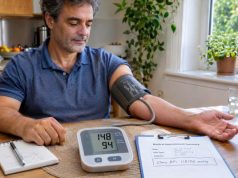
High blood pressure and high Lp(a) are a harmful combination because both contribute to vascular damage over time. Home monitoring can help detect hypertension that a clinic reading misses. Diabetes and insulin resistance should also be managed actively, and smoking cessation is one of the highest-impact steps a smoker can take.
Regular physical activity, a Mediterranean- or DASH-style eating pattern, adequate sleep, and weight management can improve several risk factors at once. These changes are not “failed Lp(a) treatments” simply because the Lp(a) number stays high.
Consider coronary risk refinement when the treatment decision is uncertain
In primary prevention, a clinician may sometimes use coronary artery calcium scoring or other risk information to decide how aggressively to lower LDL-C. High Lp(a) is one reason that an apparently borderline risk estimate may deserve a closer look. Testing should answer a decision question, not simply add more numbers.
Family screening can also be useful. Because Lp(a) is highly heritable, first-degree relatives may benefit from being tested at least once, especially when there is premature cardiovascular disease in the family.
New Lp(a) drugs in development
The most exciting Lp(a) drugs attack the problem close to its source: production of apolipoprotein(a) in the liver or assembly of the Lp(a) particle. Early and mid-stage trials have produced reductions far larger than current therapies.
| Drug | Approach | What has been seen | Current big question |
|---|---|---|---|
| Pelacarsen | Antisense oligonucleotide | Large Lp(a) reductions in earlier studies | The phase 3 Lp(a)HORIZON outcomes trial did not meet its primary cardiovascular endpoint in 2026 |
| Olpasiran | siRNA | Very large, durable Lp(a) reductions in phase 2 | Whether ongoing phase 3 outcome trials reduce cardiovascular events |
| Lepodisiran | Long-duration siRNA | About 90% or greater sustained lowering at higher studied doses in phase 2 | Whether phase 3 ACCLAIM-Lp(a) translates lowering into fewer events |
| Muvalaplin | Oral small-molecule Lp(a) assembly inhibitor | Up to roughly 80%–86% lowering depending on dose and assay in phase 2 | Whether the ongoing MOVE-Lp(a) phase 3 outcomes trial confirms clinical benefit |
| Zerlasiran | siRNA | More than 80% time-averaged lowering in phase 2 | Phase 3 development and eventual cardiovascular outcome data |
The pelacarsen result changed the conversation
In September 2026, Novartis announced that the phase 3 Lp(a)HORIZON trial of pelacarsen lowered Lp(a) but did not meet its primary endpoint for reducing major cardiovascular events. This was a major result because it was the first large test of whether specifically lowering Lp(a) on top of modern treatment would improve outcomes.
It does not prove that Lp(a) is irrelevant, nor does it automatically predict failure for every other drug. The magnitude, duration, timing, patient population, drug mechanism, baseline Lp(a), achieved level, and trial design may all matter. Full peer-reviewed results are important before drawing detailed conclusions from a topline announcement.
Other phase 3 programs are still moving forward
Olpasiran is being tested in the OCEAN(a) program, including a phase 3 secondary-prevention outcomes trial and additional phase 3 studies. Lepodisiran is in the phase 3 ACCLAIM program. Muvalaplin is especially notable because it is an oral drug rather than an injection; the large MOVE-Lp(a) cardiovascular outcomes trial is underway.
These programs matter for a simple reason: impressive percentage reductions are not enough. A successful drug needs to show that treatment improves outcomes that patients care about, such as heart attack, ischemic stroke, urgent revascularization, or cardiovascular death, with acceptable safety.
How to read the new trial results
When headlines report “90% lower Lp(a),” it is easy to assume that cardiovascular risk must also fall by 90%. That is not how risk works. A biomarker reduction and an event reduction are different endpoints.
Several questions determine whether a trial result is clinically meaningful:
- Who was studied? A drug may work differently in people with established coronary disease than in lower-risk people who have never had an event.
- How high was Lp(a) at baseline? A trial enriched for very high levels may not apply to someone just above a threshold.
- How much and how long was Lp(a) lowered? Atherosclerosis develops over years, so duration may matter.
- Were LDL-C and other risks already well controlled? The incremental benefit can be harder to demonstrate when background therapy is excellent.
- What outcome was measured? A reduction in Lp(a) concentration is not the same as fewer heart attacks or strokes.
- Was safety acceptable? A preventive therapy may be used for years, so even uncommon adverse effects can matter.
The 2026 pelacarsen result makes this distinction especially important. The field now has direct evidence that lowering Lp(a) substantially does not automatically guarantee a positive cardiovascular outcomes trial. The remaining phase 3 programs should therefore be judged on event data, not only laboratory percentages.
A practical plan for high Lp(a)
If your Lp(a) is high, the most useful next step is not to search for a supplement that claims to lower it. Build a clear risk-reduction plan with your clinician.
- Confirm the result and units. Know whether the laboratory reports nmol/L or mg/dL. Do not use a simple conversion formula between them.
- Review your overall risk. Include age, family history, blood pressure, smoking, diabetes, kidney disease, LDL-C, non-HDL cholesterol, apoB, and any known plaque or prior cardiovascular event.
- Set an LDL-C/apoB strategy. High Lp(a) often justifies stronger attention to atherogenic cholesterol. If medication is recommended, focus on proven outcome benefit rather than whether the drug lowers Lp(a) directly.
- Measure blood pressure accurately. A validated upper-arm cuff and repeated home readings can uncover risk that a single office measurement misses.
- Use lifestyle for the risks it can change. Favor minimally processed foods, unsaturated fats, legumes, whole grains, fruits, vegetables, fish, regular exercise, healthy sleep, and no tobacco.
- Discuss family testing. First-degree relatives often share elevated Lp(a), and early awareness can lead to earlier prevention.
- Ask about a lipid specialist or clinical trial when appropriate. This is especially reasonable for very high Lp(a), premature cardiovascular disease, recurrent events despite intensive therapy, or complicated lipid disorders.
Do you need to repeat the Lp(a) test?
For most adults, Lp(a) is genetically set and a single reliable measurement is enough to establish whether it is elevated. Repeating it every few months usually adds little if nothing important has changed. A repeat test can make sense when the first result was obtained during a major acute illness, when kidney or thyroid disease is changing, when a laboratory method or unit creates uncertainty, or when a clinician wants a new baseline before a therapy or clinical trial.
If a future Lp(a)-specific drug is started, repeat testing will become more useful because the achieved reduction may help confirm treatment response and adherence. Until then, the values worth following more often are usually the ones that treatment can change now: LDL-C, non-HDL cholesterol or apoB, blood pressure, glucose or A1C when indicated, smoking status, weight or waist measures when relevant, and exercise capacity.
It is also worth separating screening from monitoring. Once a person is known to have high Lp(a), the inherited result can prompt one-time testing in close relatives. Their results do not need to match yours to matter; each person should interpret Lp(a) alongside their own age, cholesterol, blood pressure, diabetes status, and personal or family history of early cardiovascular disease.
The most important point is that high Lp(a) is actionable even before a dedicated drug is approved. You may not be able to change the inherited number much today, but you can change the environment in which that risk operates. As new outcome trials report results, treatment will become more precise—but proven LDL lowering, blood pressure control, smoking avoidance, diabetes management, and heart-healthy habits remain the foundation.
References
- A focused update to the 2019 NLA scientific statement on use of lipoprotein(a) in clinical practice 2024 (Position Statement)
- Lipoprotein(a) in atherosclerotic cardiovascular disease and aortic stenosis: a European Atherosclerosis Society consensus statement 2022 (Consensus Statement)
- Lepodisiran – A Long-Duration Small Interfering RNA Targeting Lipoprotein(a) 2025 (RCT)
- Oral Muvalaplin for Lowering of Lipoprotein(a): A Randomized Clinical Trial 2025 (RCT)
- Zerlasiran-A Small-Interfering RNA Targeting Lipoprotein(a): A Phase 2 Randomized Clinical Trial 2024 (RCT)
- Novartis announces Lp(a)HORIZON Phase III topline results for pelacarsen in patients with elevated Lp(a) and established cardiovascular disease (CVD) 2026
Disclaimer
This article is for general educational information and is not a substitute for individualized medical care. Lp(a) treatment decisions depend on your full cardiovascular history, other lipid values, medications, and overall risk; do not start, stop, or change prescription therapy without discussing it with your clinician.