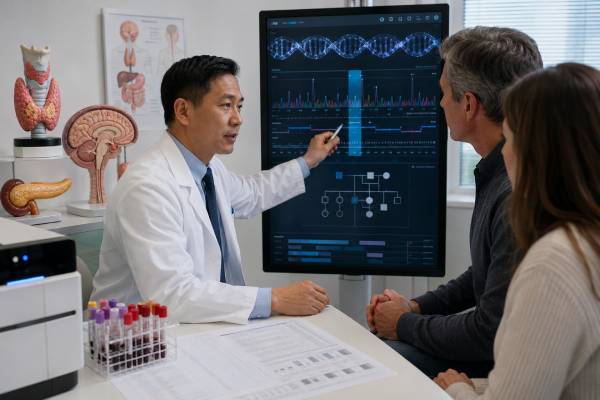
A MEN1 genetic test looks for an inherited pathogenic variant that causes multiple endocrine neoplasia type 1, a syndrome marked mainly by parathyroid tumors, pituitary tumors, and neuroendocrine tumors of the pancreas and duodenum. Other findings can include adrenal tumors, thymic or bronchial neuroendocrine tumors, facial angiofibromas, collagenomas, lipomas, and meningiomas. Testing is performed on blood or saliva and should include both sequencing and deletion/duplication analysis. A positive result confirms inherited MEN1 and allows lifelong, gene-specific surveillance before symptoms develop. It also gives each child and first-degree relative a 50% chance of carrying the same variant. A negative result can be definitive when the family variant is known, but it may be inconclusive in a person who meets clinical criteria without an identified familial cause. Results require careful counseling because surveillance starts young, continues for life, and balances early tumor detection against repeated testing, radiation exposure, false positives, and treatment burden.
- A pathogenic or likely pathogenic MEN1 variant confirms the hereditary syndrome; a variant of uncertain significance does not.
- Each child, sibling, or parent of a person with MEN1 has a 50% chance of carrying the familial variant.
- Parathyroid overactivity is often the earliest and most common manifestation, but pancreatic, duodenal, pituitary, adrenal, and thoracic tumors also require surveillance.
- A negative test for a known family variant usually means the person did not inherit MEN1 and can avoid syndrome-specific surveillance.
- People with a MEN1-like presentation but negative testing may need deletion analysis, panel testing, tumor review, or evaluation for MEN4 and other phenocopies.
Table of Contents
- What MEN1 is and what the test finds
- Who should have MEN1 testing
- How testing is performed
- Understanding positive, negative, and uncertain results
- Tumor risks and surveillance
- Treatment and daily management
- Family testing and next steps
What MEN1 is and what the test finds
MEN1 is a tumor-suppressor gene on chromosome 11. It encodes menin, a protein involved in gene regulation, DNA repair, and control of cell growth. A person with hereditary MEN1 is born with one nonworking copy in every cell. A susceptible endocrine cell can form a tumor after the remaining working copy is lost or disabled. This is often described as the two-hit model.
The syndrome is autosomal dominant. One pathogenic variant is enough to create susceptibility, and each pregnancy has a 50% chance of inheriting it. The variant does not determine exactly which tumors will develop or at what age. Even relatives with the same variant can have very different manifestations.
The three classic tumor groups are:
- Primary hyperparathyroidism, usually caused by enlargement or multiple tumors of several parathyroid glands.
- Pituitary neuroendocrine tumors, which may secrete prolactin, growth hormone, adrenocorticotropic hormone, or no active hormone.
- Duodenopancreatic neuroendocrine tumors, including gastrinomas, insulinomas, nonfunctioning pancreatic neuroendocrine tumors, glucagonomas, and VIPomas.
A clinical diagnosis has traditionally been made when a person develops at least two of these major manifestations, or one major manifestation plus a first-degree relative with MEN1. Genetic testing is valuable because it can confirm the diagnosis before a second tumor appears and can identify relatives who need screening.
Other associated findings include adrenal cortical tumors, thymic neuroendocrine tumors, bronchial neuroendocrine tumors, gastric neuroendocrine tumors, meningiomas, facial angiofibromas, collagenomas, and lipomas. Many are benign, but some pancreatic, duodenal, thymic, or bronchial tumors can metastasize. Tumor type, size, hormone secretion, grade, and growth rate matter more than the presence of the gene variant alone.
Most pathogenic MEN1 variants are small sequence changes, including nonsense, frameshift, splice-site, or missense variants. Some are whole-exon or multiexon deletions. There is no single common mutation that explains most families, so a comprehensive test must sequence the full coding region and assess copy-number changes.
Most inherited MEN1 variants are present at roughly 50% variant allele fraction in blood. A lower fraction can indicate mosaicism, meaning the variant arose after conception and is present in only some cells. Mosaic MEN1 can be missed by standard analysis, especially if the blood level is very low. Testing tumor tissue or another normal tissue may help in selected cases.
A tumor-only MEN1 mutation does not prove the hereditary syndrome. MEN1 is also commonly altered somatically in sporadic pancreatic neuroendocrine tumors and some other endocrine tumors. Germline testing in blood or saliva is required to establish inherited risk.
MEN1 is different from multiple endocrine neoplasia type 2, which is caused by RET and is associated with medullary thyroid cancer, pheochromocytoma, and hyperparathyroidism. The distinction affects surveillance and family testing. See the RET genetic test guide for MEN2.
Who should have MEN1 testing
Testing is recommended for a person who meets clinical criteria for MEN1 and for relatives of someone with a known pathogenic variant. It is also considered when the presentation is strongly suggestive even before full clinical criteria are met.
Situations that raise suspicion include:
- primary hyperparathyroidism at a young age, particularly when multigland disease or recurrence is present;
- multiple pancreatic or duodenal neuroendocrine tumors;
- gastrinoma, especially with additional endocrine findings or family history;
- a pancreatic neuroendocrine tumor at a young age;
- a pituitary tumor plus hyperparathyroidism or a pancreatic neuroendocrine tumor;
- two or more MEN1-associated endocrine tumors in one person;
- a thymic or bronchial neuroendocrine tumor with other MEN1 features;
- several relatives with parathyroid, pituitary, or neuroendocrine tumors; or
- a known familial MEN1 variant.
Primary hyperparathyroidism is common in the general population, especially later in life. A single parathyroid adenoma in an older adult is less suggestive than multigland disease before age 30. Likewise, pituitary adenomas are relatively common and most are sporadic. The combination and age pattern are more informative than one isolated tumor.
Genetic testing can be considered in children from a known MEN1 family because surveillance begins in childhood or adolescence. The exact age for predictive testing is discussed with the family, but testing should occur early enough that a positive result can change medical care. Unlike many adult-onset cancer syndromes, deferring all testing until age 18 can miss the recommended start of biochemical surveillance.
Testing a person who has had an MEN1-related tumor is more informative than testing an unaffected distant relative first. If a pathogenic variant is identified, family members can then receive a focused test. If no variant is found, the result can be interpreted alongside the affected person’s full phenotype.
A broad hereditary cancer genetic panel may be appropriate when the diagnosis is unclear. Relevant genes can include CDKN1B, CDC73, CASR, RET, AIP, PRKAR1A, MAX, VHL, NF1, TSC1, TSC2, and genes associated with hereditary paraganglioma or neuroendocrine tumors. Panel composition should match the clinical picture rather than simply be as large as possible.
Some people have a MEN1-like phenotype without a detectable MEN1 variant. These cases are called phenocopies or genotype-negative MEN1. They may have two unrelated sporadic endocrine tumors, a variant in another gene, mosaicism, or a technical limitation. Compared with variant-positive MEN1, some genotype-negative groups develop fewer additional tumors, but management must be individualized rather than assuming risk is absent.
Before testing, the genetics professional should review the pathology of each tumor. A pancreatic adenocarcinoma is not the same as a pancreatic neuroendocrine tumor. A thyroid nodule is not a classic MEN1 manifestation. Accurate diagnoses prevent a misleading syndrome label.
How testing is performed
Germline testing usually uses a blood sample or saliva. Blood is often preferred when mosaicism, a blood-cell disorder, or sample quality is a concern. No fasting is required. Results commonly take two to several weeks, depending on whether a focused family test, single-gene test, or panel is ordered.
A complete MEN1 assay should include:
- sequence analysis for substitutions and small insertions or deletions;
- deletion/duplication analysis for one or more missing exons; and
- a validated approach to splice-region variants and quality-limited regions.
If standard testing is negative in a person with a convincing phenotype, the laboratory can review read depth, variant balance, and copy-number data. RNA analysis may clarify suspected splice variants. Higher-depth sequencing or testing another tissue may evaluate mosaicism. Genome sequencing can identify some deep intronic or structural variants not captured by routine panels, though access and interpretation vary.
The report should state the transcript used, DNA and protein notation, classification, inheritance, test limitations, and whether deletion/duplication analysis was completed. “No mutation detected” is not enough without knowing the assay’s scope.
Tumor sequencing can provide clues. Loss of chromosome 11q or a second MEN1 mutation supports the two-hit process, but a somatic MEN1 change is common in sporadic neuroendocrine tumors. Paired tumor-normal testing distinguishes variants found only in the tumor from those present constitutionally.
Saliva contains DNA from cheek cells and white blood cells. It is usually adequate for germline testing, but contamination, recent eating, low DNA yield, or a blood-derived clone can complicate rare cases. Cultured skin fibroblasts may be used when blood is unsuitable, particularly after an allogeneic stem-cell transplant.
A pathogenic result should be confirmed according to the laboratory’s validated process before predictive testing in relatives. Relatives should be tested for the exact familial variant, not merely receive a generic endocrine cancer panel. A focused test is less expensive, faster, and produces a clear positive or true-negative result.
A variant allele fraction far below 50% should prompt consideration of mosaicism. Confirming mosaicism can change recurrence counseling: transmission risk may be lower than 50%, but it is not zero if reproductive cells carry the variant. Testing children should be based on the confirmed familial variant and counseling.
A result in CDKN1B may indicate MEN4, a rarer syndrome with overlapping parathyroid and pituitary tumors. Evidence and surveillance recommendations are less extensive than for MEN1. The finding should be managed by specialists familiar with the specific gene rather than copying every MEN1 recommendation automatically.
Understanding positive, negative, and uncertain results
A pathogenic or likely pathogenic MEN1 variant confirms hereditary MEN1. Likely pathogenic is treated clinically like pathogenic because the evidence that the variant disrupts gene function is strong. The result justifies lifelong surveillance even if the person currently has normal laboratory tests and imaging.
A positive result does not predict the number or severity of tumors. Genotype-phenotype correlations are generally weak. Relatives with the same variant can develop different tumors decades apart. Management should therefore follow age, existing manifestations, biochemical results, imaging, and family experience rather than variant type alone.
A true negative occurs when a relative tests negative for the known familial variant. That person usually does not have the family’s MEN1 syndrome, does not need MEN1-specific surveillance, and cannot pass that variant to children. Ordinary health care still applies, and an independent endocrine problem can still occur by chance.
An uninformative negative occurs when a symptomatic person has no detectable MEN1 pathogenic variant and there is no known family variant. This result does not erase the clinical findings. Possible next steps include confirming that deletion/duplication analysis was done, rechecking pathology, testing additional genes, assessing mosaicism, or following a phenotype-based surveillance plan.
A variant of uncertain significance, or VUS, does not confirm MEN1. It should not be used to test healthy relatives as though it were pathogenic, and it should not trigger irreversible surgery. Management should be based on the person’s tumors and family history until the variant is reclassified.
Evidence that can help reclassify a VUS includes whether it is absent from population databases, segregates with disease in relatives, affects a critical protein region, disrupts RNA splicing, or is found with a second hit in tumor tissue. Family studies should be coordinated by the testing laboratory or genetics clinic so results are interpreted correctly.
A somatic-only result means a MEN1 variant was detected in tumor but not in constitutional DNA. It can help explain tumor development but usually does not create a 50% risk for relatives. Tumor purity, loss of the normal allele, and technical sensitivity should be reviewed before concluding the variant is somatic.
A negative result in a child from a known family can relieve the need for repeated endocrine testing. A positive result can cause anxiety but also allows surveillance to replace symptom-driven diagnosis. Families should receive a written plan rather than a gene result without follow-up.
Results can be updated. Laboratories may reclassify variants, and new guidelines can alter surveillance. Keep the original report and remain connected to a genetics clinic or endocrine center.
Tumor risks and surveillance
MEN1 surveillance aims to detect hormone excess and tumors before they cause irreversible harm or metastasis. It combines clinical review, blood tests, and selective imaging. Recommendations have evolved as experts try to reduce unnecessary radiation and interventions while maintaining early detection.
Parathyroid disease
Primary hyperparathyroidism develops in most adults with MEN1 and can begin in childhood or adolescence. Testing includes calcium adjusted for albumin or ionized calcium, often with parathyroid hormone. High calcium can cause kidney stones, reduced bone density, fatigue, abdominal symptoms, thirst, frequent urination, mood changes, or confusion.
Surveillance typically starts in childhood and continues annually. Vitamin D, kidney function, bone density, and urinary calcium may be assessed. MEN1 usually affects multiple glands, so surgery differs from removal of one sporadic adenoma. Experienced endocrine surgeons plan subtotal parathyroidectomy or total parathyroidectomy with autotransplantation in selected cases. Recurrence and permanent hypoparathyroidism are competing risks.
Duodenopancreatic neuroendocrine tumors
These tumors can be functioning or nonfunctioning. Gastrinomas cause excess acid, ulcers, reflux, abdominal pain, and diarrhea. Insulinomas cause low glucose, sweating, tremor, confusion, or seizures. Other functional tumors are rarer.
Biochemical testing is selected by symptoms and guideline. Fasting glucose, insulin during documented hypoglycemia, gastrin under appropriate conditions, and other hormones may be used. Proton-pump inhibitors raise gastrin and can make interpretation difficult; they should not be stopped without medical supervision because severe acid disease can rebound.
Imaging can include MRI, CT, endoscopic ultrasound, and somatostatin-receptor PET. MRI avoids radiation and is useful for repeated surveillance. Endoscopic ultrasound detects small pancreatic lesions but is invasive and operator-dependent. The interval depends on prior findings, tumor growth, and the current guideline.
Small nonfunctioning pancreatic neuroendocrine tumors can often be observed, while larger, growing, higher-grade, symptomatic, or functional tumors may need surgery or systemic treatment. A fixed size threshold is not the only factor. Location, multiplicity, surgical morbidity, and patient preference matter.
Pituitary tumors
Surveillance includes symptoms, prolactin, insulin-like growth factor 1, and periodic pituitary MRI. Headache, visual changes, menstrual changes, infertility, sexual dysfunction, milk discharge, rapid growth, changes in facial or hand size, or unexplained cortisol features warrant evaluation.
Many prolactinomas respond to dopamine agonists. Other pituitary tumors may require surgery, medication, or radiation. MEN1-associated pituitary tumors are managed according to hormone type, size, visual effects, and growth, with awareness that some can be larger at diagnosis.
Adrenal and thoracic tumors
Adrenal lesions are common and often nonfunctioning. Imaging appearance, size, growth, and hormone production determine management. Tests may assess cortisol, aldosterone, and catecholamines when clinically indicated.
Thymic neuroendocrine tumors are uncommon but can be aggressive, particularly in men and smokers. Chest imaging is considered at defined intervals, often using CT or MRI. Avoiding tobacco is especially important. Bronchial neuroendocrine tumors may be slower growing but also require surveillance.
Skin examination can identify angiofibromas, collagenomas, and lipomas that support the diagnosis but usually do not threaten health. Bone density, kidney health, and quality of life deserve attention because hormone excess and repeated procedures create long-term effects.
Treatment and daily management
MEN1 has no single preventive drug or one-time operation. Treatment addresses each manifestation while preserving organ function and avoiding repeated procedures when possible. Care is best coordinated through a multidisciplinary endocrine neoplasia center.
Hyperparathyroidism often requires surgery, but timing depends on calcium level, symptoms, kidney stones, bone loss, age, and patient preference. Cinacalcet can lower calcium in selected people who cannot undergo surgery or have persistent disease, but it does not remove the abnormal glands.
Gastrinoma management combines acid suppression with assessment of tumor location and spread. High-dose proton-pump inhibitors can control dangerous acid secretion. Decisions about duodenal or pancreatic surgery are complex because tumors are often multiple and small. Insulinoma usually requires localization and surgery because severe hypoglycemia can be life-threatening.
Nonfunctioning pancreatic neuroendocrine tumors require careful observation or surgery based on risk. Repeated pancreatic surgery can cause diabetes, digestive enzyme deficiency, and other complications. A small stable lesion may be safer to monitor than to remove immediately, while growth or higher-risk features can shift the balance.
Pituitary treatment follows standard hormone-specific approaches. Dopamine agonists are first-line for most prolactinomas. Transsphenoidal surgery is used for selected tumors causing visual compression, hormone excess, or medication resistance. Long-term hormone replacement may be needed after treatment.
Advanced neuroendocrine tumors may be treated with somatostatin analogs, targeted drugs, peptide receptor radionuclide therapy, liver-directed treatment, chemotherapy, or surgery. Tumor grade, receptor imaging, site, symptoms, and prior therapy guide selection. The germline MEN1 result explains susceptibility but does not select one systemic treatment by itself.
Daily management includes recognizing hormone symptoms and maintaining a clear emergency plan. Severe low glucose can cause loss of consciousness or seizures. Severe hypercalcemia can cause dehydration, vomiting, confusion, or abnormal heart rhythm. Persistent ulcer pain or black stools may signal gastrointestinal bleeding.
Pregnancy requires specialist coordination. Calcium can change during pregnancy, pituitary tumors can enlarge, and medication safety must be reviewed. A person should not stop endocrine medication independently after learning of a pregnancy.
Repeated imaging can create cumulative burden. MRI and ultrasound can reduce radiation where clinically appropriate, though CT remains valuable for the chest, pancreas, or acute questions. Surveillance should be intentional rather than a collection of disconnected tests.
Psychological support matters. Living with lifelong screening and uncertainty can cause anxiety. A written schedule, one coordinating clinician, and clear thresholds for intervention can reduce the sense that every small lesion is an emergency.
Family testing and next steps
After a positive result, offer the exact familial-variant test to first-degree relatives. Parents can clarify which side of the family is at risk. Adult siblings and children should receive counseling, and testing of minors should be timed to allow recommended childhood surveillance.
A family letter should include the gene, exact variant, inheritance pattern, and contact information for a genetics service. Saying “MEN runs in the family” is not enough because MEN1 and MEN2 involve different genes and tumors.
Questions to ask after testing include:
- Is the result pathogenic, likely pathogenic, uncertain, or negative?
- Did the assay include deletion/duplication analysis and assess mosaicism when relevant?
- Which current surveillance guideline will the clinic follow?
- At what ages should calcium, pancreatic, pituitary, adrenal, and chest surveillance begin?
- Which imaging method minimizes radiation while answering the question?
- What tumor size, growth rate, or hormone finding would lead to treatment?
- Which relatives should be tested now, including children?
- Should reproductive counseling be offered?
Reproductive options include natural conception, prenatal diagnosis, donor gametes, adoption, and in vitro fertilization with preimplantation genetic testing. These choices are personal. A genetics professional can explain timing, limitations, and costs without directing the decision.
If no pathogenic variant is found but the person meets clinical MEN1 criteria, create a phenotype-based plan. First-degree relatives may need targeted clinical assessment until the cause is clarified, but they should not be labeled genetically positive. Testing an additional affected relative can be informative.
Seek urgent care for severe confusion, dehydration, repeated vomiting, black or bloody stools, loss of consciousness, seizure, or severe low-glucose symptoms. New visual loss, rapidly worsening headache, or symptoms of pituitary apoplexy also require emergency evaluation.
Keep a personal record of hormone results, imaging, operations, pathology, and genetic reports. MEN1 care spans decades and often several health systems. A concise timeline helps clinicians distinguish a stable lesion from a new or growing one and prevents unnecessary repeat testing.
The goal of genetic diagnosis is not to search endlessly for tumors. It is to identify people who benefit from structured surveillance, detect clinically important disease at a treatable stage, and spare true-negative relatives from lifelong MEN1 testing.
References
- Multiple Endocrine Neoplasia Type 1 2022 (GeneReview)
- Multiple endocrine neoplasia type 1 (MEN1) 2025 (Clinical Practice Guideline)
- Multiple endocrine neoplasia type 1 – navigating the new clinical practice guidelines 2025 (Review)
- American Association of Clinical Endocrinology Consensus Statement on Management of Multiple Endocrine Neoplasia Type 1 2025 (Consensus)
- Screening and surveillance practices for Multiple Endocrine Neoplasia type 1-related Neuroendocrine Tumours in European Neuroendocrine Tumor Society Centers of Excellence (ENETS CoE)—An ENETS MEN1 task force questionnaire study 2025 (Practice Study)
- Clinical practice guidelines for multiple endocrine neoplasia type 1 (MEN1) 2012 (Guideline)
Disclaimer
This article is educational and does not replace genetic counseling or care from an endocrinology and endocrine tumor team. MEN1 surveillance and treatment should be tailored to age, gene result, existing tumors, hormone findings, growth, and current guidelines. Severe hypoglycemia, confusion, dehydration, gastrointestinal bleeding, new visual loss, or loss of consciousness requires urgent medical care.