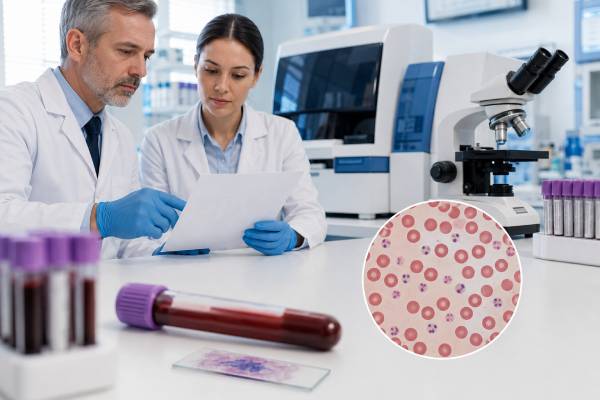
Platelet distribution width, or PDW, is a platelet size-variation marker reported on some complete blood count results. It describes how similar or different your platelets are in size, not how many platelets you have. A normal PDW usually suggests that most circulating platelets are fairly consistent in size, while a high PDW means the platelet population is more mixed, often with both smaller older platelets and larger younger or activated platelets.
PDW can be useful when it is interpreted with the platelet count, mean platelet volume, plateletcrit, blood smear findings, symptoms, and the reason the test was ordered. By itself, PDW rarely gives a diagnosis. It is best viewed as a supporting clue about platelet production, turnover, activation, or sample quality. A mildly abnormal PDW with a normal platelet count is often less concerning than an abnormal PDW that appears with thrombocytopenia, thrombocytosis, bleeding, clotting symptoms, or other abnormal CBC markers.
- PDW measures platelet size variation, also called platelet anisocytosis.
- A common adult PDW reference range is about 9–17 fL, but some laboratories report PDW as a percentage, often around 10–18%.
- High PDW often reflects mixed platelet sizes, which can occur with platelet activation, increased platelet turnover, inflammation, iron deficiency, immune platelet destruction, or bone marrow disorders.
- Low PDW is often less clinically useful and may simply mean platelets are unusually uniform in size, especially when the platelet count is normal.
- PDW should not be interpreted alone; platelet count, MPV, symptoms, medications, and blood smear findings usually matter more.
- No fasting is usually needed for PDW because it is part of a CBC, but poor sample handling or platelet clumping can affect platelet-related results.
Table of Contents
- What PDW Measures on a Blood Test
- PDW Normal Range and Reference Values
- How PDW Is Reported and Why Units Differ
- High PDW Meaning and Common Causes
- Low PDW Meaning and Common Causes
- Interpreting PDW With Platelet Count, MPV, and Other CBC Results
- Test Preparation, Sample Issues, and Accuracy
- Follow-Up, Repeat Testing, and When to Seek Care
What PDW Measures on a Blood Test
PDW measures how much platelets vary in size. Platelets are tiny blood cell fragments that help form clots, seal injured blood vessels, and take part in inflammation and immune signaling. A CBC may report the platelet count, which tells you how many platelets are present, and platelet indices, which describe platelet size and platelet mass. PDW is one of those platelet indices.
A simple way to think about PDW is to imagine looking at a group of coins. If almost every coin is the same size, the “distribution width” is narrow. If the group contains many different coin sizes, the distribution width is wider. PDW works in a similar way for platelets. A lower or normal PDW means the platelets are more similar in size. A higher PDW means the platelets are more varied.
Platelet size variation can change when the body makes new platelets quickly, when platelets are being destroyed or consumed, or when platelets become activated. Larger platelets are often younger and more metabolically active, although size alone does not prove function. Smaller platelets may be older or may reflect certain production patterns. PDW captures the spread in sizes rather than the average size.
PDW is related to, but different from, mean platelet volume. MPV is the average platelet size. PDW is the variation around that average. Two people can have the same MPV but different PDW values. One person may have most platelets close to average size. Another may have a mixture of very small and very large platelets that balance out to the same average. For that reason, PDW can sometimes add context to an MPV result, especially when the platelet count is abnormal.
PDW is not a standard decision-making test in the same way that platelet count is. Many clinicians focus first on whether the platelet count is low, normal, or high. PDW becomes more useful when the main platelet number needs more explanation. For example, a low platelet count with large variation in platelet size may suggest increased platelet destruction or turnover, while a low platelet count with less size variation may point more toward reduced platelet production. That pattern is not absolute, but it can guide the next step.
PDW Normal Range and Reference Values
A common adult PDW reference range is about 9–17 fL when PDW is reported in femtoliters. Some laboratories and analyzers report PDW as a percentage, with common reference intervals around 10–18%. These ranges are not interchangeable because PDW calculation methods vary by analyzer.
The most accurate “normal range” for your result is the one printed on your own lab report. PDW is more analyzer-dependent than many basic CBC markers, so one laboratory may flag a value as high while another may consider a similar number within range. This happens because hematology analyzers use different measurement technologies, platelet-sizing methods, calibration systems, and mathematical definitions for platelet distribution width.
| PDW result pattern | Typical interpretation | What to check next |
|---|---|---|
| Within the lab range | Platelet sizes are within the expected distribution for that analyzer. | Review platelet count and MPV if symptoms or other CBC abnormalities are present. |
| Mildly high | Platelet sizes are more varied than expected; this may occur with platelet activation or increased turnover. | Check platelet count, MPV, inflammation markers, iron studies, medications, and recent illness. |
| Very high | Marked platelet size variation; may be more meaningful if platelet count is low or high. | Consider repeat CBC, peripheral smear, and clinician review. |
| Low | Platelets are more uniform in size; often has limited meaning when platelet count is normal. | Interpret with platelet count, MPV, and the clinical situation. |
Adult platelet count is usually interpreted first. A typical platelet count reference range is about 150,000–450,000 platelets per microliter, although some laboratories use a slightly narrower upper limit such as 400,000/µL. PDW does not replace this number. Someone can have a normal PDW and a dangerously low platelet count, or a high PDW with a normal platelet count that only needs routine follow-up.
Age can also matter. Newborns and infants may have different platelet indices than adults. Children’s values may vary by age, analyzer, and clinical setting. Pregnancy, recent infection, inflammation, bleeding, iron deficiency, medications, and chronic disease can also shift platelet patterns. For these reasons, PDW should be interpreted with the reference interval printed beside the result and the person’s full clinical picture.
PDW is not usually described as “optimal” in the same way some wellness sources discuss vitamins, lipids, or glucose markers. There is no widely accepted optimal PDW target for healthy people. A PDW inside the laboratory’s reference range is generally considered normal, and a PDW outside the range is a signal to interpret the CBC pattern rather than a diagnosis by itself.
How PDW Is Reported and Why Units Differ
PDW may appear as PDW, PDW-CV, PDW-SD, or simply “platelet distribution width.” Some reports give a number in femtoliters, abbreviated fL. Others give a percentage. This difference can be confusing because the same abbreviation may refer to different calculation styles.
A femtoliter is a tiny unit of volume. When PDW is reported in fL, the result describes the spread of platelet volumes. When reported as a percentage, PDW often reflects a coefficient of variation or related calculation. Because laboratories do not all calculate PDW the same way, a PDW of 15 fL and a PDW of 15% should not be treated as the same measurement.
Automated hematology analyzers estimate platelet size by studying how platelets behave as they pass through the instrument. Some analyzers use impedance methods, some use optical or fluorescence methods, and some combine technologies. The analyzer creates a platelet size distribution curve, then calculates indices such as MPV and PDW from that curve.
This analyzer dependence explains why PDW is less standardized than hemoglobin, hematocrit, or platelet count. A person who has blood drawn at two different laboratories may see a different PDW even when there has been no meaningful health change. The difference may come from technology, sample timing, anticoagulant effects, or the way each laboratory defines its reference interval.
PDW may not appear on every CBC. Some laboratories report platelet count and MPV but omit PDW. Others include PDW only when the analyzer generates a reliable platelet histogram. A missing PDW result does not automatically mean something is wrong. It may simply reflect the laboratory’s reporting policy.
PDW also has limits in research and clinical use. Many studies link abnormal PDW with inflammation, cardiovascular disease, diabetes complications, sepsis, pregnancy-related conditions, autoimmune disease, and other illnesses. These associations do not mean PDW diagnoses those conditions. PDW often changes because platelets respond to stress, inflammation, and vascular injury. It can reflect biological activity, but it is not specific enough to identify the cause without other information.
High PDW Meaning and Common Causes
High PDW means platelet sizes are more varied than expected for the laboratory’s reference range. This often suggests a mixed platelet population, such as a combination of older smaller platelets and larger younger or activated platelets. A high result is more meaningful when the platelet count, MPV, symptoms, or blood smear are also abnormal.
A high PDW can happen when the body is making platelets rapidly. During increased platelet production, the bone marrow may release larger, younger platelets into circulation. This can occur after bleeding, after platelet destruction, during recovery from a temporary marrow slowdown, or in some inflammatory states. A high PDW can also occur when platelets become activated and change shape. Activated platelets may form projections, release granule contents, interact with white blood cells, and participate in clot formation.
Common situations linked with high PDW include:
- Recent infection or inflammation
- Iron deficiency, sometimes with a high platelet count
- Immune thrombocytopenia or other platelet destruction patterns
- Recovery after bleeding or platelet consumption
- Some myeloproliferative disorders, where marrow cells overproduce blood cells
- Cardiovascular or vascular inflammatory states
- Diabetes, kidney disease, liver disease, or severe systemic illness in some studies
- Sample problems such as platelet clumping or delayed processing
High PDW should not be interpreted as “blood clots are forming” without evidence. Platelets are involved in clotting, but PDW is not a clot test. Tests such as PT, INR, aPTT, fibrinogen, D-dimer, platelet function testing, and clinical imaging answer different questions. A high PDW may reflect platelet activation or turnover, but it does not prove that a clot is present.
The platelet count changes the meaning. High PDW with a normal platelet count may be a mild or temporary finding, especially after infection, exercise stress, or inflammation. High PDW with a low platelet count may suggest increased platelet destruction or consumption, although other causes are possible. High PDW with a high platelet count may occur in reactive thrombocytosis, iron deficiency, inflammation, or marrow disorders. When platelet count is elevated, it helps to compare the pattern with common causes of high platelets rather than focusing only on PDW.
Iron deficiency deserves special mention. Many people think of iron deficiency only as a red blood cell problem, but it can also affect platelets. Some people with low ferritin develop a high platelet count, and platelet indices may shift. In that setting, PDW should be read with ferritin, transferrin saturation, hemoglobin, MCV, and RDW. A pattern of high platelets with low ferritin has a different meaning from high platelets with high inflammatory markers or abnormal white blood cells.
A high PDW can also appear in platelet disorders. In immune thrombocytopenia, platelets may be destroyed in the bloodstream, and the marrow may respond by releasing larger younger platelets. In some inherited platelet disorders, platelets can be very large or unusually variable in size. In myeloproliferative neoplasms, platelet production may be excessive and abnormal. These conditions require more than PDW for diagnosis. Platelet count trends, blood smear, clinical history, and sometimes specialized hematology testing are needed.
For a more focused discussion of elevated PDW patterns, see high platelet distribution width causes.
Low PDW Meaning and Common Causes
Low PDW means platelet sizes are more uniform than expected. In many cases, especially when the platelet count is normal and there are no bleeding or clotting symptoms, low PDW has limited clinical importance. It often does not require a separate workup.
A low PDW can simply mean the circulating platelet population is fairly even in size. That may be normal for that person, or it may reflect how the analyzer measured the sample. Because PDW reference ranges vary, a slightly low result from one lab may not be considered low elsewhere.
Low PDW may deserve more attention when it appears with other abnormal findings. For example, low PDW with a low platelet count can sometimes fit reduced platelet production, where the marrow is not producing enough new platelets. In that situation, the body may not be releasing many large young platelets, so the platelet population may look more uniform. Possible causes include bone marrow suppression, certain medications, viral infections, nutrient deficiencies, marrow disorders, chemotherapy, or severe chronic illness.
Low PDW with anemia or low white blood cells can be more important than low PDW alone. When several blood cell lines are low, clinicians think about broader marrow production problems, severe nutritional deficiency, autoimmune disease, infection, medication effects, hypersplenism, or hematologic disease. A low platelet count together with other low cell counts may need prompt medical review depending on severity and symptoms.
Low PDW should not be used to rule out platelet problems. A person can have impaired platelet function with a normal or low PDW. Aspirin, clopidogrel, some anti-inflammatory drugs, kidney failure, liver disease, inherited platelet function disorders, and von Willebrand disease can affect bleeding risk even when PDW is not high. Platelet function is not the same as platelet size variation.
Low PDW is also less studied than high PDW. Many clinical studies focus on elevated PDW because platelet activation and mixed platelet sizes are easier to connect with inflammation, thrombosis risk, and disease severity. A low value may still be worth noting, but it is usually interpreted as part of the CBC pattern rather than as an independent marker.
For more detail on low results, see low platelet distribution width meaning.
Interpreting PDW With Platelet Count, MPV, and Other CBC Results
PDW becomes more useful when it is matched with the platelet count and MPV. The platelet count tells you how many platelets are present. MPV tells you the average platelet size. PDW tells you how varied those platelet sizes are. Together, these markers can suggest whether platelet production, destruction, activation, or distribution may be changing.
| Pattern | Possible meaning | Typical next step |
|---|---|---|
| Normal platelets, normal MPV, normal PDW | Platelet number and size pattern look typical. | No platelet-specific follow-up unless symptoms or other results suggest it. |
| Normal platelets, high PDW | More size variation despite normal platelet number; may be temporary or related to inflammation, iron deficiency, or platelet activation. | Review symptoms, trends, ferritin or inflammatory markers if clinically relevant. |
| Low platelets, high PDW or high MPV | Can fit increased platelet destruction or turnover, but is not diagnostic. | Repeat CBC, blood smear, medication review, and clinician assessment. |
| Low platelets, low or normal PDW and MPV | Can fit reduced platelet production, depending on other CBC findings. | Assess other blood cell lines, smear, nutritional status, infections, and medication effects. |
| High platelets, high PDW | May occur with reactive thrombocytosis, iron deficiency, inflammation, or marrow overproduction. | Check ferritin, inflammation clues, repeat trend, and consider hematology review if persistent or marked. |
Platelet count usually carries more immediate clinical weight than PDW. A very low platelet count can increase bleeding risk, especially when it falls below 50,000/µL, and risk becomes more serious at lower levels. Symptoms and the cause matter, so the number alone does not tell the whole story. A high platelet count can be reactive and temporary, but persistent or very high counts may require evaluation for inflammation, iron deficiency, infection, cancer, splenectomy effects, or myeloproliferative disease. A separate article on the platelet count normal range can help put PDW into context.
The rest of the CBC can point toward the cause. Low hemoglobin, low MCV, and high RDW may suggest iron deficiency, which can also affect platelets. High white blood cells or neutrophils may point toward infection, inflammation, stress, steroid use, or marrow disease. Low white blood cells and low platelets together may suggest marrow suppression, viral infection, medication effects, autoimmune disease, or other systemic causes. A full CBC interpretation is usually more useful than reading PDW alone.
A peripheral blood smear can be especially helpful when platelet indices look unusual. A smear lets a trained professional examine blood cells under a microscope. It can show platelet clumping, giant platelets, small platelets, abnormal red blood cell shapes, immature white cells, or other findings that automated analyzers may not fully explain. When PDW is abnormal and the platelet count does not match the clinical picture, a peripheral blood smear can clarify whether the result reflects true biology or a sample issue.
Medication history matters. Aspirin and other antiplatelet drugs may affect platelet function without strongly changing PDW. Anticoagulants such as warfarin, apixaban, rivaroxaban, dabigatran, and heparin affect clotting pathways or thrombin activity rather than platelet size variation. Chemotherapy, some antibiotics, valproate, linezolid, quinine, heparin, immune therapies, and many other medications can affect platelet count. PDW can support the pattern, but the medication list often provides the stronger clue.
Trends are usually more informative than one value. A PDW that has been mildly high for years with a stable normal platelet count may be less concerning than a PDW that suddenly rises along with falling platelets, new anemia, or new symptoms. When comparing results over time, use the same laboratory when possible because PDW can vary by analyzer.
Test Preparation, Sample Issues, and Accuracy
PDW usually requires no special preparation. It is part of a complete blood count, which is drawn from a vein into a tube containing an anticoagulant, often EDTA. You usually do not need to fast unless other blood tests are being drawn at the same time.
Good sample handling matters for platelet indices. Platelets are small, reactive cell fragments. They can change shape after blood is drawn, especially if the sample sits too long, is stored at an unsuitable temperature, or begins to clot. These changes can affect MPV, PDW, platelet histograms, and sometimes the platelet count.
Platelet clumping is one of the most important sample issues. In some people, EDTA can trigger platelets to clump together in the tube. The person’s actual platelet count in the bloodstream may be normal, but the analyzer may count clumps poorly and report a falsely low platelet count. This is called pseudothrombocytopenia. A clue is a low platelet count in someone with no bleeding symptoms, especially if the analyzer flags platelet clumps or the blood smear confirms clumping.
When platelet clumping is suspected, the laboratory or clinician may repeat the CBC, review a smear, or redraw blood in a different tube such as sodium citrate. Citrate results may need correction because the tube contains liquid anticoagulant that dilutes the sample. The laboratory usually handles that adjustment.
Small clots in the tube can also cause inaccurate results. This can happen if the tube was underfilled, overfilled, not mixed properly, or difficult to draw. Clotted samples may falsely lower platelet count because platelets get trapped in the clot. In that situation, repeat testing may be needed.
Very large platelets can create another problem. Some analyzers may misclassify giant platelets or fragments from other cells, especially when platelet size overlaps with red cell fragments or other particles. A smear can help confirm whether platelets are truly large, clumped, or abnormal in appearance. In some cases, a platelet morphology review gives more useful information than PDW alone.
Timing can affect platelet indices more than many people realize. MPV and PDW may shift as platelets swell or change shape in the tube after collection. For this reason, laboratories often process CBC samples within defined time windows. When monitoring a subtle platelet index trend, comparing results from the same lab with similar processing practices is more reliable than comparing numbers from different facilities.
Follow-Up, Repeat Testing, and When to Seek Care
Follow-up depends on the whole CBC pattern, not PDW alone. A mildly abnormal PDW with normal platelets, normal hemoglobin, normal white blood cells, and no symptoms may only need routine monitoring or no action. A clearly abnormal PDW with low or high platelets, anemia, abnormal white blood cells, or symptoms should be reviewed with a clinician.
A repeat CBC is often the simplest first step when PDW does not fit the clinical picture. This is especially true if there is a new platelet abnormality, a lab flag for clumping, or a result that changed sharply from prior tests. Repeating the test can show whether the finding was temporary, due to sample handling, or part of a real trend.
Additional tests depend on the pattern. A clinician may consider ferritin and iron studies if the platelet count is high or anemia suggests iron deficiency. Inflammatory markers, liver tests, kidney tests, B12, folate, viral testing, autoimmune testing, or medication changes may be relevant in certain situations. If platelet count is persistently very high, very low, or accompanied by abnormal cells, a hematology referral may be needed.
Seek urgent medical care if an abnormal platelet result appears with concerning symptoms such as:
- Uncontrolled bleeding
- Vomiting blood or passing black, tarry stools
- New severe headache, confusion, weakness, or vision changes
- Tiny widespread red or purple spots on the skin, especially with fever
- Large unexplained bruises or rapidly spreading bruising
- Chest pain, shortness of breath, coughing blood, or one-sided leg swelling
- Heavy bleeding after injury or surgery
- Pregnancy with severe headache, upper abdominal pain, high blood pressure, or abnormal bleeding
Bleeding and clotting symptoms should not be judged by PDW. A person with normal PDW can still have a serious platelet count problem, platelet function disorder, coagulation disorder, or clot. A person with high PDW may have no immediate danger. Symptoms, platelet count, medical history, and exam findings guide urgency.
PDW can be a useful clue, but it is a supporting marker. The safest interpretation starts with the platelet count, checks whether the result is real, looks for patterns across the CBC, and then connects the lab findings to symptoms and medical history.
References
- Reference intervals for platelet large cell ratio, platelet distribution width, plateletcrit and standard haematological parameters determined on the Sysmex XN-10 in a cohort of 30,917 Danish blood donors 2022 (Reference Interval Study)
- Definition of reference ranges for the platelet distribution width (PDW): a local need 2010 (Reference Interval Study)
- Platelet Distribution Width Is Associated with P-Selectin Dependent Platelet Function: Results from the Moli-Family Cohort Study 2021 (Clinical Study)
- Normal and Abnormal Complete Blood Count With Differential 2024 (Review)
- Pseudothrombocytopenia-A Review on Causes, Occurrence and Clinical Implications 2021 (Review)
- National recommendations of the Croatian Chamber of Medical Biochemists and Working group for Laboratory hematology of the Croatian Society of Medical Biochemistry and Laboratory Medicine: Management of samples with suspected EDTA-induced pseudothrombocytopenia 2024 (Guideline)
Disclaimer
PDW is a laboratory marker that must be interpreted with the full CBC, symptoms, medications, and medical history. A normal or abnormal PDW result does not diagnose or rule out bleeding disorders, clotting disorders, infection, inflammation, cancer, or bone marrow disease. Discuss abnormal platelet results with a qualified healthcare professional, especially if platelet count is low or high, results are changing, or bleeding or clotting symptoms are present.