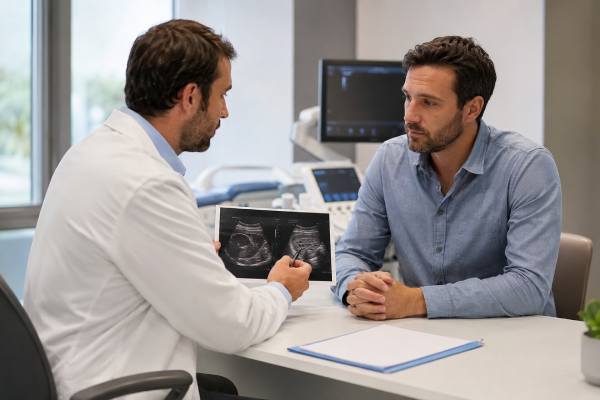
A lump, swelling, or firm change in one testicle should be checked, even if it does not hurt. Testicular cancer often starts as a painless lump or a heavier, larger-feeling testicle, but pain, aching, sudden fluid buildup, breast tenderness, back pain, or groin discomfort can also happen. Many testicle changes are not cancer. Cysts, infections, fluid around the testicle, swollen veins, and injuries are common causes of lumps or swelling. The problem is that you usually cannot tell the difference by feel alone.
The safest move is to treat a new testicle change as something that needs a medical exam, not something to watch for months. A clinician may examine the scrotum, order an ultrasound, and use blood tests called tumor markers when cancer is possible. Sudden severe pain is different: that can be an emergency and needs immediate care.
Table of Contents
- The first signs men usually notice
- What lumps, swelling, and texture changes can feel like
- Pain, aching, and symptoms that need urgent care
- Other causes that can look or feel similar
- Who has a higher risk of testicular cancer
- How to check your testicles without overdoing it
- What happens when you get checked
- What treatment and follow-up may involve
The first signs men usually notice
The most common early sign is a lump, swelling, or firm area in one testicle. It may be painless. Some men first notice that one testicle feels heavier, larger, harder, or shaped differently than before.
Possible symptoms include:
- A painless lump on or in a testicle
- Swelling or enlargement of one testicle
- A firm, heavy, or uneven feeling
- A dull ache in the lower belly, groin, testicle, or scrotum
- Sudden fluid buildup in the scrotum
- Pain or discomfort in the testicle or scrotum
- Breast tenderness or breast tissue growth
- Back pain, cough, shortness of breath, or unexplained weight loss in more advanced cases
Cancer usually affects one testicle, not both. That does not mean a two-sided symptom is harmless, but a new one-sided lump or size change deserves prompt attention.
A common mistake is waiting because there is no pain. Painless does not mean safe. Many infections and injuries hurt; many tumors do not. Another mistake is assuming a lump is only a cyst because it feels smooth. Some harmless lumps are smooth, but feel alone is not reliable.
Get checked soon if a lump, swelling, hardness, or shape change is new, lasts more than a couple of days, or cannot be clearly explained by a minor injury that is quickly improving. If you already have an article on what a testicular lump could be, it is a useful next step for comparing common possibilities, but a real lump still needs an exam.
What lumps, swelling, and texture changes can feel like
A suspicious change is often described as a hard pea-sized bump, a firm nodule, a larger swollen testicle, or a testicle that feels heavier than usual. Some men do not feel a separate lump at all. They only notice that the whole testicle feels firmer, fuller, or less smooth than the other side.
Normal testicles are not perfectly identical. One may hang lower. One may be slightly larger. The epididymis, a soft coiled tube behind the testicle, can feel like a small ridge or bump. Blood vessels and tubes can also be felt around the testicle. These normal structures are a major reason men get confused during self-checks.
A change is more concerning when it is:
- New compared with your usual baseline
- Firm or hard rather than soft
- Inside the testicle rather than separate from it
- Growing over days or weeks
- Paired with heaviness, aching, or swelling
- Not improving after a minor injury should have settled
Swelling can mean different things. A testicle itself may be enlarged, or the scrotum may look swollen because fluid, inflammation, or enlarged veins surround the testicle. A clinician may use a light exam and ultrasound to tell whether swelling is solid, fluid-filled, or outside the testicle.
A heavy feeling matters because some men with testicular cancer do not feel a sharp lump. They describe it as “one side feels weighted,” “my testicle feels dense,” or “my underwear suddenly fits differently.” That kind of change should not be ignored.
Breast tenderness or growth can also occur. Some testicular tumors make hormones that affect breast tissue. This symptom has many other causes, including medications, alcohol use, liver problems, and hormone changes, but breast tenderness plus a testicle change should be checked promptly.
Pain, aching, and symptoms that need urgent care
Testicular cancer can cause discomfort, but sudden severe testicle pain is more often treated as an emergency until proven otherwise. The main concern is testicular torsion, where the testicle twists and cuts off its blood supply. Torsion can threaten the testicle within hours.
Go to emergency care now if you have:
- Sudden, severe pain in one testicle
- Testicle pain with nausea or vomiting
- A testicle that sits higher than usual or at a strange angle
- Pain after an injury that does not quickly settle
- Severe swelling, redness, fever, or feeling very ill
- Pain that lasts more than an hour or continues at rest
Do not wait for a routine appointment if the pain is sudden and intense. The article on testicular torsion symptoms explains why timing matters, but the safe action is immediate evaluation.
Cancer-related discomfort is often different. It may feel like a dull ache, pressure, heaviness, or mild pain in the testicle, scrotum, groin, or lower abdomen. It can come on slowly. It may be easy to dismiss as a pulled muscle, cycling soreness, or underwear irritation.
Pain alone does not point to cancer. Epididymitis, prostatitis, kidney stones, hernias, pelvic floor tension, injury, and sexually transmitted infections can all cause pain in or near the testicle. Persistent or recurring symptoms still deserve a medical exam, especially if there is swelling or a lump. For broader causes, see common causes of testicular pain.
Back pain, belly pain, cough, shortness of breath, or neck lumps can occur if cancer has spread, but these symptoms are much more often caused by other conditions. The important pattern is a body symptom plus a testicle change, or a testicle change that has been ignored for weeks or months.
Other causes that can look or feel similar
Most scrotal lumps and swellings are not testicular cancer, but they still need proper identification. The difference between “outside the testicle” and “inside the testicle” is especially important. Lumps outside the testicle are more often benign. Solid lumps inside the testicle raise more concern.
| Possible cause | How it may feel | Typical next step |
|---|---|---|
| Testicular cancer | Firm lump, enlarged testicle, heaviness, sometimes ache | Exam, ultrasound, tumor marker blood tests, urology referral |
| Epididymal cyst or spermatocele | Smooth lump above or behind the testicle | Exam and ultrasound if new, growing, or uncertain |
| Hydrocele | Fluid swelling around the testicle, often painless | Exam, sometimes ultrasound; treatment if large or bothersome |
| Varicocele | Bag-of-worms feeling, usually above the testicle, often left-sided | Exam; fertility or pain evaluation if needed |
| Epididymitis | Pain, tenderness, swelling; sometimes urinary symptoms or STI risk | Urine or STI testing and treatment when infection is likely |
| Hernia | Groin or scrotal bulge, often worse with lifting or coughing | Physical exam; urgent care if severe pain or trapped bulge |
| Injury | Pain, bruising, swelling after trauma | Urgent care if severe pain, swelling, nausea, or blood in urine |
A spermatocele is a cyst near the epididymis that can feel like a separate small lump. It is usually not cancer, but it can worry men because it sits close to the testicle. More detail is available in the guide to spermatocele symptoms.
A hydrocele is fluid around the testicle. It may make the scrotum look enlarged or feel heavy. A hydrocele can be harmless, but a new adult hydrocele should be checked because swelling can hide the testicle and make it harder to feel a mass. See hydrocele causes and treatment for the typical patterns.
A varicocele is a group of enlarged veins. It often feels like a soft bundle above the testicle and may become more noticeable when standing. Varicoceles are usually not cancer, but sudden right-sided swelling, a new varicocele that does not reduce when lying down, or swelling with other symptoms should be evaluated. The article on varicocele symptoms and treatment covers when it matters for pain or fertility.
Epididymitis is inflammation of the epididymis. It can be caused by urinary bacteria or sexually transmitted infections. It often hurts more than cancer and may come with burning urination, discharge, fever, or tenderness behind the testicle. A comparison with torsion and other urgent causes is covered in epididymitis vs testicular torsion.
Who has a higher risk of testicular cancer
Testicular cancer is uncommon, but it is one of the more common cancers in younger adult men. It can happen at any age, including older age, but it is most often diagnosed in teens, young adults, and men in early middle age.
Risk is higher if you have:
- A history of an undescended testicle, even if it was repaired
- A previous testicular cancer
- A father, brother, or son with testicular cancer
- Abnormal testicle development or a smaller, poorly functioning testicle
- Certain genetic conditions, such as Klinefelter syndrome
- A history of testicular carcinoma in situ
- Infertility or abnormal semen findings in some cases
Having a risk factor does not mean you will get cancer. Many men with testicular cancer have no obvious risk factor. Having no risk factor also does not mean a lump can be ignored.
Men who have had cancer in one testicle need long-term follow-up because cancer can occur in the other testicle later. Men with an undescended testicle history should ask their clinician what kind of follow-up makes sense for their situation.
Race is sometimes listed as a risk factor because rates are higher in White men than in several other groups. This should not lead anyone else to dismiss symptoms. A testicle lump needs evaluation regardless of race, age, or fitness level.
Lifestyle choices such as diet, exercise, masturbation, sexual frequency, and underwear style are not reliable ways to explain a new testicular lump. Heat exposure, alcohol, smoking, anabolic steroids, infections, and hormones may affect fertility or testicle function, but they should not be used as a reason to delay care for swelling or a firm mass.
How to check your testicles without overdoing it
A self-check is useful for learning what is normal for you, but it is not a perfect screening test. No routine screening test is standard for testicular cancer in men without symptoms. Still, many cancers are first noticed by men themselves or their partners, so knowing your baseline can help you act sooner.
A simple way to check:
- Check during or after a warm shower, when the scrotal skin is relaxed.
- Look for new swelling, size change, or one side hanging very differently than usual.
- Hold one testicle with both hands.
- Gently roll it between your thumbs and fingers.
- Feel for a hard lump, firm nodule, new thickening, or change in texture.
- Find the epididymis behind the testicle so you do not mistake it for a new lump.
- Repeat on the other side.
Do not squeeze hard. Do not check many times a day. Repeated checking can irritate the area, increase anxiety, and make normal structures feel suspicious. Once a month is enough for many men who choose to self-check. Men at higher risk should ask a clinician what schedule is reasonable.
The goal is not to diagnose yourself. The goal is to notice a clear change and get it checked. A detailed walkthrough is available in how to do a testicular self-exam.
Partners sometimes notice changes first. That can feel embarrassing, but it is common and worth taking seriously. A partner may notice swelling, firmness, or one testicle looking different during sex or bathing. Do not argue yourself out of getting checked just because someone else noticed it.
If you are anxious, set a rule: check at a planned time, write down what you feel, and make an appointment if there is a new lump, swelling, hardness, or change that persists. Avoid repeated “reassurance checks” throughout the day.
What happens when you get checked
A testicle lump visit is usually straightforward. The clinician asks when you noticed the change, whether it hurts, whether there was an injury, and whether you have urinary symptoms, fever, discharge, fertility concerns, or STI risk. They examine the testicles, scrotum, groin, and sometimes abdomen.
Common next steps include:
- Scrotal ultrasound. This uses sound waves to show whether a lump is inside or outside the testicle and whether it looks solid or fluid-filled.
- Blood tests for tumor markers. These may include AFP, beta-hCG, and LDH. They can help with diagnosis, staging, and follow-up, but normal results do not rule out cancer.
- Urine or STI testing. These are used when infection is possible.
- Urology referral. A urologist handles suspicious masses, surgery decisions, and follow-up.
- CT or other imaging. If cancer is diagnosed or strongly suspected, imaging may be used to check whether it has spread.
A scrotal ultrasound is painless and does not use radiation. You lie on your back while gel and a small probe are placed on the scrotum. The scan helps separate common benign problems from masses that need urgent urology care.
A biopsy through the scrotal skin is usually avoided when testicular cancer is suspected. Instead, if imaging and exam suggest cancer, the usual diagnostic and treatment step is removal of the affected testicle through an incision in the groin. This is called radical inguinal orchiectomy. The testicle is then examined by pathology to confirm the type of cancer.
This can sound frightening, but it is done this way to avoid spreading cancer cells through the scrotum and to treat the primary tumor properly. Before surgery, ask about sperm banking if future fertility matters to you. Some men can still father children after treatment, but chemotherapy, radiation, surgery, and the cancer itself can affect fertility.
If you are unsure where to go, a primary care clinician, urgent care clinic, sexual health clinic, or urologist can start the evaluation depending on the symptom. For persistent lumps, swelling, urinary symptoms, pelvic pain, fertility concerns, or cancer worries, seeing a urologist is often the right next step.
What treatment and follow-up may involve
Testicular cancer is often highly treatable, including many cases that have spread. Treatment depends on the cancer type, stage, tumor markers, imaging results, and personal factors such as fertility plans.
The two main germ cell tumor groups are seminoma and nonseminoma. Seminomas often grow more slowly and may respond well to radiation and chemotherapy. Nonseminomas tend to occur at younger ages and can grow or spread faster. Some tumors contain mixed cell types and are treated based on the more aggressive features.
Treatment may include:
- Surgery to remove the affected testicle
- Surveillance with scheduled exams, scans, and blood tests
- Chemotherapy
- Radiation therapy, mainly for selected seminoma cases
- Surgery to remove lymph nodes in selected cases
- Additional treatment if cancer comes back
Many men with early-stage disease need surgery first and then careful monitoring. Surveillance is not “doing nothing.” It means following a strict schedule so recurrence can be found early. Missing follow-up visits can turn a low-treatment situation into a more complicated one.
Removing one testicle usually does not stop erections, orgasm, or testosterone production if the other testicle works normally. Some men notice emotional effects, body image concerns, or anxiety about sex. A testicular prosthesis can be discussed before surgery if appearance matters to you.
Fertility should be discussed early. Sperm banking is often recommended before chemotherapy, radiation, or certain surgeries. Even before treatment, some men with testicular cancer have lower sperm counts. If you may want children later, bring it up before the first treatment when possible.
Follow-up after treatment may last for years. It can include physical exams, tumor marker blood tests, CT scans, chest imaging, and monitoring for late effects of treatment. Survivorship care may also include heart health, hearing, kidney function, nerve symptoms, testosterone symptoms, fertility, and emotional health.
The most important step is not to diagnose the lump yourself. A new testicle lump, swelling, firmness, or lasting ache deserves a medical exam. Sudden severe pain deserves emergency care. Both situations are easier to handle when you act early.
References
- EAU Guidelines on Testicular Cancer – DIAGNOSTIC EVALUATION 2025 (Guideline)
- Testicular Cancer Treatment (PDQ®)–Patient Version 2023 (Patient Summary)
- Testicular Cancer Screening – NCI 2025 (Patient Summary)
- Testicular cancer – Symptoms and causes – Mayo Clinic 2024 (Medical Reference)
- Testicular cancer – Diagnosis and treatment – Mayo Clinic 2024 (Medical Reference)
- Testicle lumps and swellings – NHS 2023 (Official Page)
Disclaimer
This article is educational and cannot diagnose the cause of a lump, swelling, pain, or change in a testicle. A qualified healthcare professional should evaluate new or persistent testicle changes, and sudden severe testicular pain should be treated as an emergency. Treatment choices, fertility planning, and follow-up schedules should be discussed with a clinician who knows your medical history.