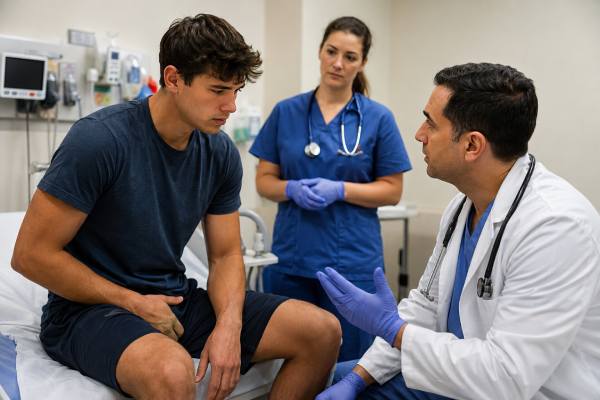
Testicular torsion is one of the few causes of testicle pain where waiting can cost a man a testicle. It happens when the testicle twists on the spermatic cord, cutting off blood flow. The pain is usually sudden, often severe, and may come with swelling, nausea, vomiting, belly pain, or a testicle that sits higher than usual. It is most common in teens and young men, but it can happen at any age, including adulthood.
The safest rule is simple: sudden one-sided testicle pain needs emergency care right away. Do not wait to see whether it improves overnight. Do not try to “walk it off.” Doctors may use an exam and ultrasound, but if torsion is strongly suspected, surgery should not be delayed. The best chance of saving the testicle is usually in the first few hours after symptoms begin.
Table of Contents
- What Testicular Torsion Is
- Symptoms That Need ER Care
- Who Is Most at Risk
- Torsion vs Other Causes of Testicle Pain
- What Happens at the ER
- Treatment and Recovery
- Fertility, Testosterone, and Long-Term Effects
- What Not to Do When Testicle Pain Starts
What Testicular Torsion Is
Testicular torsion means the testicle has rotated and twisted the spermatic cord. The spermatic cord carries blood vessels, nerves, and the tube that transports sperm from the testicle. When it twists tightly enough, blood flow drops or stops.
Without blood flow, testicular tissue can be damaged quickly. That is why torsion is treated as a surgical emergency, not as a routine office problem.
A common underlying reason is a “bell clapper” deformity. In a typical scrotum, the testicle is attached in a way that limits twisting. In some men, the testicle hangs more freely inside the scrotum, making it easier to rotate. This can affect both testicles, even if pain starts on only one side.
Torsion does not always need a clear trigger. It may happen during sleep, after exercise, after minor trauma, or while sitting still. Some men remember a sudden movement or injury. Others wake up with intense pain and no obvious cause.
The condition is often thought of as a teenage problem because many cases occur around puberty. That can be dangerous thinking. Adult men can also develop torsion. Older age makes it less likely, but it does not rule it out.
The time window matters. The chance of saving the testicle is highest when blood flow is restored early, especially within the first several hours. After that, the risk of permanent damage and testicle removal rises. Some testicles can still be saved after longer delays, so late pain still needs emergency evaluation.
Symptoms That Need ER Care
Sudden, severe pain in one testicle is testicular torsion until proven otherwise. The pain may be in the scrotum, groin, lower belly, or all three. Some men feel embarrassed or unsure whether the pain is “bad enough,” but a delay can change the outcome.
Go to the ER now if you have any of these symptoms:
- Sudden pain in one testicle
- Testicle pain with nausea or vomiting
- A swollen, red, or tender scrotum
- One testicle sitting higher than usual
- A testicle that seems turned sideways or at an odd angle
- Lower belly or groin pain with testicle tenderness
- Testicle pain that comes and goes in waves
- Pain after a hit or injury that does not quickly settle
- New testicle pain in a child, teen, or adult who cannot clearly describe the symptoms
The pain is often intense, but not always. Partial torsion can reduce blood flow without fully cutting it off. Intermittent torsion can twist and untwist, causing sudden pain that improves and then returns. Pain that fades is not proof that everything is fine.
Nausea and vomiting are especially concerning when they happen with scrotal pain. The body can react strongly to the loss of blood flow, and the symptoms can look like a stomach problem at first. A teen boy or adult man with sudden lower abdominal pain should be asked whether the testicle also hurts.
A missing or reduced cremasteric reflex can also point toward torsion. This reflex normally pulls the testicle upward when the inner thigh is lightly stroked. It is not something most people can check reliably at home, and it is not perfect even in medical settings. A normal reflex does not make torsion impossible.
Pain relief with lifting the testicle, sometimes called Prehn’s sign, is also unreliable. Do not use it to decide whether to go to the ER.
If there is sudden testicle pain, especially on one side, the safest next step is emergency care. For a broader look at urgent and nonurgent causes, see common causes of testicular pain.
Who Is Most at Risk
Torsion can happen to newborns, children, teens, and adults, but it is most common around puberty. Many cases occur between ages 12 and 18, when the testicles are growing and the anatomy may make twisting easier.
Risk is higher when a man has:
- A history of sudden testicle pain that went away on its own
- A known bell clapper deformity
- A prior torsion on the other side
- A family history of torsion
- An undescended testicle
- Recent scrotal trauma, even if the injury seemed minor
Intermittent pain deserves special attention. A man may have a sudden attack of one-sided pain, feel nauseated, notice the testicle sitting oddly, and then feel better after minutes or hours. That may mean the testicle twisted and untwisted. It can happen again, and the next episode may not untwist on its own.
Sports injuries can confuse the picture. A hit to the groin can cause bruising, swelling, or testicular rupture, but trauma can also trigger torsion or make it easier to notice. If pain is severe, one-sided, worsening, or linked with nausea, get urgent care.
Torsion can also happen after surgery or in unusual anatomy, but most men who get it did not know they were at risk. There is no reliable home screening test for bell clapper anatomy.
Regular awareness still helps. A monthly testicular self-exam can help men notice changes such as lumps, swelling, or a testicle that feels different than before. Self-exams do not prevent torsion, but they can make men more familiar with what is normal for them.
Torsion vs Other Causes of Testicle Pain
Several conditions can cause scrotal pain, and some look similar at first. The hard part is that torsion cannot always be separated from infection or inflammation by symptoms alone. When the story fits torsion, doctors act quickly because the cost of missing it is high.
| Condition | Typical pattern | Why it can be confusing | Usual urgency |
|---|---|---|---|
| Testicular torsion | Sudden one-sided pain, swelling, nausea or vomiting, high-riding or oddly angled testicle | Pain can be in the belly or groin first, and intermittent torsion may improve temporarily | ER now |
| Epididymitis | Gradual pain near the back of the testicle, urinary symptoms, discharge, fever, or STI risk | It can still cause one-sided swelling and tenderness | Same day; ER if severe or torsion is possible |
| Torsion of the appendix testis | Localized pain near the upper testicle, sometimes with a small blue dot under the skin | It can mimic early torsion, especially in children | Urgent evaluation if torsion cannot be ruled out |
| Inguinal hernia | Groin or scrotal bulge, pressure, pain with lifting or coughing | A trapped hernia can cause severe pain and swelling | ER if severe pain, vomiting, or a stuck bulge |
| Testicular tumor | Painless lump, heaviness, swelling, or dull ache | Some tumors cause discomfort or sudden bleeding inside the mass | Prompt medical visit; ER for sudden severe pain |
Epididymitis is one of the most common conditions mistaken for torsion. It is inflammation of the epididymis, the coiled tube behind the testicle. It can come from sexually transmitted infections, urinary tract bacteria, prostate problems, or urinary tract procedures. Symptoms often build more gradually than torsion, but that is not a reliable enough difference when pain is sudden or severe.
A younger man with sudden testicle pain, nausea, and no clear urinary symptoms should not assume it is an infection. For a detailed comparison, see epididymitis vs testicular torsion.
Testicular cancer is usually not a sudden pain emergency, but it belongs in the broader picture of scrotal symptoms. A painless lump, firmness, heaviness, or swelling should be checked soon, even if there is no pain. Learn more about testicular cancer symptoms if the main concern is a lump rather than sudden severe pain.
The bottom line: sudden pain is treated differently from a slow ache or a stable lump. Sudden one-sided scrotal pain belongs in the ER.
What Happens at the ER
The ER team will usually ask when the pain started, whether it was sudden or gradual, whether nausea or vomiting occurred, and whether there was injury, fever, urinary burning, discharge, or STI exposure. Timing matters, so be as specific as possible. “It started around 6 a.m.” is more helpful than “this morning.”
A clinician will examine the abdomen, groin, and scrotum. They may look for swelling, redness, testicle position, tenderness, hernia, and signs of infection. The exam can be uncomfortable, but it helps decide how urgent surgery is.
Tests may include:
- Scrotal ultrasound with Doppler to check blood flow
- Urinalysis to look for infection or blood
- STI testing when infection is possible
- Blood tests if fever, vomiting, or surgery is likely
Ultrasound is often helpful because Doppler can show reduced or absent blood flow. It can also point toward epididymitis, hydrocele, abscess, trauma, or other causes. However, ultrasound is not perfect. Partial torsion and intermittent torsion can be harder to catch, especially if the testicle has untwisted or still has some blood flow.
When the history and exam strongly suggest torsion, doctors may call a urologist and go to surgery without waiting for every test. That is not an overreaction. It is how doctors protect the testicle from avoidable delay.
In some cases, a clinician may try manual detorsion, which means gently rotating the testicle by hand to try to untwist it. This may ease pain and improve blood flow, but it does not replace surgery. The testicle can twist again, and the doctor cannot always know by feel whether the twist is fully corrected. Surgery is still needed to confirm the diagnosis and secure the testicle.
Pain medicine may be given, but pain control should not slow down the evaluation. Tell the team about your last food or drink, medications, allergies, bleeding problems, and prior surgeries. This helps anesthesia and surgery teams move faster if an operation is needed.
Treatment and Recovery
Surgery is the standard treatment for testicular torsion. The operation is usually called scrotal exploration with detorsion and orchiopexy. Detorsion means the surgeon untwists the testicle. Orchiopexy means the testicle is stitched in place to lower the chance of future twisting.
Surgeons usually secure both testicles, not just the painful one. The same loose anatomy that allowed one side to twist may be present on the other side. Fixing both sides helps prevent torsion later.
During surgery, the surgeon checks whether the testicle looks healthy after blood flow is restored. If it recovers enough, it is kept and fixed in place. If the testicle is clearly dead and cannot be saved, it may need to be removed. Removal of a testicle is called orchiectomy.
Recovery depends on what was done, but many men go home the same day or after a short hospital stay. Typical aftercare may include:
- Scrotal support or snug underwear to reduce movement.
- Ice packs as directed, usually wrapped and used for short periods.
- Pain medicine, often including anti-inflammatory medication if safe.
- Avoiding heavy lifting, running, cycling, and sports until cleared.
- Keeping the incision clean and dry according to discharge instructions.
- Follow-up with urology to check healing and discuss long-term questions.
Sex and masturbation are usually paused until the surgeon says healing is far enough along. That timeline varies, but many men need a few weeks before returning to sexual activity and strenuous exercise.
Call the surgeon or seek urgent care after surgery if you develop fever, worsening redness, pus, heavy bleeding, increasing swelling, severe pain that is not controlled, vomiting, or sudden return of testicle pain.
If one testicle was removed, a testicular prosthesis may be an option later. This is a saline-filled implant placed in the scrotum for appearance. It is not medically required, but some men choose it for comfort with body image.
Fertility, Testosterone, and Long-Term Effects
Many men do well after torsion, especially when the testicle is saved quickly. One healthy testicle can often make enough testosterone and sperm for normal puberty, sex drive, erections, and fertility. Still, torsion can affect fertility in some men, especially when blood flow was blocked for a long time or the injured testicle had to be removed.
Testosterone usually remains normal if the other testicle is healthy. Symptoms such as low libido, fatigue, depressed mood, loss of morning erections, or reduced muscle strength should be discussed with a clinician rather than assumed to be from torsion alone. Many other health issues can cause the same symptoms.
Fertility is more complex. Testicular injury can affect sperm production, and some studies show semen changes after torsion. Men who are trying to conceive and have concerns may ask about semen analysis. That test measures sperm count, movement, and shape. If results are abnormal, a urologist or fertility specialist can discuss next steps.
A man should consider follow-up fertility discussion if:
- He had torsion in his only testicle
- One testicle was removed
- Torsion happened in both testicles
- He has had infertility before
- He and his partner have tried to conceive for 12 months without success, or sooner if the female partner is 35 or older
- He had delayed treatment and was told the saved testicle may have been badly injured
For men already thinking about fertility, male fertility testing can explain what doctors commonly check.
Emotional effects are also real. Sudden genital pain, emergency surgery, fear of losing a testicle, and changes in appearance can be stressful. Some men feel anxious about sex, sports, or checking the scrotum afterward. Follow-up is not only for the incision; it is also a chance to ask direct questions about pain, fertility, testosterone, body image, and return to normal activity.
What Not to Do When Testicle Pain Starts
The biggest mistake is waiting. Testicular torsion is time-sensitive, and the clock starts when symptoms begin, not when the pain becomes unbearable.
Do not wait overnight to see if the pain improves. Do not schedule a routine appointment for sudden severe pain. Do not drive yourself if pain, nausea, or faintness makes driving unsafe. Do not rely on home remedies, ice, hot baths, stretching, or pain pills to decide whether the problem is serious.
Do not assume it is “just blue balls,” especially if pain is sudden, one-sided, severe, or linked with swelling or nausea. A dull ache after arousal that fades with time is different from sudden acute scrotal pain. If the pattern is unclear, treat it as urgent. For nonemergency aching after arousal, see testicular ache after arousal.
Do not assume it is an STI or urinary infection because there is discomfort near the testicle. Infection can cause scrotal pain, but sudden severe pain needs torsion ruled out first. Antibiotics do not fix a twisted spermatic cord.
Do not try to manually untwist the testicle yourself. Manual detorsion is sometimes attempted by trained clinicians while arranging surgery. Done incorrectly, it may worsen the twist or delay definitive care.
Do not skip ER care because pain got better. Intermittent torsion can untwist on its own, then twist again later. A pain-free moment does not prove the blood supply is safe.
The safest action is direct: sudden one-sided testicle pain, especially with swelling, nausea, vomiting, or an abnormal testicle position, means go to the ER immediately.
References
- ACUTE SCROTUM 2026 (Guideline)
- Acute scrotal pain and suspected testicular torsion guidelines (2022) 2022 (Guideline)
- Acute Onset of Scrotal Pain-Without Trauma, Without Antecedent Mass 2024 (Guideline)
- Trends in the Management of Testicular Torsion: A Scoping Review of Delays and Outcomes 2025 (Scoping Review)
- Ultrasound for the Diagnosis of Testicular Torsion: A Systematic Review and Meta-analysis of Diagnostic Accuracy 2026 (Systematic Review)
- Epididymitis 2021 (Guideline)
Disclaimer
This article is for education only and does not replace care from a qualified medical professional. Sudden testicle pain can be a surgical emergency, and testicular torsion cannot be safely ruled out at home. If you have sudden one-sided testicle pain, swelling, nausea, vomiting, or an abnormal testicle position, seek emergency care right away.