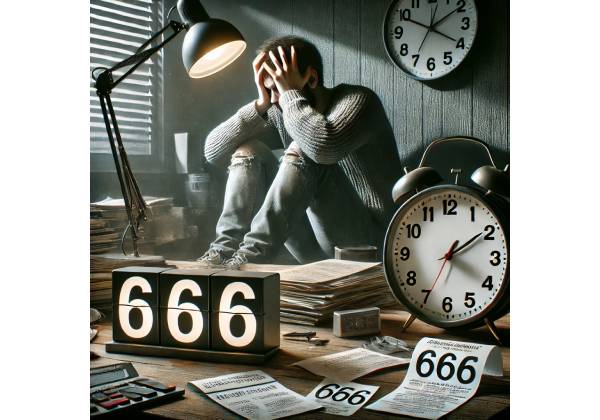
A number can look harmless on a page, a receipt, a hotel door, or a phone screen. Yet for someone with hexakosioihexekontahexaphobia, seeing 666 can set off a rapid surge of alarm. The term refers to an intense fear of the number 666, usually because of its religious, symbolic, or apocalyptic associations. In popular culture, the fear is often treated as a curiosity or a joke. In real life, it can shape choices, strain relationships, and trigger genuine panic. Some people avoid addresses, order totals, account numbers, or dates that include 666. Others become trapped in rituals, repeated checking, or reassurance-seeking meant to neutralize the fear. Not every concern about 666 is a phobia, and not every religious belief around the number is a mental health problem. The difference lies in intensity, persistence, and how much the fear controls a person’s life.
Table of Contents
- What It Is
- Signs and Symptoms
- Causes and Risk Factors
- How Diagnosis Works
- Daily Impact and Complications
- Treatment Options
- Coping and Self-Management
- When to Seek Help and Outlook
What It Is
Hexakosioihexekontahexaphobia is the commonly used name for an intense fear of the number 666. The word is long, but the underlying pattern is familiar in mental health: a specific trigger produces fear that is stronger, more persistent, and more disruptive than the situation itself would reasonably justify. In this case, the trigger is not a snake, a storm, or an elevator. It is a number that has acquired powerful symbolic meaning.
For many people, 666 carries a religious association because it is linked in Christian tradition and popular culture with the “number of the beast.” That background helps explain why the number can feel loaded, ominous, or morally dangerous. At the same time, the mere fact that a person notices or dislikes the number does not mean they have a phobia. A phobia usually involves a pattern of marked anxiety, avoidance, distress, or impairment. The person may know on one level that a receipt or room number cannot harm them, yet their body reacts as if the threat is immediate and urgent.
In clinical practice, hexakosioihexekontahexaphobia is not usually treated as a separate official diagnosis with its own dedicated section in diagnostic manuals. Instead, clinicians ask what kind of problem it most closely resembles. For some people, it functions like a specific phobia focused on a symbol. For others, the fear overlaps with obsessive-compulsive symptoms, especially if the person feels compelled to neutralize the number through rituals, checking, or avoidance. In some cases, the fear may also reflect trauma, panic sensitivity, or highly distressing religious experiences.
The exact form of the fear can vary. One person may panic only when 666 appears in a meaningful context, such as an address or financial transaction. Another may react to any appearance of the digits, even in random sequences, articles, license plates, or timestamps. Some people fear what the number represents. Others fear that exposure to it could bring contamination, bad luck, punishment, or moral danger. Still others are less afraid of the number itself than of what it seems to signal about the future.
That distinction matters because treatment works best when it fits the mechanism behind the fear. The goal is not to dismiss a person’s beliefs or mock their distress. It is to understand whether the fear has become excessive, rigid, and life-limiting. When it has, it deserves the same careful attention as any other anxiety-based condition.
Signs and Symptoms
The symptoms of hexakosioihexekontahexaphobia can be surprisingly intense because the trigger is woven into ordinary daily life. A person may encounter 666 on receipts, apartment numbers, serial codes, dates, barcodes, social media posts, phone numbers, tax forms, or digital timestamps. What seems minor to other people can feel immediate and threatening to the person experiencing the fear.
Physical symptoms often resemble panic. These may include:
- Racing heart
- Sweating
- Trembling
- Shortness of breath
- Tight chest
- Nausea
- Dizziness
- Feeling faint
- Urgent need to escape or get rid of the trigger
Emotional symptoms can include fear, dread, shame, disgust, and a sense of spiritual or moral contamination. Some people feel as if they are in danger simply by seeing the number. Others feel a wave of guilt or dread that something terrible will happen to them or to someone they love.
The thought pattern is often repetitive and catastrophic. Common thoughts include:
- “This is a sign that something bad is coming.”
- “I need to remove or avoid this right away.”
- “If I ignore it, I am inviting harm.”
- “Seeing this number means danger, evil, or punishment.”
- “I will not be able to calm down unless I fix this.”
Behavioral symptoms often cause the greatest disruption. A person may:
- Refuse hotel rooms, house numbers, or phone numbers containing 666
- Ask cashiers to rerun purchases if a total shows 6.66 or 666
- Avoid products, license plates, or seats with the number
- Cross out the digits in notebooks, calendars, or documents
- Perform prayers, counting rituals, or reassurance-seeking after exposure
- Repeatedly check numbers in bills, addresses, and reservations
- Leave websites or videos if 666 appears on screen
Children and adolescents may show the fear differently. Instead of naming it clearly, they may cry, panic, cling, refuse to attend events, or become preoccupied with numbers in a way that is hard for caregivers to understand. They may interpret accidental exposure as a sign of danger and then seek repeated reassurance.
Severity can vary widely. Some people feel only a spike of discomfort and then move on. Others lose sleep, change routines, and spend large amounts of time trying to avoid the number altogether. Symptoms become more clinically concerning when they are persistent, difficult to control, and linked to significant impairment.
A useful distinction is whether the person can tolerate seeing the number without engaging in escape or neutralizing behaviors. If exposure to 666 repeatedly leads to panic, ritual, or disruption of normal functioning, the issue is no longer simple discomfort. It has become a fear pattern that may benefit from professional assessment and treatment.
Causes and Risk Factors
Hexakosioihexekontahexaphobia does not arise from one cause alone. In most cases, it grows out of a combination of symbolic meaning, learning history, personal vulnerability, and reinforcement. The number 666 does not carry the same emotional weight in every culture or every person. What gives it power is the meaning attached to it and the fear that meaning activates.
For many people, the most obvious influence is religious or cultural learning. If a person grows up hearing that 666 signals evil, judgment, or the end times, the number may become loaded long before they fully understand the context. That does not mean religious teaching is automatically harmful or pathological. For many people it is not. The problem emerges when the number becomes associated with overwhelming threat, intense guilt, or an enduring sense that accidental contact could have serious consequences.
Possible contributing factors include:
- Fear-based religious teaching or repeated exposure to apocalyptic material
- Traumatic experiences linked to faith, shame, or spiritual punishment
- Family or community models of intense fear about “signs” and symbols
- High baseline anxiety
- Obsessive or scrupulous thinking
- Strong need for certainty and control
- Tendency toward magical thinking or threat amplification
- Panic sensitivity
Media can also intensify the fear. Films, conspiracy content, internet prophecy discussions, sermons, and sensational stories can make 666 feel not just symbolic but active, dangerous, and personally relevant. The more often the number is paired with frightening images or dire predictions, the easier it becomes for the brain to treat it as a true threat.
Another major factor is reinforcement through avoidance. Suppose a person sees 666 on a screen and instantly closes the page, changes the number, or performs a ritual. Their anxiety drops. That relief is powerful, but it teaches the brain the wrong lesson: “Avoidance saved me.” Over time, the fear becomes stronger because the person never stays with the trigger long enough to learn that the distress can fade on its own.
For some people, the fear is less about theology and more about control. Superstitious thinking often becomes more intense in times of uncertainty, stress, grief, illness, or major life change. A loaded symbol can begin to feel like proof that life is unstable or dangerous. In this way, 666 may become a focal point for broader anxiety rather than the true origin of it.
It is also possible for the fear to overlap with obsessive-compulsive features. If the person believes they must neutralize the number to prevent disaster, the cycle begins to look less like a straightforward phobia and more like obsession and compulsion.
In short, the fear usually develops when a culturally loaded symbol meets a nervous system that is already primed for threat, uncertainty, or ritualized control. The meaning may be learned, but the distress is real.
How Diagnosis Works
There is no laboratory test or brain scan for hexakosioihexekontahexaphobia. Diagnosis is clinical. That means a mental health professional evaluates the person’s symptoms, triggers, beliefs, level of distress, and effect on daily functioning. Because this fear sits at the intersection of symbolism, anxiety, and sometimes religion, diagnosis needs to be careful and respectful.
A clinician usually starts by asking what the number 666 means to the person. That question matters more than it may seem. One person may fear bad luck. Another may fear spiritual corruption. Another may fear that the number predicts disaster. Another may mainly fear the panic they experience when they see it. These differences shape diagnosis and treatment.
A good assessment often covers five areas:
- Trigger pattern
Does the fear involve only the exact number 666, or also 6.66, 616, “mark of the beast” language, barcodes, or related symbols? - Symptom intensity
Does exposure cause mild distress, marked anxiety, panic, or loss of control? - Avoidance and rituals
Does the person escape, neutralize, pray compulsively, seek reassurance, cross out numbers, or change plans to avoid exposure? - Duration and consistency
Has the problem lasted for months or years, and does it recur across many settings? - Functional impact
Is it interfering with work, finances, travel, sleep, relationships, shopping, or ordinary decision-making?
Differential diagnosis is especially important here. Fear of 666 can resemble several different conditions depending on what drives it. A clinician may consider:
- Specific phobia
- Obsessive-compulsive disorder, especially scrupulosity
- Panic disorder
- Trauma-related symptoms
- Psychotic disorders if beliefs are fixed and not reality-based in a broader way
- Generalized anxiety with superstitious or catastrophic focus
This step helps prevent oversimplification. Not every person distressed by 666 has a phobia. For example, someone may hold a religious belief about the number without having clinical anxiety. Another person may be trapped in compulsive rituals, which points more strongly toward OCD-related treatment. Another may have panic attacks and then start fearing any trigger associated with panic.
Assessment should also take context seriously. Clinicians need to distinguish sincere belief from disabling fear. The key question is not whether the person’s worldview is acceptable or not. It is whether the response is excessive, rigid, and impairing relative to the situation.
A good diagnosis often brings relief. Many people feel embarrassed by the fear and hide it for years. Naming the pattern can reduce shame and make the problem more workable. The label is not the main point. The main point is understanding how the fear operates so treatment can target the real drivers instead of just the surface trigger.
Daily Impact and Complications
A fear of 666 can seem narrow until you notice how often numbers appear in modern life. Bills, passwords, flights, hotel rooms, receipts, invoices, order numbers, timestamps, tax forms, addresses, social media counters, and digital systems all generate strings of digits constantly. When one sequence becomes loaded with danger, daily life can start to feel full of traps.
Common areas of disruption include:
- Refusing addresses, apartment numbers, or office suites that include 666
- Avoiding purchases when the total shows 6.66 or 666
- Rechecking bank transactions, account numbers, and invoices
- Panic around travel bookings, tickets, and reservation codes
- Conflict with family or coworkers who do not understand the fear
- Loss of time from repeated checking, changing, or “fixing” numbers
The condition can become especially draining because the trigger is hard to control. Unlike fear of snakes or heights, fear of 666 can intrude through everyday paperwork and digital life. A person may spend long periods scanning for the number so they can avoid it, only to become more sensitized and more likely to notice it. This hypervigilance makes the world feel saturated with the threat.
Another common complication is ritualization. The person may not simply avoid the number. They may feel compelled to neutralize it by adding another digit, deleting a file, closing a tab, reentering a transaction, praying repeatedly, or asking someone else for reassurance. These behaviors can provide short-term relief while deepening long-term dependence on ritual.
Relationships often suffer as well. Partners, relatives, and colleagues may mistake the fear for stubbornness, eccentricity, or excessive religiosity. The person, meanwhile, may feel ashamed and misunderstood. Some keep the fear secret and hide the rituals. Others become dependent on other people to inspect numbers, manage forms, or handle transactions.
Complications can include:
- Increased generalized anxiety
- Sleep disruption after exposure to the feared number
- Avoidance spreading to related symbols or dates
- Financial inconvenience from canceling or changing transactions
- Intensified scrupulosity or compulsive prayer
- Social embarrassment and isolation
- Depressive symptoms related to shame or loss of control
In severe cases, the fear may begin to structure life decisions. People may turn down housing, change phone numbers, refuse jobs, avoid medical forms, or become trapped in repetitive checking that consumes large parts of the day. At that point, the problem is no longer about one number. It is about reduced freedom.
The deepest cost is often the loss of proportion. A symbol that most people would dismiss becomes a source of major distress, and more and more of life is organized around avoiding it. That shrinking of life is one of the clearest signs that the fear has become clinically important and worth treating directly.
Treatment Options
Treatment depends on the mechanism behind the fear, but in many cases the most effective approach is some form of cognitive behavioral therapy. The goal is not to force a person to abandon their values or beliefs. It is to reduce disabling fear, interrupt avoidance, and help them respond to the trigger with more freedom and less panic.
For a phobic pattern, exposure-based therapy is often central. This means gradually facing the feared stimulus in planned steps rather than escaping it. The therapist and patient build a ladder from easier tasks to harder ones. In this kind of fear, the ladder might include:
- Writing the number once
- Looking at 666 on paper for a short period
- Saying the number aloud
- Seeing it on a screen without closing the page
- Leaving it visible in a note or document
- Handling a mock receipt containing 666
- Tolerating the number in a more personally meaningful setting
- Resisting the urge to neutralize or change it
The exposure is gradual and collaborative. The person learns that anxiety can rise, peak, and then fall without catastrophe. That is the opposite of what avoidance teaches.
Cognitive therapy can help identify and challenge catastrophic thoughts, such as “seeing this number invites disaster,” “I must fix this immediately,” or “my distress proves the number is dangerous.” The therapist does not mock the belief system. Instead, treatment focuses on the link between trigger, thought, body response, and behavior.
If the fear has strong compulsive features, exposure and response prevention may be more appropriate than simple exposure alone. In that case, treatment targets both the trigger and the ritual. For example, the person may practice seeing 666 without praying repeatedly, checking for signs, or changing the number to feel safe.
If trauma or fear-based religious experiences are central, trauma-informed therapy may be needed. Sometimes 666 is not the true problem but the symbol through which earlier fear has become organized. Treatment may need to address shame, coercive teaching, or past experiences of spiritual threat.
Medication is not usually the first-line solution for a narrow phobic trigger by itself. However, if the person also has severe anxiety, depression, panic attacks, or OCD symptoms, a clinician may recommend medication as part of a broader treatment plan.
In some cases, respectful collaboration with a trusted faith leader can help, especially when the person’s religious life is important to them and they need reassurance that treatment is not attacking their beliefs. The best results usually come from care that is both evidence-based and sensitive to the meaning the fear carries.
Good treatment does not require loving the number 666. It requires being able to encounter it without losing control.
Coping and Self-Management
Self-management can help reduce the grip of hexakosioihexekontahexaphobia, especially when symptoms are mild to moderate or when the person is already in treatment. The key is to use strategies that build tolerance instead of feeding the cycle of alarm and avoidance.
A helpful first step is to map the pattern clearly. Instead of saying, “I am afraid of 666,” ask more specific questions:
- What do I believe will happen if I see it?
- Is the main feeling fear, guilt, disgust, or contamination?
- Do I avoid the number, or do I perform rituals after exposure?
- Do I react to the number itself or only in certain contexts?
- What short-term action brings relief, and does that action make the fear stronger later?
The answers often reveal whether the problem is closer to phobia, compulsive behavior, or broader anxiety.
Helpful coping strategies include:
- Keeping a written record of triggers and responses
- Reducing repeated reassurance-seeking
- Limiting doom-focused media and internet searches that intensify threat
- Practicing slow breathing when anxiety spikes
- Building a gradual exposure ladder
- Delaying rituals instead of performing them instantly
- Tracking whether feared outcomes actually happen
It is also important to distinguish reasonable preference from rigid avoidance. A person may choose not to decorate with horror imagery or read upsetting content. That can be healthy. The problem begins when the number appears accidentally and the person feels unable to continue ordinary life unless they neutralize it.
Common traps include:
- Asking other people to check every number in advance
- Repeatedly canceling or changing transactions
- Treating every accidental sighting as meaningful
- Using prayer only as a panic ritual rather than as a grounded spiritual practice
- Seeking certainty from endless online searching
- Leaving exposures too quickly to let the anxiety fall
For some people, it helps to work with both mental health and faith-supportive resources at the same time. A balanced, trusted spiritual adviser may help reduce fear-amplifying interpretations, while therapy addresses panic, ritual, and avoidance. That combination can be especially useful when the person worries that treatment will dismiss something deeply important to them.
Lifestyle basics also matter more than they seem. Sleep loss, caffeine overuse, chronic stress, and social isolation can make intrusive fears louder and harder to manage. A steadier nervous system makes exposure work easier.
Self-help is usually most effective when the person can reflect on the fear without becoming overwhelmed. If the fear causes strong panic, major impairment, or compulsive behavior that feels impossible to resist, professional care is often the better option. Still, even in formal treatment, daily self-management is what turns insight into change. The long-term goal is not perfect certainty. It is the ability to tolerate a feared symbol without handing it control over your day.
When to Seek Help and Outlook
It is time to seek professional help when fear of 666 is causing more than momentary discomfort. The clearest sign is interference. If the fear is changing your decisions, consuming large amounts of time, damaging relationships, or making everyday tasks feel unsafe, an evaluation is reasonable and often very helpful.
Consider seeking help if:
- You panic when you see or anticipate the number
- You avoid receipts, room numbers, addresses, transactions, or documents because of it
- You perform rituals or compulsive checking to neutralize the fear
- The problem has lasted for months and is not improving
- Sleep, concentration, work, travel, or finances are being affected
- Shame about the fear is making you withdraw from other people
- The fear is tied to distressing religious memories, guilt, or trauma
A mental health professional can help determine whether the pattern is best understood as specific phobia, obsessive-compulsive symptoms, trauma-related distress, or another anxiety condition. That distinction matters because the treatment focus may be different even when the trigger looks the same from the outside.
It is also important to seek help urgently if the fear is part of a broader crisis, such as:
- Thoughts of self-harm
- Severe depression
- Extreme agitation
- Inability to function
- Loss of touch with reality
- Dangerous compulsive behavior that is escalating rapidly
The outlook is generally good when the fear is treated directly. Anxiety tied to specific triggers often responds well to structured therapy, especially when exposure is done carefully and consistently. People who have spent years hiding the fear are often surprised by how much change is possible once the cycle of avoidance and ritual is interrupted.
Improvement does not usually mean that the person starts liking 666 or stops seeing it as symbolically charged. Recovery is more practical than that. It means the number can appear without causing panic, hours of rumination, or major disruption. A person may still notice it. The difference is that they no longer need to obey it.
Relapse can happen, especially during periods of stress, religious anxiety, grief, or heavy exposure to fear-amplifying media. That does not mean treatment failed. It usually means the nervous system needs a return to basic tools: exposure, reduced reassurance, clearer thinking, and support.
Hexakosioihexekontahexaphobia is a niche fear, but its effects can be very real. It can trap people in cycles of dread, shame, and ritual over something that appears everywhere in modern life. The encouraging part is that these cycles are understandable and treatable. With the right help, the number can become what it is for everyone else: a number, not a command.
References
- Specific Phobia – StatPearls – NCBI Bookshelf 2024
- One session treatment (OST) is equivalent to multi-session cognitive behavioral therapy (CBT) in children with specific phobias (ASPECT): results from a national non-inferiority randomized controlled trial – PubMed 2023 (RCT)
- Superstitious beliefs, locus of control, and feeling at risk in the face of Covid-19 – PMC 2022
- Phobia of the Supernatural: A Distinct but Poorly Recognized Specific Phobia With an Adverse Impact on Daily Living – PMC 2018
- Number of the beast | 666, Antichrist, Satan, Revelation, Numerology, History, & Facts | Britannica 2026
Disclaimer
This article is for educational purposes only and is not a substitute for diagnosis, treatment, or spiritual guidance from qualified professionals. Fear of 666 can overlap with specific phobia, obsessive-compulsive symptoms, trauma-related distress, panic, or other mental health conditions, and those differences affect treatment. Seek urgent local or emergency help right away if anxiety is accompanied by thoughts of self-harm, inability to stay safe, severe agitation, or loss of touch with reality.
If this article was useful, please share it on Facebook, X, or another platform that is meaningful to your audience.