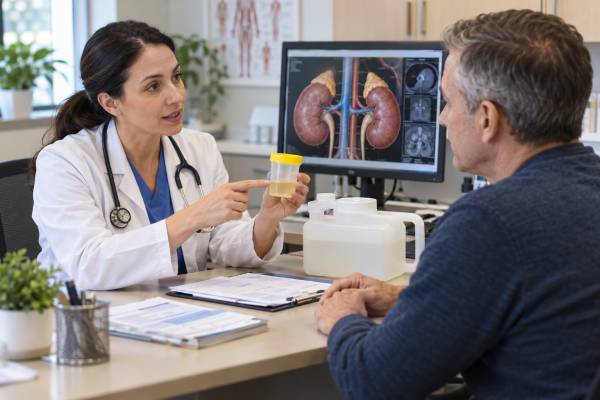
A urine metanephrines test measures breakdown products of the stress hormones epinephrine and norepinephrine, usually in a 24-hour urine collection. It is one of the recommended first-line biochemical tests for pheochromocytoma and paraganglioma (PPGL), rare neuroendocrine tumors that can produce catecholamines. The two main measurements are metanephrine and normetanephrine; some laboratories also report total metanephrines or methoxytyramine.
High urine metanephrines do not automatically mean an adrenal tumor is present. Stress, illness, strenuous activity, caffeine, nicotine, certain medications, collection errors, and differences in laboratory methods can cause mild elevations. Results several times above the upper reference limit are generally more concerning than borderline elevations. Because reference ranges differ by laboratory, age, assay, and collection method, the result should be interpreted against the range printed on the report. When biochemical evidence is convincing, clinicians usually proceed to imaging and, after diagnosis, consider genetic evaluation.
- What it measures: metanephrine and normetanephrine, continuously produced metabolites of epinephrine and norepinephrine.
- Main purpose: to detect biochemical evidence of pheochromocytoma or paraganglioma before tumor-localizing imaging.
- Borderline high result: often needs review of medications, collection quality, stress, illness, and repeat or complementary testing.
- Marked elevation: levels more than about 2–3 times the upper limit are more suspicious for PPGL, especially with compatible symptoms or an adrenal mass.
- Collection: a complete 24-hour urine sample is essential; missed urine or incorrect timing can make the result unreliable.
Table of Contents
- What metanephrines are
- Why urine metanephrines are ordered
- How to collect a 24-hour urine sample
- What high urine metanephrines mean
- Causes of false-positive results
- Urine versus plasma metanephrines
- What happens after an abnormal result
What metanephrines are
The adrenal medulla and sympathetic nervous system produce catecholamines—mainly epinephrine, norepinephrine, and dopamine. These chemicals help control blood pressure, heart rate, blood flow, and the body’s response to stress. Enzymes continuously break catecholamines down into metabolites.
Metanephrine is produced mainly from epinephrine, while normetanephrine is produced mainly from norepinephrine. Dopamine can be metabolized to 3-methoxytyramine, which is useful in selected PPGL settings. Because pheochromocytomas and sympathetic paragangliomas can continuously produce metanephrines inside tumor cells even when catecholamine release is episodic, metanephrines are generally more sensitive markers than measuring catecholamines alone.
That is why modern biochemical evaluation favors plasma free metanephrines or urinary fractionated metanephrines. A separate urine catecholamines test can provide additional information, but normal catecholamines do not exclude a tumor that is better detected through its metabolites.
Pheochromocytoma refers to a catecholamine-producing tumor arising in the adrenal medulla. A paraganglioma arises from related paraganglionic tissue outside the adrenal gland. Some head and neck paragangliomas are predominantly nonsecretory, while sympathetic paragangliomas in the chest, abdomen, or pelvis are more likely to produce catecholamines.
The urine test does not locate a tumor and does not determine whether it is benign or metastatic. It answers a biochemical question: Is there evidence of abnormal catecholamine metabolism strong enough to justify further investigation?
Why urine metanephrines are ordered
Clinicians order metanephrine testing when symptoms, imaging, family history, or a genetic syndrome raises the possibility of PPGL. The tumors are uncommon, so pretest probability matters. Testing everyone with common symptoms such as anxiety or occasional palpitations would generate many more false positives than true diagnoses.
Common reasons to test include:
- an adrenal mass with imaging features that could represent pheochromocytoma;
- spells of headache, sweating, palpitations, tremor, or marked blood-pressure elevation;
- resistant or highly variable hypertension, especially when accompanied by characteristic attacks;
- a previous pheochromocytoma or paraganglioma requiring surveillance;
- a family history or germline variant associated with PPGL, such as variants involving SDHx genes, VHL, RET, NF1, or TMEM127;
- certain tumors or clinical patterns that suggest an inherited PPGL syndrome.
The classic triad of headache, sweating, and palpitations is helpful when present but is not required. Some tumors are discovered incidentally on CT or MRI, and some patients have few symptoms. Conversely, panic attacks, sleep apnea, pain, medications, withdrawal states, and many common illnesses can mimic catecholamine excess.
A metanephrine test is therefore most useful when the clinical question is specific. If a person already has an adrenal mass, biochemical testing is generally performed before biopsy or surgery when pheochromocytoma is possible, because manipulating an unrecognized catecholamine-producing tumor can provoke dangerous blood-pressure and heart-rate changes.
How to collect a 24-hour urine sample
Accuracy depends on collecting every urine void during the designated 24-hour period. Laboratories may provide a large container, sometimes with preservative, plus specific storage instructions. Follow those directions rather than assuming every collection kit is handled the same way.
A typical collection works like this:
- Choose a day when you can reliably collect all urine for 24 hours.
- On the starting morning, urinate into the toilet and record that time. This empties the bladder and starts the clock.
- Collect every subsequent urination in the provided container or transfer vessel for the next 24 hours.
- At exactly the same time the next morning, urinate one final time and add that urine to the collection.
- Store and transport the container exactly as instructed by the laboratory.
If a substantial urine void is missed, spilled, or accidentally discarded, contact the laboratory. Starting over is often more reliable than submitting an incomplete sample. Some laboratories measure 24-hour urine creatinine to help judge whether the collection is plausible, but creatinine cannot identify every collection error.
Preparation before and during collection
The ordering clinician should review prescription drugs, over-the-counter medicines, supplements, nicotine, caffeine, alcohol, and recreational stimulants. Drugs that raise norepinephrine or interfere analytically can increase results. Examples can include tricyclic antidepressants, some serotonin-norepinephrine reuptake inhibitors, monoamine oxidase inhibitors, sympathomimetic decongestants, amphetamines, levodopa, and certain method-specific laboratory interferences.
Do not stop a prescribed medicine on your own. The risk of stopping treatment may be greater than the benefit of a cleaner test. The clinician and laboratory can decide whether a medication should be continued, temporarily withheld, or simply documented when interpreting the result.
Strenuous exercise, acute pain, severe stress, sleep deprivation, hypoglycemia, and acute illness can stimulate sympathetic activity. When the clinical situation allows, testing under stable conditions improves interpretability. Laboratories may also give specific instructions about caffeine, nicotine, foods, or supplements based on their analytical method.
If part of a 24-hour collection is missed, the total may be unreliable even when the laboratory can still run the assay. Patients should report collection problems instead of estimating the missing volume. Recollection under correct conditions is often more useful than overinterpreting a questionable number.
What high urine metanephrines mean
Interpretation begins by comparing each analyte with its own laboratory upper reference limit. There is no single universal “normal urine metanephrine level” that applies to every assay, because laboratories use different instruments, units, reference populations, and age adjustments.
A marked elevation is more concerning than a mild one. In clinical practice, metanephrine or normetanephrine results above roughly 2–3 times the upper limit of normal are much harder to explain by ordinary biological variation, especially when the pattern matches a suspicious adrenal mass or classic symptoms. Very large elevations can make PPGL highly likely, although the final diagnosis still requires a complete evaluation.
A borderline elevation, such as a result just above the reference limit, is a different problem. Mild increases are common and may reflect sympathetic activation, medication effects, sleep apnea, renal or acute illness, or suboptimal collection conditions. Rather than immediately ordering extensive imaging, clinicians often verify the result under better-controlled conditions or use plasma free metanephrines as a complementary test.
The pattern can also provide clues. Predominant metanephrine elevation suggests epinephrine production, while predominant normetanephrine elevation suggests norepinephrine production. Certain hereditary tumor groups have characteristic biochemical patterns, but the pattern alone does not identify a specific gene or tumor location.
A normal result substantially lowers the likelihood of a secreting PPGL when testing is performed correctly. However, very small tumors, some dopamine-producing tumors, and many head-and-neck paragangliomas may not produce the usual metanephrine pattern. Clinical suspicion can therefore justify specialized testing despite a normal standard panel.
How the clinical setting changes interpretation
The same laboratory elevation can mean very different things in different patients. Suppose a person has a 3-cm adrenal mass with imaging features that are not clearly benign and a normetanephrine level three times the upper reference limit. That combination creates a much higher probability of PPGL than the same biochemical result obtained during an emergency hospitalization for severe pain, sepsis, and multiple sympathomimetic medications.
Pretest probability also explains why clinicians often repeat borderline results instead of immediately ordering nuclear medicine scans. When PPGL is uncommon in the tested population, even a highly sensitive assay can generate many false positives if sampling conditions are poor. Repeating under stable conditions improves the chance that an abnormal result represents tumor biology rather than transient sympathetic activation.
The opposite mistake is dismissing a modest abnormality in someone with strong hereditary risk. People with pathogenic variants in PPGL susceptibility genes may be screened when tumors are still small and minimally symptomatic. In that setting, even a less dramatic biochemical change may deserve specialist review and comparison with previous values.
Common collection mistakes that can distort a 24-hour result
A timed urine test is only as good as the collection. Frequent problems include starting the clock after already saving the first urine, forgetting a void during work or sleep, adding an extra morning sample after the 24-hour end time, failing to keep the container under the required storage conditions, or transferring only part of the total urine to the laboratory. These errors can make an apparently high or low excretion value difficult to trust.
Urine volume by itself does not tell whether the collection is complete. Someone who drinks heavily may produce several liters, while another person may produce much less. Laboratories sometimes use total creatinine excretion as a reasonableness check, but age, sex, body size, and muscle mass affect creatinine, so it is not a perfect validator. If the collection was clearly incomplete, the safest interpretation is usually that the test needs to be repeated.
Causes of false-positive results
False positives are common because catecholamine metabolism responds to normal physiology as well as tumors. The key is to separate analytical interference from true biological elevation caused by sympathetic activation.
Potential contributors include:
- acute illness, pain, or hospitalization;
- vigorous physical activity;
- severe emotional stress;
- obstructive sleep apnea;
- nicotine and stimulant use;
- caffeine in susceptible patients or under certain laboratory protocols;
- medications that increase norepinephrine signaling or block catecholamine metabolism;
- withdrawal from alcohol, clonidine, benzodiazepines, or other sedating drugs;
- incomplete or overlong urine collection;
- laboratory-specific analytical interference.
Kidney function also matters. Urine-based measurements depend on renal excretion and a complete timed collection. In advanced kidney failure, plasma testing with appropriate methodology may be preferred because urine results are harder to interpret.
The magnitude of the result often guides how aggressively clinicians search for a false-positive explanation. A value 10% above the upper limit during an acute illness is very different from a value five times the upper limit in a stable patient with an adrenal mass. Repeating a borderline result after correcting avoidable factors can prevent unnecessary imaging and anxiety.
Urine versus plasma metanephrines
Both 24-hour urinary fractionated metanephrines and plasma free metanephrines are accepted first-line biochemical tests. The best choice depends on the patient, laboratory expertise, and how well preanalytical conditions can be controlled.
Plasma testing is highly sensitive but requires careful collection. For maximum specificity, many expert protocols use fasting blood drawn after the patient has rested supine for about 20–30 minutes. Blood drawn immediately after walking into a clinic or while seated can increase normetanephrine and create false positives.
A 24-hour urine collection integrates secretion over a full day and avoids the need for a carefully timed resting blood draw. Its major weakness is collection error. It can also be inconvenient, particularly for people who work away from home, have urinary incontinence, or cannot reliably capture every void.
Urinary metanephrines are generally preferred over relying on urinary epinephrine and norepinephrine alone because catecholamine secretion can occur in bursts. Other neuroendocrine markers, such as chromogranin A, are less specific and are not a substitute for properly collected metanephrines when PPGL is suspected.
| Test | Main advantage | Main limitation |
|---|---|---|
| 24-hour urine fractionated metanephrines | Integrates production over a full day | Requires complete timed collection |
| Plasma free metanephrines | Very high sensitivity with controlled sampling | Posture, rest, stress, and collection conditions strongly affect specificity |
| Urine catecholamines | Shows parent hormone excretion | Less sensitive because secretion can be episodic |
What happens after an abnormal result
The next step depends mainly on the degree of elevation and the pretest probability of PPGL.
For a borderline result, the clinician may review medications and collection quality, treat or stabilize an acute illness, address sleep apnea or other sympathetic triggers, and repeat testing. A carefully collected plasma metanephrine test can sometimes clarify an ambiguous urine result. In selected patients with persistent isolated borderline normetanephrine elevation, endocrinologists may use specialized testing such as a clonidine suppression test.
For clearly elevated results, imaging usually follows biochemical confirmation. CT or MRI of the abdomen and pelvis is commonly used first to locate an adrenal or extra-adrenal tumor. Functional imaging may be added for hereditary disease, large or multifocal tumors, suspected metastases, or specific biochemical/genetic patterns.
Imaging is usually not the first step when the only clue is a mildly abnormal metanephrine result. Incidental adrenal nodules are common, and scanning before establishing biochemical likelihood can uncover unrelated findings that complicate the workup. The usual sequence—biochemistry first, then localization when warranted—helps keep the evaluation focused. An important exception is a patient who already has imaging because an adrenal mass was found incidentally; in that case the scan has already happened, but metanephrine testing is still used to determine whether the mass is functioning before invasive procedures or surgery are considered. This matters because the biochemical diagnosis changes perioperative preparation and can prevent dangerous catecholamine surges during tumor manipulation.
A confirmed PPGL should prompt discussion of genetic counseling and testing because a substantial proportion of these tumors are associated with inherited susceptibility. Genetics can affect the search for additional tumors, type of imaging, follow-up duration, and screening recommendations for relatives.
If surgery is planned for a catecholamine-secreting tumor, preoperative management is specialized. Patients usually require alpha-adrenergic blockade and careful fluid and salt management under expert supervision. A suspected pheochromocytoma should never be treated as an ordinary adrenal lump without biochemical assessment.
Seek urgent medical care for severe persistent chest pain, fainting, neurologic symptoms, or extremely high blood pressure with symptoms such as severe headache, confusion, shortness of breath, or weakness. These can represent a hypertensive emergency and should not wait for outpatient tumor-marker interpretation.
Borderline elevations deserve proportionate follow-up rather than immediate assumptions about a tumor. When the increase is small, clinicians often review medication exposure, acute illness, sleep and stress conditions, and collection accuracy before choosing the next test. Repeating metanephrines under better-controlled conditions can clarify whether the abnormality is persistent. Marked, reproducible elevations in a compatible clinical setting generally carry more weight than a single marginal result.
References
- Catecholamines and Metanephrines: Quantification in the Diagnosis of Pheochromocytoma and Paraganglioma, Considerations and Critical Issues 2026 (Review)
- Biochemical diagnosis of pheochromocytoma and paraganglioma: analytical challenges and perspectives for optimization 2026 (Review)
- Diagnosis and Management of Pheochromocytomas and Paragangliomas: A Guide for the Clinician 2023 (Review)
- Biochemical Assessment of Pheochromocytoma and Paraganglioma. 2023 (Review)
- A Laboratory Medicine Perspective on the Investigation of Phaeochromocytoma and Paraganglioma 2023 (Review)
- Update on the diagnosis of the pheochromocytoma. 2025 (Review)
Disclaimer
This article is for general education and does not replace evaluation by an endocrinologist or other qualified clinician. Urine metanephrine reference ranges and medication effects vary by laboratory, and abnormal results require individualized interpretation. Do not stop prescription medicines before testing unless the clinician who manages them advises you to do so.