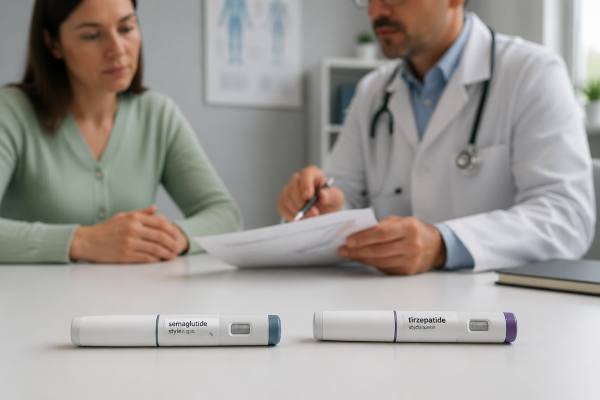
For most adults comparing the standard weekly injectable versions, Zepbound currently looks better for average weight loss. Wegovy is still a strong option, but the newest head-to-head evidence favors tirzepatide over semaglutide for pounds lost and waist reduction over time. That does not automatically make Zepbound the better choice for every person. Coverage, side effects, dose tolerance, supply, and what happens after the first plateau can matter just as much as the headline number.
This article compares Wegovy and Zepbound in the ways that actually affect real treatment decisions: how the drugs differ, how much weight people tend to lose, what side effects are most likely, how current manufacturer savings and insurance rules can change the math, and which option may fit better if your goal is not just losing weight fast, but keeping progress going once the easy early losses are over.
Table of Contents
- Key differences at a glance
- Which one leads to more weight loss
- Dosing and how the drugs actually differ
- Side effects and safety trade-offs
- Cost, insurance and current offers
- Who may do better with each option
- Plateaus, regain and long-term planning
Key differences at a glance
Wegovy and Zepbound are both once-weekly prescription injections used for chronic weight management, but they are not the same type of medicine with different labels attached. Wegovy uses semaglutide, a GLP-1 receptor agonist. Zepbound uses tirzepatide, which acts on both GIP and GLP-1 pathways. That dual-action difference is one major reason many clinicians and patients now expect stronger average weight loss from Zepbound.
When people compare them casually, they often focus on the brand names or the milligram numbers. That can be misleading. A 15 mg tirzepatide dose is not “stronger” than 2.4 mg semaglutide just because the number is bigger. These are different molecules with different dosing systems, different trial programs, and different response patterns.
A quick side-by-side view helps clarify the decision:
| Feature | Wegovy | Zepbound |
|---|---|---|
| Active ingredient | Semaglutide | Tirzepatide |
| Drug type | GLP-1 receptor agonist | GIP and GLP-1 receptor agonist |
| How it is taken | Once-weekly injection | Once-weekly injection |
| Typical efficacy reputation | Strong weight-loss option | Currently stronger average weight-loss option |
| Common reason people choose it | Semaglutide familiarity, plan access, comfort with the brand | Greater expected average weight loss |
| Common reason people avoid it | Less total average loss than tirzepatide | Coverage barriers, higher self-pay costs at many doses, side-effect concerns |
That table gives the short version, but the real answer depends on what “better” means in your situation. If better means the best chance of losing more body weight, Zepbound has the edge. If better means the option you can actually get covered, tolerate, and continue long enough to matter, the answer may be different.
This is also why brand-vs-brand articles can create false certainty. A person with excellent Zepbound coverage, good tolerance, and a strong plateau history is in a different position from someone whose insurer prefers semaglutide, whose stomach is sensitive, or whose treatment is likely to stop after a few months. The better drug on paper is not always the better drug in practice.
For readers who want broader context around how these treatments fit into the market, it helps to understand GLP-1 medications for weight loss and how tirzepatide fits within the larger picture in this guide to tirzepatide for weight loss.
Which one leads to more weight loss
If the question is purely about average weight loss, Zepbound currently wins.
That conclusion comes from two kinds of evidence. First, the major placebo-controlled trials for each drug show that tirzepatide tends to produce larger average losses than semaglutide. Second, there is now direct head-to-head evidence, which is more useful than trying to compare separate studies as if they were identical.
In the pivotal semaglutide obesity trial, adults without diabetes lost about 14.9 percent of body weight on average over 68 weeks. In the pivotal tirzepatide obesity trial, average losses were roughly 15 percent, 19.5 percent, and 20.9 percent at the 5 mg, 10 mg, and 15 mg doses over 72 weeks. Those are not perfect apples-to-apples comparisons because trial populations and designs differ, but they already pointed toward tirzepatide being the more potent option.
The clearer comparison came later. In the head-to-head SURMOUNT-5 trial, tirzepatide beat semaglutide on average percentage weight loss and waist reduction at 72 weeks. The average reduction was about 20.2 percent with tirzepatide versus 13.7 percent with semaglutide. Participants on tirzepatide were also more likely to hit 10 percent, 15 percent, 20 percent, and 25 percent weight-loss thresholds.
That does not mean every person on Zepbound will outperform every person on Wegovy. Real treatment outcomes vary for several reasons:
- Some people never reach the top dose because of side effects.
- Some people respond unusually well to semaglutide.
- Some people do better on the drug they can stay on more consistently.
- Eating patterns, protein intake, sleep, activity, and dose interruptions still matter.
Even so, the average gap is large enough to influence how most clinicians think. If a patient has a substantial amount of weight to lose, a history of repeated stalls, or wants the strongest current branded weekly injectable option for obesity, Zepbound is usually the front-runner.
There is one important nuance, though. Faster or larger loss is not automatically better if it leads to a harder time eating enough protein, managing nausea, keeping up with resistance training, or maintaining results later. Some people lose weight more aggressively on tirzepatide and then struggle with under-eating, fatigue, constipation, or rebound hunger when treatment changes. So the strongest weight-loss drug is not always the smoothest long-term journey.
This is where expectations matter. People often judge a medication by the first month or two, when titration, water shifts, and appetite changes can distort the picture. A better way to think about it is whether the drug is creating a sustainable trend and whether that trend is likely to continue once the easy early momentum slows.
For average efficacy, Zepbound currently leads. For real-life success, that lead still has to survive cost, tolerance, and time.
Dosing and how the drugs actually differ
Wegovy and Zepbound are both weekly injections, so this comparison is not like Saxenda versus Wegovy, where one drug clearly wins on convenience. Here, the weekly schedule is similar. The more meaningful difference is how the drugs are built and how dose escalation feels over time.
Wegovy is titrated gradually from a low starting dose toward a maintenance dose, usually through monthly step-ups. Zepbound follows a similar gradual approach, but its dose ladder extends through more strength levels. In both cases, the slow build is there for a reason: it gives the body time to adapt and reduces the chance that side effects become overwhelming.
A few practical points matter here:
- Do not compare milligrams directly.
The numbers are not interchangeable across these drugs. - The best dose is not always the highest dose.
Some people get good results before the top dose. Others need the highest tolerated dose to see meaningful loss. - Tolerance can matter more than theoretical potency.
A person who can stay on a workable semaglutide dose may do better than someone who keeps stopping and restarting tirzepatide.
This is why real-world adherence is tied to dose strategy, not just drug choice. People often assume the stronger drug will simply dominate. But if the stronger drug causes repeated pauses, skipped injections, or a reluctance to escalate, the expected advantage can shrink.
Another overlooked issue is missed doses. Weekly medications sound simple until travel, illness, work stress, or prescription delays interrupt the rhythm. That is when clear rules become important. If missed doses are likely to be a problem in your life, it is worth reading about what to do after a missed dose of Wegovy or Zepbound and how dose escalation normally works in a weight loss medication dosing schedule.
The more interesting clinical difference is how patients experience appetite change. Semaglutide often feels like a strong reduction in hunger and slower eating. Tirzepatide can produce that too, but some people describe it as a stronger shift in fullness, food interest, and portion tolerance. That can be helpful, but it can also backfire if someone is not prepared to change meal size, hydration, and food composition.
So while both drugs are weekly, they do not always feel the same in daily life. One person may experience Wegovy as steady and manageable. Another may feel Zepbound shuts down food noise more effectively. Another may find the opposite. That is why the dosing section matters even though the calendar schedule looks similar. What you need to tolerate is not just the injection frequency. It is the biological effect that follows.
Side effects and safety trade-offs
Wegovy and Zepbound share many of the same side effects because both affect appetite, gastric emptying, and gut signaling. The most common problems are nausea, vomiting, diarrhea, constipation, reflux, bloating, early fullness, and stomach discomfort. Most of these issues are worst during dose escalation and often improve with time, smaller meals, and better eating habits.
The main difference is not that one drug has gentle side effects and the other has severe ones. It is that Zepbound’s stronger average weight-loss effect can come with a stronger physiologic push in some people. For certain patients, that is exactly why it works better. For others, it is why the first few months feel harder.
In real life, side effects are shaped by behavior as much as by the drug itself. People tend to struggle more when they:
- keep eating large meals,
- eat quickly and push past fullness,
- rely on greasy or very rich foods,
- under-hydrate,
- or fail to adjust protein and fiber intake as appetite changes.
That is why side-effect management is often less about “toughing it out” and more about learning how to eat differently on the medication. If nausea becomes a barrier, this guide to managing nausea on GLP-1 medications is often more useful than generic advice to just wait for it to pass.
Both drugs also carry broader safety considerations that should not be treated lightly. These include warnings around pancreatitis, gallbladder issues, dehydration, and serious gastrointestinal problems. There are also boxed warnings related to thyroid C-cell tumor risk in people with certain personal or family histories. If a person already has significant reflux, symptoms of delayed stomach emptying, a history of gallbladder trouble, or extreme sensitivity to GI side effects, those details can change which drug is more realistic.
Another practical point is that side effects influence maintenance just as much as initiation. People sometimes think of nausea and constipation as “starter problems,” but milder versions of these issues can quietly shape long-term adherence. Someone who is chronically under-eating, dreading meals, or living with ongoing constipation may stay technically on the drug while slowly becoming less consistent with exercise, hydration, and follow-up. Over time, that can undermine results.
Gallbladder risk is another concern that deserves attention rather than panic. Rapid weight loss itself can increase gallstone risk, and GLP-1-based therapies add another layer of caution. That is one reason it helps to understand GLP-1 side effects and gallbladder risk before assuming any upper abdominal symptoms are minor.
If side effects are the main deciding factor, there is no universal winner. Some people tolerate Wegovy more comfortably. Others tolerate Zepbound surprisingly well. The better approach is to ask which drug gives you the best balance between weight-loss benefit and a side-effect burden you can realistically manage for months, not just weeks.
Cost, insurance and current offers
Cost is where neat comparisons fall apart. There is no single honest answer to “Which is cheaper?” because what people actually pay is shaped by coverage, prior authorization, employer exclusions, pharmacy routing, and manufacturer savings terms that can change over time.
At the insurance level, the most important question is not the sticker price. It is whether your plan covers anti-obesity medication at all, and if it does, which brand it prefers. A patient can be quoted a low monthly amount for one drug and full self-pay pricing for the other even when both are medically reasonable. That is why a lot of frustration starts before anyone checks the formulary.
As current manufacturer offers stand, the self-pay structures are different enough that a direct comparison can be confusing:
| Cost issue | Wegovy | Zepbound |
|---|---|---|
| Commercial insurance offer | Can be as low as $25 per month for eligible patients | Can be as low as $25 for eligible patients with qualifying coverage |
| Self-pay entry pricing | Current pen offers start lower at introductory doses | Current self-pay starts higher than Wegovy’s starter promotional offer |
| Higher-dose self-pay pattern | Current pen pricing is more compressed under the present offer | Pricing rises by dose tier, with higher doses carrying higher self-pay amounts |
| What most changes the real cost | Coverage rules and prior authorization | Coverage rules and prior authorization |
In other words, Wegovy may look cheaper on a starter-dose self-pay promotion, while Zepbound may still be the better value if it produces more weight loss for the money and can actually be continued. Or the reverse may be true if one plan covers semaglutide much more generously than tirzepatide.
This is why it is worth checking four things before committing emotionally to either option:
- whether the plan covers anti-obesity medications,
- whether prior authorization is required,
- whether one brand is preferred,
- and what the current cash or self-pay path looks like if coverage fails.
Many people lose weeks by assuming their doctor’s prescription is the main hurdle, when the real hurdle is the insurer’s process. A more efficient approach is to review insurance coverage for weight loss medications and understand how prior authorization for weight loss medications can change approval odds before the prescription is sent.
There is also a long-term cost question that matters more than the first fill. A treatment is only affordable if you can keep getting it. A low promotional price for month one is helpful, but not if month three becomes unrealistic or the insurer stops covering the drug because documentation is thin. Cost, in practical terms, includes continuity.
If you are paying cash, Zepbound often asks more from the budget at many dose levels. If you are comparing average weight loss rather than just entry price, some people still decide that the extra cost is worth it. Whether that is rational depends on your budget, your expected duration of therapy, and how much difference an extra several percentage points of body-weight loss is likely to make in your life and health.
Who may do better with each option
For many adults with obesity or overweight plus weight-related complications, Zepbound is the better fit when the goal is the strongest current branded weekly injectable option for weight loss. That is especially true for people who have more weight to lose, want a higher probability of reaching larger percentage-loss milestones, or have already spent time on less effective approaches.
Zepbound may be the stronger fit for people who:
- want the highest average weight-loss potential between these two drugs,
- are comfortable titrating toward a more potent treatment,
- have struggled with repeated plateaus,
- or are willing to pay more out of pocket if the extra efficacy seems worth it.
Wegovy may still be the better fit for people who:
- have better insurance access to semaglutide,
- want a well-established semaglutide option they and their clinician know well,
- have responded well to semaglutide before,
- or prefer not to switch when steady progress is already happening.
This is where treatment comparisons become more human and less mathematical. A person who loses 12 to 14 percent on Wegovy, tolerates it well, can afford it, and keeps it going for a year may do better overall than someone who starts Zepbound, loses quickly, then stops because of cost or inconsistency. The better medication is not always the one with the highest trial average. It is the one that fits your real life closely enough to stay useful.
The reverse is also common. Someone spends months on semaglutide, loses some weight, but never gets far past the first wave of progress. Hunger starts to creep back, plateaus become more frequent, and the patient keeps feeling like they are working hard for only modest movement. That is often the person who asks whether switching to tirzepatide could be worth it. In those cases, the answer is often yes, but it should be done carefully and with realistic expectations. This guide to switching weight loss medications safely is useful if treatment is being changed rather than started.
Another overlooked factor is mindset. Some people do best on the treatment that quiets food noise more strongly and creates clear momentum. Others need the drug that feels more sustainable and less disruptive to daily life. Those are not superficial preferences. They are adherence factors.
If you want the shortest practical answer, it is this: Zepbound is better for average weight-loss performance. Wegovy can still be better for access, tolerance, or overall fit. And if you are still deciding whether medication is the right tool at all, a broader look at how weight loss medications work can help you compare these drugs with the rest of the treatment landscape.
Plateaus, regain and long-term planning
The most useful way to compare Wegovy and Zepbound is not just to ask which one starts stronger. It is to ask which one gives you the best odds of still doing well after the first plateau.
Both drugs can create impressive early progress because they reduce appetite, improve fullness, and help people maintain a calorie deficit more consistently. But neither removes the biology of adaptation. As body weight falls, energy needs drop, hunger often rises, and the same dose may no longer feel as powerful as it did during the first few months. That slowdown is normal. It does not automatically mean the medication stopped working.
This is where many treatment decisions go wrong. People assume that a slower scale after several months means failure. Then they jump doses too quickly, stop too abruptly, or chase another drug without fixing the issues that actually eroded progress. Sometimes the problem is the medication. Just as often, it is a shrinking deficit, lower daily movement, more restaurant meals, poorer sleep, or quiet calorie drift on weekends.
The more potent average effect of Zepbound can help some people push farther before a plateau becomes obvious. But it does not make plateaus disappear. In fact, aggressive early progress can create a false sense that the medication will keep pulling weight down at the same rate indefinitely. It will not.
That is why long-term planning matters from day one. The patients who usually do best are the ones who treat medication as part of a system:
- protein intake stays deliberate even when appetite is low,
- activity and resistance training continue,
- dose interruptions are minimized,
- follow-up is regular,
- and the goal shifts from chasing weekly drops to protecting a sustainable trend.
This becomes even more important if treatment stops. Appetite rebound after discontinuation can be stronger than people expect, especially when they have gotten used to quieter hunger signals. That is where many regain stories begin. A useful place to troubleshoot a slowdown is this guide to a weight loss plateau on GLP-1 medications, and if treatment is being stopped or coverage is lost, this article on weight regain after stopping GLP-1 medications helps frame the next step more realistically.
So which is better in the long run? For most people starting from scratch, Zepbound currently offers the stronger average ceiling. But the long-run winner is still the drug you can stay on, support with good habits, and transition away from without losing all of the ground you fought to gain. That is why the right choice is never just about the first 20 pounds. It is about what happens after them.
References
- Tirzepatide as Compared with Semaglutide for the Treatment of Obesity 2025 (RCT)
- Once-Weekly Semaglutide in Adults with Overweight or Obesity 2021 (RCT)
- Tirzepatide Once Weekly for the Treatment of Obesity 2022 (RCT)
- Wegovy® Cost & Coverage Information | Wegovy® (semaglutide) 2026
- Savings Options | Zepbound® (tirzepatide) 2026
Disclaimer
This article is for general educational purposes only. Wegovy and Zepbound are prescription medications with individualized risks, contraindications, and coverage rules, so this information should not replace advice, diagnosis, or treatment from your clinician or pharmacist.
If this article helped you compare your options, please share it on Facebook, X, or any other platform where it may help someone else make a better-informed decision.