Xanthium strumarium, often called common cocklebur, is one of those herbs that deserves both respect and caution. In traditional medicine, especially East Asian practice, its processed fruit has long been used for stubborn nasal congestion, sinus discomfort, headache, and certain inflammatory complaints. Modern research has added interest in its sesquiterpene lactones, phenolic acids, and other compounds that may influence inflammation, oxidation, microbial activity, and platelet signaling. At the same time, this is not a gentle kitchen herb. Raw plant material, especially seeds and seedlings, can be toxic, and even medicinal use is best approached conservatively.
What makes Xanthium especially interesting is this tension between promise and risk. It offers a real history of use and some encouraging laboratory findings, but human evidence is still limited and product quality matters greatly. A helpful guide, then, has to do two things at once: explain why people use it, and show where the safety boundaries are. That is the approach here.
Key Insights
- May support nasal congestion and allergic-rhinitis symptoms, especially when used in traditional multi-herb formulas.
- Shows anti-inflammatory activity in laboratory and animal studies, but standalone human evidence remains limited.
- Traditional adult use is often 3 to 10 g per day of processed dried fruit in decoction form.
- Avoid during pregnancy or breastfeeding, in children, and in people with liver disease or a history of strong plant allergies.
Table of Contents
- What is Xanthium strumarium?
- Key ingredients and medicinal properties
- Potential health benefits and what the evidence shows
- Traditional and modern uses of Xanthium strumarium
- Forms, preparation, and how to use it
- Dosage, timing, and duration
- Xanthium strumarium safety, side effects, and interactions
What is Xanthium strumarium?
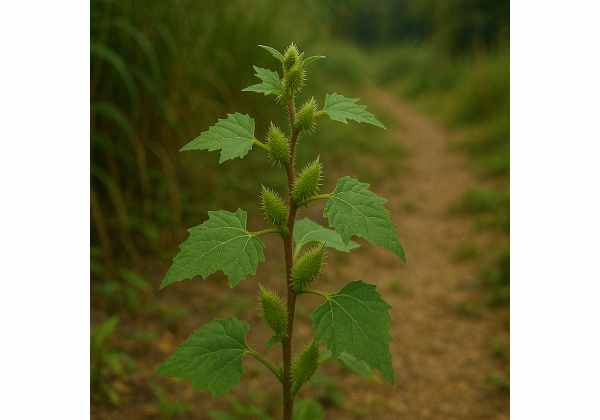
Xanthium strumarium is an annual herb in the Asteraceae family, the same broad botanical family that includes many medicinal plants and weeds. It is easy to recognize once it fruits: the plant produces oval, spiny burs that cling to clothing and animal fur. Those burs are part of why the plant spread so widely. In English, it is usually called common cocklebur. In traditional Chinese medicine, the processed medicinal fruit is known as cang er zi, though readers should know that classical and modern sources sometimes discuss closely related Xanthium species under overlapping names.
For health use, the important point is that the medicinal material is not simply “the whole weed.” Traditional practice centers on the dried, mature fruit, usually processed before use. That detail matters because raw plant material, especially seeds and young seedlings, has a much harsher safety profile than the prepared herb used in formal herbal systems. This is one reason casual self-harvesting is a poor idea.
Historically, Xanthium has been used most often for blocked nasal passages, sinus pressure, headache associated with congestion, and some rheumatic or inflammatory complaints. In older herbal traditions, it also appears in discussions of skin irritation, itching, and external discomfort. That broad use history helps explain why modern researchers became interested in it. Still, a long history of use is not the same as proof for every modern claim.
Another source of confusion is that people sometimes lump Xanthium together with other bitter or aromatic Asteraceae plants. That can lead to unsafe assumptions. For example, it is not interchangeable with sweet wormwood, and it should not be treated as a general-purpose “wild medicinal green.” Xanthium is better understood as a specialized traditional herb with a narrow practical lane and a relatively small margin for error.
So, what is it in plain terms? It is a traditionally valued but potentially toxic herb whose best-known role is short-term support for nasal and sinus complaints. That alone explains why it continues to appear in formulas, monographs, and modern pharmacology papers. It also explains why any serious discussion of benefits has to be paired with an equally serious discussion of safe preparation and use.
Key ingredients and medicinal properties
The medicinal profile of Xanthium strumarium comes from a mix of useful and potentially harmful compounds. That is not unusual in herbal medicine, but in Xanthium the contrast is especially sharp. Some constituents are the reason the plant attracts research interest; others are the reason clinicians and regulators treat it carefully.
A major group is sesquiterpene lactones, including compounds such as xanthatin and related molecules. These are often discussed for anti-inflammatory, analgesic, and cell-signaling effects. In laboratory work, some of them appear to influence inflammatory mediators, oxidative stress, and growth pathways. These compounds help explain why Xanthium is frequently described as having anti-inflammatory and biologically active properties rather than being merely aromatic or nutritive.
Another important group is phenolic acids, especially chlorogenic-acid-type and caffeoylquinic-acid derivatives. These compounds are commonly associated with antioxidant activity and may also contribute to the plant’s effects on inflammatory pathways. They are part of the reason researchers explore Xanthium in discussions of tissue irritation, allergic responses, and oxidative stress.
The plant also contains flavonoids and other polyphenols, which may support antioxidant and signaling effects. On paper, this gives Xanthium a respectable phytochemical profile. It is one reason reviews often describe broad medicinal properties that include anti-allergic, antimicrobial, and anti-inflammatory potential.
But the herb also contains toxic glycosides, especially atractyloside and carboxyatractyloside. These are the compounds that make safety such a central issue. They are linked to mitochondrial toxicity and are strongly associated with liver injury and poisoning in both animals and humans. Processing can reduce toxic content, which is one reason traditional practice favors stir-baked or otherwise prepared material instead of raw plant parts.
This dual chemistry is the best way to understand Xanthium’s medicinal properties:
- It has compounds that may calm inflammatory or allergic processes.
- It has compounds that may contribute to antioxidant and antimicrobial activity.
- It also has compounds that can damage cells and organs when the herb is misused, overused, or poorly prepared.
That makes Xanthium very different from a nutritive herb taken for daily wellness. It is closer to a targeted traditional remedy that demands correct form, correct dose, and good judgment. In that sense, its chemistry is a reminder that “natural” does not mean mild. Even among botanicals with active sesquiterpene lactones, Xanthium sits in a more guarded category than gentler roots or leaves such as burdock.
The bottom line is simple: Xanthium’s key ingredients give it legitimate pharmacological interest, but they also make safe preparation non-negotiable. Its medicinal value is real enough to study, yet its toxicology is real enough to respect.
Potential health benefits and what the evidence shows
The most honest way to discuss Xanthium strumarium benefits is to separate traditional use, preclinical findings, and human evidence. When all three are blurred together, the herb sounds stronger than the data really support.
The most plausible benefit area is nasal and sinus support, especially for allergic rhinitis patterns. In traditional practice, processed Xanthium fruit is a classic herb for “opening” the nose. That use is not random. Modern animal and mechanistic studies suggest anti-allergic and anti-inflammatory effects that could plausibly fit congestion, sneezing, nasal irritation, and mucus overproduction. Human evidence is more encouraging for Chinese herbal medicine formulas that include Xanthium than for Xanthium alone. In other words, the herb’s best-supported modern role is likely as one piece of a broader formula rather than as a standalone capsule.
A second potential benefit is anti-inflammatory and pain-relief support. Various extracts and isolated compounds have shown anti-inflammatory and antinociceptive activity in laboratory and animal studies. That does not prove it works like a standard pain medicine in humans, but it does support the idea that the plant has genuine biological effects beyond tradition. This may help explain why it has been used historically for headache, joint discomfort, and rheumatic complaints.
A third area is antioxidant and antimicrobial activity. Extracts have shown antioxidant, antibacterial, and antifungal actions in vitro. These findings are interesting, especially from a drug-discovery perspective, but they should not be translated into casual claims such as “Xanthium treats infections.” Lab inhibition of microbes is common in plant research; real-world clinical usefulness is a much higher bar.
More recently, researchers have explored antiplatelet and antithrombotic activity. This is a scientifically interesting direction, but it is still early. Experimental results do not mean people should use Xanthium for circulation, clotting prevention, or heart health on their own. In fact, that line of research increases the need for medication-interaction caution.
Some papers also discuss antitumor or cytotoxic effects. These are best understood as laboratory observations, not self-care guidance. Many plants can damage or suppress cell lines in a dish. That does not make them safe or effective anticancer remedies.
So what should a reader take away?
- The strongest traditional and modern signal points to nasal and sinus complaints, especially allergic-rhinitis-type symptoms.
- The best nontraditional evidence supports anti-inflammatory potential, but mostly in preclinical models.
- Claims about antimicrobial, antitumor, or circulation benefits are still exploratory, not practice-ready.
For readers comparing it with more familiar herbs for upper-airway comfort, Xanthium is much more specialized than peppermint. Peppermint is widely used for soothing comfort; Xanthium is a stronger, more technical herb with a tighter safety window.
That makes the herb neither useless nor miraculous. It simply means its benefits are most believable when framed narrowly, used traditionally, and matched to the evidence we actually have.
Traditional and modern uses of Xanthium strumarium
Traditional and modern uses of Xanthium overlap, but not perfectly. Historically, the herb has been valued most for the head and upper airways. If someone in a traditional setting complained of a blocked nose, thick discharge, sinus pressure, or headache linked to congestion, Xanthium fruit might enter the conversation quickly. In that sense, its most recognizable use has always been practical and symptom-focused.
The classic use is nasal obstruction. That includes chronic stuffiness, seasonal irritation, and sinus discomfort. In formal herbal systems, Xanthium is rarely used completely alone. It is more often paired with herbs chosen to disperse congestion, reduce irritation, or improve drainage. This matters because many of the better real-world outcomes attributed to Xanthium come from formulas, not isolated use.
A second traditional use is headache related to blocked passages. This is a narrower claim than simply saying “Xanthium helps headaches.” The traditional logic is that when sinus tension and obstruction drive head pain, a herb that helps open the passages may indirectly reduce the headache. That is a much more believable claim than treating it as a general pain herb for any kind of headache.
A third use is wind-damp or rheumatic discomfort, which in modern language loosely overlaps with stiffness, achiness, or inflammatory irritation. Here again, the herb’s preclinical anti-inflammatory profile gives some plausibility to old use, but modern human evidence remains sparse.
There are also older references to skin complaints, itching, and external irritation, though these uses are much less central in modern practical discussions. Given the plant’s toxicity and allergenic potential, external experimentation is not something most readers should attempt on their own.
In modern wellness culture, people sometimes stretch Xanthium far beyond its strongest lane. It gets promoted for immune health, antimicrobial cleansing, detoxification, and even broad chronic-disease prevention. That kind of expansion usually moves faster than the evidence. A better modern use framework would look like this:
- Short-term professional use for nasal and sinus complaints
- Formula-based use rather than improvised self-blending
- Cautious consideration in inflammatory patterns when a trained practitioner is involved
What it should not be used for casually:
- As a wild edible plant
- As a daily “tonic”
- As a self-prescribed liver or detox herb
- As a do-it-yourself antimicrobial or antiparasitic remedy
If someone wants a broader culinary herb or a more approachable digestive anti-inflammatory, options like ginger make much more sense for routine self-care. Xanthium belongs in a different category: less friendly, more targeted, and more dependent on preparation quality.
That is why its traditional uses still matter. They help define the boundaries of sensible use. The more closely modern use stays within those boundaries, the more credible and safer it tends to be.
Forms, preparation, and how to use it
The safest starting principle for Xanthium strumarium is this: form matters as much as dose. With many herbs, form changes convenience. With Xanthium, form changes safety.
The traditional medicinal form is the processed dried fruit, not raw seedlings, not casual seed use, and not freshly foraged burs used without training. Processing, especially heat treatment, is important because it can lower the content of some toxic glycosides. That is why quality herbal systems emphasize properly prepared medicinal material instead of raw plant parts.
The most traditional preparation is a decoction. In practical terms, that means simmering the processed herb in water rather than simply steeping it like a light tea. This is how many classical dosage ranges are framed. Decoction is also one reason dosage is often discussed in grams of crude herb, not only in milligrams of extract.
You may also encounter Xanthium as:
- powdered herb in capsules
- concentrated extracts
- multi-herb tablets or granules
- practitioner-dispensed formulas for rhinitis or sinus patterns
The challenge is that these forms are not interchangeable. A 500 mg extract can be far stronger than 500 mg of simple powdered herb, while two products labeled “Xanthium” may differ substantially in plant part, extraction ratio, and processing method. That is why labels that lack detail should be treated with caution.
A sensible use approach includes a few checks:
- Make sure the product specifies processed fruit or a comparable traditional medicinal material.
- Avoid products that look vague about source, plant part, or extraction.
- Prefer formula-based use when the goal is rhinitis or sinus support.
- Do not use self-harvested raw burs, seedlings, or seeds.
- Stop immediately if symptoms suggest intolerance or liver stress.
In everyday herbal practice, Xanthium is usually a short-course herb, not something taken indefinitely. Its role is more like targeted support during a specific symptom period than a daily foundational supplement.
Readers are often tempted to assume that a stronger extract is better. With this herb, that assumption can backfire. Because the active and toxic chemistry are both important, a more concentrated product is not automatically a smarter product. In many cases, a conservative, professionally guided preparation is the better choice.
The practical lesson is simple: if you decide to use Xanthium, choose the most transparent and traditionally grounded form available. Correct preparation is part of the medicine here, not a minor technical detail.
Dosage, timing, and duration
Dosage is where Xanthium strumarium should be handled with unusual discipline. There is no broadly accepted modern consumer dose the way there is for some mainstream supplements. Most meaningful dosage discussion still comes from traditional use, pharmacopoeial practice, and regulatory review rather than large modern clinical trials.
A commonly cited traditional adult range for the processed dried fruit is 3 to 10 g per day, usually in decoction form. A practical midpoint often discussed in traditional literature is around 5 g daily, though the exact amount depends on the formula, the person’s constitution, symptom pattern, and whether the herb is being used alone or in combination. For people using listed products, modern regulatory review in Australia also aligns with a maximum daily dose of 10 g for Xanthium species in appropriate processed form.
That does not mean everyone should start near the top of the range. A cautious approach is more sensible:
- Begin at the low end if you are new to the herb.
- Use only processed medicinal material.
- Follow the product label if using capsules or extracts, because extract strength varies.
- Do not try to “match” crude-herb gram doses to extract capsules unless the manufacturer clearly states the equivalence.
Timing also matters. Traditional use often places Xanthium within formulas taken once or twice daily, sometimes with meals if stomach sensitivity is a concern. If the aim is nasal or sinus support, consistency over several days tends to matter more than taking a large one-time dose.
Duration should be short and purposeful. For self-care, many readers would be wise to think in terms of days to a few weeks, not open-ended use. If a product or practitioner suggests longer use, that should come with a clear reason, monitoring, and confidence that the preparation is appropriate. A short trial also makes it easier to notice whether the herb is helping or causing problems.
A practical self-monitoring plan might include:
- Use one product only, not several formulas at once.
- Track the main symptom you want to improve, such as congestion or sinus pressure.
- Watch for digestive upset, unusual fatigue, rash, dizziness, or dark urine.
- Stop immediately if symptoms worsen or if new concerning symptoms appear.
A few dosage mistakes are worth avoiding:
- confusing raw plant material with processed medicinal material
- assuming “more” will clear symptoms faster
- combining multiple Xanthium-containing products
- continuing long term because the herb seems traditional and therefore harmless
With Xanthium, dosage is not just about effectiveness. It is part of the safety system. Staying within conservative, processed, label-supported use is what keeps the herb in the realm of rational herbal practice.
Xanthium strumarium safety, side effects, and interactions
Safety is the section that matters most with Xanthium strumarium. This herb has genuine traditional value, but it also has a documented toxicology record. That means the right question is not only “Can it help?” but also “When does it stop being reasonable to use?”
The most important risk is toxicity from raw or improperly prepared plant material, especially seeds and young seedlings. Poisoning has been reported in animals and in humans, with liver injury as a central concern. Severe cases have involved acute illness and, in rare reports, liver transplantation. This is why Xanthium should never be treated as a casual wild-food experiment or an improvised home remedy.
Potential side effects from medicinal use can include:
- nausea or stomach upset
- dizziness or headache
- rash or allergy symptoms
- unusual fatigue
- elevated liver stress in susceptible people
The people who should be most cautious, or usually avoid it altogether, include:
- pregnant or breastfeeding women
- children
- people with liver disease
- people with significant kidney disease
- anyone with a history of strong Asteraceae or pollen allergy
- people taking anticoagulant or antiplatelet medicines
- people already using other potentially hepatotoxic herbs or drugs
The interaction question is especially important. Because Xanthium has emerging antiplatelet activity in research, combining it casually with blood-thinning medication is unwise. Because liver toxicity is a known issue, combining it with alcohol-heavy routines, high-dose acetaminophen, or multiple liver-stressing supplements is also unwise.
The allergy point deserves a brief note too. Xanthium pollen and plant material have allergenic potential. That does not mean everyone with seasonal allergies will react to the herb, but it does mean there is enough overlap with plant sensitivity to justify extra caution.
Symptoms that should prompt immediate discontinuation and medical evaluation include:
- yellowing of the eyes or skin
- dark urine
- severe vomiting
- unusual sleepiness or confusion
- right-upper abdominal pain
- rapid worsening after ingesting raw plant material
For readers thinking, “Could I balance the risk by pairing it with a liver-support herb?” the honest answer is that this is not a do-it-yourself problem. While people often discuss gentler herbs such as milk thistle in liver-health conversations, acute or suspected Xanthium toxicity needs medical care, not supplement layering.
Taken together, the safety picture is clear. Properly processed Xanthium used conservatively is a very different thing from raw cocklebur exposure. The herb can still have a place in traditional or practitioner-guided care, but only when the preparation is correct, the duration is limited, and the user understands exactly who should stay away from it. With Xanthium, caution is not negativity. It is part of responsible use.
References
- Traditional Uses, Botany, Phytochemistry, Pharmacology, Pharmacokinetics and Toxicology of Xanthium strumarium L.: A Review – PMC 2019 (Review)
- Oral application of Chinese herbal medicine for allergic rhinitis: A systematic review and meta-analysis of randomized controlled trials – PMC 2021 (Systematic Review)
- Xanthium strumarium L. Exhibits Potent Antiplatelet and Antithrombotic Effects by Modulating MAPK and PI3K/AKT Signaling Pathways and Inhibiting Ferric Chloride-Induced Thrombosis – PubMed 2025 (Preclinical Study)
- Xanthium strumarium poisoning requiring liver transplantation – PubMed 2014 (Case Report)
- Final Decisions: Proposed low-negligible risk changes to the Permissible Ingredients Determination 2024-25 – V1.0 December 2024 2024 (Regulatory Guidance)
Disclaimer
This article is for educational purposes only and does not replace medical advice, diagnosis, or treatment. Xanthium strumarium is not a routine wellness herb and can be toxic if misidentified, improperly prepared, or used in excess. Do not use it to self-treat severe nasal disease, unexplained liver symptoms, poisoning, or any urgent condition. Pregnant or breastfeeding women, children, and people with liver disease, bleeding risk, or significant medication use should seek qualified medical advice before considering it.
If this guide was useful, please share it on Facebook, X, or any other platform you prefer so others can find balanced, safety-first information.