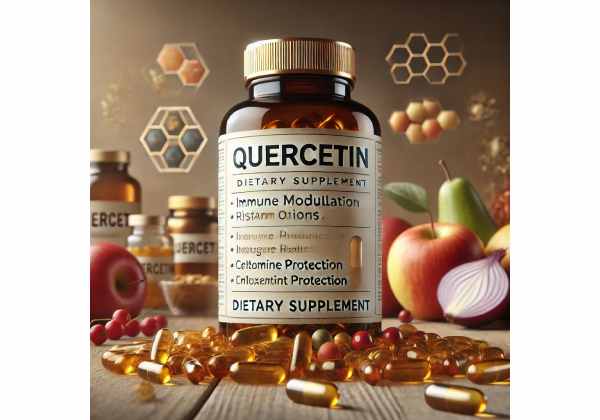
Quercetin is one of the most widely studied plant flavonoids, found naturally in foods such as onions, apples, berries, capers, and tea. It attracts so much attention because it sits at the crossroads of several brain-relevant processes: oxidative stress, inflammation, vascular health, and cellular signaling. Those are not abstract ideas. They shape how well the brain ages, how resilient it remains under stress, and how vulnerable it may be to cognitive decline over time.
That said, quercetin is easy to oversell. Laboratory research is impressive, and animal studies often look promising, but human outcomes are more uneven. The strongest case is not that quercetin is a fast-acting “brain booster.” It is that it may support a healthier internal environment for the brain, with some early clinical signals in cognitive aging and mood-related symptoms. This guide explains how quercetin works, what the research actually supports, who may benefit most, how absorption and dosing affect real-world results, and what safety issues matter before you try it.
Table of Contents
- Why quercetin matters for the brain
- What research says about cognition and mood
- Where quercetin may fit best
- Bioavailability forms and absorption
- Dosage timing and practical use
- Safety side effects and interactions
Quercetin’s appeal in brain health comes from a simple but important idea: the brain does not only suffer when neurotransmitters are off balance. It also struggles when inflammation, oxidative damage, mitochondrial stress, and vascular strain build up over time. Quercetin appears relevant to all four. That makes it interesting, but it also means its effects may be gradual, indirect, and highly dependent on the form used and the person taking it.
Why quercetin matters for the brain
Quercetin is a flavonol, a type of polyphenol found in many plant foods. It has become a major focus in neuroscience and nutrition research because it appears to influence several of the same processes that shape cognitive aging and mental resilience. In practical terms, quercetin is not mainly studied because it boosts one neurotransmitter or creates a stimulant-like effect. It is studied because it may help protect the brain from wear, stress, and inflammatory overload.
The brain is especially sensitive to oxidative stress. It uses a lot of oxygen, depends heavily on mitochondria, and contains lipid-rich tissues that can be damaged by oxidation. Quercetin’s antioxidant activity is part of what makes it appealing, but that is only the start. Researchers also focus on its anti-inflammatory effects, its ability to influence cellular stress pathways, and its possible support for vascular and metabolic function.
Based on preclinical research, quercetin may act through mechanisms such as:
- reducing oxidative stress inside neural tissue
- damping inflammatory pathways, including NF-kB-related signaling
- influencing NLRP3 inflammasome activity
- supporting mitochondrial function and cellular energy balance
- reducing toxic protein aggregation in some disease models
- helping preserve neuronal survival and synaptic function
This is why quercetin appears again and again in discussions of Alzheimer disease, Parkinson disease, stroke, pollution-related neurotoxicity, and brain aging. It seems to work as a multi-target compound rather than as a one-pathway supplement. That can be a strength, because brain decline is usually not caused by a single problem. It is often the result of many stressors acting together over time.
There is also a vascular angle that matters. Brain health depends on blood flow, endothelial function, and low chronic inflammation. Quercetin has been studied for its broader cardiometabolic effects, which could indirectly matter for cognition, especially in older adults. A brain-support supplement does not always need to act directly on memory circuits to be meaningful. Sometimes the benefit is in improving the environment those circuits depend on.
This wider systems view helps explain why quercetin belongs in the same broader conversation as inflammation, brain fog, mood, and fatigue. It is not best understood as a quick-fix nootropic. It makes more sense as a protective flavonoid that may help the brain stay more resilient under conditions of chronic stress, inflammation, or age-related wear.
Still, biological plausibility is not the same as a proven clinical result. Quercetin’s mechanisms are compelling, but the real question is whether those mechanisms translate into better memory, mood, or mental performance in humans. That is where the picture becomes more selective and more interesting.
What research says about cognition and mood
Quercetin’s human evidence is promising in places, but it is not strong enough to justify sweeping claims. This is the key tension readers need to understand. The laboratory story is impressive. The human story is more modest and more mixed.
For cognition, some of the better signals come from older-adult studies rather than from healthy younger populations. One clinical trial found that 24 weeks of quercetin-rich onion intake improved Mini-Mental State Examination scores and emotional-function measures in healthy elderly participants compared with placebo. Another study of quercetin glycosides reported improvement in reaction time and suggested possible support for cerebral blood flow and cognitive function. These findings matter because they suggest quercetin may have real-world relevance in aging populations, especially when used consistently over time.
At the same time, the evidence is not uniform. Earlier work suggested quercetin was unlikely to generate large cognitive effects when taken in amounts typical of standard supplements. That is an important reminder that not every formulation performs the same way, and not every population has the same potential to benefit. A healthy younger person with good metabolic health may simply have less room to improve.
Mood is similar. Recent reviews argue that quercetin has plausible anti-anxiety and antidepressant potential, but much of that case still rests on preclinical evidence. The mechanisms are biologically credible: reduced inflammation, less oxidative stress, support for neuroplasticity-related signaling, and possible effects on neurotransmitter systems. But strong human trials for depression or anxiety are still limited. This means quercetin should not be presented as a proven first-line treatment for either condition.
A practical summary of the evidence looks like this:
- Quercetin has strong neuroprotective and anti-inflammatory rationale.
- Human cognition studies show some encouraging but not definitive results.
- Cognitive signals appear more compelling in older adults than in young healthy users.
- Mood-related evidence is still earlier and relies heavily on mechanistic and animal research.
- The product form and absorption profile may strongly affect the outcome.
This last point is especially important. Poor absorption has long limited quercetin’s clinical usefulness, which is one reason the human evidence sometimes lags behind the biology. Better-delivered forms may produce more meaningful effects than older, less bioavailable products. That does not solve the entire evidence gap, but it does help explain why “quercetin” is not one uniform intervention.
Overall, the best-supported mental-performance case for quercetin is not that it transforms focus overnight. It is that it may help support cognitive aging, reduce inflammatory burden, and contribute to a healthier neurological environment over time. If someone is mainly looking for a rapid mental lift, the comparison with nootropics for focus and their risks helps set expectations in the right place.
Where quercetin may fit best
Quercetin is most likely to make sense when the goal is long-term brain support rather than immediate symptom relief. That is the most honest way to place it. It is not mainly a “feel it today” supplement. It is more likely to be useful as part of a prevention-minded or resilience-focused strategy.
The people most likely to consider quercetin include:
- older adults interested in cognitive aging support
- people focused on inflammation-related brain health
- individuals who prefer plant-derived compounds with broad biological effects
- those interested in diet-linked flavonoids rather than highly stimulating nootropics
- people exploring complementary support for oxidative stress or vascular health
Quercetin may also be appealing to people whose mental complaints sit partly in the territory of low-grade inflammatory burden, such as feeling mentally sluggish, foggy, or less sharp when overall health habits are poor. In that context, its value is not necessarily direct. It may help as part of a wider approach that also improves diet quality, sleep, movement, and metabolic health.
Where quercetin may be a weaker fit is just as important:
- someone looking for immediate anxiety relief
- someone expecting a strong stimulant effect
- someone with severe depression trying to self-treat
- anyone with worsening forgetfulness who needs medical evaluation
- people using low-quality supplements with poor absorption
That last group matters because quercetin’s real-world effect is tightly linked to delivery. Many people buy a cheap product, take it inconsistently, feel nothing, and conclude the compound is useless. Others read glowing claims based mostly on cell studies and expect dramatic changes. Both reactions miss the real issue: quercetin may help the right person, in the right form, for the right goal, but it is not a universal answer.
Quercetin may fit especially well when paired with a food-first mindset. Since it is abundant in onions, apples, berries, and other plant foods, it naturally sits within a wider pattern of eating that supports vascular and neurological health. That is part of why it often makes more sense in the context of foods that support brain health than in the category of aggressive, performance-marketed brain stacks.
Another important use case is healthy aging rather than acute optimization. If someone is asking how to support the brain over years, a compound with antioxidant, anti-inflammatory, and vascular relevance becomes more interesting. If the question is how to feel laser-focused in an hour, quercetin is usually not the best match.
In short, quercetin fits best where patience, prevention, and long-range brain support are the priorities. It fits less well where the goal is rapid, noticeable, or strongly symptomatic relief.
Bioavailability forms and absorption
One of quercetin’s biggest practical limitations is poor bioavailability. This is not a minor technical detail. It is one of the main reasons human results can be inconsistent. A compound can look excellent in cell and animal models and still disappoint in practice if not enough of it is absorbed in a useful form.
Plain quercetin has low water solubility and relatively poor absorption. It is also rapidly metabolized, which means the form you swallow is not the only form circulating afterward. For users, the key issue is simple: not all quercetin supplements deliver the same exposure, and that may change the likelihood of benefit.
Common forms include:
- quercetin aglycone capsules
- quercetin glycosides
- phytosome or phospholipid-bound forms
- micellar or liposomal-style formulations
- quercetin combined with bromelain or other adjuncts
The logic behind many newer products is to improve absorption. Human pharmacokinetic work has shown that some enhanced formulations can raise blood levels of quercetin far more effectively than standard forms. In one pilot study, a micellar formulation produced substantially higher blood concentrations than standard quercetin. Earlier work with a phytosome formulation also reported markedly improved oral absorption in healthy volunteers.
This matters because a supplement with very low absorption may not meaningfully match the dose written on the label in practical biological terms. When people say quercetin “did nothing,” part of the answer may be that the product never delivered enough of the compound into circulation.
Still, better absorption is not the same as proven brain-health benefit. It improves the odds that the supplement can exert a meaningful effect, but it does not automatically prove that cognition or mood will improve. This is why a more bioavailable quercetin product should be seen as a stronger candidate, not as a guaranteed performer.
Food matrix also matters. Quercetin from foods such as onions is often present in glycosylated forms, and those forms may behave differently from standard supplement powders. That may be one reason some food-based quercetin studies in older adults have shown more encouraging results than people expect from plain capsules.
A practical way to think about product choice is:
- Standard quercetin is the simplest and often the cheapest.
- Glycoside-rich food sources may have distinct absorption advantages.
- Phytosome or micellar forms are often chosen to improve bioavailability.
- Better absorption may justify lower nominal doses in some products.
- Product quality matters at least as much as the headline milligram count.
For readers comparing antioxidant-oriented supplements, this is also where quercetin starts to overlap conceptually with compounds such as resveratrol for mental health and wellness, where bioavailability shapes real-world usefulness almost as much as the underlying biology.
Dosage timing and practical use
There is no universally accepted quercetin dose specifically for brain health or mental wellness. That is worth stating clearly. Research uses vary widely by goal, formulation, and duration, and the best dose depends heavily on the type of product being used.
In general supplement practice, daily intake often falls in the range of a few hundred milligrams, but enhanced formulations may reach higher blood levels at lower doses. Food-based studies have used lower daily quercetin amounts than many capsules, while still showing some cognitive signals in older adults. This is one reason dose alone can be misleading. A 500 mg label does not automatically outperform a lower-dose but better-absorbed product.
A sensible practical approach usually looks like this:
- Decide whether your goal is general support, healthy aging, or a more targeted experiment.
- Choose one reputable formulation rather than stacking several.
- Start with the manufacturer’s lower suggested dose.
- Take it consistently for several weeks before judging it.
- Reassess whether the benefit is noticeable, plausible, and worth continuing.
Timing is less critical than consistency. Quercetin is not typically used like caffeine or a pre-workout. It does not need to be taken right before a mentally demanding task to “kick in.” Many people take it with meals, partly because that is easier on digestion and partly because it fits a routine better.
There may be situations where stacking is discussed, such as pairing quercetin with other polyphenols, vitamin C, or diet-based anti-inflammatory strategies. That can make sense, but it also makes it harder to know what is helping. For most people, simpler is better at the start.
Quercetin may be especially reasonable as part of a broader lifestyle approach that includes:
- a plant-rich eating pattern
- regular exercise
- stable sleep
- attention to vascular and metabolic health
- reduction of chronic inflammatory burden
That is important because quercetin is not a substitute for the foundations that protect the brain. If sleep is poor, stress is chronic, and meals are erratic, a flavonoid supplement has less room to shine. This is why readers looking for more direct help with daily mental energy may also need to address natural ways to improve focus through everyday habits rather than relying on one compound.
The bottom line on dosage is practical rather than flashy. Use a form with a credible absorption profile, take it consistently, and match it to a long-term goal. Quercetin tends to make the most sense when the aim is support over time, not dramatic change after a single dose.
Safety side effects and interactions
Quercetin is generally considered well tolerated in typical supplement ranges, especially when taken for short to moderate periods in healthy adults. That said, “generally well tolerated” should not be confused with “risk-free for everyone.” Dose, product quality, medical context, and concurrent medications still matter.
Common side effects, when they occur, are usually mild and may include:
- stomach upset
- headache
- tingling or mild digestive discomfort
- nausea at higher doses
A bigger issue than dramatic toxicity is practical tolerance and uncertainty around long-term high-dose use. The historical safety literature on quercetin is more reassuring than alarming, and newer human studies of enhanced formulations have generally reported good tolerability. But that does not mean unlimited dosing is sensible, especially when stronger absorption technologies are used.
People who should be more cautious include:
- those who are pregnant or breastfeeding
- people with kidney disease
- anyone on multiple prescription medications
- individuals using chemotherapy or complex medical treatments
- those taking several supplements that may affect drug metabolism
Quercetin has the potential to interact with enzymes and transporters involved in how drugs are processed. In plain language, that means it could change how some medications are absorbed or metabolized, even if the exact real-world significance varies by case. This is especially relevant for people taking anticoagulants, antibiotics, immunosuppressants, or medications with narrow dosing margins.
Another sensible caution concerns self-treatment. Quercetin should not be used as a substitute for evaluation when symptoms are significant. Persistent memory changes, depression, anxiety, or slowed thinking deserve a fuller look, especially because the causes can range from poor sleep and thyroid issues to anemia, medication effects, and neurodegenerative disease. A broader understanding of common causes of memory problems in adults is often more useful than escalating supplements without a diagnosis.
Product choice matters for safety too. Some combination formulas add bromelain, piperine, or multiple herbal extracts in ways that complicate side effects and interactions. A simpler single-ingredient product is often easier to judge.
In practical terms, the safest way to use quercetin is:
- choose a reputable product
- avoid unnecessarily high doses
- review medications before starting
- stop if side effects appear
- treat it as supportive, not curative
Quercetin has a fairly favorable safety profile, but the smartest use is still a careful one. Natural compounds can be powerful, and brain-health supplements are most useful when matched to evidence, tolerance, and common sense.
References
- Research progress of quercetin on anti-anxiety and anti-depression 2025 (Review)
- The Potential Benefits of Quercetin for Brain Health: A Review of Anti-Inflammatory and Neuroprotective Mechanisms 2023 (Review)
- Recent Advances in Potential Health Benefits of Quercetin 2023 (Review)
- The effect of 24-week continuous intake of quercetin-rich onion on age-related cognitive decline in healthy elderly people: a randomized, double-blind, placebo-controlled, parallel-group comparative clinical trial 2021 (RCT)
- A Pharmacokinetic Study of Different Quercetin Formulations in Healthy Participants: A Diet-Controlled, Crossover, Single- and Multiple-Dose Pilot Study 2023 (Clinical Pharmacokinetic Study)
Disclaimer
This article is for educational purposes only and is not medical advice, diagnosis, or treatment. Quercetin is not a proven treatment for depression, anxiety disorders, dementia, or persistent brain fog, and it should not replace professional care. If you have a medical condition, take prescription medications, are pregnant or breastfeeding, or are considering higher-dose or enhanced-bioavailability quercetin products, speak with a qualified clinician before use.
If you found this article helpful, please consider sharing it on Facebook, X, or your preferred platform.