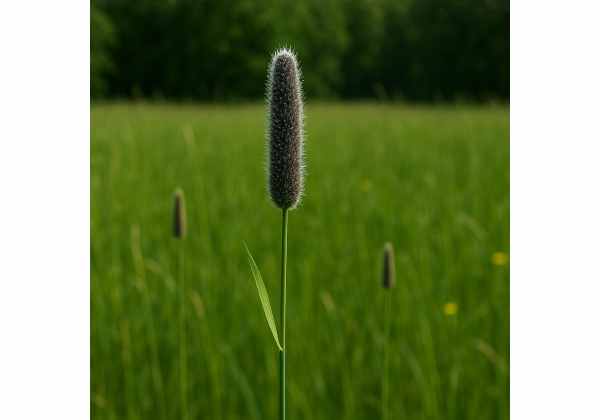
Meadow foxtail, Alopecurus pratensis, is an early-flowering perennial grass best known from meadows, pastures, hay fields, and river valleys across temperate regions. It is valuable in agriculture, recognizable in ecology, and highly relevant in allergy medicine because its pollen can contribute to seasonal rhinitis and asthma. What it is not, however, is a mainstream medicinal herb in the way chamomile, nettle, or peppermint are. That distinction matters. Searches for meadow foxtail often assume a forgotten herbal remedy, yet the modern evidence points elsewhere: forage value, grass-pollen allergenicity, and only sparse, scattered references to food or folk use.
That does not make the plant uninteresting. It helps support livestock systems when managed well, contributes to meadow habitats, and has identifiable proteins and plant compounds that matter biologically. But when the topic is human health, the most accurate answer is a careful one. Meadow foxtail has no well-established evidence-based medicinal dose, no validated supplement tradition, and no strong clinical literature for therapeutic use. This guide explains what is actually known, what is only loosely claimed, and where caution should come before curiosity.
Essential Insights
- Meadow foxtail is primarily a forage grass and pollen source, not a validated medicinal herb.
- Its clearest human health relevance is as a grass-pollen allergen that may trigger hay fever, asthma, and conjunctivitis.
- Early-cut meadow foxtail can be nutritionally useful as livestock forage, especially because of its protein content when young.
- No evidence-based human medicinal dose range has been established.
- People with grass-pollen allergy, asthma, or unexplained respiratory symptoms should avoid self-experimenting with it.
Table of Contents
- What meadow foxtail is and why the query needs context
- Key ingredients and what humans actually react to
- Meadow foxtail health benefits and what evidence supports
- Traditional properties and reported uses
- How meadow foxtail is best used in practice
- Dosage, timing, and why no standard human dose exists
- Safety, side effects, interactions, and who should avoid it
What meadow foxtail is and why the query needs context
Meadow foxtail is a cool-season perennial grass in the Poaceae family. It is native across a broad Eurasian range and has been introduced widely elsewhere for hay and pasture use. It grows early in spring, forms dense tufts or spreading stands, and produces the soft, cylindrical flower heads that give it its common name. In meadow ecology it is familiar. In agriculture it is practical. In herbal medicine, however, it sits in a much more uncertain place.
That uncertainty is the first thing a useful article has to acknowledge. Meadow foxtail is sometimes listed in broad plant databases as a species with food, environmental, animal-feed, and even medicinal uses. Yet these labels are often category markers rather than proof of a living, evidence-based herbal tradition. When you move from general plant databases to clinical literature, standardized herbal texts, and modern supplement practice, meadow foxtail almost disappears as a medicinal plant.
What remains well documented is its role as forage and as an allergenic grass. Agronomy sources describe it as an early-growing pasture and hay species whose nutritional quality can be good when harvested at the right stage. Allergy sources describe it as one of the important airborne grass-pollen contributors in temperate regions. Those two roles are far better supported than any claim that people should drink it, powder it, or treat it like a functional herb.
This is why the search query needs reframing. If someone asks about meadow foxtail “health benefits,” the honest answer is not to invent a long list of traditional cures. The honest answer is to say that direct human medicinal benefits are poorly established, while the plant’s practical importance lies elsewhere. It supports grazing systems, influences meadow ecology, and matters quite a lot to people with seasonal grass-pollen sensitivity.
That also means meadow foxtail should not be confused with grasses that are deliberately marketed for human wellness. It is not the same type of product as barley grass as an edible green supplement, nor is it part of the better-known young-grass juice category. The species matters, and so does the tradition around it.
A second important point is that a grass can be valuable without being medicinal. Meadow foxtail contributes to meadow structure, early forage availability, and habitat complexity. Those are real benefits, even if they are ecological or agricultural rather than clinical. The problem begins when those benefits are translated into unsupported promises about human healing.
So the right starting place is simple: meadow foxtail is a legitimate plant of interest, but mainly as a forage grass, ecological species, and pollen source. Anyone looking for a proven herb should know from the outset that this plant does not have a solid modern therapeutic profile for human self-care.
Key ingredients and what humans actually react to
When people ask about “key ingredients” in meadow foxtail, they often expect the kind of answer given for a medicinal herb: flavonoids, alkaloids, terpenes, or other named actives tied to a clear human use. Meadow foxtail does not fit that pattern very well. Its best-characterized biologically relevant constituents, from a human point of view, are not therapeutic molecules but pollen allergens.
The most important of these are allergenic proteins associated with grass-pollen sensitization. Species-specific sources identify meadow foxtail allergens such as Alo p 1 and Alo p 5, which belong to the major grass allergen groups 1 and 5. These are clinically important because many grass-pollen allergic individuals react to proteins in those groups. In practical terms, that means the most clearly defined “active compounds” in meadow foxtail are the very proteins that may make sensitive people sneeze, wheeze, itch, or develop seasonal eye and nose symptoms.
That is an unusual but important point. In many herbs, the active compounds are discussed because they might help. In meadow foxtail, the best-studied compounds are discussed because they may provoke allergy.
The rest of the plant’s chemistry is better understood through agronomy and general grass biology than through herbal pharmacology. Young meadow foxtail forage can contain useful amounts of crude protein, digestible dry matter, fiber, mineral ash, and carbohydrates, especially when harvested early. As the plant matures, the quality shifts. Protein and digestibility tend to decline, while structural fiber becomes more dominant. This helps explain why it can function as valuable livestock forage in some systems but lose palatability once it advances too far.
There are also broader plant metabolites present in grasses, including phenolic compounds, organic acids, and stress-responsive secondary metabolites. Experimental plant studies suggest that Alopecurus pratensis changes parts of its metabolic profile under environmental stress. That is botanically interesting, but it does not amount to a standardized medicinal profile for human use. A stressed grass containing phenols is not the same thing as a validated anti-inflammatory herb.
So from a practical viewpoint, meadow foxtail has three main constituent stories:
- forage nutrients, especially in early growth stages
- pollen allergen proteins that matter for respiratory allergy
- general grass metabolites that are real but not clinically translated into herbal use
This makes meadow foxtail very different from grasses deliberately consumed by people as concentrated health products, such as wheatgrass as a young-grass wellness product. Wheatgrass is harvested, juiced, powdered, and marketed for human intake. Meadow foxtail is not commonly or credibly used that way.
Another useful distinction is plant part. If human health is the topic, pollen is the most medically relevant part because that is where the allergic burden lies. If agricultural value is the topic, leaf and stem quality matter more because they determine grazing and hay quality. If someone starts talking about seedheads, old hay, or mature stems as though they were concentrated medicinal preparations, the discussion has already drifted away from what the evidence actually supports.
So the “key ingredients” answer here is more corrective than promotional. Meadow foxtail contains nutrients that matter in forage, proteins that matter in allergy, and plant metabolites that matter in botany. What it does not have is a well-established set of human therapeutic actives tied to an accepted medicinal use.
Meadow foxtail health benefits and what evidence supports
If “health benefits” means direct human therapeutic benefits from consuming or applying meadow foxtail, the evidence is weak. There is no established clinical tradition of meadow foxtail tea, extract, capsule, or tincture used in a standardized way for digestion, immunity, inflammation, or metabolic support. That absence is not a minor detail. It is the core fact that should guide the entire discussion.
Still, the plant does have health relevance in three indirect ways.
The first is agricultural and nutritional. Meadow foxtail can produce early forage with good nutrient content, especially protein, when managed and harvested at the right stage. This is a real benefit in livestock systems because earlier spring growth can help support grazing animals when other grasses are still lagging. From a human-health perspective, that is indirect: it supports animal feeding systems rather than acting as a human medicinal plant. But indirect does not mean irrelevant. Many valuable plants contribute to health by improving food systems rather than by entering supplement bottles.
The second is ecological. Meadow foxtail is part of grassland systems that support biodiversity, habitat structure, and pollinator-adjacent meadow processes. Again, this is not a therapeutic use, but it is part of how the plant contributes to broader environmental health. In species-rich meadows, however, very dominant or introduced meadow foxtail stands can also become a management concern. So even the ecological story is nuanced rather than purely positive.
The third human-health connection is actually cautionary: meadow foxtail pollen can contribute to seasonal allergy symptoms. In aerobiology and allergen literature, Alopecurus pratensis appears not because it heals, but because it can significantly add to airborne grass-pollen burden and symptom load in sensitive individuals. That means its most concrete effect on human health is often adverse rather than beneficial.
Could meadow foxtail still have overlooked medicinal potential? Possibly, in the broad theoretical sense that many plants contain understudied metabolites. But that possibility is not the same as evidence. A responsible article should not turn “unstudied” into “promising” without good reason.
So the most accurate ranking of meadow foxtail’s health-related effects looks like this:
- clearly supported: forage value when managed early in agricultural settings
- clearly supported: medical relevance as a grass-pollen allergen
- plausible but not clinically established: general plant antioxidant or phenolic activity
- not established: routine human medicinal benefits from self-use
This is why it can be helpful to compare meadow foxtail with a forage plant that has clearer human uses, such as alfalfa as both livestock feed and a recognizable human food herb. Alfalfa has a real history in teas, powders, and sprouts. Meadow foxtail largely does not.
For readers coming to the topic in good faith, that may sound disappointing. But it is actually useful. It prevents wasted effort, keeps expectations realistic, and directs attention to what the plant truly is: an agriculturally relevant grass with allergy significance, not a hidden medicinal superstar. In health writing, clarity is often more valuable than enthusiasm, and meadow foxtail is one of those plants that benefits from being described with restraint.
Traditional properties and reported uses
Meadow foxtail has very little standing as a formal traditional herb, at least in the way that most readers mean the term. You do not find it widely represented in major herbal monographs, supplement traditions, or modern naturopathic formularies. That does not mean it was never used by people. It means its uses were sparse, local, and usually practical rather than medicinally elaborate.
One of the more interesting reported examples comes from ethnobotanical field records in the southern Occitan Alps, where leaves and flowers of Alopecurus pratensis were recorded as being used to make better cheese. This is not a typical “medicine” claim, but it is a real traditional use. It suggests meadow foxtail had some valued place in food culture or livestock-product quality, even if that place was indirect and highly local.
That kind of use matters because it reminds us that not every useful plant was consumed as a tincture or infusion. Rural traditions often treated grasses as part of a larger food and farm ecology. A grass that improved pasture quality, influenced milk flavor, or contributed to local dairy practices could still be meaningful without becoming a recognized medicinal herb.
Beyond that, however, reported medicinal uses are thin. Meadow foxtail is sometimes mentioned in broad historical or regional plant-use lists, but the evidence is not strong, repeated, or specific enough to justify a modern medicinal profile. There is no convincing body of consistent traditional practice showing that it was a standard digestive tea, fever herb, wound plant, or nervine.
This is a good place to draw a line between “reported use” and “reliable use.” Reported use means a plant appeared in a record somewhere. Reliable use means the plant shows up repeatedly across traditions, texts, or practices with a reasonably stable purpose. Meadow foxtail mostly belongs in the first category, not the second.
That difference also helps prevent a common mistake in online herb writing. A single old record or database tag can make a plant seem more medicinal than it really is. Once copied from one site to another, that tag becomes a myth of certainty. In meadow foxtail’s case, that would be misleading.
If someone wants a true mild digestive or soothing household herb, meadow foxtail is not a sensible first choice. There are far better established options, such as peppermint for digestive and aromatic support, with much clearer traditions, better-known safety, and actual human use patterns.
So the most defensible way to describe meadow foxtail’s traditional properties is this: it had practical rural uses, especially connected to pasture and possibly dairy quality, and it may have had occasional localized folk applications. But it does not have a robust, well-documented herbal tradition that supports modern self-prescribed medicinal use.
That answer may be narrower than the query expects, but it is the one that keeps the plant in its proper context. Meadow foxtail was a useful grass before anything else. That identity should remain the center of the story.
How meadow foxtail is best used in practice
The best practical use of meadow foxtail depends on whether you are thinking like a land manager, a farmer, an allergy sufferer, or an herb user. For most people, it makes more sense as a grass to identify and manage than as a plant to ingest.
In agriculture, meadow foxtail is used mainly for early pasture and hay production, especially in cooler, moist conditions. It can be useful because it begins growth early in spring and contributes forage when some later grasses are still catching up. The drawback is that it matures quickly, and once it flowers or becomes overmature its palatability can drop. So even in farming, it is best used thoughtfully, not passively.
In meadow management and restoration, meadow foxtail can be either useful or problematic depending on the site. In some settings it contributes to established grassland cover. In others, especially where biodiversity goals are high, it may behave too aggressively or displace more sensitive plants. Practical use here means knowing the site, not assuming every meadow grass is automatically beneficial everywhere.
For people with seasonal allergies, the most practical “use” is not use at all, but awareness. If meadow foxtail is part of the local pollen load, recognizing its flowering season may help explain symptom timing. It becomes a plant to notice, avoid during mowing or disturbance, and discuss indirectly in the context of broader grass-pollen exposure.
Where meadow foxtail is not especially practical is self-directed herbal use. There is no well-established tea culture, no validated extract range, and no recognized reason to turn it into a home supplement. If someone is specifically attracted to the idea of a grass-based wellness product, it makes far more sense to look at plants already used that way, such as wheatgrass in dedicated human-use preparations, rather than improvising with meadow foxtail.
A useful practical checklist looks like this:
- Use meadow foxtail agriculturally only if it fits the soil, climate, and grazing system.
- Harvest or graze it early if forage quality matters.
- Treat it as a pollen concern if you are allergy-prone.
- Do not assume that a forage grass is automatically safe or useful as a human herb.
- Avoid casual juicing, tincturing, or capsule-making from wild or pasture stands.
This is also a plant where identification matters. Meadow foxtail can be confused with timothy and other foxtail-like grasses, especially by non-specialists. Since those species differ in flowering time, texture, and practical roles, a vague “foxtail grass” label is not good enough when health or land decisions are involved.
The plant is most useful when kept inside its strongest domains: pasture, hay, meadow ecology, and allergy awareness. Outside those domains, the value becomes speculative very quickly. That does not make meadow foxtail unimportant. It simply means the plant should be respected for what it actually does well rather than pushed into roles it does not clearly fill.
Dosage, timing, and why no standard human dose exists
The most important dosage fact about meadow foxtail is that no evidence-based medicinal human dose has been established. There is no accepted daily range for leaf powder, no standard infusion recipe used in modern herbal practice, and no clinical tradition supporting routine oral use. That answer may feel unsatisfying, but it is exactly the kind of clarity people need when a plant is better known in agriculture than in medicine.
Why is there no standard dose? Mainly because meadow foxtail has not developed into a validated human herb. There are no common commercial preparations, no major monographs establishing safe adult ranges, and no serious clinical literature showing how much of the plant should be taken for a defined therapeutic purpose. In herbal medicine, dosage becomes meaningful only when the plant has a real history of standardized internal use. Meadow foxtail largely does not.
This also means that practical questions such as timing, duration, or cycling have no meaningful answer in the usual supplement sense. You cannot responsibly say “take X grams twice daily for digestion” when the plant has no validated digestive role. You also cannot responsibly recommend fresh juice shots, powders, or capsules simply because the species is a grass.
The only standardized human exposure that is clearly relevant is medical allergy use, and that is a completely different category. Meadow foxtail pollen may appear in allergy testing panels, allergen extracts, or immunotherapy contexts under medical supervision. That is not herbal dosing. It is specialist allergy medicine. Patients should never treat clinical allergen extracts as if they were the equivalent of botanical self-care.
A practical dose section for meadow foxtail therefore has to be framed by what is known:
- no validated oral medicinal dose exists
- no routine home-preparation standard is recognized
- no long-term supplement protocol is supported
- medically prepared pollen extracts are clinician-directed, not self-directed
If a reader’s real interest is in edible grasses or “green powders,” the honest answer is to choose plants already used that way rather than forcing meadow foxtail into the role. It is closer to a pasture species than to a health beverage. In that sense it differs sharply from concentrated young-grass products and also from gentle tonic herbs.
There is one area where measured use does make sense, but it is agricultural rather than medicinal: seeding, grazing, mowing, and harvest timing. Farmers and pasture managers absolutely think in terms of rates and timing with meadow foxtail. Yet those are field-management questions, not human dosage questions.
So the safest and most useful dosing advice is unusually simple: do not self-dose meadow foxtail as a medicinal herb. If you encounter products claiming otherwise, ask for species-specific safety data, validated preparation details, and a reason this grass should be treated like a human therapeutic. In most cases, that proof will not be there.
Sometimes the best dosing recommendation is no recommendation at all. Meadow foxtail is one of those cases. Avoiding false precision is better than inventing a range that only sounds authoritative.
Safety, side effects, interactions, and who should avoid it
The main safety issue with meadow foxtail is not overdose from herbal use. It is allergy exposure. For sensitized people, meadow foxtail pollen can contribute to hay fever, allergic conjunctivitis, and asthma symptoms, especially during grass-pollen season. Because cross-reactivity among grass pollens is common, a person may react strongly without ever knowing meadow foxtail by name. The body often recognizes the broader grass-allergen pattern rather than just one species.
This makes respiratory symptoms the first area of caution. Anyone with known grass-pollen allergy, pollen-triggered asthma, seasonal wheeze, or recurrent spring and early summer nasal symptoms should treat meadow foxtail as a potential trigger, not as a self-care herb. Mowing, brushing through flowering stands, or handling dried grass material may aggravate symptoms in susceptible individuals.
A second safety issue is uncertainty of human ingestion. Since meadow foxtail is not a standard medicinal or food herb for people, safety data on oral self-use are poor. That means pregnancy, breastfeeding, childhood use, chronic illness, and medication interactions all sit in a zone of inadequate evidence. In practical terms, that argues against casual experimentation.
A third concern is field contamination. Pasture grasses can carry molds, dust, fungal residues, and environmental contaminants depending on where and how they were grown. Like other grasses, meadow foxtail may also host plant pathogens or unwanted field organisms. Even if a person were inclined to experiment, wild or forage-grade material would not be an intelligent route for human use.
There is also a narrower agricultural caution. Meadow foxtail can become less palatable as it matures, and some production guides refer to an unidentified antiquality factor that may affect livestock acceptance, especially after flowering. That does not translate neatly into a human toxicology warning, but it is one more sign that the plant is better understood as forage management material than as a wellness ingredient.
People who should especially avoid self-use include:
- anyone with grass-pollen allergy
- people with asthma triggered by seasonal pollens
- pregnant or breastfeeding individuals
- children
- anyone seeking treatment for respiratory, digestive, or chronic symptoms without a diagnosis
If the real problem is seasonal allergy rather than curiosity about the plant, a more practical direction is to focus on diagnosis, exposure reduction, and better-known supportive options such as nettle in seasonal-allergy routines, while leaving meadow foxtail in the category of trigger rather than remedy.
The final safety lesson is straightforward. Meadow foxtail is not especially dangerous in the way a poisonous plant is dangerous, but it is unsuitable for casual medicinal use because its strongest human effect is allergenic, its oral-use evidence is thin, and its preparations are not standardized. Many plants are safe because they are well understood. Meadow foxtail is safer when it is simply not miscast as a human herb.
In this case, caution is not a barrier to knowledge. It is part of accurate knowledge. The wisest use of meadow foxtail is usually recognition, management, and respect for its ecological and allergenic roles rather than attempts to turn it into a personal remedy.
References
- Shifting Herbal Knowledge: The Ecological and Cultural Dynamics Behind Plant Use Changes in the Southern Occitan Alps 2025 (Ethnobotanical Study)
- g16 Meadow foxtail 2021 (Allergen Reference)
- Grass pollen production and group V allergen content of agriculturally relevant species and cultivars 2018 (Allergy Study)
- The grass pollen season 2015: a proof of concept multi-approach study in three different European cities 2017 (Aerobiology Study)
- Meadow foxtail : a production guide 1993 (Official Production Guide)
Disclaimer
This article is for educational purposes only and is not a substitute for medical advice, diagnosis, or treatment. Meadow foxtail is primarily a forage grass and pollen source, not a well-established medicinal herb for human self-care. The available literature does not support a standardized internal dose, and the plant may worsen symptoms in people with grass-pollen allergy or asthma. Anyone with persistent respiratory symptoms, suspected seasonal allergy, or interest in using unfamiliar grasses medicinally should speak with a qualified healthcare professional before attempting self-treatment.
If you found this article helpful, please share it on Facebook, X, or another platform you prefer.