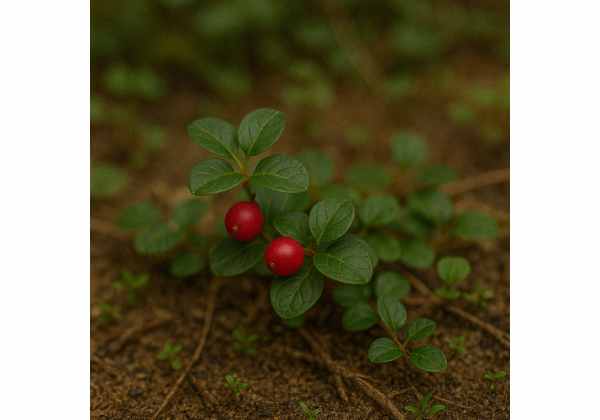
Partridge berry is a small evergreen woodland herb native to eastern North America, valued as much for its quiet persistence as for its place in traditional herbal practice. Botanically known as Mitchella repens, it is a creeping plant with paired white flowers and bright red berries that often remain visible through winter. In older North American herbal traditions, the aerial parts were used mainly for women’s health, especially as a uterine tonic, a menstrual support herb, and a preparation associated with late pregnancy and labor. Modern interest in partridge berry is more cautious. Its traditional reputation is strong, but direct human clinical evidence remains limited, so it is best discussed as a historically important herb with modest modern laboratory support rather than as a proven remedy.
That balanced view is the most useful one. Partridge berry appears to contain tannins, saponins, glycosides, and related compounds that may help explain its astringent, tonic, and mild antioxidant qualities. Yet the same history that makes it intriguing also raises safety questions, especially in pregnancy. This guide explains what partridge berry is, what it may do, how it has been used, what dosage ranges are commonly discussed, and where caution is most appropriate.
Key Insights
- Partridge berry is best known as a traditional uterine tonic rather than a modern evidence-based supplement.
- Its most plausible benefits are gentle menstrual support and mild astringent, tonic, and antioxidant activity.
- A conservative traditional tea range is about 2 to 4 g dried aerial parts per 240 mL water, up to 1 to 3 times daily.
- Avoid unsupervised use during pregnancy, especially before term, and avoid it if you have unexplained bleeding or are using it to replace medical care.
Table of Contents
- What Is Partridge Berry and Why Has It Been Used
- Partridge Berry Key Ingredients and Medicinal Properties
- Potential Health Benefits and What the Evidence Actually Shows
- Traditional Uses for Women’s Health and Modern Context
- Dosage, Preparations, and How Herbalists Typically Approach It
- Common Mistakes and How to Think About This Herb Clearly
- Safety, Side Effects, and Who Should Avoid Partridge Berry
What Is Partridge Berry and Why Has It Been Used
Partridge berry is a low, trailing, evergreen herb in the coffee family, Rubiaceae. It spreads across the forest floor in acidic, shaded habitats and is often noticed only when its bright berries appear against dark green leaves. The plant is native to eastern North America and has long been familiar to Indigenous communities, settlers, midwives, and later American herbalists. In traditional medicine, the leaves and stems were more important than the fruit. The berries are attractive and generally considered mild, but the aerial parts carried the herb’s reputation as a tonic for the reproductive tract and as a support herb during difficult menstruation, pelvic weakness, and late pregnancy.
That traditional reputation explains why partridge berry still shows up in discussions of women’s herbs, even though it is not a mainstream modern supplement. Older texts and later herbal literature often described it as gentle rather than forceful. It was not typically presented as a harsh stimulant. Instead, it was framed as a plant that gradually improved tone, steadied the tissues of the pelvis and uterus, and helped prepare the body rather than force a dramatic short-term result. That distinction matters, because many herbs in historical women’s medicine were either astringent, strongly stimulating, or outright risky. Partridge berry occupied a softer middle ground in traditional practice.
Much of its historical use centered on reproductive support. It was taken for menstrual pain, sluggish or irregular cycles, pelvic congestion, leucorrhea in older texts, and as a “partus preparator,” meaning a preparation used in the weeks leading up to labor. Modern readers should not take that phrase at face value as proof of safety or efficacy. It reflects tradition, not clinical certainty. But it does show why partridge berry became associated with uterine tone rather than with unrelated wellness trends.
There are also secondary traditional uses that appear in herbal sources: mild diuretic support, soothing use in the postpartum period, and occasional inclusion in broader formulas for urinary or pelvic discomfort. In that respect, partridge berry overlaps conceptually with other gentle tissue-supporting herbs. For example, when the goal is spasm relief rather than reproductive toning, practitioners are more likely to think of cramp bark for antispasmodic support than partridge berry itself.
The most important way to understand partridge berry is to see it as a traditional herb with a narrow historical lane. It is not a general adaptogen, not a daily tonic for everyone, and not a fashionable cure-all. It belongs to a specific corner of North American herbalism, mostly related to women’s health, uterine tone, and careful, long-term use rather than dramatic quick effects.
Partridge Berry Key Ingredients and Medicinal Properties
Partridge berry is not one of the most heavily studied North American herbs, but the available literature gives a useful sketch of its chemistry. Herbal and laboratory sources describe the plant as containing tannins, saponins, glycosides, alkaloid-like constituents, mucilage, resinous material, waxes, and related compounds. That profile helps explain why the herb has traditionally been described as mildly astringent, toning, and somewhat soothing to mucous membranes. Tannins often point toward tissue-tightening and astringent actions, while saponins are frequently discussed when an herb shows surface-active or smooth-muscle-relevant behavior in pharmacological testing.
The most interesting modern clue about partridge berry’s medicinal properties comes from how its chemistry aligns with older reproductive uses. In vitro research has shown that aqueous extracts can contract isolated uterine smooth muscle, and authors of that work proposed that saponin-rich fractions may be involved in the response. That does not prove how the herb behaves in a whole person, but it does suggest that at least part of the traditional uterine reputation is pharmacologically plausible. This is important because many historic herb claims dissolve under testing. Partridge berry has not been clinically proved, but it has at least shown some laboratory consistency with older claims.
The herb has also demonstrated antioxidant activity in infusion testing. That does not make it a premier antioxidant herb, and it certainly does not mean it should be taken mainly for that purpose. Still, it shows that partridge berry is not chemically inert. Even modest antioxidant behavior can matter when it is viewed as part of a broader tissue-supporting profile rather than as a headline claim. In this sense, the herb’s medicinal properties are best described as mild and multi-directional: somewhat astringent, somewhat tonic, somewhat antioxidant, and potentially active on uterine smooth muscle.
A useful way to think about partridge berry is to separate its traditional actions from its demonstrated actions. Traditionally, it was called a uterine tonic, menstrual support herb, diuretic, and reproductive aid. Demonstrated actions are more limited: laboratory antioxidant activity and uterine contractile activity in isolated tissue. Those are not the same thing, but they are not unrelated either. The traditional language may have overstated certainty, while the laboratory language may understate the fuller experience herbalists observed over time.
Because of this, partridge berry is best understood as a plant with plausible but incomplete pharmacology. It has enough chemistry to justify continued interest, but not enough clinical research to justify casual confidence. Readers who are interested in herbs used more broadly for cycle-related complaints often compare it conceptually with lady’s mantle for astringent women’s health support, though the two herbs are not interchangeable and have different traditional personalities.
The clearest takeaway is that partridge berry’s medicinal properties are real enough to deserve respect, but not established enough to invite reckless use. It is a subtle herb with a narrow tradition, not a plant that rewards oversimplification.
Potential Health Benefits and What the Evidence Actually Shows
When people search for partridge berry benefits, they are usually looking for support in one of three areas: menstrual comfort, uterine tone and reproductive support, or mild soothing and astringent effects for the urinary and pelvic tissues. Those are the benefit categories most closely connected to the herb’s traditional use. The problem is that the modern evidence base is much smaller than the traditional reputation. There are no strong human clinical trials showing that partridge berry reliably relieves menstrual cramps, prevents miscarriage, regulates hormones, improves fertility, or eases labor. That is the honest starting point.
Still, absence of strong trials does not mean the herb is meaningless. It means the probable benefits should be described carefully. The most plausible benefit is gentle uterine and pelvic support in traditional use. That claim is stronger historically than clinically, but it is not baseless. Laboratory work showing contractile effects on uterine tissue provides some mechanistic support for why the herb became associated with late-pregnancy and labor formulas. The key phrase there is mechanistic support. It is not the same as a safe, proven recommendation for actual pregnancy use.
A second possible benefit is mild menstrual support, especially in formulas rather than alone. Older herbal traditions did not usually present partridge berry as a dramatic antispasmodic. It was more often used as part of a broader strategy for difficult cycles, pelvic laxity, or a general sense of reproductive weakness. Modern readers looking for a more direct herb for spasm and painful cramping would often be pointed toward herbs with a clearer antispasmodic reputation, such as yarrow for menstrual support, while partridge berry may fit better as a background tonic.
A third plausible benefit is mild antioxidant and tissue support. Infusion testing shows that partridge berry can scavenge free radicals, although not with exceptional speed compared with some other medicinal plants. This is useful mostly as a supporting property. It suggests the herb may contribute to a protective, restorative profile rather than simply acting through one narrow pathway. That aligns with how many traditional tonic herbs behave: they are not dramatic, but they may support tissue resilience over time.
What benefits are not well supported? Claims that partridge berry reliably prevents miscarriage, treats infertility, safely induces labor, corrects hormonal imbalance, or acts as a proven diuretic should all be treated with caution. Some of these claims appear in old literature, but modern confirmation is weak or absent. Readers interested in more studied herbal approaches to cycle-related hormonal symptoms often look instead at herbs such as chaste tree for PMS and cycle balance, which has a clearer modern research trail.
So the evidence-based answer is modest but useful: partridge berry may offer gentle reproductive-tissue support and mild astringent, tonic, and antioxidant effects, but its best-known benefits remain traditional rather than clinically established. It belongs in careful herbal discussion, not in overconfident marketing.
Traditional Uses for Women’s Health and Modern Context
Partridge berry’s identity is tightly linked to women’s herbal medicine. In North American traditions, it was used for painful periods, irregular menstruation, leucorrhea in older terminology, pelvic weakness, and preparation for childbirth. Many historical descriptions portray it as a herb that helped the uterus “tone up” over time. That kind of language reflects a traditional framework in which tissues were thought to become lax, congested, or underactive and could be gradually restored by tonic plants. Whether modern clinicians use the same vocabulary or not, it captures why partridge berry was valued: not because it was harsh, but because it was considered steady.
Its strongest historical association is with late pregnancy and labor preparation. Traditional midwifery records and later herbal summaries often placed it among herbs taken in the final weeks before birth. This does not mean it was taken throughout pregnancy, and it certainly does not mean unsupervised pregnancy use is wise. It means the herb developed a reputation for supporting readiness for labor rather than functioning as a casual pregnancy tea. That distinction is often lost when older herbal uses are repeated online without context.
Partridge berry was also commonly paired with other reproductive herbs. In practice, historical formulas often combined it with herbs chosen for stronger spasm relief, circulatory support, or clearer uterine action. This is one reason the herb can be difficult to evaluate in isolation. Traditional herbalism rarely used it as a single-agent intervention for a large, measurable outcome. Instead, it often appeared as part of a formula whose overall purpose was to support the uterus and pelvis. That is still how many herbalists think about it today. Someone building a classic formula for menstrual cramping is more likely to compare or combine it conceptually with herbs such as black cohosh in women’s herbal traditions than to use it as a stand-alone fix.
In a modern context, partridge berry is best viewed as a heritage herb whose old use patterns have outlived the evidence needed to modernize them fully. That does not erase the tradition, but it changes how the herb should be discussed. Today, it is reasonable to describe it as a traditional North American uterine tonic with limited experimental support and limited human outcome data. It is not reasonable to present it as a proven fertility aid, a miscarriage-prevention herb, or a self-directed labor-induction tool.
There is also a language issue worth noting. Some older sources use alternative common names that many readers now find outdated or inappropriate. Using the botanical name Mitchella repens and the common name partridge berry is the clearest and most respectful approach in current writing.
The modern lesson is that tradition can preserve something valuable without settling the final clinical question. Partridge berry still has a place in herbal education, especially in discussions of historical women’s medicine, but the safest present-day use is thoughtful, selective, and professionally guided rather than nostalgic or automatic.
Dosage, Preparations, and How Herbalists Typically Approach It
Dosage is where honesty matters most with partridge berry. There is no widely accepted, clinically validated human dose for Mitchella repens. That is the clearest answer. Most dosage information comes from traditional practice, later herbal monographs, and formula use rather than from randomized trials. Because the herb has plausible uterine activity, this lack of formal dosing matters more than it would for a simple culinary herb.
In modern herbal practice, partridge berry is usually approached in one of three ways: as an infusion, a tincture, or a formula herb blended with other reproductive supports. The gentlest and most traditional preparation is a tea made from the dried aerial parts. A conservative customary range is about 2 to 4 g dried herb in 240 mL hot water, taken 1 to 3 times daily. This is best understood as a traditional working range, not a clinically proven dose. Herbalists who use it often favor steady, moderate use rather than large, aggressive amounts.
Tinctures are also used, but tincture strength varies so much by extraction ratio and solvent that milliliter advice can be misleading unless the product is well standardized. In practice, many clinicians prefer formula context over solo tincture use because partridge berry has historically been paired with herbs selected for clearer spasm relief, astringency, or reproductive-toning support. If used at all, it is often for a defined goal over a limited period rather than as an indefinite general tonic.
Timing also matters. Because the herb is tied so closely to menstrual and reproductive traditions, it should not be treated like a daily wellness supplement for anyone at any time. If someone is using it for non-pregnancy menstrual support, it is more logically used around the relevant part of the cycle or for short structured periods. If pregnancy is involved, timing becomes even more sensitive, and unsupervised use is not appropriate.
A helpful rule is to match the uncertainty of the evidence with the conservatism of the dose. Partridge berry is not an herb to megadose. There is no reason to assume that larger amounts create better results. In fact, with herbs that may act on uterine tissue, that assumption is especially unwise. Readers seeking a gentler herb mainly for soothing irritated tissues, rather than reproductive support, may find better alignment with herbs such as marshmallow for demulcent tissue support, which has a much more straightforward use pattern.
So the most responsible dosage guidance is simple: keep the form gentle, the amount moderate, the duration purposeful, and the expectations realistic. Traditional use can guide careful practice, but it cannot substitute for modern dosing evidence.
Common Mistakes and How to Think About This Herb Clearly
The first common mistake is treating partridge berry as a proven modern remedy just because it has a long history. Historical use is meaningful, but it is not the same as clinical confirmation. Many herbs were remembered because they were helpful in context; many were also remembered because they were available, symbolically important, or woven into broader systems of care. With partridge berry, tradition gives us a direction for inquiry, not a blank check for confident self-treatment.
The second mistake is assuming that “uterine tonic” means “safe for pregnancy.” In fact, that phrase should make readers more careful, not less. A herb associated with uterine tone may or may not be appropriate at a given stage of pregnancy, in a given dose, or for a given person. Even when traditional midwives used such herbs, they did so in a very different care environment and usually with much more situational judgment than a product label can provide.
A third mistake is using partridge berry as though it were interchangeable with other women’s herbs. It is not. Some herbs are more antispasmodic, some more hormonal, some more astringent, and some more clearly studied. Partridge berry sits in a narrow zone between tonic, mild astringent, and historically reproductive. Confusing it with stronger labor herbs or more evidence-backed cycle herbs leads to poor decisions and unrealistic expectations.
Another error is ignoring the difference between traditional formulas and isolated herb marketing. Older herbalists often combined partridge berry with companion plants chosen for specific reasons. Modern supplement culture tends to pull herbs out of that context and promote them with single-ingredient logic. That can distort both efficacy and safety.
A better framework is to ask four questions before taking any interest in partridge berry seriously:
- What exact goal am I trying to achieve?
- Is this herb traditionally used for that goal, or am I stretching the claim?
- Is the evidence strong enough for self-care, or only interesting enough for discussion?
- Does pregnancy, bleeding, fertility treatment, or another high-stakes issue make supervision necessary?
Those questions help keep partridge berry in proportion. It may be a worthwhile traditional herb, but it is not a shortcut. It asks for more discernment than many common herbal teas, and that alone should tell the reader something important.
Safety, Side Effects, and Who Should Avoid Partridge Berry
Safety is the section where partridge berry should be treated with the most respect. The strongest concern is not dramatic toxicity but context-sensitive risk, especially around pregnancy and uterine activity. Because laboratory studies have shown uterine smooth muscle contraction, and because the herb has a long reputation as a uterine tonic associated with childbirth, it should not be used casually during pregnancy. Historical use in late pregnancy does not establish universal safety, and it certainly does not justify early-pregnancy or unsupervised use. Anyone who is pregnant, trying to conceive, has a history of miscarriage, or is dealing with preterm labor concerns should not self-prescribe this herb.
Outside pregnancy, partridge berry appears to be a relatively mild herb, but mild does not mean consequence-free. Possible side effects are not well mapped in modern trials, which means absence of reports should not be mistaken for proof of safety. Astringent herbs can sometimes feel drying or irritating in sensitive people. Concentrated formulas could potentially worsen cramps or create pelvic discomfort if used inappropriately. Because strong data are sparse, the safest assumption is that individual response varies.
Formal interaction data are also limited. The most practical concern is additive reproductive or uterine effects if partridge berry is combined with other herbs or medications aimed at labor, menstruation, or pelvic circulation. That does not mean every combination is dangerous, but it does mean combinations should be intentional rather than improvised. Caution is also reasonable for people with unexplained abnormal bleeding, severe endometriosis symptoms, active pelvic pain of unknown cause, or ongoing fertility treatment.
Who should avoid partridge berry unless guided by a qualified clinician?
- Pregnant people, especially before term
- Anyone using it to prevent miscarriage or induce labor on their own
- People with unexplained vaginal bleeding or pelvic pain
- Those actively pursuing fertility treatment unless their care team approves
- Breastfeeding people if the goal is medicinal rather than food-level exposure
- Children and adolescents using concentrated extracts
For everyone else, the safest stance is still moderation. Use only clearly identified material. Prefer gentle forms over high-potency extracts. Stop if cramping, bleeding, rash, nausea, or unusual symptoms appear. And remember that partridge berry belongs to a part of herbal medicine where traditional wisdom and modern uncertainty overlap more than they resolve. That is not a reason to fear the herb. It is a reason to approach it with clinical humility.
The bottom line is simple: partridge berry is a traditional reproductive herb with plausible activity and limited human evidence. That combination calls for caution, especially when the uterus, bleeding, or pregnancy are involved.
References
- Uterotonic Plants and their Bioactive Constituents – PMC 2011 (Review)
- Free Radical Scavenging Activity of Infusions of Different Medicinal Plants for Use in Obstetrics – PubMed 2021
- Mitchella repens (Partridge Berry) contracts uterine smooth muscle in isolated mouse tissues 2021
- An Investigation into the Use of an Herbal Labor Induction Tincture Containing Black Cohosh, Cramp Bark, Partridgeberry, and Motherwort on Contractile Responses Produced from Isolated Strips of Mouse Uterine Tissues | Pharmacognosy Journal 2021
- Herbal fertility treatments used in North America from colonial times to 1900, and their potential for improving the success rate of assisted reproductive technology – PMC 2018 (Review)
Disclaimer
This article is for educational purposes only and does not replace medical advice, diagnosis, or treatment. Partridge berry has a strong traditional association with women’s reproductive health, but modern human evidence is limited and uterine activity is a genuine safety consideration. Do not use it during pregnancy, for labor preparation, or for abnormal bleeding without qualified medical or herbal supervision. Seek medical care promptly for heavy bleeding, severe pelvic pain, contractions, or pregnancy-related concerns.
Please share this article on Facebook, X, or your preferred platform if you think a careful, balanced guide to partridge berry could help someone else.