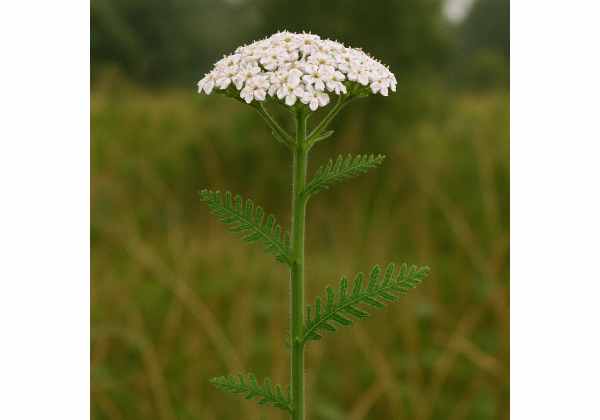
Yarrow, or Achillea millefolium, is a bitter, aromatic herb with a long history in traditional European and Western herbal practice. It is easy to recognize by its feathery leaves and flat clusters of white or pale pink flowers, but its reputation comes more from what people have used it for than how it looks. Traditionally, yarrow has been taken for mild digestive discomfort, temporary loss of appetite, and menstrual cramping, and it has also been applied topically to small superficial wounds.
What makes yarrow interesting is the way its actions overlap. It is not simply a “digestive herb” or a “skin herb.” It contains flavonoids, sesquiterpene lactones, and volatile compounds that may help explain its mild anti-inflammatory, spasm-modulating, and astringent effects. At the same time, the modern evidence base is still mixed: some uses are supported mostly by long-standing traditional use, while others have only limited human research. That means yarrow can be useful, but it is best approached with clear expectations, practical dosing, and careful attention to safety.
Essential Insights
- Yarrow is most often used for mild digestive complaints, minor menstrual cramping, and small superficial wounds.
- Its key compounds include flavonoids, sesquiterpene lactones, and volatile oils that may support anti-inflammatory and spasm-modulating activity.
- A common adult tea range is 1.5 to 4 g dried herb in 150 to 250 mL hot water, taken 3 to 4 times daily for appetite or mild digestive complaints.
- People who are pregnant, breastfeeding, under age 12, or allergic to Asteraceae plants should avoid self-treating with yarrow.
Table of Contents
- What yarrow is and why it has been used for centuries
- Key ingredients and medicinal properties
- Yarrow health benefits and what the evidence suggests
- Ways to use yarrow in tea, tincture, compresses, and skin care
- Dosage, timing, and how long to use it
- Safety, side effects, interactions, and who should avoid it
What yarrow is and why it has been used for centuries
Yarrow is a flowering plant in the Asteraceae family, the same broad botanical family that includes chamomile, feverfew, chrysanthemum, and ragweed. In herbal medicine, the aerial parts of the plant are most often used, especially the flowering tops and upper stems. These can be dried and prepared as tea, turned into liquid extracts and tinctures, or infused for topical use.
Part of yarrow’s staying power comes from how flexible it is. Bitter aromatic herbs often earn a place in traditional medicine because they can fit many everyday complaints. Yarrow has been used before meals when appetite feels flat, after meals when there is bloating or mild cramping, around the menstrual cycle when spasm-like discomfort is present, and externally when the goal is to cleanse and soothe small surface injuries. That broad range does not mean it is a cure-all. It means herbalists have long seen it as a practical, multipurpose plant for short-term, mild problems.
Its taste and character matter too. Yarrow is distinctly bitter, a little pungent, and slightly drying. Those sensory qualities help explain why it has often been grouped with digestive bitters. Like gentian root for appetite support, it is sometimes used when digestion feels sluggish rather than irritated by strong heat or acidity. The bitterness is not a flaw in the herb. In traditional practice, it is often treated as part of the mechanism.
Historically, yarrow has also been associated with wound care. Folk names and stories often emphasize its use on cuts and battlefield injuries, though historical reputation should not be mistaken for proof of strong modern clinical effectiveness. Still, this long-standing external use aligns with what researchers continue to study: its mild antimicrobial activity, influence on inflammation, and possible support for tissue repair.
A sensible modern view is that yarrow belongs in the category of traditional herbal medicines that may be most useful for clearly defined, lower-risk situations. It is not the first herb to reach for in every digestive issue, every menstrual complaint, or every skin problem. But for the right person, used for the right reason, it can be a thoughtful, well-matched option.
Key ingredients and medicinal properties
Yarrow’s chemistry is one reason it attracts so much interest. The plant contains a mix of flavonoids, sesquiterpene lactones, volatile oil compounds, phenolic substances, and other smaller constituents such as choline. This matters because yarrow’s traditional uses are not built around one single “active ingredient.” Instead, its effects appear to come from a group of compounds working together.
Among the best-known flavonoids are apigenin, luteolin, quercetin derivatives, and rutin. Flavonoids are often discussed for their antioxidant and anti-inflammatory activity, but that description is too narrow on its own. In herbs, these compounds may also influence smooth muscle tone, capillary stability, and tissue response to irritation. Readers interested in one of these compounds specifically may also want to explore apigenin in more detail.
Yarrow also contains volatile oil components that vary depending on the plant’s growing conditions, subspecies, and processing. These may include camphor, borneol, cineole, limonene, and azulene-related compounds in some preparations. Volatile oils help explain why yarrow can smell strongly aromatic and why concentrated forms such as essential oil behave differently from a simple tea. Chemical variation is important here: not every yarrow preparation has the same profile, and that is one reason traditional tea, tincture, and essential oil should never be treated as interchangeable.
Sesquiterpene lactones are another key group. These are often linked with anti-inflammatory activity, but they are also relevant to safety because this class of compounds may contribute to allergic reactions in sensitive people, especially those who already react to Asteraceae plants. In practice, that means the very compounds that help make the herb pharmacologically interesting can also make it a poor fit for some users.
When herbalists describe yarrow as bitter, aromatic, mildly antispasmodic, astringent, and vulnerary, they are summarizing this chemistry into functional language:
- Bitter suggests support for digestive signaling and appetite.
- Aromatic points to volatile compounds that may influence digestive comfort and local circulation.
- Antispasmodic suggests a possible role in easing cramp-like discomfort.
- Astringent reflects its slightly drying, toning quality, which helps explain some traditional topical uses.
- Vulnerary is the old herbal term for an herb used to support minor wound care.
The most important takeaway is balance. Yarrow is not chemically simple, and its properties depend heavily on preparation type, concentration, and the reason it is being used. A weak tea for mild digestive discomfort is not the same thing as a concentrated alcohol extract, and neither is comparable to essential oil. Understanding that difference is central to using the herb well.
Yarrow health benefits and what the evidence suggests
The strongest case for yarrow is not that it has been proven for many major conditions. It is that it has a long, coherent history of traditional use, and some modern research gives plausible support to those uses. The key phrase is “plausible support.” That is different from high-certainty clinical proof.
For digestion, yarrow is traditionally used for temporary loss of appetite and mild spasmodic gastrointestinal complaints such as bloating and flatulence. This makes sense when you consider its bitter taste and its apparent effects on gastric motility and smooth muscle activity. A small body of pharmacological research suggests that yarrow extracts may support stomach movement and help explain why it has been used in dyspepsia-like states. People comparing options for this kind of complaint often also look at peppermint for digestive comfort, though the feel of the two herbs is different: peppermint is cooling and relaxing, while yarrow is more bitter and drying.
For menstrual discomfort, yarrow has traditional use support for minor spasm associated with menstrual periods, and there is limited human evidence pointing in the same direction. A small randomized trial found reduced pain severity in primary dysmenorrhea, which is promising, but not enough on its own to make yarrow a first-line evidence-based treatment. It is more accurate to say that yarrow may help some people with mild crampy menstrual discomfort, especially when taken early in the cycle of symptoms, but more high-quality research is still needed.
For skin and small superficial wounds, yarrow has long been used externally as a wash, compress, or dressing infusion. Laboratory and animal studies suggest antibacterial and wound-healing potential, including effects on collagen-related repair and local inflammation. That said, topical use should stay in its proper lane. Yarrow is appropriate for minor, clean, superficial problems, not deep wounds, infected wounds, or injuries that need formal medical care.
There is also broader research on yarrow’s antioxidant, anti-inflammatory, antimicrobial, and even metabolic effects. Some studies suggest possible benefits in areas such as blood sugar balance, lipid regulation, and tissue protection under stress. These findings are interesting, but they are still too preliminary to justify routine use of yarrow as a self-treatment for diabetes, cholesterol problems, liver disease, or cancer.
So what does yarrow seem best suited for right now?
- Mild digestive complaints, especially when bloating and cramping are part of the picture.
- Temporary loss of appetite.
- Minor menstrual spasm.
- Small superficial wounds when used topically and carefully.
That is a useful range, but it remains a modest one. Yarrow works best when expectations are grounded.
Ways to use yarrow in tea, tincture, compresses, and skin care
Yarrow can be used in several forms, and the form you choose shapes both the experience and the likely effect. For most people, the simplest place to start is tea. A tea highlights the herb’s bitter and aromatic qualities, is easy to control, and is well suited to short-term digestive or menstrual use. It also tends to be gentler than concentrated extracts.
A standard yarrow tea is usually prepared by pouring boiling water over the dried herb and steeping it as an infusion. The resulting tea is bitter, somewhat grassy, and slightly spicy. Some people drink it plain, while others combine it with herbs that soften the taste or broaden the effect. For example, pairing yarrow with a soothing herb such as calendula for skin support makes sense in external preparations, while combining it with digestive herbs may make more sense for internal use.
Tinctures and liquid extracts are more concentrated and more convenient for people who do not want to drink several cups of tea a day. They may be useful when appetite support is the goal, since liquid bitter herbs are often taken shortly before meals. The tradeoff is that tinctures are easier to overuse casually, especially when people assume “natural” means unlimited. They also may contain alcohol, which matters for some users.
For topical use, yarrow is commonly prepared as:
- a strong infusion used as a wash
- a soaked compress laid over a small superficial wound
- a dressing moistened with the infusion
- a component of creams, salves, or ointments
This is where practical judgment matters. Yarrow can be reasonable for small, shallow, noninfected skin issues, but it should not replace wound cleaning, proper dressings, or medical care when there is spreading redness, warmth, swelling, pus, severe pain, or delayed healing. Traditional use supports it as an adjunct for minor care, not as a substitute for standard treatment.
Essential oil deserves extra caution. Yarrow essential oil is not the same as yarrow tea. It is far more concentrated, chemically variable, and more likely to irritate sensitive users if applied incorrectly or used too aggressively. Internal use of essential oil should not be improvised. Even topical use requires dilution and care.
A practical way to think about forms is this:
- Tea is the best everyday entry point.
- Tincture or liquid extract is useful when convenience and concentration matter.
- Topical infusion or compress fits small superficial skin concerns.
- Essential oil is a specialist preparation, not a beginner form.
Choosing the right form is often more important than choosing the herb itself.
Dosage, timing, and how long to use it
Yarrow dosage depends on why you are using it and what kind of preparation you have. For everyday readers, dried herb tea is the easiest format to understand because the dose is visible and less concentrated than many extracts.
For temporary loss of appetite and mild digestive complaints, a commonly cited adult dose is:
- Tea: 1.5 to 4 g of dried yarrow herb in 150 to 250 mL boiling water, taken 3 to 4 times daily between meals.
- Liquid extract: 2 to 4 mL, 3 times daily.
- Expressed juice: 5 to 10 mL, 2 to 3 times daily.
- Tincture: 2 to 4 mL, 3 times daily, depending on the preparation.
When the goal is appetite support, liquid preparations are often taken about 30 minutes before meals. That timing reflects the traditional use of bitters: the herb is meant to prompt digestive readiness rather than to rescue a heavy meal after the fact.
For minor menstrual spasm, the adult traditional-use range is smaller:
- Tea: 1 to 2 g in 250 mL boiling water, 2 to 3 times daily.
- Dry extract: 250 mg, 2 to 3 times daily, in preparations standardized to the referenced extract range.
For small superficial wounds, yarrow is used externally rather than internally:
- Topical infusion: 3 to 4 g of the dried herb in 250 mL boiling water, used 2 to 3 times daily as an infusion for the affected area.
Duration matters just as much as dose. Yarrow is generally used for short-term, clearly defined situations. A sensible framework is:
- For appetite loss or mild digestive complaints, do not continue self-treatment beyond about 2 weeks without professional advice.
- For menstrual cramping or superficial wound use, do not continue beyond about 1 week without reassessment.
- Stop sooner if symptoms worsen, a rash appears, or the herb clearly does not suit you.
A few practical tips help prevent mistakes:
- Start at the lower end of the range if you are trying yarrow for the first time.
- Do not use tea, tincture, and capsules all together just because each seems modest on its own.
- Do not assume stronger is better. Herbal medicine often works best at the minimum effective dose.
- Keep the reason for use narrow. If you are taking yarrow “for everything,” the herb is no longer being used thoughtfully.
Good dosing is not only about quantity. It is about matching the form, timing, and duration to the problem you are actually trying to solve.
Safety, side effects, interactions, and who should avoid it
Yarrow is often described as gentle, but that can be misleading if it encourages careless use. In the right context it may be well tolerated, yet it still has clear safety boundaries.
The first major issue is allergy. Yarrow belongs to the Asteraceae family, so people who react to ragweed, chrysanthemum, chamomile, or feverfew may be more likely to react to it as well. Reactions may show up as skin irritation, rash, itching, or contact sensitivity. If you already know that daisy-family plants cause trouble for you, yarrow is not a casual experiment.
The second issue is pregnancy and breastfeeding. Safety has not been established well enough for routine self-use in either setting. That does not automatically prove harm, but it does mean yarrow should not be used casually during pregnancy or lactation without qualified guidance.
The third issue is age. Traditional monograph guidance does not recommend yarrow for children under 12 because adequate data are lacking. Again, this is not the same as proven toxicity. It simply means the evidence is not strong enough to support unsupervised use in younger children.
Alcohol-containing preparations deserve a separate note. Tinctures may be inappropriate for people avoiding alcohol, for those taking medications where alcohol matters, or for anyone who would be better served by a tea or alcohol-free extract. Concentrated preparations also increase the risk of misunderstanding dose.
Interaction data are limited. Official monograph sources report no specific interactions, but “none reported” is not the same thing as “none possible.” If you take prescription medicines, manage a chronic illness, or use several herbs and supplements together, it is wise to check with a clinician or pharmacist before adding yarrow. That is especially important when the symptom you are treating could also be a sign of a condition that needs diagnosis.
Avoid self-treatment with yarrow when:
- you are allergic to Asteraceae plants
- you are pregnant or breastfeeding
- the user is under age 12
- the wound is deep, infected, or not healing
- digestive pain is severe, persistent, or accompanied by vomiting, fever, black stools, or weight loss
- menstrual pain is new, unusually intense, or associated with fainting or very heavy bleeding
The safest way to use yarrow is also the most ordinary: short term, moderate dose, clear purpose, and a low threshold for stopping if it does not feel right.
References
- European Union herbal monograph on Achillea millefolium L., herba 2020 (Guideline). ([European Medicines Agency (EMA)][1])
- Achillea millefolium: Mechanism of action, pharmacokinetic, clinical drug-drug interactions and tolerability 2023 (Review). ([PubMed][2])
- Experimental and clinical studies on pharmacological actions of the genus Achillea: A comprehensive and updated review 2024 (Review). ([PMC][3])
- In vitro Antibacterial Activity and Wound Healing Effects of Achillea millefolium Essential Oil in Rat 2023 (Preclinical Study). ([PubMed][4])
- Effect of Achillea Millefolium on Relief of Primary Dysmenorrhea: A Double-Blind Randomized Clinical Trial 2015 (RCT). ([PubMed][5])
Disclaimer
This article is for educational purposes only and does not diagnose, treat, or replace medical care. Herbal medicines can cause side effects, allergic reactions, and problems when used in the wrong form, dose, or setting. Yarrow may be appropriate for short-term, mild complaints, but persistent digestive symptoms, severe menstrual pain, infected wounds, pregnancy-related concerns, and symptoms in children should be assessed by a qualified healthcare professional. Use product labels carefully, and seek personalized advice if you take prescription medicines, have chronic health conditions, or have a history of plant allergies.
If this article helped you, please consider sharing it on Facebook, X, or another platform your community uses.