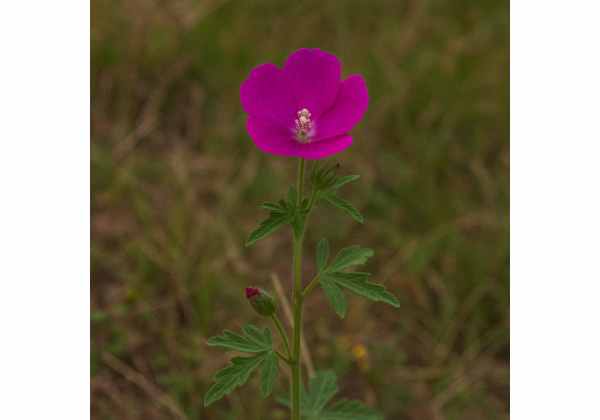
Purple poppy mallow, also called winecup or buffalo rose, is a prairie plant better known for its vivid magenta flowers than for a well-developed place in modern herbal medicine. Botanically, it is Callirhoe involucrata, a North American perennial in the mallow family with a deep taproot and a long record of use as both a native food and a traditional remedy. That combination makes it interesting, but it also requires caution. Unlike better-studied medicinal herbs, poppy mallow does not have a modern clinical literature base strong enough to support confident claims about standardized health effects, dosing, or long-term safety in medicinal preparations. What it does have is a credible ethnobotanical history: its roots were eaten, described as palatable, and used in traditional preparations for pain and head-cold complaints. For readers searching for health benefits, the most honest and useful approach is to separate traditional use, food use, and proven medical use. This guide does exactly that, so you can understand what poppy mallow may offer, where the evidence stops, and how to avoid overstating a plant whose reputation is older than its research.
Core Points
- Traditional use of poppy mallow centered on root preparations for internal pain and dried-root smoke for aching body parts and head-cold discomfort.
- The root has also been documented as edible and palatable, which supports its role as a traditional food plant.
- A cautious food-first trial is about 15 to 30 g of cooked root with a meal; no standardized medicinal dose has been established.
- Avoid medicinal self-use if you are pregnant, breastfeeding, managing chronic illness, or trying to treat significant pain, infection, or breathing symptoms.
Table of Contents
- What poppy mallow is and why the evidence is limited
- Traditional uses, edible roots, and ethnobotanical context
- Key ingredients and medicinal properties
- How poppy mallow is used today
- Dosage, timing, and what can actually be recommended
- Safety, side effects, interactions, and who should avoid it
What poppy mallow is and why the evidence is limited
Poppy mallow is a trailing perennial wildflower native to the central United States and nearby regions. Its botanical name, Callirhoe involucrata, places it in the Malvaceae family, which also includes hibiscus, okra, cotton, and many plants valued for their soft, mucilaginous tissues or edible roots. In gardens, it is usually grown as an ornamental groundcover because it tolerates drought, spreads attractively, and produces bright cup-shaped flowers for a long season. In ethnobotanical records, however, it is more than decorative. The plant also appears as a native food source and a traditional remedy, especially through use of the root.
That combination often creates confusion. When people search for “poppy mallow benefits,” they frequently assume they are looking at an established medicinal herb with defined compounds, clinically tested uses, and standard dosage instructions. That is not the case. Poppy mallow has a documented traditional reputation, but it does not have the modern research base that would justify strong claims for pain treatment, respiratory therapy, digestive support, or inflammation control. In practical terms, it belongs to a group of plants that are ethnobotanically meaningful but clinically under-studied.
This distinction matters because many herbs with food or folk-medicine histories end up getting overstated online. A statement like “Native communities used the root for pain” is historically specific. A statement like “Poppy mallow relieves pain” sounds medically certain, and that certainty is not supported by human trials. A trustworthy article has to keep that line clear. For this plant, the most solid claims are about identification, traditional context, edibility of the root, and the absence of standardized medicinal guidance.
Another reason the evidence feels limited is that most modern attention given to Callirhoe involucrata is horticultural rather than pharmacological. Botanical gardens, native-plant programs, and conservation pages discuss its drought tolerance, pollinator value, and garden performance far more than any medicinal chemistry. That is not a weakness in itself. It simply shows where the contemporary knowledge base is strongest. The plant is well recognized as a native perennial, but only lightly developed as a modern therapeutic herb.
This is also why comparisons can mislead. Because poppy mallow belongs to the mallow family, people sometimes assume it behaves like all mallows medicinally. Family resemblance can offer clues, but it does not replace species-specific evidence. A plant may share general traits with its botanical relatives and still lack proven medicinal action in human use. Readers interested in the broader family pattern sometimes compare it with okra as a better-known edible mallow, but that should be seen as botanical context, not proof of equivalent medicinal value.
The most accurate starting point, then, is simple: poppy mallow is a traditional food and folk-use plant with genuine ethnobotanical importance, but its health profile remains more historical than clinically established.
Traditional uses, edible roots, and ethnobotanical context
The strongest case for poppy mallow as a useful plant comes from ethnobotany rather than from clinical medicine. In Native American plant records, Callirhoe involucrata is documented as both food and drug, with the root playing the central role. That matters because roots that are both edible and used medicinally usually occupy a practical middle ground in traditional life. They are not exotic specialty remedies. They are familiar, accessible plants that became meaningful through repeated observation, repeated harvest, and repeated use.
For poppy mallow, one of the clearest recorded traditions is among Dakota sources. Ethnobotanical documentation describes a decoction of the root being taken for internal pains. The dried root was also used in smoke form to “bathe” aching body parts, and the smoke was inhaled for head colds. These details are valuable because they show the plant was not used randomly. Different preparations were tied to different complaints: a liquid preparation for internal discomfort and smoke exposure for aches and cold-related symptoms. Even without modern pharmacology, that level of specificity tells us the plant had a defined place in practice.
The root also has a food history. Official and ethnobotanical sources describe the perennial poppy mallows as having edible, palatable roots, and early travelers as well as Native communities reportedly ate them across parts of the Great Plains and the southern United States. Nutritional work on traditional foods from the central United States also included Callirhoe involucrata roots among native plant foods studied for protein and fiber content. This does not turn poppy mallow into a modern superfood, but it supports a practical interpretation: the root was credible as a human food source, not merely emergency folklore.
That food history changes how the plant should be read today. A root that was eaten and also used in decoction suggests three things. First, it was probably familiar enough that people could distinguish normal use from harmful overuse. Second, it may have delivered more subtle, repeated benefits rather than dramatic one-time effects. Third, its medicinal reputation likely grew out of lived use, not abstract theory.
Still, traditional use should not be flattened into modern certainty. Historical use can tell us what people trusted, what they prepared, and what they considered helpful. It cannot tell us the exact active compounds, the optimal human dose in milligrams, or whether the same preparation would outperform a placebo in a modern trial. That is why traditional use is best treated as evidence of cultural and practical relevance, not as proof of clinical effectiveness.
This distinction becomes even clearer when compared with herbs that now have far larger pain-relief evidence bases. For example, readers looking for a more studied plant in that category may find willow bark for pain relief more relevant to modern self-care questions. Poppy mallow, by contrast, is better understood as a historically documented prairie remedy whose strongest modern value may still lie in its ethnobotanical importance.
In short, the traditional record supports poppy mallow as a food root and a pain and cold folk remedy, but it does not justify pretending that those uses have been clinically settled.
Key ingredients and medicinal properties
This is the section where many herb articles overreach, because “key ingredients” sounds as if every plant comes with a neat chart of actives, mechanisms, and human outcomes. For Callirhoe involucrata, the responsible answer is narrower: species-specific phytochemical data are sparse, and its medicinal properties are better described as inferred, plausible, or traditional rather than firmly characterized. That does not make the plant uninteresting. It simply means the chemistry has not been mapped in the same detail as it has for mainstream medicinal herbs.
Some cautious observations can still be made. Poppy mallow belongs to the mallow family, and many members of that family contain tissues rich in mucilage, carbohydrate reserves, and softening plant compounds that can be soothing or nourishing when eaten. The poppy mallow root has been described as palatable and was used as food, which suggests a composition that is at least partly starchy and compatible with culinary use. Nutritional research on native foods also places the roots among plant materials contributing fiber and carbohydrate rather than standing out as unusually high-protein plant foods.
That matters because one of the most realistic “medicinal properties” of a traditional edible root is not always drug-like. Sometimes it is simply nutritive support. A root that is safe enough to be eaten, filling enough to matter nutritionally, and familiar enough to be gathered may support health in slower, broader ways than a concentrated medicine does. In that sense, the line between food and remedy becomes thinner.
Beyond that, any discussion of active compounds has to be cautious. There is not a strong modern literature showing that Callirhoe involucrata contains clinically validated analgesic, anti-inflammatory, antimicrobial, or sedative constituents in meaningful standardized amounts. Traditional pain use makes those possibilities interesting, but it does not prove them. The strongest scientifically grounded statement is that the plant has not been adequately characterized to support ingredient-driven therapeutic claims.
This is also where family-level assumptions can mislead. Because poppy mallow is related to plants known for soothing textures and demulcent behavior, readers may expect it to function like more familiar softening herbs. That may be directionally reasonable, but it is still an inference, not a settled fact. A better way to frame the issue is this: the plant’s edible root and mallow-family background make nutritive and soothing interpretations plausible, but not sufficiently proven for clinical recommendation.
From a practical perspective, the medicinal properties most honestly associated with poppy mallow are these:
- a documented role in traditional pain-related root preparations
- a history as an edible root
- a likely food-based rather than drug-like profile
- a lack of modern evidence strong enough to define specific therapeutic actions
That last point is not a flaw. It is an important part of the plant’s identity. Many herbs remain better described by use history than by laboratory certainty. If readers want a clearer example of a soothing, plant-based texture with more familiar food context, slippery elm as a better-known demulcent herb offers a helpful comparison point, even though it is a different species and should not be treated as a stand-in for poppy mallow.
So the key-ingredients story for poppy mallow is less about named molecules and more about honest limits: edible root, likely nutritive value, possible soothing family traits, and traditional use that deserves respect without exaggeration.
How poppy mallow is used today
Today, most people encounter poppy mallow as a native ornamental plant, not as a bottle of capsules or a standardized herbal tea. That modern reality should shape how it is used. If a plant’s medicinal record is traditional but its strongest current body of knowledge is horticultural, then the safest and most sensible modern use usually stays close to the oldest credible pattern: food use, gentle experimentation, and respect for limits.
For poppy mallow, that means the most defensible contemporary use is not as a replacement for pain medicine or cold treatment. It is as a traditional edible root plant and, secondarily, as a culturally interesting herb for those studying prairie ethnobotany. A reader who grows the plant may see its large taproot and wonder whether it can be used. Historical sources support the idea that perennial poppy mallows had edible roots and that these roots were considered pleasant enough to eat. That is more reliable than assuming the leaves, flowers, or homemade extracts all have the same record of safety or usefulness.
In practical terms, modern use falls into three broad categories.
First is garden and native-plant use. This is the most common form today. The plant is appreciated for drought tolerance, long bloom, pollinator value, and groundcover behavior.
Second is edible-root curiosity. For foragers and native-food enthusiasts, the root is the part with the strongest documented human-use history. If someone wants to explore poppy mallow as a plant food, the right frame is culinary and cautious, not medicinal and ambitious.
Third is historical or educational herbal use. Some readers simply want to understand how prairie plants were used traditionally. In that context, decoction and smoke uses are part of the story, but they are not automatically instructions for modern self-treatment.
This is where many people make a category mistake. A plant with a recorded medicinal use is not automatically a good candidate for home herbalism in concentrated forms. Traditional preparation methods often depended on local knowledge, context, and familiarity with the plant across seasons. Modern users usually do not have that continuity. That is why it is wiser to stay closest to the plant’s most credible modern-use lane: food and education.
Topical use is sometimes mentioned indirectly because roots used for pain and smoke for aching body parts invite modern analogies to salves and external preparations. But those analogies are still analogies. There is no modern clinical basis for saying that a poppy mallow salve, poultice, or tincture has validated topical benefit. For readers interested in herbs with a clearer topical tradition and better developed modern herbal use, calendula for minor skin support is a far better example.
So how should poppy mallow be used today? Conservatively. Appreciate it as a native plant. Treat the edible-root history as real but limited. See the medicinal record as culturally important, not as a substitute for evidence-based care. That approach preserves both honesty and usefulness, which is exactly what an under-studied herb needs.
Dosage, timing, and what can actually be recommended
The most important fact about poppy mallow dosage is this: there is no standardized medicinal dose established for humans. No widely accepted monograph, no modern clinical guideline, and no solid human trial literature defines how much Callirhoe involucrata root should be taken for pain, head-cold symptoms, or any other health outcome. That means any article that offers precise medicinal dosing as though it were settled is moving beyond the evidence.
Still, readers need something practical. The best way to provide that without inventing false precision is to separate culinary starting amounts from medicinal claims.
For food use, a cautious starting amount is about 15 to 30 g of cooked root, or a few small bites, taken with a meal the first time. This is not a clinically proven dose. It is simply a conservative food-first portion meant to test taste and tolerance. Because the root has a documented history as edible and palatable, this is the most defensible way to approach the plant in modern personal use. If it agrees with you and you actually enjoy it, portions can be adjusted gradually as a food rather than as a therapy.
For decoctions, tinctures, extracts, and powders, the honest recommendation is different: no validated dose can be recommended. Traditional records show that decoctions existed, but they do not provide a modern framework for standardized preparation strength, extraction time, or dose frequency that can be used safely as a contemporary rule. The same problem applies to smoke-based traditional uses. A historical record of use is not enough to justify creating a home protocol.
Timing also matters. If someone is trying the root as food, taking it with a meal is the most practical option. That reduces the chance that a new, unusual root will sit harshly on an empty stomach and keeps the use anchored in the plant’s strongest documented lane: edible root consumption. There is no good reason to take poppy mallow on an empty stomach, as a daily “tonic,” or as a multi-week medicinal challenge.
Duration should also remain modest. A one-time food trial or occasional culinary use makes sense. What does not make sense is assuming that because a plant once had a folk-pain use, it should be taken regularly for chronic pain, sinus issues, or inflammation. At that point, the question is no longer about tradition. It becomes a question of evidence, monitoring, and safety, and the plant does not have enough modern support to carry that weight.
A useful way to think about poppy mallow dosing is:
- Food amount: acceptable starting point.
- Medicinal amount: not established.
- Repeated therapeutic use: not supported.
- Strong extracts: unnecessary and poorly defined.
Readers looking for herbs with more established guidance for digestive or comfort-oriented self-care may do better with ginger as a more studied household herb. Poppy mallow is not that kind of herb. It is a traditional plant with a credible edible root, but not a modern medicine with a reliable dosing chart.
So the dosage answer is deliberately modest: small cooked food portions are the only practical starting range that can be responsibly suggested, and no standardized medicinal dose exists.
Safety, side effects, interactions, and who should avoid it
Safety is where under-studied herbs can become risky, not necessarily because they are highly toxic, but because people fill evidence gaps with confidence. Poppy mallow is a good example. There is enough historical information to know the root was used as food and medicine, but there is not enough modern clinical data to define a full safety profile for repeated medicinal use, concentrated extracts, pregnancy exposure, or drug interactions. That means the safest working assumption is moderate: food-level experimentation may be reasonable for healthy adults, but medicinal self-prescribing is not well supported.
The most likely short-term issues are practical rather than dramatic. Any unfamiliar root food can cause digestive upset, especially if eaten in large amounts or prepared poorly. Nausea, bloating, or stomach discomfort are all possible. There is also the general possibility of plant allergy, particularly in people who react easily to unfamiliar botanicals. Because poppy mallow is not a mainstream food, most people will not already know whether they tolerate it well.
Pregnancy and breastfeeding deserve clear caution. There is no strong safety literature establishing medicinal use in either situation. In the absence of reassuring data, concentrated preparations, repeated decoctions, and experimental home use are best avoided. The same caution applies to children, whose smaller body size and different physiology make guesswork more problematic.
Drug interactions are not well defined, but this is not a reason to ignore them. When an herb has poorly mapped chemistry, the safest assumption is that concentrated use could potentially alter digestion, discomfort perception, or tolerance in unpredictable ways. Anyone taking prescription medicines for pain, respiratory symptoms, or chronic illness should not treat an under-studied prairie root as harmless simply because it is traditional.
Certain situations clearly fall outside appropriate self-use:
- moderate or severe pain that needs diagnosis
- lingering sinus or head-cold symptoms with fever or breathing trouble
- suspected infection
- pregnancy or breastfeeding
- chronic disease requiring medication
- allergy-prone individuals trying concentrated herbal preparations
A second safety issue is substitution. People sometimes assume plants in the mallow family are gentle enough to use interchangeably. They are not. Poppy mallow is not a stand-in for marshmallow root, slippery elm, or hibiscus, and it should not be dosed as though it were one of those better-known plants.
There is also the risk of false reassurance. If a person reads that Dakota preparations were used for internal pain, they may try to manage ongoing abdominal pain, body pain, or respiratory discomfort on their own. That is exactly the kind of use that should raise caution, not confidence. Traditional pain use does not mean the plant is appropriate for modern undiagnosed pain.
The safest conclusion is straightforward. Poppy mallow appears best treated as a traditional edible root plant with limited medicinal evidence. Small food-like exploration may be reasonable for healthy adults, but concentrated medicinal use should be avoided unless guided by someone with real expertise in the plant. If your main interest is external soothing care, better-characterized options such as witch hazel for topical use make far more sense than inventing a poppy mallow protocol.
In other words, the main safety rule is restraint. Do not mistake historical use for modern proof, and do not turn a lightly documented plant into a self-prescribed treatment plan.
References
- Callirhoe involucrata (Torr. & Gray) Gray 2026
- Culturally Important Plants of the Lakota 2015
- Nutritional Properties of Native Plants and Traditional Foods from the Central United States 2018
- Purple Poppy Mallow | Missouri Department of Conservation 2026
Disclaimer
This article is for educational purposes only and is not medical advice, diagnosis, or treatment. Poppy mallow has a documented traditional history, but it does not have a modern clinical evidence base strong enough to support standardized medicinal use, predictable results, or reliable dosing for pain, respiratory symptoms, or other health conditions. Do not use it in place of professional care for persistent pain, fever, breathing symptoms, infection, pregnancy-related concerns, or chronic illness. If you take prescription medication or are considering concentrated herbal use, speak with a qualified healthcare professional first.
If you found this article helpful, please share it on Facebook, X, or your preferred platform.