Toothache plant is one of those herbs that earns its common name almost instantly. A fresh flower head or leaf produces a striking tingling, buzzing, and mildly numbing sensation in the mouth, followed by a burst of salivation. That unusual effect has made it famous in traditional medicine, culinary culture, and modern natural-product research. Most contemporary sources identify the plant as Acmella oleracea, though older literature and commercial labels often still use Spilanthes acmella, which is one reason the herb can seem more confusing than it really is.
Its appeal goes well beyond novelty. Toothache plant has been used for oral discomfort, gum irritation, appetite support, and inflammatory complaints, while modern studies focus on spilanthol and related alkylamides for local anesthetic, anti-inflammatory, antimicrobial, and pain-modulating effects. At the same time, not every traditional use is backed by strong human trials, and not every extract behaves like the fresh plant.
A useful guide should therefore do two things well: explain why this herb feels so distinctive, and separate plausible benefits from overconfident claims. That is the approach taken here.
Fast Facts
- Toothache plant is best known for brief tingling and numbing effects that may help with minor oral discomfort.
- Spilanthol-rich extracts also show promising anti-inflammatory and antimicrobial activity, especially in oral-care research.
- Studied local oral products range from 0.0003% spilanthol rinse to 1% Acmella gel, while standardized systemic dosing remains unsettled.
- Avoid medicinal use if you have Asteraceae allergy, significant mouth ulceration, are pregnant or breastfeeding, or are delaying needed dental treatment.
Table of Contents
- What Toothache Plant Is and Why It Has Two Names
- Key Ingredients and What Causes the Mouth Tingle
- Toothache Plant Health Benefits and Medicinal Properties
- Traditional Uses and Where Modern Evidence Is Strongest
- How Toothache Plant Is Prepared and Used
- Dosage Timing and What Amounts Are Actually Studied
- Safety Side Effects Interactions and Who Should Avoid It
What Toothache Plant Is and Why It Has Two Names
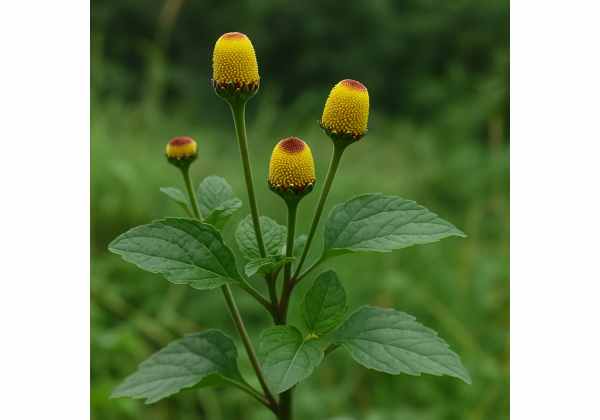
Toothache plant is a tropical herb in the Asteraceae family, valued both as a medicinal plant and as an edible, high-impact culinary green. It is widely known as jambu, paracress, buzz buttons, electric daisy, and eyeball plant, depending on region and use. The species most often associated with these names is Acmella oleracea, a low-growing annual with bright green leaves and round yellow flower heads that may carry a dark or reddish center.
One reason the herb can be confusing is that the literature still carries two scientific names: Acmella oleracea and Spilanthes acmella. In older texts, herbal trade, and some supplement marketing, Spilanthes acmella is still used broadly. In more current botanical treatment, Acmella oleracea is the name most often applied to the culinary and medicinal toothache plant familiar in Brazil and elsewhere. For readers, the practical lesson is simple: many studies and product labels refer to the same traditional herb under slightly different naming systems, so the chemistry and uses are often discussed across both names.
This naming issue matters because people sometimes assume they are looking at different plants when they are really looking at overlapping literature. It also matters because the herb is used in two distinct worlds. In one world, it is a food plant, especially in northern Brazil, where it contributes its tingling taste to soups, broths, and regional dishes. In the other, it is a medicinal herb used for oral discomfort, salivary stimulation, topical soothing, and pain-related complaints.
Its signature effect is immediate and memorable. Chewing a fresh flower head or leaf creates a fast tingling that can feel cooling, buzzing, or electrically prickly. The mouth may become slightly numb, and saliva production often increases. This is the sensory basis for the common name “toothache plant,” but it also helps explain why the herb moved so easily from folk practice into modern oral-care research.
Unlike broad tonic herbs, toothache plant is not famous because it energizes or nourishes the whole body. Its identity is more localized and functional. It is best understood as a pungent sensory herb with strong oral effects and a growing research profile around spilanthol-rich extracts. That narrower identity is helpful because it keeps expectations realistic. Toothache plant is not a miracle cure, but it is not merely a novelty garnish either. It is a distinctive medicinal food herb whose most convincing traditional reputation begins in the mouth and then extends outward into broader anti-inflammatory and supportive applications.
Key Ingredients and What Causes the Mouth Tingle
The chemistry of toothache plant is the reason it feels so different from most herbs. Its best-known compounds are alkylamides, especially spilanthol, which is widely regarded as the plant’s signature molecule. Spilanthol is the main reason fresh flower heads and extracts create that buzzing, tingling, saliva-triggering sensation that people notice almost immediately.
Spilanthol is not acting like a standard minty cooling agent or a simple aromatic oil. Instead, it appears to interact with sensory pathways involved in pain, temperature, and oral nerve signaling. That helps explain why the plant can feel mildly numbing and stimulating at the same time. Rather than creating a deadened sensation, it often produces a lively mix of tingling, warmth, and salivation before settling into a softer local dulling of discomfort.
Beyond spilanthol, toothache plant contains a broader chemical family of alkylamides or alkamides. These molecules are considered central to the herb’s pharmacological identity. Some research also identifies phenolic compounds, flavonoids, scopoletin, and other secondary metabolites that may contribute antioxidant, antimicrobial, and anti-inflammatory activity. Essential oil fractions and solvent extracts can show different profiles, which is one reason fresh herb, tinctures, gels, and concentrated extracts do not all behave the same way.
This matters in practice. A person chewing a fresh bud experiences the plant as a whole-food herb with fast oral sensory effects. A person using a standardized extract or mouthwash is interacting with a more selective or concentrated preparation. A person buying a supplement capsule may get a product whose chemistry is much less obvious unless the manufacturer states what is standardized. In other words, “toothache plant” is not one fixed exposure.
The local oral effect also helps explain why the herb keeps getting compared to better-known dental botanicals. Its niche overlaps partly with clove in short-term oral comfort traditions, but the two plants do not feel the same. Clove leans more toward warm numbing through eugenol-rich aromatic action, while toothache plant is more buzzing, salivating, and trigeminal in character. That difference can matter a great deal in real use.
Researchers are also interested in how spilanthol and related compounds behave beyond the mouth. These compounds have been studied for anti-inflammatory signaling, pain modulation, antimicrobial action, and possible interactions with pathways such as TRPV1 and CB2. Those mechanisms are intriguing because they connect the herb’s folk reputation with modern pharmacology. Still, mechanistic promise is not the same thing as proven clinical benefit in every setting.
The best way to summarize the ingredients is this: toothache plant is an alkylamide-driven herb, with spilanthol at the center of its identity. The tingling is not a side note. It is the sensory clue that the plant contains bioactive compounds capable of meaningful local effects, especially in oral tissues.
Toothache Plant Health Benefits and Medicinal Properties
Toothache plant has a stronger medicinal reputation than many edible herbs, but the evidence is uneven across different uses. Its most convincing profile is not as a general tonic or everyday wellness cure. It is as a local sensory herb with promising oral analgesic, anti-inflammatory, sialagogue, and antimicrobial properties, plus broader experimental data suggesting relevance to pain and tissue irritation.
The first and most practical benefit is short-term oral comfort. This is where traditional use and pharmacological plausibility align most clearly. The plant’s tingling, numbing, and salivation-promoting action can make minor mouth discomfort feel more manageable for a short time. That does not mean it treats the cause of dental pain, but it helps explain why people have chewed the fresh flowers for generations.
The second likely benefit is support for gum and oral tissue inflammation. Human studies on Acmella-containing oral products, though still limited, suggest potential usefulness in gingival and periodontal settings. Some of that benefit may come from direct anti-inflammatory effects, some from antimicrobial action, and some from changes in local sensation and saliva. This is a sensible area for the herb because it keeps the application close to the tissue where the plant is most active.
A third medicinal property is antimicrobial support. Extracts and spilanthol-rich preparations have shown activity against various microbes in laboratory and oral-care research. This does not make toothache plant a replacement for antibiotics or dental treatment, but it does help explain why it keeps appearing in mouth rinses, gels, and oral-health experimentation.
A fourth area is pain modulation beyond the mouth. Reviews and preclinical studies suggest the herb may have broader antinociceptive and anti-inflammatory potential. This is where the article needs restraint. The plant looks promising for pain management research, but most of that evidence is still preclinical or comes from mixed formulations rather than from direct, stand-alone human proof. It is fair to say the herb is promising. It is not fair to say it is established therapy for chronic pain.
A fifth commonly overlooked benefit is salivary stimulation. Increased saliva may sound minor, but it can matter for comfort, oral lubrication, and the sensory experience of dry mouth or irritated mucosa. The herb’s buzzing effect is often followed by exactly that response.
The most useful summary of benefits therefore looks like this:
- best supported by tradition and plausibility: oral tingling and brief numbing support
- good emerging fit: gum and oral-care products
- plausible from research: anti-inflammatory and antimicrobial action
- promising but not yet strong for self-care claims: broader pain management
This is why toothache plant is often more interesting than expected but should still be used with realistic boundaries. Its medicinal properties are real enough to justify attention, yet narrow enough that people should not treat it as a substitute for proper dental care, infection treatment, or chronic pain management. When used well, it belongs in the category of focused botanical tools rather than broad cure-all herbs.
Traditional Uses and Where Modern Evidence Is Strongest
Traditional medicine gave toothache plant its reputation long before modern phytochemistry named spilanthol. In folk use, the flowers and leaves were chewed for tooth discomfort, mouth soreness, gum complaints, and throat irritation. The herb was also used to stimulate saliva, awaken appetite, and support digestion. In some traditions it appeared in topical preparations for skin complaints or in broader formulas for inflammation and pain.
One reason the plant traveled so well between medicine and food is that its effect is immediate. A herb that makes the mouth tingle within seconds naturally earns trust in oral traditions. It is far easier for a community to preserve the use of a plant when the experience is obvious and repeatable. Toothache plant does not ask the user to believe in an invisible effect. It announces itself quickly.
The culinary side of the herb also matters. In Brazil, especially in northern regional food traditions, jambu is eaten as a vegetable and flavoring plant. This gives toothache plant a medicinal-food identity much like certain other herbs that sit between the kitchen and the clinic. In that sense, it resembles ginger in culinary and therapeutic overlap, though the sensory experience is entirely different. Both plants show how repeated food use can preserve medicinal familiarity across generations.
Where is the modern evidence strongest? It is strongest where the traditional use is most specific and locally testable:
- oral care products and gingival support
- sensory relief in irritated oral tissues
- topical or local anti-inflammatory applications
- mechanistic and preclinical pain research
Where is the evidence weaker? It is weaker in broad internal claims such as “immune boosting,” “whole-body detox,” or general pain control from casual self-dosing. Some of these ideas may have roots in the plant’s anti-inflammatory chemistry, but they are not yet the plant’s most credible use cases.
It is also important to separate traditional chewing of fresh herb from modern commercial products. A person chewing a flower head for a few seconds during a toothache episode is not doing the same thing as a person taking a concentrated oral supplement every day. Traditional use often involved short-term, local, symptom-focused application. Modern marketing sometimes stretches that into broader health claims that go beyond the strongest evidence.
That distinction helps readers avoid a common mistake. When a plant has clear traditional success in a narrow area, people often assume it must also work well in broader, less related areas. Toothache plant does not need that kind of inflation. Its traditional use already gives it a strong and distinctive identity. Modern research is most persuasive when it respects that identity rather than trying to turn the herb into a universal remedy.
How Toothache Plant Is Prepared and Used
Toothache plant can be used fresh, dried, extracted, or formulated into oral-care products, and each method changes the experience. The freshest and most traditional method is simple chewing of the leaves or flower heads. This is the form most closely tied to the herb’s common name and oral folk use. A small amount is chewed briefly, allowed to create tingling and salivation, and then either swallowed or discarded depending on the tradition and the user’s comfort.
Fresh use has one major advantage: it makes the herb’s local character immediately clear. The user can gauge the intensity within seconds and stop if the sensation feels too strong. It also avoids some of the uncertainty that comes with concentrated extracts. The disadvantage is that fresh herb is not always available, and the effect can vary with plant age, growing conditions, and which part is chewed.
Other practical forms include:
- tinctures and liquid extracts
- powders and capsules
- oral gels
- mouth rinses
- functional foods or culinary uses
Modern oral products are where the herb is becoming especially interesting. Gels and rinses allow local use without the full sensory force of chewing a whole flower. In periodontal or gingival settings, this can be a more controlled way to use the plant. It also fits the herb’s evidence profile better than broad daily supplementation does. For readers comparing botanical oral-care styles, this is somewhat analogous to how tea tree is used in targeted antimicrobial topical care, though toothache plant is more notable for tingling and sensory effects than for aromatic antiseptic identity.
Culinary use deserves more attention than it usually gets in herbal writing. In regions where jambu is eaten, the leaves and flowers are part of soups, broths, and savory dishes. This form is not mainly about numbing a tooth. It is about appetite, sensory stimulation, and medicinal-food tradition. Culinary use is usually gentler than concentrated herbal dosing, though the mouthfeel is still unmistakable.
The herb can also appear in topical or cosmetic products, especially where spilanthol is marketed for sensory, smoothing, or anti-aging effects. Those uses are part of modern commercial development, but they are somewhat different from the plant’s classic oral identity.
The best way to think about preparation is to match the form to the goal:
- fresh flower or leaf for brief traditional oral experience
- gel or rinse for targeted oral-care use
- food use for culinary-medicinal tradition
- extract only when the dose and purpose are clear
That last point matters. Toothache plant feels vivid enough that people may assume stronger is better. Usually it is not. This is one of those herbs where the most intelligent use is often local, measured, and short-term rather than maximal.
Dosage Timing and What Amounts Are Actually Studied
Dosage is the place where toothache plant requires the most honesty. There is no widely accepted, evidence-based oral systemic dose for all forms of Acmella oleracea or Spilanthes acmella. The plant appears in fresh food, folk chewing methods, extracts, gels, and mouthwashes, but these are not interchangeable. A fresh flower head, a concentrated capsule, and a standardized oral rinse do not deliver the same chemistry or the same risk profile.
That means the most reliable dosage information comes from studied local oral products, not from a universal daily intake rule.
Human and product-based research gives a few practical anchors:
- a 1% Acmella oleracea gel has been studied as local drug delivery in chronic periodontitis settings
- a mouthwash studied for gingivitis used 0.0003% spilanthol in a local rinse format
- some enriched floral-bud extracts have been analyzed for spilanthol content, but that does not automatically translate into a standard daily home dose
These numbers are useful because they show the herb can be used in very low local concentrations when the aim is oral support. They also show why trying to copy a dose from one product to another is risky. A 1% periodontal gel is not equivalent to swallowing a capsule, and a 0.0003% mouth rinse is not equivalent to chewing fresh flowers.
For practical self-care, the most realistic use patterns are:
- Fresh local use for short-term oral sensation, using only a small amount and stopping if burning or excessive numbness occurs
- Professionally formulated gels or rinses that already specify concentration and instructions
- Culinary use in modest food quantities, where the plant behaves more like an edible herb than a concentrated medicine
What is missing is a high-confidence systemic dose for “general health.” That gap matters. It means people should be careful with powders, capsules, and tinctures marketed for broad daily benefit unless the product is standardized and the intended use is clear.
Timing is more important for local use than for systemic use. If the goal is oral comfort, the herb makes sense close to the moment of need. If the goal is oral hygiene support through a rinse or gel, consistency according to product directions matters more than chasing a stronger sensation. The herb is not improved by repeated overuse in a single day.
A good rule is to treat toothache plant as a targeted botanical rather than a daily tonic. If someone wants a gentler daily herbal routine for oral or tissue comfort, a softer option such as chamomile for soothing, lower-intensity support may be easier to use regularly.
So the dosage lesson is not that the herb lacks value. It is that its best-supported use is local and form-specific, while broad internal dosing remains underdefined.
Safety Side Effects Interactions and Who Should Avoid It
Toothache plant is often described as safe because it is edible and traditionally used in food. That is partly true, but the more accurate statement is that it is usually well tolerated in modest food or local-use contexts, while concentrated or poorly understood use deserves more caution. Its dramatic oral sensation can make people assume the herb is automatically strong enough to be harmless because it is familiar. In reality, the same chemistry that makes it interesting can also make it irritating.
The most common side effects are local and sensory:
- strong tingling or buzzing in the mouth
- temporary numbness that feels unpleasant rather than helpful
- excess salivation
- mouth or gum irritation if the herb is too concentrated or used on already damaged tissue
- occasional stomach discomfort if large amounts are swallowed
These reactions are not always dangerous, but they matter. A person with inflamed gums, open mouth ulcers, burning mouth symptoms, or fragile oral tissue may find the herb too stimulating rather than soothing. Stronger is not better here. With toothache plant, comfort often depends on moderation.
Allergy is another important issue. Because the plant belongs to the Asteraceae family, people with known sensitivity to related plants should be cautious. Asteraceae-reactive individuals sometimes tolerate one member and not another, so history matters. First use should be modest.
There are also several groups who should avoid medicinal experimentation unless guided by a clinician:
- pregnant or breastfeeding people, because human safety data are limited
- children, unless the use is food-level and clearly gentle
- people with severe oral ulcers, active bleeding, or very irritated mucosa
- anyone delaying dental care for persistent tooth pain, swelling, fever, or drainage
That last point may be the most important safety message in the whole article. Toothache plant may briefly reduce discomfort, but it does not repair cavities, drain abscesses, or solve the cause of dental pain. If a person uses the herb to mask a worsening infection, the real risk is not the plant itself. It is the delay in proper treatment.
Interactions are not as well mapped as they are for major pharmaceutical herbs, but caution is still wise with concentrated products. The plant’s active compounds interact with sensory and inflammatory pathways, and some commercial formulas combine it with other botanicals or cannabinoids, making interpretation even harder.
For readers who want a gentler topical herbal style, calendula for mild soothing topical care is often easier to tolerate than a tingling oral herb. That does not make calendula “better.” It simply highlights how specialized toothache plant really is.
The bottom line is sensible rather than alarming. Toothache plant is usually manageable when used modestly, locally, and intelligently. Trouble tends to come from overuse, tissue irritation, mislabeled products, or using it as a stand-in for real dental care.
References
- Botany, Ethnopharmacology, Phytochemistry, and Biological Activities of Acmella oleracea: A Comprehensive Review 2026 (Review)
- A Systematic Review of the Potential of Acmella Genus Plants for the Treatment of Musculoskeletal Disorders 2025 (Systematic Review)
- Evaluation of the Effectiveness of a Mouthwash Containing Spilanthol and Cannabidiol on Improving Oral Health in Patients with Gingivitis—Clinical Trial 2025 (Clinical Trial)
- The potential of Acmella oleracea as a nutraceutical source for the symptomatic treatment of Burning Mouth Syndrome 2024
- Pharmacological Characteristics of the Hydroethanolic Extract of Acmella oleracea (L) R. K. Jansen Flowers: ADME/Tox In Silico and In Vivo Antihypertensive and Chronic Toxicity Evaluation 2023
Disclaimer
This article is for educational purposes only and is not medical or dental advice. Toothache plant may provide short-term oral comfort, but it does not diagnose or treat the cause of tooth pain, gum infection, or oral disease. Seek prompt care from a dentist or qualified healthcare professional for severe, persistent, or worsening symptoms, and use extra caution with pregnancy, breastfeeding, allergies, children, or concentrated commercial extracts.
If you found this guide useful, please share it on Facebook, X, or your preferred platform so others can approach toothache plant with more realistic expectations and safer habits.