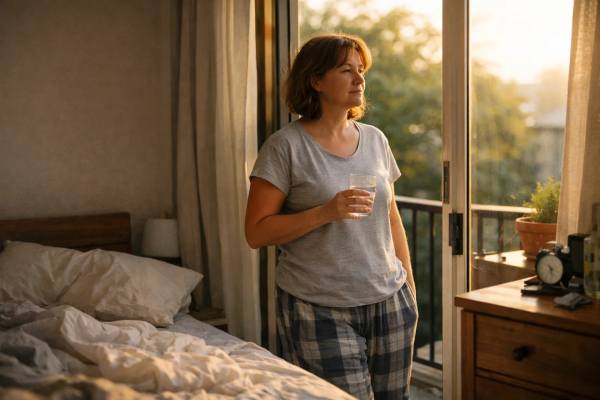
Light timing will not make you lose fat by itself, but it can make weight loss easier to sustain. Getting daylight at the right times helps set your circadian rhythm, which affects when you feel alert, sleepy, hungry, and ready to eat. When that timing gets pushed off course by dim mornings, bright nights, and too much indoor time, sleep quality, appetite regulation, energy, and routine consistency often get worse.
That is why daylight exposure matters for weight loss more than many people realize. It is not a metabolism hack. It is a body-clock input. When your light exposure lines up better with your day, it often becomes easier to sleep on time, manage cravings, follow meal routines, and make better decisions consistently.
Table of Contents
- How light sets your body clock
- Why light timing affects weight loss
- The best times to get daylight
- Why nighttime light can work against you
- A practical daily light routine
- What to do if your schedule is not ideal
- Common mistakes and realistic expectations
How light sets your body clock
Your circadian rhythm is your body’s roughly 24-hour timing system. It helps coordinate sleep and wake timing, body temperature, hormone release, appetite, digestion, and daily changes in energy and alertness. The most powerful signal that sets this clock is light, especially the contrast between bright days and dark nights.
A helpful way to think about circadian rhythm is that it is not just about sleep. It is about timing. Your body is constantly trying to answer a simple question: Is it daytime or nighttime right now? Daylight gives a strong answer. Bright morning light tells your brain that the active phase of the day has started. Darkness in the evening tells it that the sleep phase is approaching. When those signals are clear and regular, the system works better.
When they are blurred, problems start to build. A dim indoor morning, hours under artificial light, bright screens at night, and inconsistent sleep times can create a weak or delayed rhythm. That does not always mean you will develop a formal sleep disorder. More often, it shows up as subtle friction: you are not sleepy when you want to be, not fully alert when you need to be, and more likely to drift into late eating, caffeine overuse, or low-energy decision making.
That is one reason the broader link between circadian rhythm and weight loss matters so much. Weight management tends to go better when your daily rhythm is stable enough that sleep, meals, movement, and recovery happen at fairly predictable times.
Morning light is especially important because it helps anchor the clock earlier. For many people, that means an earlier natural rise in alertness during the day and an earlier rise in sleepiness later at night. In contrast, a lot of bright light late in the evening can shift the clock later, making it harder to fall asleep on time and easier to slip into a later eating pattern.
This is also why outdoor light matters more than most people assume. Even on cloudy days, outdoor daylight is usually much stronger than ordinary indoor lighting. A bright office can still be a weak circadian signal compared with stepping outside for a short period in the morning.
A useful takeaway is that your body clock responds less to what you intend and more to the light pattern you actually live in. If your real pattern is dim days and bright nights, your circadian system will follow that pattern whether or not you want an earlier bedtime or better appetite control.
Why light timing affects weight loss
Daylight exposure supports weight loss indirectly, not magically. It helps create conditions that make consistent eating, sleep, and activity easier. That matters because fat loss usually depends less on one dramatic tactic and more on how steady your habits are over weeks and months.
The biggest pathway is sleep. When circadian timing is off, sleep timing often shifts later, sleep quality may worsen, and short sleep becomes more likely. Poor sleep does not just make you tired. It often raises hunger, increases reward-seeking, reduces patience, and makes highly palatable foods harder to resist. That is one reason poor sleep can make you feel hungrier even when your willpower has not changed.
Daylight timing also affects appetite rhythm. Hunger is not random across the day. It is shaped by both behavior and internal timing. When sleep and circadian cues are misaligned, appetite cues can feel less predictable. Some people notice weaker hunger in the morning, then much stronger cravings later in the day. Others feel more drawn to evening snacking, especially when tired, stressed, or under-stimulated. Light timing is not the only cause, but it is part of the system.
There is also a routine effect. People often think of weight loss as a food-and-exercise issue, but it is also a scheduling issue. When your body clock is better anchored, it is usually easier to:
- wake up at a more consistent time
- feel alert enough to move earlier in the day
- eat meals on a steadier schedule
- cut down on late-night drifting and snacking
- fall asleep at a more reasonable hour
That rhythm supports better meal timing for appetite control, which can reduce the chaos that often leads to overeating.
Energy and mood are part of the picture too. If mornings feel foggy and evenings feel wired, healthy routines become harder to maintain. You may delay breakfast, rely on extra caffeine, skip movement, work late, snack while scrolling, and tell yourself you will reset tomorrow. None of those choices happen in isolation. They often stack together. Stronger daytime light exposure can improve the day-night contrast your brain relies on, which may help the rest of your routine feel less like friction.
It is important not to oversell this. Daylight exposure is not a substitute for a calorie deficit, adequate protein, regular movement, or enough sleep. But it can make those fundamentals easier to follow. That is the real value. Good light timing helps the rest of your plan work better.
The best times to get daylight
If you want the short version, get outdoor light soon after waking, get some light again during the day, and avoid making late evening your brightest part of the day.
| Timing | What it usually does | Why it matters for weight loss habits |
|---|---|---|
| Within 1 hour of waking | Strengthens wake signals and helps anchor the body clock | Supports earlier alertness, steadier routine, and easier sleep timing later |
| Late morning to midday | Reinforces day-night contrast | Can help energy, mood, and daytime activity consistency |
| Late afternoon | Usually neutral to helpful in normal amounts | Better than staying indoors all day, especially for office workers |
| Evening bright light | Can delay the clock and reduce natural sleepiness | Makes late nights, extra snacking, and next-day fatigue more likely |
| Overnight light exposure | Weakens dark-night signals and can disturb sleep | Can increase circadian disruption and make recovery harder |
For most people, morning daylight is the highest-value target. A practical starting point is to get outside within the first hour after waking whenever you can. On bright days, even a short exposure may help. On darker, cloudy, or winter mornings, you usually need longer. For many people, 10 to 30 minutes outdoors is a realistic starting range, with longer exposure often being more useful in dim conditions.
You do not need a perfect sunrise ritual to benefit. Walking the dog, drinking coffee outside, commuting on foot for part of the trip, or doing a short errand outdoors can all count. The key is that your eyes are exposed to outdoor light, not that you stare at the sun or do something elaborate.
A second daylight exposure later in the day can also help, especially if you work indoors. A 10- to 20-minute midday outdoor break can reinforce the message that it is still daytime. This matters because many people now spend most of the day in lighting that is too dim to act as a strong circadian signal and then spend the evening in relatively bright light from overheads, TVs, and phones.
If appetite control is one of your main goals, stronger mornings may be especially valuable. A more anchored day often leads to more stable evening behavior, which is why morning sunlight can support appetite control in practical ways even though it is not literally “burning fat.”
Two final points make this easier to use in real life:
- Consistency beats perfection. Daily morning light is more helpful than occasional heroic efforts.
- Outdoor light matters more than window light. Sitting by a sunny window is not useless, but stepping outside is usually a stronger cue.
Why nighttime light can work against you
People often focus on not getting enough daylight and miss the other half of the equation: getting too much light at the wrong time.
Bright evening and nighttime light can delay your circadian rhythm, reduce natural sleepiness, and make it harder to fall asleep when you intend to. This does not only apply to phones. Overhead room lighting, tablets, laptops, TVs, brightly lit kitchens, and even “just one more task” under strong indoor light can all keep the day feeling artificially extended.
That matters for weight loss because late nights rarely stay isolated. They often come bundled with behaviors that push progress off course:
- later dinners
- more grazing after dinner
- second desserts or sweet cravings
- extra caffeine the next day
- shorter sleep
- lower activity and worse food decisions the following afternoon or evening
This is where a lot of people get caught. They think the problem is lack of discipline around nighttime eating, when the pattern is partly being driven by their schedule and light environment. If your brain is still receiving “daytime” signals at 10:30 or 11:30 p.m., it is not surprising that you do not feel ready to shut down.
Screens deserve attention, but not panic. You do not need to be afraid of every device. The goal is to stop making the last few hours of the day the brightest, most stimulating part of the day. That means dimmer overhead lights, less intense screen exposure close to bedtime, and fewer long stretches of bright artificial light after dark. A more detailed look at blue light and sleep can help if screen use is one of your main weak points.
It also helps to think about light and sleep timing together. An evening environment that is dimmer and calmer works best when paired with a regular bedtime and wake time. Without that consistency, your circadian rhythm keeps getting mixed signals. That is why sleep consistency often matters as much as total sleep time when your goal is better appetite control and steadier daily habits.
You do not have to turn your house into a cave. You just want a clear contrast:
- brighter mornings
- decent daylight during the day
- dimmer evenings
- darker nights
That contrast is one of the simplest ways to support circadian alignment. The more your environment reflects the natural pattern of day and night, the less your body has to guess what time it is supposed to be.
A practical daily light routine
The most useful daylight plan is one you can repeat on an ordinary week, not just on your most disciplined day. This routine is simple enough for most people to adapt.
1. Get outside soon after waking
Aim for outdoor light within the first hour of the day. Walk, stretch, have coffee, or simply stand outside for a few minutes if that is all you can do. If mornings are dark where you live, stay out longer when possible.
2. Pair light with something you already do
Habits stick better when they ride on existing routines. You could:
- drink your first coffee outside
- take a short walk after getting dressed
- walk part of the commute
- do your first phone call outdoors
This works especially well if you tie it into a broader morning routine for weight loss instead of treating light exposure like a separate wellness chore.
3. Get a second dose of outdoor light later
If you work indoors, add a midday or early afternoon outdoor break. Even a short walk or lunch outside can strengthen the daytime signal. This is often the easiest fix for people whose days are spent almost entirely under office lighting.
4. Start dimming the environment before bed
Try to make the last 2 to 3 hours before sleep calmer and dimmer than the rest of the day. Lower overhead lights, reduce unnecessary screen time, and avoid turning late evening into a second work shift.
Pairing that with a stable bedtime routine often gives better results than focusing on light alone.
5. Use caffeine in a way that fits your sleep timing
A lot of people try to fix a weak circadian rhythm by pushing harder with coffee. That can backfire if it keeps you from getting sleepy at night. If late-day caffeine is part of the problem, adjusting your caffeine timing may help your evening light strategy work better.
6. Keep the goal simple
You do not need to track lux, buy gadgets, or obsess over perfect timing. A practical target looks like this:
- outdoor light after waking
- at least one more daylight break during the day
- less bright light at night
- a darker sleeping environment
The best light routine is not the most technical one. It is the one that makes your days feel brighter, your nights feel calmer, and your schedule easier to keep.
What to do if your schedule is not ideal
Not everyone can live on a perfect daylight schedule. Office workers, parents of young children, people in northern winters, shift workers, and late chronotypes all run into real constraints. You can still improve the signal even if your schedule is messy.
If you work indoors all day
Make morning and midday outdoor exposure non-negotiable whenever possible. A short morning walk plus lunch outside often helps more than trying to “make up for it” later. If you can, sit near natural light during the day, but treat that as a bonus rather than the main strategy.
If you are a night owl
You probably need stronger morning light and more protection from late evening brightness than someone with an earlier natural schedule. Late chronotypes often do better when they stop trying to force an early bedtime without changing their light pattern first. A more specific plan for weight loss with a late schedule can be helpful if your main challenge is delayed sleep timing.
If you work shifts
Shift work is harder because the outside light-dark cycle and your work demands may conflict. The general rule is to anchor light to your intended wake period and protect darkness during your intended sleep period. That may mean seeking bright light after waking for a night shift, then using blackout shades, an eye mask, and careful light reduction before daytime sleep. If this is your situation, a targeted plan for shift work and weight loss will usually be more useful than standard advice built for a daytime schedule.
If it is winter or you live in a darker climate
You usually need more deliberate effort, not perfection. Stay outside longer in the morning when you can, look for midday daylight breaks, and be extra careful not to let bright indoor evenings become your main light exposure.
If mornings are chaotic
Lower the bar. You do not need a 45-minute sunrise walk to benefit. Five minutes outside while the car warms up or a quick loop around the block is still better than zero. The pattern matters more than the performance.
A good rule for all of these situations is to stop chasing ideal and start strengthening contrast. Whatever your schedule is, make your wake phase brighter and your pre-sleep phase dimmer. That one principle travels well across almost every lifestyle.
Common mistakes and realistic expectations
The most common mistake is expecting daylight exposure to cause direct fat loss on its own. It usually does not work that way. Light timing is best understood as a support habit. It improves the environment in which sleep, appetite control, meal timing, and movement happen.
Another common mistake is focusing only on morning light while ignoring nighttime light. You can get outside every morning and still feel stuck if your evenings are bright, long, and screen-heavy. Circadian rhythm depends on contrast, not just one healthy act.
A third mistake is making the plan too complicated. Many people start reading about lux, color temperature, melanopic light, sunrise timing, and wearable trackers, then do nothing because the topic feels technical. You do not need that level of detail to get real benefit. Most of the value comes from a few basics done consistently:
- brighter mornings
- more daylight during the day
- dimmer evenings
- darker nights
- a fairly regular wake time
It also helps to set realistic expectations about timing. You may notice better morning alertness quickly, but appetite and routine effects are often more gradual. The real win is not usually “I lost weight because I got sun.” It is more like this:
- you started falling asleep earlier
- you slept more consistently
- evening cravings eased a bit
- late-night snacking became less automatic
- morning energy improved enough to support better routines
That is exactly how many useful weight-loss habits work. They do not always produce dramatic changes in a day or two. They reduce friction.
Finally, do not use light timing as a way to blame yourself if weight loss feels hard. If you have severe insomnia, loud snoring, shift-work strain, depression, medication-related weight gain, or medical issues affecting sleep and appetite, light exposure may help but will not solve everything. In those cases, it makes sense to look at the bigger picture and talk with a qualified healthcare professional when needed.
The practical bottom line is simple: treat daylight as a daily anchor, not a bonus. When your body gets a clearer signal about when day starts and when night begins, the rest of your routine often becomes easier to manage. And when routine gets easier, weight loss usually becomes more sustainable.
References
- Circadian Rhythms 2025 (Official Resource)
- Role of Circadian Health in Cardiometabolic Health and Disease Risk: A Scientific Statement From the American Heart Association 2025 (Scientific Statement)
- Efficacy of Morning Shorter Wavelength Lighting in the Visible (Blue) Range and Broad-Spectrum or Blue-Enriched Bright White Light in Regulating Sleep, Mood, and Fatigue in Adults: A Systematic Review 2024 (Systematic Review)
- The role of insufficient sleep and circadian misalignment in obesity 2023 (Review)
- Associations between light exposure and sleep timing and sleepiness while awake in a sample of UK adults in everyday life 2023 (Observational Study)
Disclaimer
This article is for general educational purposes only and is not a substitute for medical advice, diagnosis, or treatment. If you have persistent insomnia, major daytime sleepiness, suspected sleep apnea, shift-work sleep problems, or medical concerns affecting weight or appetite, speak with a qualified healthcare professional.
If you found this article useful, please share it on Facebook, X, or your preferred platform to help others improve their sleep, routine, and weight-loss habits.