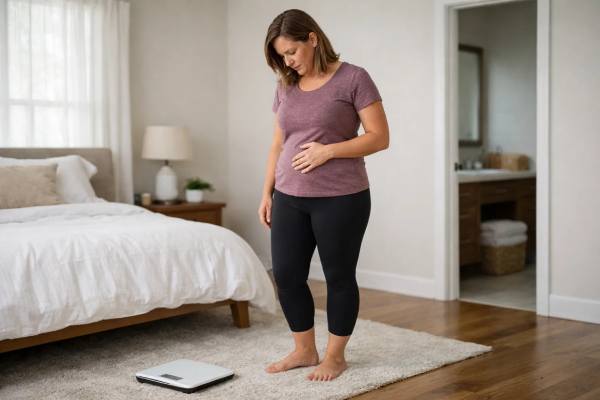
A sudden jump on the scale can feel discouraging, especially when you have been trying to lose weight or maintain progress. In many cases, though, a higher number does not mean you suddenly gained body fat. Bloating, constipation, a large meal, more carbohydrates, more sodium, travel, hormonal shifts, and even a hard workout can all push your weight up temporarily.
The key is not just the number itself, but the pattern around it. Bloating usually changes quickly and feels different in your body. Fat gain is usually slower, steadier, and less tied to what happened in the last day or two. Here is how to tell the difference, what clues matter most, and when a rising scale may need a closer look.
Table of Contents
- What bloating and fat gain usually look like
- Why speed matters on the scale
- Signs the jump is mostly bloating
- Signs you may be gaining body fat
- Common reasons bloating happens
- A simple checking process that works
- When to get medical help
What bloating and fat gain usually look like
Bloating and fat gain can both make your stomach look larger, your clothes feel tighter, and your scale weight increase. That is why people mix them up so often. But they usually behave very differently once you know what to watch for.
Bloating is usually a short-term change. It often shows up as pressure, fullness, puffiness, gas, abdominal tightness, or the feeling that your stomach is stretched. Many people notice that they look fairly normal in the morning and more swollen by afternoon or evening. The change can be dramatic in appearance, but it tends to come and go. You may also notice burping, flatulence, constipation, cramping, or relief after a bowel movement.
Fat gain is different. It is not just something you feel after one meal. It usually develops from a consistent calorie surplus over time. The change is less likely to appear and disappear within the same day. Instead, you may notice that your average weight has drifted upward over a few weeks, your waist measurement is gradually increasing, and multiple areas of your body feel a bit softer or tighter, not just your abdomen.
A quick comparison helps:
| Clue | Bloating | Fat gain |
|---|---|---|
| How fast it appears | Often within hours or a day | Usually over days to weeks |
| How it feels | Pressure, fullness, gas, tightness | Less pressure, more gradual body-size change |
| Changes through the day | Often worse later in the day | Usually more consistent from morning to night |
| What the scale does | Jumps up and down quickly | Trends upward more steadily |
| What helps | Time, digestion, bowel movement, less gas-triggering food | A sustained nutrition and activity adjustment |
| Where you notice it | Mostly the abdomen | Often abdomen plus hips, thighs, face, or upper body |
One important nuance: these two things can happen at the same time. Someone can be slightly bloated and also be gaining fat slowly. That is why one isolated weigh-in is rarely enough to tell the full story.
Why speed matters on the scale
The speed of a weight change is one of the most useful clues. True body-fat gain is usually slower than people think. A noticeable overnight scale increase is far more likely to reflect food volume, fluid shifts, digestive contents, or bloating than a sudden accumulation of body fat.
For example, after a restaurant meal, a weekend off-plan, a celebration, or a travel day, the scale may jump the next morning. That does not automatically mean you undid your progress. A heavier meal leaves more physical mass in your digestive tract. Extra carbohydrates can temporarily raise stored glycogen, which also pulls in water. High-sodium foods can make you hold more fluid. Alcohol can disrupt digestion and recovery. Constipation can leave more stool sitting in the gut. Even muscle soreness from a tough workout can nudge weight upward for a short time.
That is why short spikes are poor evidence of fat gain. If your weight rises sharply and then settles back after one to several normal days, it was probably not much fat at all. The same principle shows up with carb-related weight spikes and with cycle-related water retention, where the scale can move faster than body fat actually changes.
What matters more is your trend:
- A one-day spike tells you very little.
- A three-day bump may still be digestion, sodium, hydration, or hormones.
- A week or two of higher morning weights may mean you need to look more closely.
- Several weeks of a rising average usually deserve attention.
This is also why daily emotion-driven interpretation is so misleading. People often read a temporary jump as failure, then react by skipping meals, overdoing cardio, or slashing calories. Those responses can worsen the cycle by increasing hunger, stress, and inconsistency.
A better rule is simple: do not diagnose fat gain from one weigh-in, one dinner out, one bloated afternoon, or one tight waistband at night. Use repeated morning measurements, your weekly average, and how your body looks and feels over time.
Signs the jump is mostly bloating
If the scale is up and you are trying to decide whether it is bloating, look for signs that point to your digestive system rather than to body-fat change.
Bloating is more likely when the increase feels sudden and uncomfortable. Your abdomen may look rounder or harder, but the rest of your body looks about the same. You may feel gassy, stretched, or like your stomach is “sticking out” more than usual. Sometimes the belly looks much flatter in the morning and much more distended by evening. That pattern strongly suggests bloating rather than fat gain.
Other clues that support bloating include:
- You recently had a very large meal.
- You ate more sodium than usual.
- You had more carbonated drinks, sugar alcohols, beans, onions, dairy, or other foods that bother you.
- You have not had a normal bowel movement.
- You feel relief after passing gas or using the bathroom.
- Your rings, face, or lower belly feel puffy, but the change fades.
- The scale rise happened too fast to match your recent habits.
Constipation is one of the most overlooked reasons for a temporary scale increase. If you are backed up, you are not just uncomfortable. You are also carrying more material in your digestive tract, which can make the scale and waistline look worse than your true fat-loss picture. If that is a recurring issue, constipation affecting the scale is worth thinking about directly.
Bloating is also more likely when the body change is mostly local. If your stomach feels tight but your hips, thighs, arms, and upper body have not changed much, digestion is a more likely explanation than broad fat gain.
Another useful clue is responsiveness. Bloating often changes with time, hydration, gentle movement, a calmer eating pattern, a bowel movement, or identifying a food trigger. Fat gain does not vanish because you walked after dinner or had a less salty day.
That said, bloating can be very real and very disruptive. “It is just bloating” does not mean it should be ignored. Persistent bloating can signal food intolerance, IBS, constipation, or another digestive issue. The point is simply that a bloated body and a heavier scale are not the same thing as immediate fat gain.
Signs you may be gaining body fat
Fat gain usually tells a quieter story. It tends to be less dramatic from one day to the next, but more consistent over time. If your weight is trending upward week after week, and that rise is not fading after normal eating and routine digestion, body-fat gain becomes more likely.
A few patterns point in that direction.
First, the scale trend keeps climbing rather than bouncing around and settling back. If your morning weights are gradually shifting upward over multiple weeks, that is more meaningful than one bloated evening or one heavy morning after takeout.
Second, your body measurements or clothing fit change in a stable way. With fat gain, pants may feel tighter in the waist not just at night, but in the morning too. You may notice tighter fit in several places, not only the abdomen. That whole-body pattern is more suggestive of added tissue than temporary digestive swelling.
Third, there is less of a “symptom” feeling and more of a “my body is slowly changing” feeling. Fat gain does not usually come with gas, abdominal pressure, or obvious relief after a bowel movement. It is not commonly accompanied by the sharp fullness people describe with bloating.
Fourth, your recent habits support the trend. This does not mean you need perfect tracking to know what happened. But if portion sizes have drifted up, weekends are regularly undoing weekday deficits, workouts made you hungrier, or maintenance has quietly become a surplus, the rising trend may reflect real fat gain rather than random fluctuation.
Some common signs that make fat gain more likely are:
- Your weekly average weight is up for several weeks.
- Your waist is gradually increasing even in the morning.
- Clothes are tighter consistently, not just after meals.
- You do not feel especially gassy or distended.
- The change is showing up in more than one body area.
- The higher weight is not resolving after a few normal days.
This is also where honesty matters. It is easy to blame every scale increase on bloating. Sometimes that is true. Sometimes it is just more comfortable than admitting that intake has crept up or activity has dropped. The goal is not self-criticism. It is accurate diagnosis. If the pattern is persistent, broad, and not linked to digestion, fat gain deserves a straightforward response.
Common reasons bloating happens
Bloating has many triggers, and not all of them mean something is wrong. In a weight-loss or maintenance phase, some of the most common causes are ordinary, temporary, and fixable.
A large, rich, or unusually salty meal is a big one. Restaurant food often combines high sodium, high carbohydrate load, larger portions, and slower digestion. That can make your stomach feel swollen and push scale weight up the next morning.
A sudden increase in fiber is another common cause. Fiber can be helpful for appetite and bowel regularity, but raising it too fast can lead to gas and distension before your gut adjusts. The same is true for sugar alcohols, protein bars, “healthy” desserts, and some high-volume diet foods.
Constipation is another major factor. When digestion slows, your abdomen can feel fuller, heavier, and harder. Some people interpret that as fat gain when it is really delayed elimination and trapped gas.
Hormonal changes matter too. Many women notice more bloating and a heavier scale around parts of the menstrual cycle. Travel, long sitting, poor sleep, stress, and harder-than-usual training can also change fluid handling and digestion enough to affect how your midsection looks.
Some medications can contribute as well. People using GLP-1 drugs may notice delayed stomach emptying, fullness, nausea, burping, or bloating, and those symptoms can blur the line between a digestive issue and a true weight change. If that applies to you, GLP-1 digestive side effects can be part of the picture.
Common bloating triggers include:
- Big meals eaten quickly
- Very salty foods
- Higher-carb days
- Carbonated drinks
- Dairy, beans, onions, garlic, or other individual trigger foods
- Sugar alcohols and some “diet” snacks
- Constipation
- Menstrual-cycle changes
- Travel and long sedentary periods
- Stress and poor sleep
It is also important to separate bloating from fluid retention. They can overlap, but they are not identical. Bloating is more digestive. Fluid retention can make you feel puffy more broadly, including fingers, face, legs, and lower abdomen. If your scale is up but your main clue is overall puffiness rather than gas or stomach pressure, water retention hiding fat loss may be the better explanation.
A simple checking process that works
When you are unsure whether the scale increase is bloating or fat gain, the best approach is not guesswork. It is a short checking process done under consistent conditions.
Use this sequence:
- Weigh under the same conditions.
Check your weight in the morning, after using the bathroom, before food, and in similar clothing or no clothing. - Look at the trend, not the isolated number.
A single high weigh-in means very little. A 7-day average tells you much more. A structured daily weigh-in protocol makes it easier to spot true changes without overreacting. - Measure your waist.
Take the measurement in the morning at the same spot each time. If the waist is only larger later in the day, bloating is more likely. If it is gradually larger over weeks, fat gain is more likely. - Check symptoms and context.
Ask yourself what happened in the last 24 to 72 hours. Large meal? Restaurant food? More carbs? Constipation? Period starting? Hard leg workout? Travel? Alcohol? These matter. - Use non-scale data.
Photos, clothing fit, gym performance, hunger, bowel regularity, and how your body looks over a few weeks can be more informative than one number. That is why tracking progress without the scale is so useful.
A practical reality check can be even simpler:
- Up suddenly, feels tight, worse by evening, digestion off: probably bloating.
- Up gradually, no digestive symptoms, clothes tighter consistently: more likely fat gain.
- Up after a social weekend, then settling over a few days: probably temporary.
- Up for multiple weeks with no drop back: investigate intake, activity, and routine.
Do not try to “fix” a suspected bloating spike with extreme restriction. That usually backfires. Instead, return to your normal routine, hydrate, move a little, eat predictably, and wait for the pattern to clarify. Short-term calm gives you better information than short-term panic.
When to get medical help
Most bloating episodes are not dangerous, and most short-term scale jumps are not emergencies. But some patterns should not be brushed off.
Talk with a clinician if bloating is frequent, severe, or getting worse. Also get checked if it comes with alarm symptoms such as ongoing abdominal pain, vomiting, blood in the stool, unexplained persistent diarrhea, new constipation that does not improve, fever, significant reflux, trouble eating, or unintentional weight loss. A digestive symptom that keeps recurring after meals or seems linked to specific foods may also deserve evaluation.
Medical help is also worth seeking when weight gain seems out of proportion to your habits. If you are gaining steadily despite no obvious change in intake or activity, it may be worth reviewing medications, hormones, sleep, fluid retention, and other health factors. Some prescription drugs and health conditions can change appetite, fluid balance, bowel function, or body weight in ways that are easy to miss at first. In those cases, medications that can affect weight trends may be part of the picture.
Seek prompt care sooner if you have:
- Rapid swelling with shortness of breath
- Severe abdominal pain
- Repeated vomiting
- Fainting or marked weakness
- Black or bloody stools
- A new hard or swollen abdomen that does not ease
If the main issue is that you cannot tell whether your rising weight is normal fluctuation or something else, it is also reasonable to review it with a doctor, especially if you have other symptoms or a history of digestive, hormonal, kidney, heart, or medication-related issues. A good next step may simply be learning when to see a doctor about weight gain instead of guessing on your own.
The bottom line is simple: a scale increase is not a diagnosis. Bloating tends to be fast, uncomfortable, and changeable. Fat gain tends to be slower, steadier, and persistent. When you judge the pattern instead of reacting to one number, the answer usually becomes much clearer.
References
- Management of Chronic Abdominal Distension and Bloating 2021 (Review)
- AGA Clinical Practice Update on Evaluation and Management of Belching, Abdominal Bloating, and Distention: Expert Review 2023 (Expert Review)
- Changes in body weight and body composition during the menstrual cycle 2023 (Review)
- Physical Activity and Excess Body Weight and Adiposity for Adults. American College of Sports Medicine Consensus Statement 2024 (Consensus Statement)
Disclaimer
This article is for general educational purposes only and is not a substitute for medical advice, diagnosis, or treatment. If you have persistent bloating, unexplained weight gain, severe digestive symptoms, or concerns about medications or an underlying condition, speak with a qualified healthcare professional.
If this article helped, please share it on Facebook, X, or any platform you prefer so others can find it too.