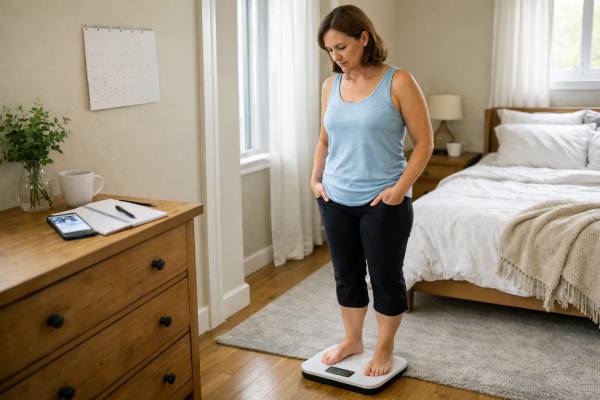
At maintenance, weight fluctuation is normal. For most people, day-to-day changes of roughly 0.5% to 2% of body weight are common, and many experts use staying within about 3% of a reference weight over time as a practical definition of weight maintenance rather than true regain. That means maintenance is usually a range, not one exact number.
The hard part is knowing when normal noise becomes a real upward trend. This article explains what kinds of fluctuations are expected, why they happen, how to set a realistic maintenance range, and when a higher scale weight should prompt action instead of panic.
Table of Contents
- Why maintenance weight is a range
- How much change is usually normal
- What causes short-term scale swings
- How to tell fluctuation from real regain
- How to set a personal maintenance range
- What to do if you go above range
- When weight change needs medical attention
Why maintenance weight is a range
One of the biggest mindset shifts after weight loss is accepting that maintenance does not look like a perfectly flat line. Your body weight changes constantly, even when your body fat is not changing in any meaningful way. Water, glycogen, sodium, bowel contents, meal timing, hormones, sleep, exercise, alcohol, travel, and stress can all move the scale up or down.
That is why a single “goal weight” often creates unnecessary anxiety. If someone decides that 150 pounds is their maintenance weight, they may feel fine at 150.0, worried at 151.8, and discouraged at 153.0, even though all three numbers could still fit within normal maintenance depending on the context. A better way to think about maintenance is as a band or zone.
That zone exists because body weight is made of more than body fat. A hard workout can temporarily increase scale weight because of inflammation and fluid shifts. A higher-carb day can refill glycogen stores and pull more water into muscle. A salty restaurant meal can make the scale jump the next morning. Constipation can add physical mass in the gut. None of those changes automatically means you are regaining fat.
Maintenance also becomes easier when you stop treating every small increase like a crisis. People often run into trouble not because they had a normal fluctuation, but because they reacted to it badly. They panic, cut calories too hard, skip meals, overexercise, or give up entirely. Ironically, that emotional overcorrection is often more damaging than the original weight change.
A more useful mental model is this:
- Your body has a daily maintenance rhythm, not a fixed number.
- Your scale is reporting everything in your body, not just body fat.
- Short-term increases are often information, not failure.
- What matters most is the trend over time, not one isolated weigh-in.
This perspective is especially important after a diet, when people are more sensitive to any upward movement. The goal of maintenance is not to freeze the scale forever. It is to keep weight within a reasonable personal range while living a normal life.
How much change is usually normal
The question most people really want answered is simple: “How many pounds up or down is still normal?” The honest answer is that it depends on body size, eating patterns, menstrual status, activity, and how often you weigh. Still, some practical guidelines are helpful.
For most adults at maintenance, day-to-day weight swings of roughly 0.5% to 2% of body weight are common. On a 150-pound body, that is about 0.75 to 3 pounds. On a 200-pound body, that is about 1 to 4 pounds. Some people will occasionally see even larger temporary jumps after travel, a very salty meal, alcohol, constipation, a tough workout, or menstrual-cycle changes.
What matters is the timescale. A one- to three-day jump is usually normal fluctuation. A weekly average that keeps creeping up for several weeks is more likely to reflect real gain. Over longer periods, a change of about 3% of body weight is often used in research and practice as a reasonable outer boundary for maintenance rather than a sign that everything has gone off track.
Here is a practical way to think about it:
| Reference weight | About 1% | About 2% | About 3% |
|---|---|---|---|
| 120 lb | 1.2 lb | 2.4 lb | 3.6 lb |
| 150 lb | 1.5 lb | 3.0 lb | 4.5 lb |
| 180 lb | 1.8 lb | 3.6 lb | 5.4 lb |
| 220 lb | 2.2 lb | 4.4 lb | 6.6 lb |
A useful interpretation is:
- About 1% up or down: very common day-to-day noise
- Around 2%: still often normal, especially after clear triggers
- Around 3% over time: worth paying closer attention to, even if it may still be manageable
The key phrase is over time. A 3-pound jump after a celebration dinner is very different from a 3-pound rise in your weekly average that stays there for a month.
This is why maintenance works better when you stop asking, “What is my exact weight?” and start asking, “Am I still moving within my normal range?” That question is much closer to how real bodies behave.
What causes short-term scale swings
Most maintenance fluctuations are driven by water, food mass, and timing, not by sudden fat gain. Understanding that difference can save a lot of stress.
One of the biggest causes is sodium. A salty restaurant meal, takeout, packaged snacks, or vacation eating can raise fluid retention quickly. Carbohydrates also matter. When you eat more carbs, your body stores more glycogen, and glycogen pulls water with it. That is why people often feel alarmed after a higher-carb weekend even though the extra weight is often temporary. If that pattern sounds familiar, a carb-related weight spike is often more about glycogen and water than body fat.
Food volume is another overlooked factor. If you ate more food yesterday, more of that food is still physically inside you today. That sounds obvious, but people often forget that the scale includes undigested food and stool. A big dinner, later meals, constipation, or travel-related digestive changes can push body weight up even when calorie intake was not extreme.
Exercise can also cause a temporary increase. Hard training, especially a workout your body is not used to, can create local inflammation and water retention. That can be frustrating if you expect the scale to reward effort immediately, but it is normal.
Hormonal changes matter too. Many women notice predictable scale increases around parts of the menstrual cycle because of extracellular fluid retention. That is one reason the scale may look worse even when habits are unchanged. If those spikes tend to follow a monthly pattern, they may fit better with water-retention-related “phantom” plateaus than with true regain.
Other common causes of short-term fluctuation include:
- Alcohol, which can disrupt hydration and appetite
- Poor sleep, which affects appetite, stress, and fluid balance
- Long travel days, flights, and sitting more than usual
- Stress, which can change digestion and behavior
- Creatine use, which can increase water held in muscle
- Bloating or constipation, which can make weight feel and look worse
That is why a sudden increase should always be interpreted in context. If you had sushi, pizza, drinks, dessert, and a late bedtime, the scale may rise the next morning for several reasons at once. That is very different from a quiet, gradual upward trend with no obvious short-term trigger.
For some people, the main question is whether they are bloated or actually regaining. If the increase feels abdominal, uncomfortable, and changes quickly, it may help to think through bloating versus fat gain instead of assuming every pound is new body fat.
How to tell fluctuation from real regain
The fastest way to misread maintenance is to judge your progress from one number. One weigh-in is mostly noise. A pattern is what matters.
The best method is to weigh under consistent conditions and look at trends. Morning weigh-ins, after using the bathroom and before food, are much more informative than random afternoon checks. If you want the clearest view, a structured daily weigh-in protocol usually works better than occasional spot checks because it shows what your normal ups and downs actually look like.
A few clues strongly suggest normal fluctuation:
- The increase happened quickly
- There is an obvious reason, such as travel, a high-sodium meal, alcohol, harder training, or cycle timing
- The scale starts drifting back down within a few days
- Your waist, photos, and clothes do not show a clear upward trend
- You feel puffy, full, or bloated rather than consistently bigger
Signs that point more toward real regain are different:
- Your weekly average keeps rising for 2 to 4 weeks
- Morning weights are trending up, not just bouncing
- Waist measurement is gradually increasing
- Clothes fit tighter consistently, not just after meals
- There is no clear short-term explanation
- Eating and activity habits have clearly loosened
This comparison helps:
| Pattern | More likely normal fluctuation | More likely real regain |
|---|---|---|
| Timing | Appears quickly after a trigger | Builds gradually over weeks |
| Duration | Improves within days | Persists or keeps rising |
| Scale pattern | Bouncy and inconsistent | Higher weekly average over time |
| Body clues | Puffiness, bloating, fullness | Waist and clothes getting tighter consistently |
| Best response | Stay calm and monitor | Tighten habits and review intake |
This is where non-scale indicators help. Waist measurements, progress photos, clothes fit, appetite, training, and daily routine all give useful context. That is why tracking progress without the scale remains valuable even at maintenance. The scale is useful, but it should not be the only signal you trust.
How to set a personal maintenance range
A personal maintenance range makes the scale much easier to manage. Instead of reacting emotionally to every bump, you know what counts as normal, what deserves attention, and what calls for action.
Start with a reference weight. This should not be your all-time lowest weigh-in after a dehydrating day or a perfect week. It should be a realistic, repeatable body weight that reflects your actual maintained condition. For many people, the best reference is a 2- to 4-week average after weight loss has stabilized.
Then create a range around it. A simple setup looks like this:
- Pick your reference weight.
Example: 150 pounds. - Define a normal zone.
Example: within about 1% to 2%, or roughly 148 to 153. - Define an action zone.
Example: around 3% above your reference, or about 154.5 and up. - Decide what you will do if you enter that zone.
Not panic, but review habits, weigh more consistently, and tighten the routine for a couple of weeks.
This is often more practical than aiming for a single number forever. Someone at 150 pounds might decide that 148 to 152 is fully normal, 152 to 154 is a watch zone, and above that means it is time to intervene early.
The best personal range also fits your lifestyle. If you weigh daily, you can probably handle a tighter range because you see the noise and understand it. If you weigh less often, you may need a slightly wider band because each weigh-in captures more randomness.
It also helps to match your scale strategy to your calorie strategy. If your maintenance intake is still vague, it is much harder to interpret scale shifts calmly. That is why learning how to set a maintenance calorie range often goes hand in hand with setting a maintenance weight range.
A strong maintenance range should also include behavior guardrails, not just numbers. Examples include:
- weigh at least several times per week
- keep step counts within a usual range
- return to normal meals after higher-calorie events
- review weekend habits if the average starts rising
- use a simple correction plan instead of a crash response
That kind of system works better than relying on motivation. It turns maintenance into a process, not a constant emotional debate. If you want a broader framework, post-diet maintenance guardrails can help you build those rules before you need them.
What to do if you go above range
Going above your normal range does not mean you failed. It means you need information first, then a proportionate response.
The first step is to pause and ask what kind of increase this is. Did it happen after a weekend away, a holiday, a harder training block, several restaurant meals, poor sleep, or a long flight? If yes, give the scale a few days under normal conditions before assuming anything.
A practical response looks like this:
- Return to your normal routine immediately.
Do not fast, punish yourself, or slash calories. Just go back to your usual meal structure, step count, hydration, and sleep routine. - Weigh consistently for the next 3 to 7 days.
One post-trip weigh-in tells you very little. A week of morning data tells you much more. - Check your weekly average.
If it settles back down, it was probably fluctuation. If it stays high, start troubleshooting. - Tighten the easy leaks first.
Restaurant extras, alcohol, grazing, larger portions, and looser weekends often explain a lot. - Use a short correction phase, not an extreme reset.
A calm 1- to 2-week clean-up is usually more effective than trying to erase everything in two days.
This is one place where people often get maintenance wrong. They either ignore the gain until it becomes much larger, or they respond so aggressively that they trigger rebound eating. The better middle ground is early, moderate correction.
Useful questions to ask include:
- Have portions drifted?
- Has daily movement dropped?
- Am I eating more socially than I realize?
- Have weekends become very different from weekdays?
- Am I underestimating alcohol, snacks, or bites while cooking?
- Has my schedule changed in a way that affects eating?
If the rise followed a trip, holiday, or special occasion, the right next step is often not “start over,” but simply use a structured recovery plan. That is where holiday and travel maintenance strategies and a clear get-back-on-track plan after a maintenance slip are more useful than guilt.
The earlier you respond, the easier maintenance usually feels. A small correction made calmly is a maintenance skill. A large correction made in panic is often the start of another cycle of overrestriction and regain.
When weight change needs medical attention
Most maintenance fluctuation is normal. Still, not every gain is just water, sodium, or a loose weekend. Some patterns deserve a medical look.
Talk with a clinician if weight is rising steadily without an obvious explanation, especially if your routine has not changed much. The same is true if the increase is paired with unusual fatigue, swelling, shortness of breath, major digestive changes, menstrual disruption, or a recent medication change.
A few warning signs matter more than the number itself:
- rapid unexplained gain over days to weeks
- swelling in the legs, face, or hands
- persistent constipation, diarrhea, or vomiting
- severe bloating or abdominal pain
- major fatigue, dizziness, or weakness
- shortness of breath
- weight change soon after starting a new medication
Medication effects are especially easy to miss. Some drugs change appetite, fluid balance, blood sugar, digestion, or energy levels in ways that can push weight upward even when someone is trying to stay consistent. If that may apply to you, it is worth reviewing medications that can affect weight trends instead of assuming your maintenance skills suddenly disappeared.
It is also smart to get help if you are doing all the right maintenance behaviors and still cannot tell whether your body is drifting upward or just fluctuating normally. In that situation, a clinician can help rule out medical issues, medication side effects, or hormonal and fluid-related causes. A good starting point may be knowing when to see a doctor about weight gain rather than guessing alone.
The goal is not to medicalize every pound. It is to avoid dismissing a meaningful pattern as “just fluctuation” when it clearly is not. Most normal maintenance variation is temporary, explainable, and manageable. A persistent change that is unexplained, symptomatic, or accelerating deserves closer attention.
References
- The definition of weight maintenance 2006 (Review)
- Obesity Management in Adults: A Review 2023 (Review)
- New insights in the mechanisms of weight-loss maintenance: Summary from a Pennington symposium 2023 (Review)
- Changes in body weight and body composition during the menstrual cycle 2023 (Review)
- Physiology of Weight Regain after Weight Loss: Latest Insights 2025 (Review)
Disclaimer
This article is for general educational purposes only and is not a substitute for medical advice, diagnosis, or treatment. If you have rapid unexplained weight gain, significant swelling, persistent digestive symptoms, or concerns about medications or an underlying condition, speak with a qualified healthcare professional.
If this article helped, please share it on Facebook, X (formerly Twitter), or any other platform you prefer.