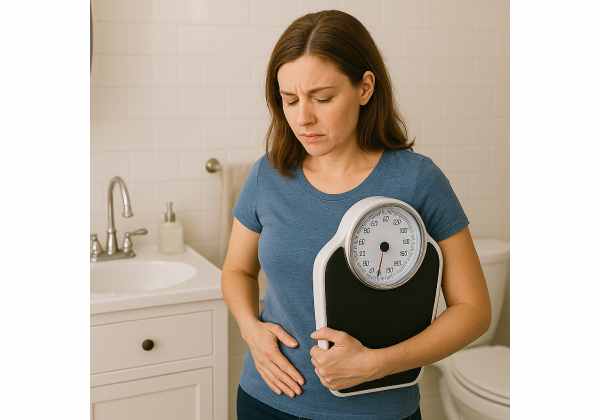
A scale that stops moving right before your period can feel like proof that your fat loss has stalled. Very often, it is not. A “phantom” plateau happens when real progress is being temporarily hidden by menstrual-cycle-related water retention, bloating, digestive changes, and normal weight fluctuation.
That does not mean every premenstrual stall is harmless or that cycle changes explain everything. It means you need a better way to interpret the data. This article explains why the scale often rises or flatlines around certain parts of the cycle, what a true phantom plateau looks like, how to track your progress without overreacting, what can help with bloating and cravings, and when cycle-related changes may be masking a different issue that deserves attention.
Table of Contents
- Why the scale can stall before your period
- What a phantom plateau looks like
- How to track fat loss across your cycle
- What actually helps bloating and adherence
- When it is not just cycle water
- When to talk with a clinician
Why the scale can stall before your period
The menstrual cycle can change what the scale shows even when your body fat is moving in the right direction. That is the starting point for understanding phantom plateaus.
In the days before a period, many people notice some combination of bloating, breast tenderness, puffiness, constipation, increased appetite, lower energy, and a feeling of being “heavier.” That feeling is not imaginary. Hormonal shifts across the cycle can affect fluid balance, digestion, appetite, and how your body stores and releases water. The result is that scale weight may hold steady or tick upward even if you are still in a calorie deficit.
The key problem is timing. If you only look at one weigh-in or even one rough week, it can appear as though fat loss has stopped. In reality, you may be looking at temporary water retention layered on top of slow fat loss. Once the water drops, the trend often becomes visible again.
This is one reason so many people believe they have “stopped losing” when what they are really seeing is the same short-lived pattern each month. If the scale is higher or flat in the late luteal phase and then drops during the first few days of bleeding or shortly after, that is a very different situation from a true multiweek stall. Understanding how water, glycogen, and sodium can hide scale loss makes this easier to interpret calmly.
It also helps to remember that water retention is not the only cycle-related factor affecting body weight. Some people eat more in the premenstrual window, crave saltier or more carbohydrate-heavy foods, sleep worse, move less, and feel more inflamed or backed up. In other words, a premenstrual plateau can be part water and part behavior. That does not make it a failure, but it does mean the solution is not always “just ignore the scale.” Sometimes the cycle creates a harder adherence window, not just a misleading number.
Patterns vary widely. Some people notice the biggest jump in the few days before bleeding. Others feel heavier during menstruation itself. Some barely fluctuate. Hormonal contraception can also change the pattern, and irregular cycles make it harder to predict. Still, the broader principle holds: a short-term rise near the same part of the cycle is usually interpreted differently from random weight gain with no repeating pattern.
A good mindset is to treat the cycle as context, not as an excuse or a mystery. Your body is not sabotaging you. It is giving you noisy data. The job is to learn how to read it.
What a phantom plateau looks like
A phantom plateau is a temporary stall or bump in scale weight that looks discouraging in the moment but does not reflect a true halt in fat loss. The easiest way to recognize it is to look for a repeatable pattern, not a single frustrating reading.
A typical phantom plateau has three features. First, it happens around the same phase of the cycle more than once. Second, it comes with other signs of premenstrual change, such as bloating, puffiness, cravings, or constipation. Third, the weight tends to fall again once that phase passes.
A true fat-loss plateau looks different. It is usually broader, less phase-specific, and slower to resolve. It often lasts across multiple weeks without a clear drop after your period begins. It may also show up alongside unchanged waist measurements, reduced adherence, fewer steps, more restaurant meals, or slower gym performance.
| Pattern | More likely a phantom plateau | More likely a true stall |
|---|---|---|
| Timing | Shows up at a similar point in the cycle | Shows up randomly or lasts across the whole month |
| Symptoms | Bloating, breast tenderness, cramps, constipation, cravings | No clear cycle-related pattern |
| Waist and fit | May feel temporarily tighter, then normal again | Measurements and fit stay unchanged or worsen over time |
| After the period | Weight drops or trend resumes within days | Weight stays flat for weeks |
| Decision | Wait, track, and compare with prior cycles | Review calories, activity, and consistency |
One of the most common mistakes is reacting too early. A person sees five to seven days of flat or rising weight, assumes the plan has failed, then cuts calories harder, adds cardio, or gives up entirely. That is how normal fluctuation becomes real derailment.
A better standard is to judge plateaus over a longer window. If the stall is happening in the same premenstrual window and then resolving, it is not a true plateau. If the flat trend continues across two to four weeks with no clear post-period drop, then it may be time to use a more formal check like how to tell whether you are in a true plateau.
Another clue is whether non-scale markers still look positive. Clothes may fit better in the middle of the cycle. Photos may show changes even when the scale is noisy. Waist measurements may be down month to month. This is why tracking progress without the scale is not a feel-good backup plan. It is a practical way to see through fluid-related distortion.
The most useful question is not, “Why am I up today?” It is, “What does this look like compared with the same point in my last one or two cycles?” That single shift turns a lot of panic into pattern recognition.
How to track fat loss across your cycle
If you menstruate and you are trying to lose fat, the best tracking system is one that expects fluctuation instead of being shocked by it. You do not need perfect data, but you do need a method that compares like with like.
The most useful approach is to track body weight frequently under similar conditions, then interpret it through the lens of cycle timing. Daily weigh-ins work well for many people because they turn one dramatic number into a broader trend. If daily weigh-ins feel excessive, four to six days per week can still be useful. What matters most is consistency.
Here is a practical cycle-aware system:
- Weigh under similar conditions, ideally in the morning after using the bathroom.
- Log the first day of your period and rough cycle phase.
- Note key symptoms such as bloating, constipation, cravings, poor sleep, or pelvic discomfort.
- Track waist measurements once weekly or at the same cycle point each month.
- Review trends monthly, not just weekly.
For many people, the most revealing comparison is not “this Monday versus last Monday.” It is “late luteal phase this month versus late luteal phase last month,” or “average weight right after my period this month versus right after my period last month.” Same-phase comparisons tend to be far more honest than mixed-phase comparisons.
This is where a structured system like a daily weigh-in protocol becomes especially valuable. It helps you separate noisy daily movement from a meaningful trend. If you see the same premenstrual spike three cycles in a row followed by a drop, you stop treating it like a surprise.
Take measurements and progress photos with the same logic. If you do them at random points in the cycle, you may compare a bloated week with a less bloated week and draw the wrong conclusion. Try to use a repeatable window, such as a few days after your period starts or another phase that is stable for you.
Cycle-aware tracking also improves decision-making. It stops you from cutting calories aggressively just because you happened to weigh more in a water-retaining phase. That matters because overreacting to a temporary bump often makes adherence worse later in the month.
A few extra notes can be surprisingly helpful:
- bowel regularity
- sodium-heavy meals
- alcohol intake
- unusually hard workouts
- travel
- sleep debt
None of those need to be tracked forever. But if you are trying to decode whether a plateau is phantom or real, those details can explain a lot.
The most important rule is simple: do not change your plan based on one bad week that lines up with the same hormonal window every month. Judge progress on a monthly rhythm when your cycle clearly influences the data. Your fat-loss plan should respond to trends, not to one biologically noisy part of the month.
What actually helps bloating and adherence
Once you recognize that a phantom plateau is often driven by water retention and symptom-related behavior, the goal changes. Instead of trying to force the scale down immediately, you try to make that phase easier to manage.
The highest-return strategies are usually the least dramatic.
Start with routine. During the premenstrual window, many people do better when meals become more predictable, not less. Keeping protein intake steady, eating enough fiber, and having simple repeat meals can reduce the “I am starving and nothing sounds good except snack food” cycle. A practical structure based on maintenance-friendly protein, carb, and fat targets often works better than swinging between restriction and cravings.
Hydration also matters, but not in the punishing “drink gallons” sense. Dehydration, high-sodium restaurant food, and inconsistent eating can make bloating feel worse. Drinking normally and consistently, rather than overcorrecting, is often enough. Many people also feel better when they keep potassium-rich foods, regular meals, and moderate movement in place.
Gentle movement can help more than people expect. A walk, easier lifting session, mobility work, or light cardio can improve mood, digestion, and the feeling of being swollen without adding extra physical stress. This phase is often a poor time to punish yourself with “burn it off” workouts just because the scale is annoying.
It also helps to plan for cravings instead of treating them like a character test. Useful tactics include:
- building a more filling dinner
- adding a protein-rich afternoon snack
- keeping one satisfying sweet option available
- eating dessert intentionally instead of nibbling through the kitchen
- choosing high-volume foods when appetite feels louder than usual
These strategies work because the premenstrual phase can be harder both physically and behaviorally. You may genuinely feel hungrier. You may also be more vulnerable to the kind of all-or-nothing decisions that turn a water spike into a real overshoot. If this phase tends to derail your intake, tactics used for high-volume eating during plateaus can be especially useful.
Sleep deserves attention too. Poor sleep can make cravings, irritability, and scale anxiety worse. If your cycle already disrupts recovery, adding late nights, extra caffeine, and erratic eating usually compounds the problem.
What usually does not help:
- slashing calories for a few days
- using laxative teas or “detox” ideas
- obsessively weighing multiple times a day
- cutting all carbs because you feel puffy
- deciding you have failed and eating like the month is lost
A smart goal for this phase is not “make the scale go down now.” It is “stay consistent enough that the real trend can show itself when the water shifts.” That is the kind of patience that protects long-term fat loss.
When it is not just cycle water
Not every frustrating pattern around menstruation is a phantom plateau. Sometimes cycle-related fluctuation and a real fat-loss problem are happening at the same time. Sometimes the issue is not the cycle at all.
One common scenario is this: the late luteal phase increases hunger, cravings, fatigue, or irritability, and the person starts eating enough extra food to erase the weekly deficit. The scale still feels “hormonal,” but the monthly average is no longer trending down. In that case, the plateau is only partly phantom. The water is real, but so is the behavioral drift.
Another scenario is repeated under-recovery. Hard training, low calories, poor sleep, and higher premenstrual stress can increase water retention and make the body feel inflamed. The scale may look worse, adherence may worsen, and the person may respond by pushing harder. That pattern often creates more noise, not more progress.
There are also cases where the pattern is too irregular to chalk up to the cycle alone. If your weight is rising across the month, your waist is increasing, your intake has become less consistent, or your cycle has become unpredictable, broader troubleshooting matters. A guide like a plateau checklist before cutting more calories is often more useful than assuming hormones are the whole story.
Age and life stage matter too. In perimenopause, cycles can become shorter, longer, heavier, lighter, or more erratic, and symptom timing can be less predictable. That makes same-phase comparisons harder. If you are in that transition, the problem may not be a classic monthly phantom plateau at all, and midlife plateau patterns may describe your experience better.
You should also pause before blaming the cycle if any of these are true:
- your cycles are very irregular or absent
- the scale is up for many weeks with no clear drop afterward
- you have major changes in hunger that feel out of proportion
- constipation, pelvic pain, or bleeding changes are significant
- medication changes, especially hormonal or psychiatric ones, recently happened
- swelling is generalized, severe, or unrelated to your cycle
This is where nuance matters. The menstrual cycle can absolutely mask progress, but it should not become a catch-all explanation for every stall. The most accurate view is often mixed: some part of the pattern is temporary fluid, some part may be harder adherence, and some part may reflect a bigger issue worth addressing.
The solution is to stay specific. Look at timing. Look at repeatability. Look at the post-period trend. Look at waist, photos, habits, and recovery. The more pieces you consider together, the easier it becomes to see whether you are dealing with a phantom plateau, a true stall, or both.
When to talk with a clinician
Cycle-related water retention is common. A predictable bump or stall around the same time each month is usually not dangerous by itself. But some symptoms deserve medical attention, especially if they are new, severe, or disrupting daily life.
Talk with a clinician if you have:
- very heavy bleeding or bleeding between periods
- severe pelvic pain, fainting, or pain that is getting worse
- major mood symptoms before periods that affect work, school, or relationships
- rapidly changing cycles, skipped periods, or very unpredictable timing
- persistent bloating or swelling that does not improve when the cycle phase changes
- unexplained weight gain that does not match your intake or activity
- signs of anemia, severe fatigue, or dizziness
- concern about pregnancy, thyroid issues, PCOS, fibroids, or another underlying condition
It is also worth getting help if cycle-related symptoms are repeatedly blowing up your nutrition plan. Many people assume they should simply “have more discipline,” when the real issue may be poorly managed PMS, PMDD, severe pain, disrupted sleep, or a medical condition that changes appetite and fluid balance. Educational content can help you interpret patterns, but it cannot diagnose what is behind them.
If you are not sure whether your weight changes are normal fluctuation or something more, start by documenting them. Bring a simple log of:
- cycle dates
- weight trend
- symptoms
- bleeding pattern
- notable food cravings or appetite changes
- medications and supplements
- exercise and sleep changes
That kind of record gives a clinician much more to work with than “my weight is weird around my period.” If you are unsure whether the pattern warrants evaluation, articles on when to see a doctor about weight gain or trouble losing weight can help you think through the threshold more clearly.
One final point matters for people actively dieting: if you have lost your period, developed very irregular cycles during a deficit, or are training hard while under-eating, do not treat that as a normal side effect of commitment. That is a sign to stop, review recovery, and get proper guidance.
The goal is not to medicalize every monthly fluctuation. It is to avoid dismissing meaningful symptoms just because you know the cycle can affect the scale. A phantom plateau is common. Severe or changing symptoms still deserve respect.
References
- Changes in body weight and body composition during the menstrual cycle 2023 (Review)
- Dietary energy intake across the menstrual cycle: a narrative review 2023 (Review)
- Premenstrual syndrome: new insights into etiology and review of treatment methods 2024 (Review)
- Management of Premenstrual Disorders: ACOG Clinical Practice Guideline No. 7 2023 (Guideline)
- Fluid Retention over the Menstrual Cycle: 1-Year Data from the Prospective Ovulation Cohort 2011 (Review)
Disclaimer
This article is for general educational purposes only and is not a substitute for medical advice, diagnosis, or treatment. If menstrual symptoms, irregular cycles, heavy bleeding, severe mood changes, or unexplained weight changes are affecting your health or progress, speak with a qualified clinician for individualized care.
If you found this article helpful, please share it on Facebook, X, or your preferred platform.