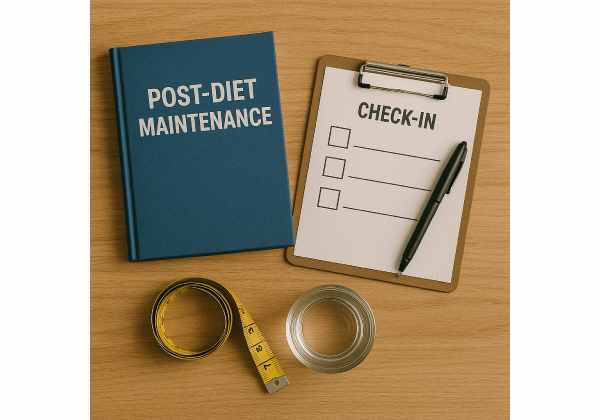
Reaching your goal weight is not the finish line most people imagine. The hardest part often starts right after the diet ends, when calories rise, structure loosens, and the scale begins to bounce. Post-diet maintenance works best when you stop treating it like a reward phase and start treating it like a new skill set. That means building clear guardrails, using simple check-ins, and deciding in advance what will trigger action before a small drift turns into full regain.
A good maintenance plan is not obsessive and it is not rigid. It is specific enough to catch problems early, but flexible enough to live with for months. The goal is not perfect control. It is staying close enough to your target that small corrections work.
Table of Contents
- Why maintenance needs its own plan
- Set your post-diet baseline
- Choose check-ins you will actually use
- Set action triggers before you need them
- What to do when a trigger is hit
- Build a maintenance routine that survives real life
Why maintenance needs its own plan
A lot of regain happens because people end a diet without replacing it with anything. The deficit ends, but no maintenance system takes its place. Meals get looser, portions drift up, weekend habits return, and the person assumes they will “just keep an eye on it.” That sounds reasonable until the scale is up seven pounds and it is no longer clear when the drift began.
Maintenance needs its own plan because it solves a different problem than fat loss. During a diet, structure is obvious. You have calorie targets, a clear reason to say no, and visible momentum from the scale. After a diet, motivation usually drops faster than hunger does. Food variety expands, social eating feels deserved, and the body often pushes back in subtle ways. Appetite can feel stronger, movement sometimes falls without you noticing, and the old habits that helped create gain in the first place are still available.
This is where guardrails matter. Guardrails are not punishments. They are boundaries that protect progress without requiring constant decision-making. Instead of asking yourself every day whether you should tighten up, you decide ahead of time what “on track” looks like and what signs mean you need to act.
A useful post-diet system has three layers:
- Guardrails
- these are your default boundaries
- examples: a weight range, minimum step count, protein target, meal structure, or number of restaurant meals per week
- Check-ins
- these tell you whether your plan is still working
- examples: weigh-ins, waist checks, training log, hunger notes, and weekly reviews
- Action triggers
- these tell you when to stop watching and start adjusting
- examples: average weight up for two weeks, steps dropping below a set floor, recurring late-night snacking, or loss of meal structure
The hidden value of this approach is emotional. Without predefined triggers, people either ignore small regain for too long or panic over normal fluctuations. Guardrails reduce both errors. They help you stay calm when the scale bumps up from travel or sodium, and they help you move sooner when the pattern is real.
That is one reason a maintenance phase often works better when it is treated as part of a longer plan rather than an afterthought. If your overall year includes periods of fat loss, maintenance, and performance focus, an annual approach that cycles fat loss and maintenance usually makes more sense than trying to diet indefinitely. It also helps to understand that your new intake needs to match your new reality, not your old diet math, which is why a solid grasp of what maintenance calories actually mean can prevent a lot of confusion.
Maintenance is not passive. It is active, lighter-touch management.
Set your post-diet baseline
You cannot build good guardrails without a baseline. Maintenance is much easier when you know what you are trying to maintain, how much daily fluctuation is normal, and which habits matter most for you.
Start with your maintenance weight range, not a single goal number. A single number encourages overreaction. A range allows for normal shifts in water, glycogen, food volume, bowel habits, menstrual cycle changes, and training recovery. For many people, a range of roughly 1 to 3 percent of body weight works better than a fixed target. Someone at 180 pounds might choose a five-pound range. Someone smaller may want a narrower band. The exact width matters less than having one.
Next, set your starting maintenance intake. If you just finished a long deficit, maintenance calories are often higher than your diet calories but may still feel lower than you expected. That is why it helps to base maintenance on real data rather than hope. Use recent intake, scale trend, and activity pattern together. If you are not sure where your true maintenance lies, start there instead of guessing wildly. A structured process to find maintenance calories without regain is usually more useful than jumping straight to “intuitive eating” the week after a hard cut.
You should also define your non-negotiable anchors. These are the habits that hold your maintenance together even when life gets busy. Good anchors usually include:
- a protein floor you can hit most days
- a rough meal pattern, such as three meals or three meals plus one snack
- a weekly activity floor, especially steps and strength training
- a bedtime and wake-time rhythm that supports appetite control
- a default breakfast, lunch, or dinner you can return to when structure slips
This is where many people make a key mistake: they restore calories but remove too much structure at once. A better move is to keep a few dependable routines while loosening the rest gradually.
Another part of the baseline is knowing what is normal in the first two to four weeks. If you add carbs after a low-carb or low-calorie phase, scale weight often rises quickly from replenished glycogen and fluid, not instant fat regain. That is why it helps to understand what a temporary carb-related weight spike looks like before you misread it as failure.
Finally, define what success looks like in maintenance. It is not always “my weight never changes.” A better definition is usually:
- weight staying mostly inside your range
- waist and clothes fit staying stable
- food feeling more normal and less restrictive
- training, energy, and recovery improving
- corrections staying small when drift happens
A clear baseline makes every future decision easier. Without one, every pound feels like a crisis or an excuse.
Choose check-ins you will actually use
The best maintenance check-in is the one you will still do when you are tired, busy, traveling, or slightly annoyed with your own body. That rules out complicated tracking systems for most people. Maintenance works better with a short list of repeatable signals than with endless data collection.
For most people, the most useful check-ins are:
- Body-weight trend
- not a random once-a-week weigh-in after a restaurant meal
- a consistent trend under similar conditions
- daily weigh-ins or at least several times per week work well for many people
- A weekly review
- average weight compared with last week
- adherence to your anchors
- step count or activity pattern
- hunger, cravings, and unplanned eating
- any unusual events such as travel, illness, or a holiday
- A monthly body-composition reality check
- waist measurement
- progress photos
- how key clothes fit
- training performance
The point is not to monitor everything equally. It is to give yourself enough signal to catch drift early. Body weight is often the earliest signal, but not always the most complete one. That is why combining scale trend with at least one non-scale measure works so well.
Daily weighing helps many people because it removes the drama from any one number. You stop asking, “Why am I up today?” and start asking, “What is my average doing over time?” A good daily weigh-in protocol makes the scale more useful and less emotional. It also helps you separate normal fluctuation from real change.
At the same time, scale-only maintenance can be misleading. If training improves, your waist stays stable, and photos look the same, a slight scale rise may not mean much. If the scale is stable but your waist, appetite, and snacking habits are drifting in the wrong direction, that matters too. That is why understanding how scale loss differs from body-composition change is still helpful even when the goal is maintenance rather than active fat loss.
A good weekly check-in can be as simple as five questions:
- Is my average weight inside my range?
- Did I hit my protein and meal structure most days?
- Did my steps or training drop?
- Have I had more unplanned snacks, drinks, or restaurant meals than usual?
- Is this a fluctuation week or a pattern week?
If you answer those honestly once a week, you will usually spot trouble before it becomes expensive in time and effort.
Check-ins are not there to keep you on edge. They are there so you do not have to rely on intuition alone when appetite, stress, and convenience are all pulling in the same direction.
Set action triggers before you need them
Action triggers are the missing piece in most maintenance plans. People often say they will respond “if things start creeping up,” but they never define what creeping up means. That vagueness is why small regain becomes medium regain before anything changes.
A good action trigger is specific, observable, and paired with a response. It should be strong enough to catch real drift but not so sensitive that it fires every time you eat sushi.
| Trigger level | What you notice | What it usually means | Recommended response |
|---|---|---|---|
| Green | Weight stays inside range or briefly bumps up after travel, higher carbs, sodium, or a social weekend | Normal fluctuation | Stay consistent and keep observing |
| Yellow | Average weight rises about 1 to 2 percent above baseline for 1 to 2 weeks, or meal structure clearly slips | Early drift | Tighten anchors for 7 to 14 days |
| Orange | Average weight rises about 2 to 3 percent, steps fall, late-night eating returns, weekends are regularly loose | Behavior pattern is changing | Run a short correction phase with clear tracking |
| Red | Average weight rises more than 3 percent for several weeks, clothes fit tighter, and adherence is poor | Regain is underway | Use a structured reset and review calories, habits, and environment |
Weight-based triggers are useful, but process-based triggers matter just as much. Sometimes your body weight has not moved much yet, but the warning signs are obvious:
- you are skipping protein-rich meals most days
- you stopped strength training
- your step count fell sharply
- you are grazing after dinner three or four nights a week
- restaurant meals and drinks are becoming the default, not the exception
- your “maintenance flexibility” is mostly weekend overeating
Those are not random bad days. They are early signals that the system is losing tension.
Behavior triggers work especially well because they are more actionable than vague fear. “I am slipping” is hard to solve. “I have stopped meal planning, my steps are down, and I keep eating after dinner” is much easier to solve. That is why it helps to know whether weekend overeating is erasing your weekly balance, or whether late-night snacking has quietly returned as your stress outlet.
The best trigger is the one that catches your personal pattern. For one person, it is the second week above range. For another, it is two missed lifts and four nights of grazing. For another, it is “I stopped weighing myself because I already know what it will say.”
Do not wait for a big number to make the problem official. Maintenance gets easier when you respond to yellow flags instead of waiting for red ones.
What to do when a trigger is hit
When a trigger fires, the goal is not punishment. It is course correction. The smartest first move is usually not a hard cut or a panic cleanse. It is a short return to structure.
For most yellow- or orange-zone situations, start with a 7- to 14-day reset built around behaviors you already know work. That usually means:
- Bring back meal structure
- stop winging it
- return to three planned meals, or whatever pattern kept you steady
- Raise food quality before lowering calories
- increase protein
- add high-fiber foods
- reduce liquid calories, mindless extras, and restaurant frequency
- Restore your movement floor
- re-establish steps
- resume normal training schedule
- avoid the trap of “I will just start over Monday”
- Track more tightly for a short period
- weigh daily
- note meals
- review weekends honestly
- do not assume awareness is the same as measurement
- Fix the environment
- shop differently
- remove routine trigger foods if needed
- prep one or two easy meals
This is often enough to stop early drift without needing an aggressive calorie cut. Many maintenance problems are not calorie-calculation failures. They are habit-loosening failures.
If the trend still has not improved after two to four weeks of honest correction, then it may be time to make a more deliberate intake adjustment. That is when a targeted review of calories and macros during a stall or drift makes sense. The key word is targeted. You are not “going back on a diet forever.” You are tightening the system enough to re-enter your maintenance range.
Food choice matters here because one of the fastest ways to make a short correction feel sustainable is to make the same calories feel more filling. This is where strategies from high-volume eating during plateaus also help during maintenance corrections. More protein, more fiber, more produce, fewer stealth calories, and better meal timing often solve more than people expect.
A few things usually make correction phases worse:
- slashing calories too hard
- overdoing cardio while under-eating
- trying to “burn off” overeating instead of restoring routine
- using one bad week as proof you need a full reboot
- ignoring sleep and stress while obsessing over macros
A correction phase should feel firm, not frantic. The best outcome is not rapid loss. It is a quick return to your maintenance range with minimal disruption.
If you need constant rescue phases, that is not a discipline problem. It usually means your maintenance setup is still too loose, too reactive, or too hard to live with.
Build a maintenance routine that survives real life
The strongest maintenance plan is not the most disciplined one on paper. It is the one that still works during holidays, busy work stretches, low-motivation weeks, and ordinary life. That means your routine has to survive real conditions, not ideal ones.
A good maintenance routine usually includes a few stable defaults:
- a repeating breakfast or lunch you genuinely like
- a grocery list built around easy protein and produce
- a minimum weekly strength-training plan
- a daily movement floor
- a short weekly review
- one or two correction tools you can use quickly
It also helps to decide where you will be flexible and where you will not. For example, you might stay flexible with dinners out but keep weekday breakfasts and lunches very consistent. Or you might allow more relaxed weekends but hold a firm line on weigh-ins, protein intake, and step count. This kind of selective flexibility works better than calling everything “balanced” while structure quietly disappears.
One of the most underrated maintenance skills is planning for predictable disruption. Travel, holidays, family events, poor sleep, and stressful work periods are not surprises. They are part of the year. That is why a maintenance plan should include “if this, then that” decisions such as:
- if I travel, I still weigh when I get home and resume normal meals immediately
- if I have a high-calorie social weekend, I do not compensate with a crash diet
- if my schedule gets chaotic, I use default breakfasts and packed lunches
- if training dips, I protect steps and protein first
This is also where support matters. Maintenance is easier when someone or something reflects the truth back to you. That can be a training log, a smart scale trend, a coach, a spouse, or a short weekly self-check. Real accountability is not pressure. It is visibility.
For seasonal disruptions, a dedicated plan for holiday and travel maintenance is often more useful than generic willpower advice. And if your biggest challenge is not losing weight but keeping it off once the urgency fades, a regain-prevention approach for the first weeks at maintenance can help you build the routine before drift becomes your new normal.
The biggest mindset shift is this: maintenance is not what happens when you stop trying. It is what happens when your trying becomes calmer, more strategic, and more repeatable.
You do not need to be strict forever. You do need a system that notices change early, tells you what to do next, and is simple enough to keep using when life stops being neat.
References
- Obesity Management in Adults: A Review 2023 (Review)
- Self-Monitoring of Weight as a Weight Loss Strategy: A Systematic Review 2024 (Systematic Review)
- A systematic review of the use of dietary self-monitoring in behavioural weight loss interventions: delivery, intensity and effectiveness 2021 (Systematic Review)
- Physiology of Weight Regain after Weight Loss: Latest Insights 2025 (Review)
- The Effectiveness of Nonsurgical Interventions for Weight Loss Maintenance in Adults: An Updated, GRADE-Assessed Systematic Review and Meta-Analysis of Randomized Clinical Trials 2025 (Systematic Review)
Disclaimer
This article is for general educational purposes only. Weight regain after dieting can be influenced by appetite changes, medications, medical conditions, fluid shifts, and mental health factors, so it is not a substitute for individualized medical or nutrition advice. If you are regaining weight rapidly, feeling out of control around food, or struggling after a major weight loss, speak with a qualified clinician or registered dietitian.
If this article helped, share it on Facebook, X, or your preferred platform so someone else can protect their results with a calmer, smarter maintenance plan.