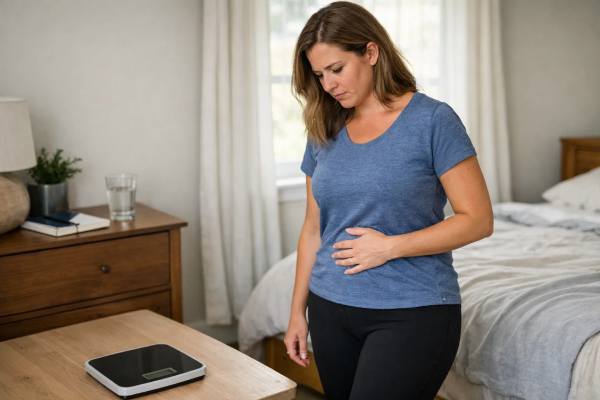
A scale plateau can feel especially frustrating when you are doing the right things and still not seeing movement. One often-overlooked reason is constipation. It does not stop fat loss by itself, but it can temporarily raise or hold body weight because the scale reflects everything in your body at that moment, including stool, water, and undigested food.
That is why a digestion slowdown can look like stalled fat loss even when your calorie deficit is still working. The key is learning how to tell a constipation-related stall from a true weight loss plateau, what commonly causes it during a fat loss phase, and what actually helps without making the problem worse.
Table of Contents
- How constipation affects scale weight
- Why dieting can lead to constipation
- Constipation or a true plateau?
- Safe relief strategies that help
- What not to do
- When a real plateau is more likely
- When to get medical help
How constipation affects scale weight
The scale does not measure body fat. It measures total body mass at that moment. That includes fat, muscle, body water, glycogen, food sitting in your digestive tract, and stool that has not been passed yet. When bowel movements slow down, the number on the scale can stay flat or rise slightly even if fat loss is still happening underneath.
This is why constipation can create a false plateau. You may be losing fat very gradually while also carrying extra intestinal contents and the water that often comes with slower digestion. The result is a confusing picture: clothes may fit a bit better, your calorie intake may still be on target, but the scale refuses to reward you.
There is another wrinkle during weight loss: many people start eating “cleaner” and higher protein, but they also eat less total food volume. Less overall food can mean less stool bulk. If fiber and fluid do not keep up, bowel movements may become smaller, harder, and less frequent. A person who used to go daily may suddenly go every other day or every third day, and the scale can drift upward or get stuck even without any real fat regain.
Constipation-related scale stalls often feel dramatic because they arrive fast. You may see a flat trend for several days, feel bloated, and then notice a drop after normal bowel movements return. That drop is not a burst of overnight fat burning. It is mostly the release of retained stool and associated fluid. Understanding that helps you stay calm and avoid making aggressive diet changes that are not actually needed.
This also explains why digestion problems are often confused with bloating versus fat gain. Both can make your midsection feel fuller and your weight appear higher, but neither automatically means you have gained body fat. A short-term scale spike is often a body-content issue, not a body-fat issue.
The important mindset shift is this: constipation can hide progress, but it does not rewrite energy balance. If you are still in a real calorie deficit, fat loss can continue even while the scale temporarily looks stalled.
Why dieting can lead to constipation
Constipation is common during weight loss for simple, practical reasons. Most are not mysterious, and many show up together.
A fat loss phase often changes eating patterns in ways that reduce bowel regularity:
- You eat less total food, which means less material moving through the gut.
- You increase protein but accidentally cut fiber-rich foods such as beans, fruit, oats, potatoes, or whole grains.
- You drink less than you think, especially if appetite is lower.
- You start skipping meals or eating at inconsistent times.
- You travel more, get busier, or ignore the urge to go because your routine changed.
- You use supplements or medications that can slow bowel function.
Protein-heavy dieting is one of the most common setups. Protein is excellent for satiety and muscle retention, but if your meals become mostly shakes, yogurt, chicken, eggs, bars, and low-carb wraps, stool bulk can drop fast. The problem is usually not “too much protein” by itself. It is protein replacing fiber, fluid, and food volume.
Low-carb phases can also contribute indirectly. Some people drop bread, beans, fruit, and high-fiber cereals all at once. Others lose water weight early, which can make them slightly underhydrated if they do not actively replace fluids. Harder stools often follow.
Routine matters more than many people realize. Your colon responds to patterns. Eating breakfast, drinking fluids, walking, and having time to use the bathroom all help create a repeatable rhythm. During a weight loss push, people often become more rigid and more rushed at the same time. They wake early, train early, rush out the door, and suppress bathroom urges because it is inconvenient. Over time, that can worsen constipation.
Some medications and supplements are also frequent culprits. Iron, calcium, some antidepressants, opioid pain medicines, and certain blood pressure medicines can all contribute. GLP-1 medications can be especially relevant because slower digestion and reduced intake often happen together; if that applies to you, it helps to understand GLP-1-related constipation rather than assuming the scale is proving that fat loss has stopped.
One subtle cause is trying to “eat healthier” too abruptly. A sudden jump in bran cereal, raw vegetables, or fiber powder can backfire if fluid intake is low or if your gut does not adapt well. More fiber is not always better overnight. The dose, type, and pace matter.
In other words, constipation during weight loss usually comes from a combination of lower intake, lower residue, lower fluid, and a disrupted bowel routine. The solution is usually to adjust the system, not to panic and cut calories harder.
Constipation or a true plateau?
This is the most useful question in practice. The answer is rarely found in one weigh-in. It comes from the pattern.
A constipation-related stall is more likely when the scale issue shows up alongside obvious bowel changes. Think fewer bowel movements than usual, hard or dry stools, straining, feeling like you are not fully empty, belly pressure, or a “backed up” sensation. In that situation, the scale may be reflecting delayed output more than stalled fat loss.
A true plateau is more likely when bowel habits are normal, adherence has quietly loosened, activity has dropped, or your average weight has been flat for a few weeks rather than a few days. It is also possible for both to be happening at once. You can be slightly constipated and also close to maintenance without realizing it.
| What you notice | More consistent with constipation | More consistent with a true plateau |
|---|---|---|
| Bowel pattern | Less frequent, harder stools, straining, incomplete emptying | Normal bowel movements with no meaningful change |
| Timing | Scale stalls for a few days, then drops after bowel movements improve | Average weight stays flat for 2 to 4 weeks |
| Abdominal feel | Bloating, fullness, pressure, “heavy” stomach feeling | No digestive symptoms, just stable weight trend |
| Other progress markers | Waist, photos, hunger control, or gym performance may still improve | Measurements and trend data are also stalled |
| Scale behavior | Day-to-day spikes and dips, often tied to bathroom timing | Consistent flat trend despite normal routine |
The best way to judge this is to standardize your weigh-ins. Use the bathroom first, weigh under similar morning conditions, and look at trends rather than isolated readings. A good daily weigh-in protocol makes digestion-related noise much easier to spot.
It also helps to track at least one non-scale metric. Waist circumference, progress photos, workout performance, hunger, and how clothes fit can reveal changes the scale hides. That is why progress without the scale matters so much during digestive slowdowns.
A few practical clues strongly suggest constipation is part of the problem:
- You feel noticeably lighter after a bowel movement.
- Your stomach looks or feels flatter after finally going.
- You recently changed food choices, protein intake, travel routine, or medication.
- Your calories are consistent, but your digestion clearly is not.
A few clues point more toward a real plateau:
- You are moving your bowels normally.
- Portion sizes have drifted up.
- Steps or daily movement have fallen.
- Weekend calories, bites, licks, drinks, or “healthy extras” have crept in.
- Your 2- to 4-week average is flat, not just your last few days.
The goal is not to diagnose yourself with certainty from one symptom. It is to avoid reacting to short-term digestive noise as if it were proof that fat loss has stopped.
Safe relief strategies that help
Most constipation-related stalls improve when you make the gut’s job easier instead of pushing the diet harder. Start with the boring basics. They work more often than people expect.
Here is the most useful sequence:
- Check food volume and fiber first.
If your meals have become very lean and low-residue, add back some fiber-rich foods in a gradual, realistic way. Fruit, cooked vegetables, beans, oats, chia, kiwi, prunes, and higher-fiber starches are often easier to build around than just dumping bran on top of an unchanged diet. If you need help planning it, review practical daily fiber targets and food swaps rather than guessing. - Increase fluids with intention.
Fiber works best when fluids come with it. Many people think they are hydrated because they drink coffee or a protein shake, but total daily fluid can still be too low. Use a simple system: water with each meal, one between meals, and extra around exercise or hot weather. Consistent hydration strategies often matter more than one huge bottle late in the day. - Keep regular meal timing when possible.
The gut likes rhythm. Eating at roughly similar times, especially earlier in the day, can help stimulate bowel activity. For some people, breakfast plus hot liquid plus an unhurried bathroom window is enough to restart normal regularity. - Walk more, especially after meals.
Gentle movement can help gut motility. You do not need a heroic workout. A 10- to 15-minute walk after meals or a general boost in daily steps is often enough to help. - Stop ignoring the urge to go.
This sounds simple, but it matters. Repeatedly delaying bowel movements can make stools harder and harder to pass. - Use bathroom mechanics that make passing easier.
A footstool, relaxed breathing, and a forward-leaning posture can reduce straining and make bowel movements easier. - Consider short-term over-the-counter help when appropriate.
Some people benefit from fiber supplements, while others do better with an osmotic option such as polyethylene glycol. The best choice depends on the pattern. If you are bloated and already eating a lot of fiber, piling on more may not be the smart first move. Follow label directions, and check with a clinician or pharmacist if you are pregnant, older, have kidney disease, or take multiple medications.
One useful insight: the “best” constipation fix depends on the cause. If the issue is low food volume and low fiber, nutrition changes usually help. If it is medication-related, food alone may not be enough. If it is pelvic floor dysfunction, forcing more fiber can make you feel worse. That is why persistent constipation deserves more than random trial and error.
Expect improvement over days, not minutes. Once bowel regularity returns, the scale may drop quickly, but that does not mean your fat loss suddenly accelerated. It means the noise on top of your fat-loss trend finally cleared.
What not to do
When the scale stalls, it is easy to overcorrect. That is where a temporary digestion issue turns into a bigger problem.
Do not respond to constipation by slashing calories lower. If anything, eating even less can reduce stool bulk further and make the problem more stubborn. It can also increase stress, hunger, and the urge to “be extra strict,” which often backfires later.
Do not use laxatives as a weight loss tool. Any quick drop you see after a bowel cleanout is not fat loss. It is body-content loss. Chasing that feeling can create a cycle of false reassurance, dehydration, and rebound discomfort. The same warning applies to detox teas and laxative cleanses, which are often marketed as if they “flatten” the stomach in a meaningful way. They do not reduce body fat.
Do not add huge amounts of fiber overnight. A sudden jump from a low-fiber diet to very high fiber can worsen gas, distension, and discomfort, especially if you are not drinking enough or if your gut is already sluggish.
Do not treat one post-bathroom drop as proof that your plan is perfect, either. The opposite mistake also happens: people feel relieved, see the scale fall, and assume nothing needs attention. If constipation keeps returning, the underlying cause still needs work.
Do not ignore the pattern if constipation becomes your new normal. Occasional short-term constipation during travel or routine changes is one thing. Repeated straining, hard stools, and incomplete emptying are not something to normalize just because you are dieting.
The smarter approach is to see constipation as a signal, not a verdict. It is feedback about digestion, meal structure, hydration, routine, medication effects, or bowel mechanics. Fix the signal before you rewrite your fat-loss plan.
When a real plateau is more likely
Not every scale stall is constipation. Sometimes the plateau is real, and the digestive symptoms are minor or unrelated.
A true plateau becomes more likely when:
- Your bowel movements are normal.
- Your average body weight has been flat for at least 2 to 4 weeks.
- Your adherence is good on paper, but the deficit may have quietly shrunk.
- Daily movement has dropped as fatigue, adaptation, or routine drift sets in.
- You are closer to goal weight, so fat loss is slower and easier to hide in normal fluctuations.
This is where honesty matters. Many plateaus are not caused by broken metabolism. They come from smaller changes that add up: slightly larger portions, a few more restaurant meals, more nibbling while cooking, fewer steps, less structured weekends, or overestimating exercise calories. Constipation can distract you from these factors because it gives the stall a convenient explanation.
A useful rule is this: if the digestive issue clears and the trend still does not move, zoom out. Ask whether you are in a true weight loss plateau rather than reacting to daily noise. Then work through a structured plateau decision tree before cutting calories again.
Often, the answer is not a dramatic change. It may be recalculating your intake, tightening weekends, bringing steps back up, or restoring consistency. Sometimes it is simply accepting that progress is slower now than it was earlier in the diet.
The most important takeaway is that constipation can mask a plateau, but it can also coexist with one. Clearing your digestion does not automatically solve every stall. It just removes one major source of confusion so you can evaluate the rest of the picture more accurately.
When to get medical help
Constipation deserves medical attention sooner rather than later if it is persistent, painful, or paired with red-flag symptoms. Weight loss can change bowel habits, but it should not make you ignore warning signs.
Contact a clinician promptly if you have constipation along with:
- blood in the stool or rectal bleeding
- severe or constant abdominal pain
- vomiting
- inability to pass gas
- fever
- unexplained weight loss
- new or clearly worsening constipation that does not improve with reasonable self-care
- regular need for laxatives just to have a bowel movement
- concern that a medication or supplement may be causing the problem
Medical help is also important if constipation keeps recurring during a fat loss phase. Repeated symptoms can point to more than low fiber or low fluid. Medication effects, hypothyroidism, pelvic floor dysfunction, irritable bowel disorders, and structural problems can all be part of the picture.
This matters for your weight-loss process too. A person who keeps blaming the scale on constipation may miss an underlying problem, while someone who assumes every stall is medical may overlook basic consistency issues. Good evaluation prevents both mistakes.
In practice, the best rule is simple: if constipation is occasional and clearly linked to routine disruption, start with conservative fixes. If it is persistent, painful, or accompanied by alarm symptoms, stop trying to self-manage it as just another plateau trick.
References
- Pharmacological management of chronic idiopathic constipation 2023 (Guideline)
- Dietary management of chronic constipation: a review of evidence-based strategies and clinical guidelines 2025 (Review)
- Evaluation and management of refractory constipation 2026 (Clinical Practice Update)
- Constipation 2023 (Review)
Disclaimer
This article is for general educational purposes only. Constipation during weight loss can sometimes reflect medication effects, pelvic floor problems, digestive disorders, or other medical issues, so it is not a substitute for personal medical advice, diagnosis, or treatment from a qualified clinician.
If this article was helpful, share it on Facebook, X, or any other platform where it might help someone make sense of a frustrating scale stall.